The Indian Electric Small Commercial Vehicle Market is expected one of the fastest segments in the Indian Commercial Vehicle segment. Many Product attributes, Product Applications, and other factors support the adoption of eSCV.

The Key highlights of the Report:

  • Historic Sales Trend, Forecast 2030, Outlook, and analysis of eSCV and SCV – GVW, applications & OEM wise
  • Top States and Cities to adopt eSCV
  • Buying patterns for SCV and eSCV segment in India, major key criteria, and how it is changing
  • Market Size of SCV in India, major players, Customer segment, Sales Volume, Market share, Product detail, Product price, Application Suitability, and Business Strategy
  • Market size Forecast for various applications for eSCV
  • eSCV penetration rate of various major applications for the next 10 years
  • eSCV Product Specs – Battery size, range, payload, Charging time, and others
  • Roadmap transition from IC SCV to eSCV
  • Buying pattern of Single, Small, Medium, and Large Fleet owners
  • Customer segmentation, Potential customer, Customer profile (Age Group, Marital status, family background, income range, fleet size, business – Startups or Establish Transporter (Family Business), behavior, habits, educational qualification, Aspiration, children, etc), and target market Analysis
  • Product position and offering of SCV and eSCV
  • Opportunities and Challenges in the adoption of eSCVs – such as Charging infrastructure, investments and ROI, Battery costs, range, Components supply chain, skills, Manpower, and others
  • OEM R&D capabilities
  • Growth drivers for eSCV and SCV segment: Government initiatives, private sector participation, technological developments, possibilities of institutional collaboration (OEM & e-commerce/logistics companies) for the adoption of EVs, and so on
  • Competitor Analysis and their future plan along with Product road map
  • TCO comparison (ICE Vs Electric) and turnaround time for vehicles
  • Customer buying trends for Electric Small Commercial Vehicles (eSCV)/SCV, for different applications Customer Profile of eSCV/SCV customers in India – Metro, Tier I, II and others
  • The buying behavior and how they rate eSCV and SCV at the time of buying decision
  • How Brand management will play role in the eSCV segment
  • Future Trend to add eSCV in their fleet for different vehicle applications
  • Customer feedback to adopt a new brand or existing brand into the eSCV segment
  • Customer expectation from Product, Price, Performance, Life cycle, Resales value, and Technology reliability
  • Why or Why not customer change from ICE SCV to eSCV segment
  • Willingness to pay to switch to eSCV

Branding of Electric vehicles can change the game of EV Sales. Currently, there is no brand name that influences buyer’s decisions just with their “Brand Name”. There are no OEMs at the core of customer’s minds in Electric vehicles except Tesla. This is the opportunity for all players wanting to become EV synonyms.

The Brand Strategy of Electric vehicles (EV) increases the OEMs’ profit by up to 5 to 10 times.

As per our survey on Brand Strategy, we found that the customer’s mind does not have any brand name image that comes first in their buying decision. ACG helps OEMs to create Brand Strategy which matches Product Portfolio, Target Customers, Market, Future predictions, and Customer expectations.

This is important to manage the Emotional and Functional needs of the potential EV buyer expectations.

We support Europe, the USA, Canada, Middle East, India, China, and Africa. The Key highlights of our Brand Strategy Consulting Service:

  • Developing the brand name
  • Develop Brand system
  • Branding process and roadmap
  • Why do you need a brand
  • How can you stand out
  • Brand management techniques
  • Brand promise touchpoints
  • Connect the brand to product and service design
  • Creating the Brand book with macro details
  • How Brand can influence the market
  • How to increase the brand value
  • Identifying the core values of your brand
  • What are the Brand Drivers and how to create them
  • Designing your brand architecture
  • Position the Brand
  • Engaging with customers
  • Identifying your customers, their beliefs, Culture, and Expectations
  • What promise and the value proposition
  • Communicate brand in Digital and Social Media
  • Understanding the brand performance and how to measure it
  • Managing brand equity
  • Evaluate Brand visuals and language
  • Branding through storytelling
  • Brand responsibility
  • Brand Loyalty measure tool and its impact
  • Who are the brand promoters, what impact, and their role

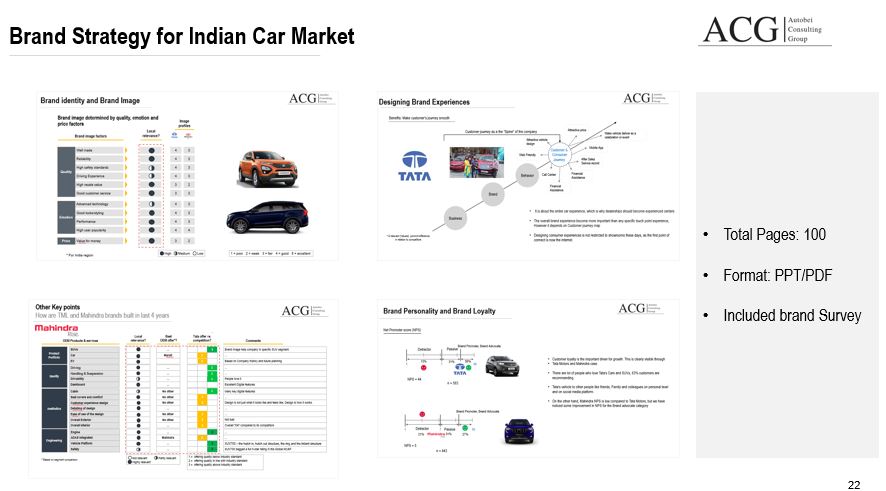
What is a Brand and how is it relevant for the Indian Car Industry, Dealers, Buyers, Company Growth, Market Share, Product Portfolio, Revenue, and most importantly Profit? The Mini was never profitable but after adding BMW’s name to Mini it started to make a profit. A Trusted brand is a long-term tool for growing the Car OEMs profitably.

One of the best examples of a brand is the Mini. This car is worth Euro ~ €23,000 in functional value but sold for ~ €33,000 in Germany. The willingness to pay is significantly high due to its brand image. The Mini normally does not offer any discounts to prospective customers, The Mini is one of the best examples of both intangible and tangible qualities. Since it is associated with the BMW brand, it promises Quality, reliability, power, and road-holding performance. The Aesthetic look and design get the attention of anyone on the street just like Tata Harrier.

Indian Car Brand Strategy and its impact

How brand Loyalty is the new key parameter for the Indian Passenger vehicles Industry compared to any other brand attributes like Brand awareness, or bargain loyalty. It’s a new growth engine.

How Tata Motors’ brand strategy created a success story for the company. How a brand is different compared to 2015.

ACG released a report on Indian Car Industry Branding Strategy and its impact on all stakeholders. We covered Maruti Suzuki, Hyundai, Tata Motors, Mahindra, Toyota, Volkswagen, Renault, Citroen, Skoda, Porsche, BMW, Audi, Mercedez, Volvo,  Kia, MG, and Honda cars. This report is a game changer for many Businesses.

We have covered the following points in our latest report:

  • Branding Strategy of Car OEMs
  • Current and previous Brand Position of OEMs in the Indian Market
  • What were the big Brand mistakes Volkswagen done in India
  • Company-centric and Customer-centric Brand Strategy
  • Impact of brand strategy on the Indian Car Industry
  • How to design a brand campaign in India
  • How do Indian customers think and perceive brand on Functional parameters and emotional side
  • What are the key ingredients of Brand Strategy and how to mix them to get the desired result
  • How to design the brand strategy: Target Customers, Competitors, Similarities, Differences, Relevance, and Deliverability
  • Strong Brand Analysis and how to build in every segment of the Indian Car Industry – Entry level, Premium, Luxury, High End, and Electric Car
  • Relationship between Car, SUV, MUV (Product), and Brand image
  • Brand Identity and Brand image (For customers)
  • The connection between the business and the brand strategy
  • Types of Brand Intangible associations: User profile, Psychographic mindset-based, Personality, and Heritage
  • Pricing Strategy and mapping with brand association with OEMs and Customers
  • Brand identity and Brand Image
  • Why Brand Experiences matter
  • Digital brand experience
  • Designing Brand Experience
  • Signature pricing
  • Brand practices and Engagement
  • Brand Metrics and Returns
  • Brand Design and Delivery
  • Connecting Dots
  • Brand Portfolio Management
  • Brand Practices
  • The Six A’s of Brand Engagement
  • The ABCs of behavior change
  • Brand health
  • Internal Brand Health
  • Customer-based brand equity
  • Brand Value – different understanding
  • Brand Perception, Image, and Strategy for Rural and Urban India
  • 5 Tenets of Brand Building
  • How to measure Consumer based brand equity
  • Case Study: Tata Motors, Kia, VW, and Mahindra

ACG released Indian Top Cities Sales Data of Small Commercial Vehicle is an exclusive data. The Data is prepared and collected for creating an Electric Vehicle Strategy.

The database is helpful for Truck OEMs, new startups, Automotive Suppliers, Research firms, and other stakeholders for the Business Strategy, Production Planning,  and Sales Planning for Electric three-wheelers, Mini trucks, Pickup trucks, and Minibuses.

Three segments are included:

  • Mini Truck
  • Pick up truck and
  • Three Wheeler

There are primarily two applications for Small Commercial vehicles:

  • Passenger vehicle
  • Goods carrier

Mahindra is focusing on the passenger 3W segment and Start-up Euler Motor is focusing on Goods carriers or transport vehicles. Tata Motors and Switch Mobility have launched the Tata ACE Electric Mini Truck version.

Start-up Triton also launched a 4.5T GVW Semi truck with advanced features.

The Wheeler segment is the second largest segment in the Indian Electric Vehicle Industry. There is a high acceptance rate to adopt Electric Three Wheeler in every pocket in India. Euler Motor is one example that penetrates this segment with high efficiency by creating a single product at the right price position. The price factor plays an important role because it is price price-sensitive segment.

The segment is moving from lead Acid batteries to LFP batteries. Customers are looking for performance, Efficiency, Design, Reliability, and Sales Support.

Following are the key highlights of the Data of the last 10 years:

  • Three Wheeler Goods vehicle
  • Three Wheeler Passenger vehicle
  • Model level Sales Volume
  • Key Applications of the vehicle
  • OEMs included:
    • Tata Motors
    • Bajaj, Mahindra
    • Piaggio
    • TVS Motors
    • Atul Auto
    • Force Motors
    • Scooters, and others
  • Data Fields:
    • OEMs
    • Model name
    • Average no of trips
    • Category
    • Applications
    • Geography
    • Duty Cycle
    • Vehicle Type
    • Customers

The data is also helpful in creating Product Planning, Channel Sales networks, Sales teams, Budgeting, and Road maps.

Data format: Excel

Cycle: Quarter-level data is also available based on Subscription.

The used car market is booming in India. ACG covers all key points of the Indian Used car market.

Key Highlights of the report:

  • The market size in Volume and Value of used cars in India
  • Demand Analysis of used car in India
  • The market trend of used cars in India
  • The relation between new car model launches and existing car model price
  • Key OEM volume and market share
  • The volume of Car, SUV, and MUV Types of Cars (Hatchback, Sedan, Luxury, Premium, and other types)
  • Top volume based on used car states, District, and Cities
  • “Willingness to pay” analysis based on various features, Brand name, Product Age, and technical specs
  • Used Car Price Analytics and correlation of car features and function
  • How do customers take buying decision to buy second-hand cars
  • What are the key channels to buy the second-hand cars
  • How brand name  and brand image influence the buying decision
  • How do customers decide to change or buy the car
  • Top used car dealers
  • Used car dealers and their product knowledge
  • Selling skills of the sales staff of dealers
  • How to improve the sales skill
  • OEM sales channel brand audit report
  • How digital platforms help customers buy the used car and how to make them more effective
  • Organizes and unorganized dealer’s opportunities and challenges
  • What are the key drivers of used car
  • Inventory management analysis
  • Car loan option to buy the second-hand car
  • Customer profiles for different car segments
  • After-sales challanges
  • Major Used car players: CARS24, OLX, CarDekho, Carwale, Maruti True value, Hyundai H Promise, Mahindra First Choice, Honda Auto Terrace, Toyota U Trust, BMW Premium Selection, Audi Approved Plus, Mercedes-Benz Certified, Car Trade, and local major players

Indian Two Wheeler Industry Analysis 2022 is the combination of the Electric Two Wheeler and ICE Two Wheeler Segment.

The Indian Two Wheeler unit in 2021 stands at about 13.7 million units which is equivalent to the sales volume of 2013 and is expected to register a 5 per cent CAGR over the next 5 years.

The year 2021 wasn’t a cakewalk for the Indian two-wheeler industry as it had to navigate across various hurdles to keep up the pace with its sales volume. However, the growth was a meager 3.5% up from the year CY 2020 which proved to be fatal for the two-wheeler industry. The two-wheeler industry has always had a significant foothold across the nation and the cumulative market value stood at 1321.8 billion INR during this year.

Indian Two Wheeler Market and buyers segment Analysis and Forecast

ACG has put forth various reasons that led to the disastrous outing for the two-wheeler industry, and the most prominent of them is the rapid and incessant shot up in customer preference to buy Electric Two Wheeler, fuel prices, massive inflation, and also the exorbitant interest rates. All these factors continued to trouble the already plagued two-wheeler industry and led to its downfall.

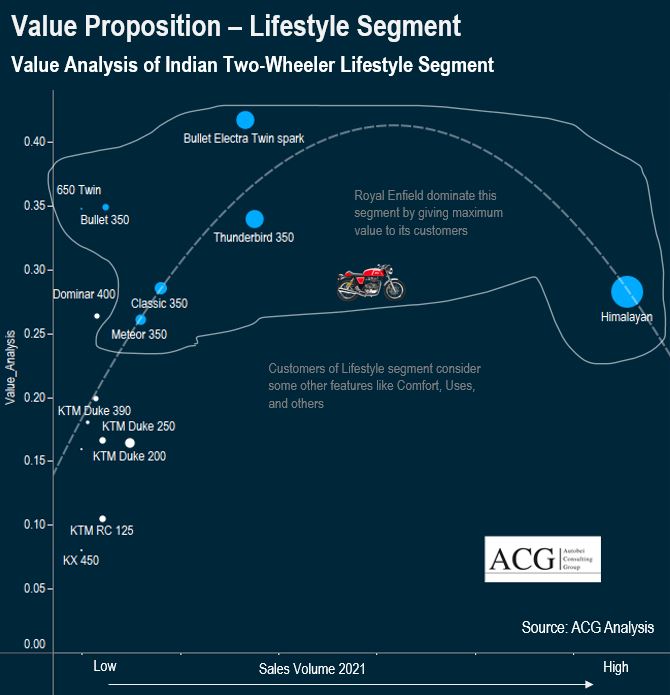
When we take a look at the market dynamics post-2018, we notice an astonishing fact that the scooter and motorcycle segment are mostly in tandem with the growth curve and the overall performance in the market.

The two-wheeler segment in India has enjoyed a flawless run in the market, thanks to the wide variety of product choices it offers to its customer base.

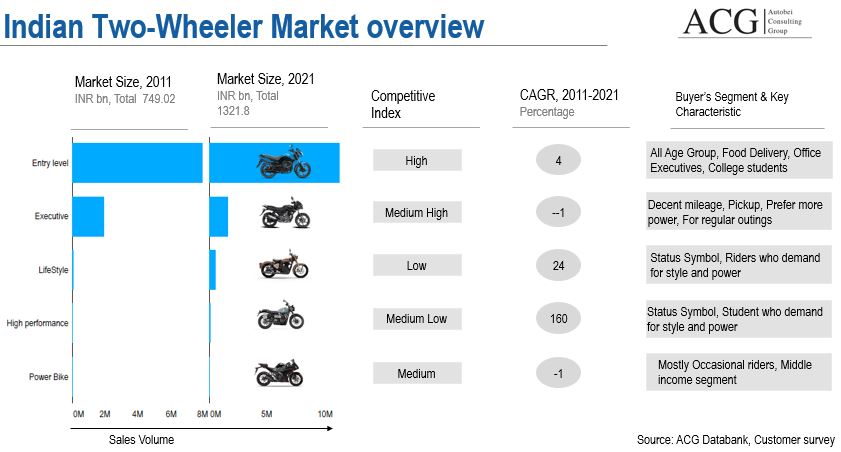
The two-wheeler segment can be broadly classified under 5 categories i.e Economy, Executive, High performance, Lifestyle, and Power Bike. Out of all the categories listed above, the economy and the executive category have established a firm hold in the market by amassing a record number of sales in the past. Their market presence stands at a whopping 93% as far as the year 2021 is considered. While the other categories have not been able to get big in the market but have decently performed as they all witnessed good growth in the yesteryear.

Taking a look at the growth curve of the various bike categories reveals an interesting insight that the overall growth rate has been encouraging. The entry-level segment has been able to record a CAGR of 4%, while its close competitor Executive faced a slash in its sales volume, which brought its growth to -1%. However, the lifestyle, high performance, and the power bike have made the most of the market opportunity and have amassed a growth of 24%, 160%, and -1% respectively during the last decade starting from the year 2011.

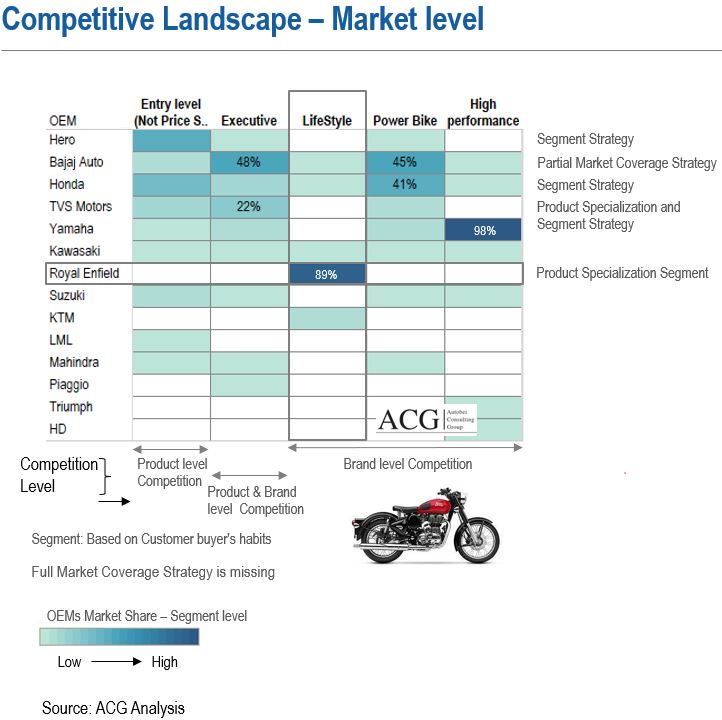
Indian Two Wheeler Competitor Analysis FY 2023

Road to owning a two-wheeler:

Procuring a two-wheeler to facilitating commuting needs has been the top priority for the Indian community at the moment. The buyers take into consideration various factors before zeroing in on their purchase call.

The key areas of consideration are price range, ergonomics and style, economy, status and prestige symbol, emotions, ease of comfort and convenience, and most importantly maintenance cost and safety. The weightage of these factors depends on the type of segment. Ultimately, the customer makes the final call in regards to procuring a two-wheeler.

Indian Two Wheeler Motorcycle segment Analysis 2022

The hierarchy of the factors that influence the purchase decision will vary from person to person, and the key areas like age and income of the buyer, gender, and most critically the geographical base play a critical role in influencing the buyer.

The report formulated from our end depicts the fine relation between the purchase decision of the buyer and the influence it has on the OEM’s market dynamics. The report also highlights the corrective action that needs to be inculcated for being able to build on the trust of the potential buyers.

Key factors contributing to the Purchase decision:

The marketing and the advertisement channels do constitute a major part in getting the traction from the customer base and thereby enhance the sales volume. The brands have started focusing on unravelling the various standout features of their product in a visual mode and this in turn has enabled them to reach a wide range of audiences. For instance, two-wheeler products like Pulsar and Apache have been periodically making the headlines by coming up with advertisements to showcase the product’s best-in-class power ability, seamless ride experience, and the confidence it instils in the rider.

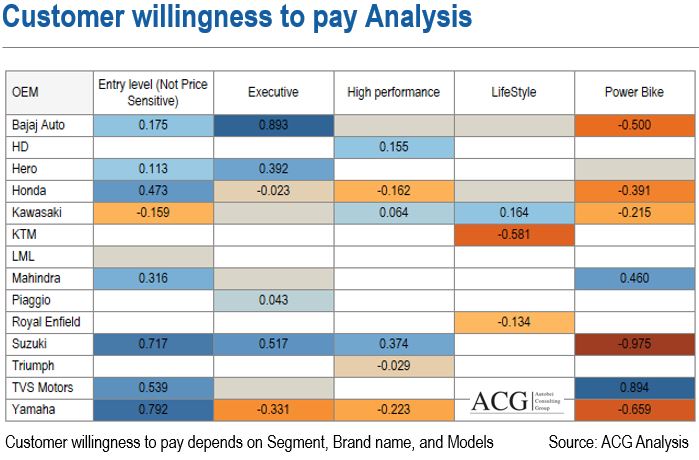
Indian Two Wheeler customer willingness to pay Analysis report

Altogether, these advertisements have emerged as a strong medium to directly engage with the potential customer base. Taking a look at the ad conceptualized by Pulsar and Apache reveals that the brands are trying their best to attract customers to get their hands on the product and we will soon get to know whether the brands would be able to reap the best with this tactical Move.

The recently concluded study has revealed a scintillating insight that the Word of Mouth(WOM) stands tall in influencing the mindset of the buyers to make purchase-related decisions, it is then closely followed by the product visibility attributes which also attract the customers to own a brand. Both these factors cumulatively sum up to almost 75% of the influencing medium, out of which 40% is by the WOM and the rest is from the product attributes.

The key insights of this analysis are briefly listed below:

Sentiment Analysis:

It is one of the prime factors that have a good impact on the buyer, this analysis helps the brand to formulate a product strategy and a sales plan. Over the last half a decade the TVS brand has done commendably well in hitting the positive sentiment well.

Impact induced by the culture:

The profile of the person making the purchase decision: the two-wheeler industry has always been customer-driven. The industry has been able to quickly adapt itself to deliver to the needs of the customers, which has been a prominent reason for its flawless run in the market. Getting to understand the customer’s mindset is one of the keys to success.

The different ways in which the communication is sent across:

Communication amounts to the overall rise in the sales volume, as it strikes the right chord of the customer and influences them to buy a product. Communication across the two-wheeler industry is divided into 3 types i.e Points of Parity (POPs), Points of Difference (PODs), and Points of irrelevance ( POIs). All these 3 types of communication come together and render a good experience to the customer thereby contributing to the success of this two-wheeler segment. However, the influence of this communication factor is purely dependent on the customer’s mindset.

Impact by the surrounding culture:

Let’s take a look at the most luxurious two-wheeler brand i.e the Harley Davidson in the Indian context. We get to know that Harley Davidson has evolved to be one of the key prestige and status indications in the Indian scenario. The buyers usually get their hands on this product to enhance its popularity and traction in society rather than using it as a mainstream commuting option.

Taking a further keen look in regards to how the competition has turned out be in the two-wheeler industry for the last few years reveals an astounding point that the dominance of the two-wheeler segment is segment-specific, and even the segment leaders have been able to make the most of the market by maintaining a popular product chunk of not more than 2 to 3 two-wheeler models.

Case study analysis:

  1. Ola Impact, Market share, Customer experience, and its impact on the Electric Two Wheeler Industry and Overall Indian Two Wheeler segment
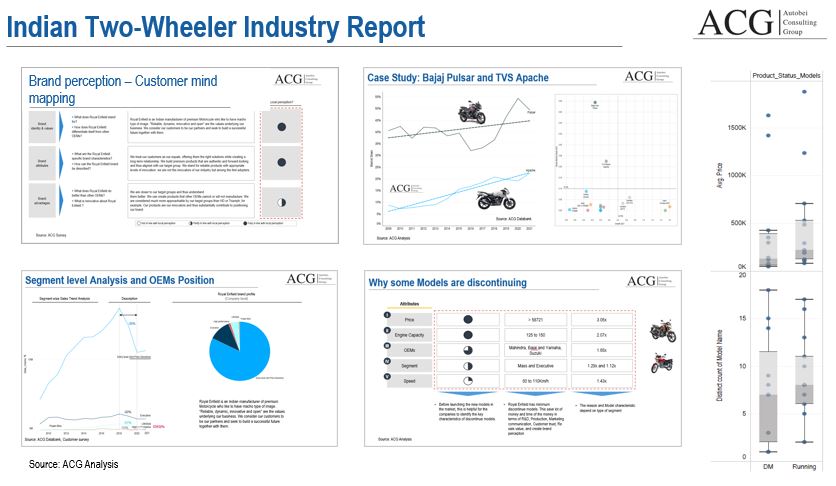
  2. The study conducted on a customer who previously owned a Bajaj Pulsar and went on to purchase a TVS Apache has revealed the various factors that influenced the owner to make his buying preference.

Indian Two Wheeler Industry Analytics

Key Highlights of the report: Electric Two Wheeler and IC Segment

  • Indian Two-Wheeler Market Trend and Forecast 2030 – Electric Two-Wheeler and IC Two-Wheeler
  • Used Two Wheeler Market Analysis
  • Comparison of Electric Two Wheeler Products, Markets, Price, Product life cycle, Maintenance cost, Resale value, Getting a loan from Banks to buy a vehicle, Challenges, Opportunities, Forecast, OEM profile, Customer Acceptance, Customer expectations, Customer experience, Dealership difference, Selling Strategy, Technology, Key Features, and Design
  • How buying and selling process is different for EV and IC Two-wheeler
  • Customer willingness to pay for each brand and Model
  • The average life of a Motorcycle, Scooter, and Electric Two Wheeler
  • Demand Analysis – Long, Medium, and Short term
  • Scenario Analysis of Changing Price, Specs, and Key Features
  • Establish OEMs strategy to invest in Electric Two Wheeler Start-ups
  • Product improvement Analysis – Engineering, Design, Quality, Reliability, Features
  • How Honda and Yamaha are leading the innovation to win the trust of the buyers
  • Market Fit and Go-To-Market Strategy Analysis
  • How to develop a Product roadmap for an Electric Two Wheeler
  • Indian Two Wheeler Segment Analysis – Market Share, Volume, Growth, Price bracket, Number of Models, Model Distribution Analysis
  • Motorcycle and Scooter Customer profile and map with purchase criteria
  • Income and Age group and their buying pattern
  • Uses of Motorcycle and Scooter
  • Maintenance Cost Analysis of Major Models
  • Brand Perception of Bajaj Auto, Hero, Honda, TVS, Harley Davidson, Royal Enfield, Yamaha, Piaggio, Ola, and others
  • Two Wheeler Market Dynamics of Rural and Urban India
  • State wise EV Policy and Penetration Forecast
  • Key growth drivers of Electric Two Wheeler and IC two-wheeler
  • Customer preference to select the specific Models
  • Market Attractiveness for each Two Wheeler Segment
  • Top Selling Models and Why Customers Prefer Those Top Models
  • Indian Two Wheeler Competitive Assessment tool
  • Communication Style of Major OEMs and Marketing Strategy
  • Opportunity Analysis based on Low growth, Low Market Share, and Product life cycle
  • How some models are replacing segment leader Models

ACG released the latest 2W data Indian Two-Wheeler Market Forecast.

Key Highlights of the Two Wheeler Data:

  • Indian Two Wheeler Industry Forecast and Trends of the last 10 years
  • Scooter and Motorcycle – ICE and Electric Two-Wheeler
  • OEM wise Sales, Production, and Export data
  • Product Status: Running, Discontinue, and New Launches
  • More than 200 models included
  • Engine Detail, Speed, Price, Torque, and Kerb Weight
  • OEMs: Bajaj Auto, HD, Hero, Honda, Kawasaki, LML, Mahindra, Piaggio, Royal Enfield, Suzuki, Triumph, TVS Motors, Yamaha

Key Benefits of Data:

  • Which are the top models, the Fastest growing Models, and on the border of phase-out models
  • Production, Sales, and Overall Business planning
  • Competitor Position and Strategy
  • The Data service is available Monthly, Quarterly, and Yearly basis
  • Data available in Excel along with Dashboard
  • Useful for Auto Components Suppliers, OEMs, Financial Institutes, Marketing companies, and other stakeholders

The Indian Auto Consumer Insights Report is a comprehensive report featuring primary and secondary data analytics. The Indian automobile market offers a level playing field for various brands to reach their full potential and enable them to succeed in the market. Automobile brands must have a clear understanding of the economic and cultural mindset of consumers before embarking on any product conceptualization—the points mentioned above serve as a strong underpinning for the cost and product models. The production planning, however, remains the pivotal point in forecasting the overall success ratio in a country like India.
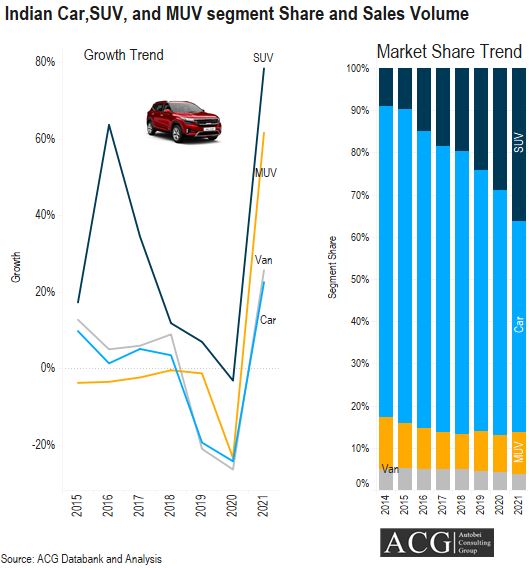
Indian Car SUV and MUV Market Trend Analysis, Market share and Growth

Looking at the year 2021, we observe that the Indian car segment was able to achieve a sales volume of just over 33 lakhs. The Indian PV industry had a fantastic outing in the market, registering a 44% growth compared to 2020. This value corresponds to the sales volume recorded before the COVID-19 pandemic.

The Dealer network plays a significant role in the OEM’s success in India, enabling it to reach the target segment. There is a direct positive correlation between the number of dealers and the sales volume of Car OEMs:
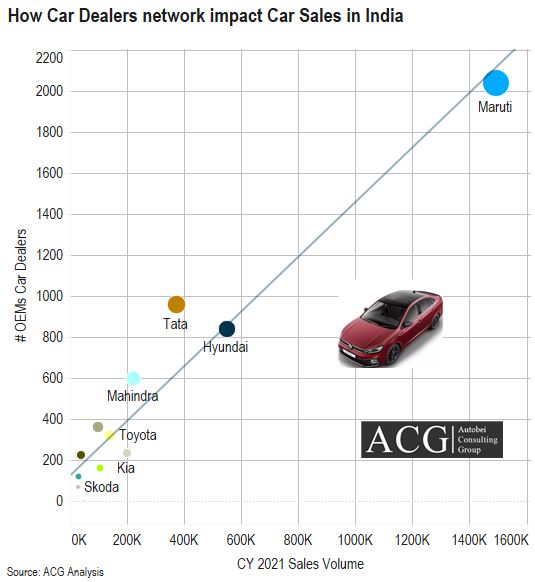
How number of car dealers impact sales in India

Maharashtra, Gujarat, Delhi. Karnataka and Tamil Nadu arethe  top states in terms of the number of car dealers:
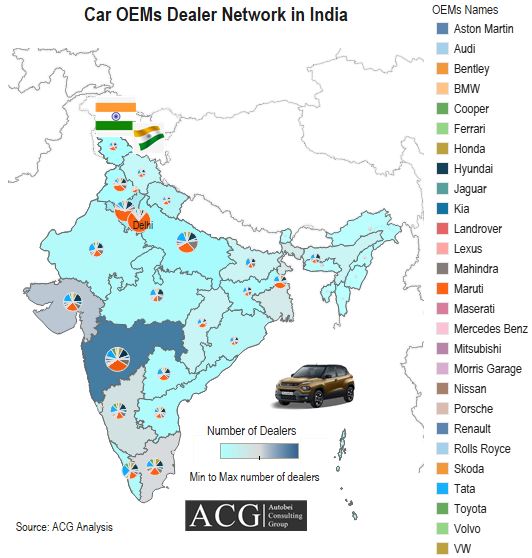
City wise Car dealer network in India

Luxury and high-car OEMs have different dealer network strategies due to their target market and buyer segment. Most of them have one or two dealers in a single state, owned by a single firm.
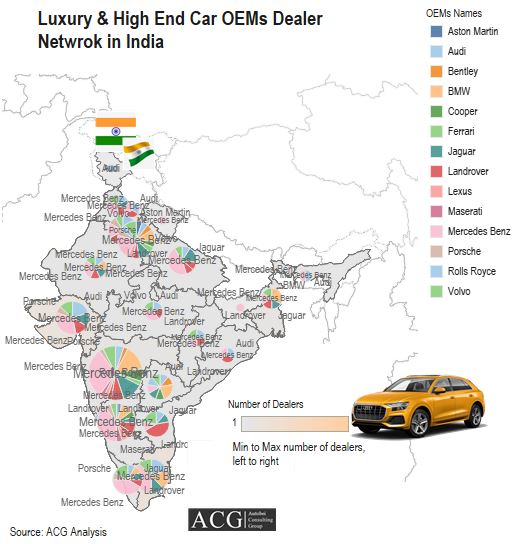
Luxury and High end Car OEMs dealer Network in India

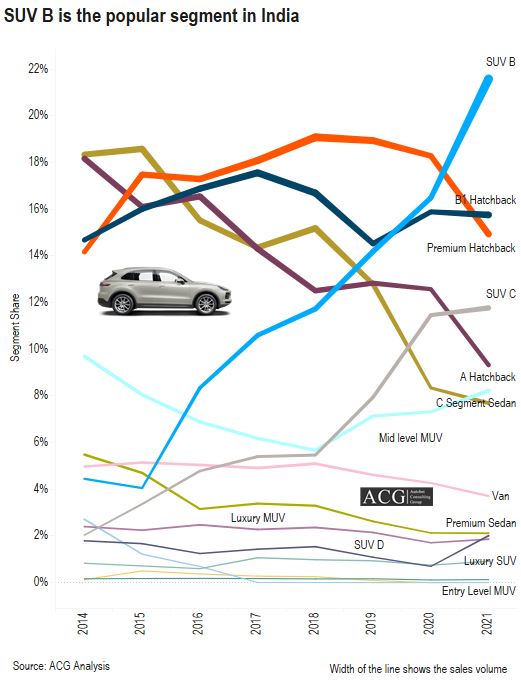
The SUV segment seems to have no stopping at the moment as it has emerged as the first choice for consumers. This is evident from the sales figures, with the volume sold in 2021 more than double that of the previous year.
Indian Car market share Analysis 2021

There was a gradual rise in the overall market share of SUVs; the share was at a meager 9% in 2014 and rose to 37% by 2021. This hurt the overall car segment, as its market share dipped to 50% in the last year from 74%, which was the case in 2014.Indian SUV product and customer analytics
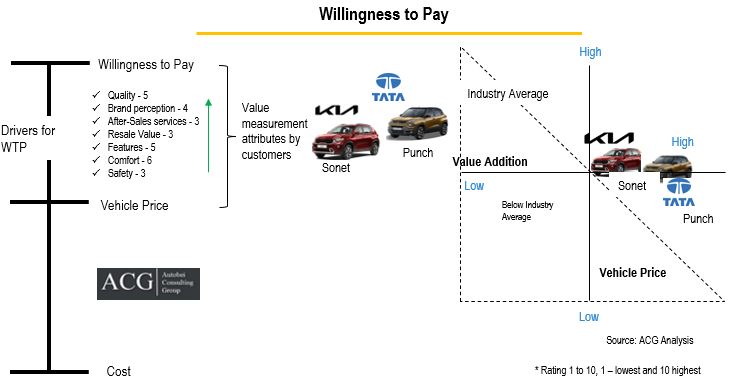
The key factor in the rise of SUVs in the contemporary market is the advent of new models alongside a very affordable price range, which caught the buyer’s eye.

The SUV B has an almost 60% market share in the SUV segment presently, which is 4% higher than the value seen in 2020.
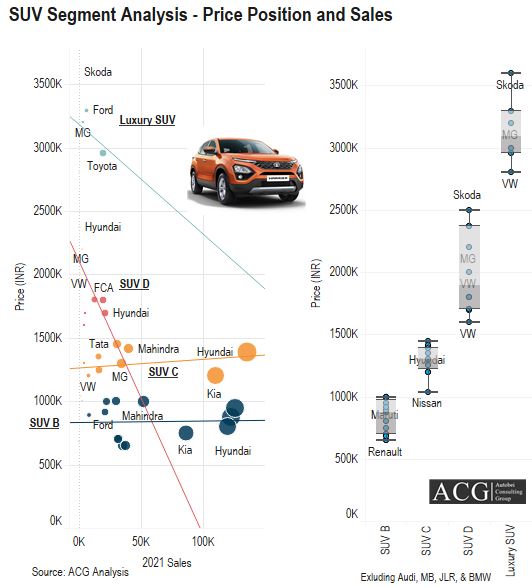
Indian SUV Segment sales and Price analysis 2021

Experts had anticipated a boom in the economic upswing following the COVID period. It’s true that the Indian PV industry has rejuvenated itself over the last few years and has become more oriented towards buyers and product choices. Since the COVID-19 scare is still present across the nation in bits and pieces, one-third of potential buyers are in the process of making up their minds to proceed with the buying choice.
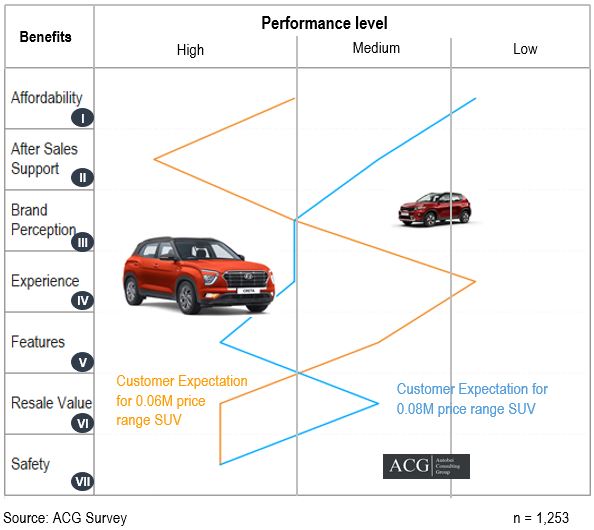
Indian SUV customer survey for purchase decision

Amidst all the problems faced by the automobile sector of our country, the industry’s future still appears to have a fair chance of excelling in the market, and it indeed has a supreme capacity to grow further. The Indian automobile market is one of the most widely acclaimed market spaces globally and has consistently performed exceedingly well, with demand in this market never falling below the threshold. Indeed, even used vehicles are attracting buyers in the same way as brand-new car models do.

In recent days, the automotive industry has been plagued by numerous problems, presenting formidable hurdles in its path to growth. They are facing a tough time aligning with the digitalization, the advent of electric vehicles, and innovative vehicle connected features, as well as pricing factors. Most importantly, it’s a challenge for them to build a sustainable product that will last for almost half a decade from now. The ongoing tussle between Russia and Ukraine has had an impact on global fuel prices, which will likely lead to significant increases in fuel costs. This, in turn, will affect the pricing of ICE vehicles and overall operations. The advent of electric cars from OEMs would address the issue to some extent, but it can only be a damage control method and never a permanent solution to the problem.
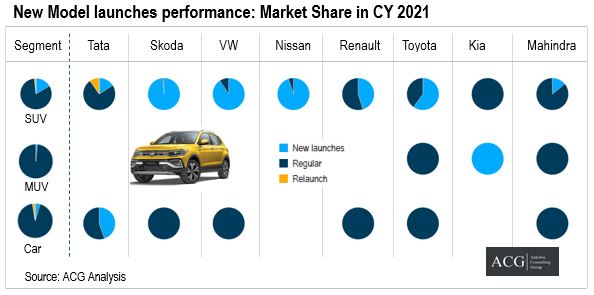
New Model launches performance_Market Share in CY 2021

The OEMs have presented new entrants to the market, the count stands at 14 brand new and three reintroduced models, and these new launches have been brought in with a strategy of offering a model as an alternative to the existing market giants, it also aims at bridging the space that exists between the market and also in placing the available products in the key position.
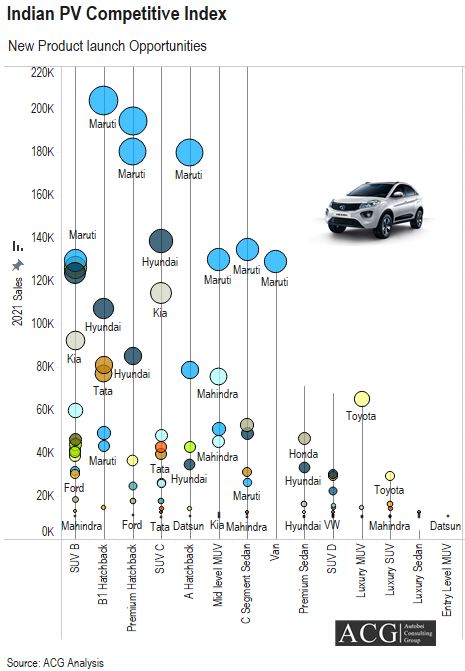
Indian SUV MUV and Car competitive Index

Tata Motors has given an enormous contribution by launching new products at regular intervals. This has set up rigorous competition in the Indian PV industry. Notably, the SUV segment has seen a surge in new entrants, with brands like Kia and Tata demonstrating their potential to capture a significant market share. They can even attract new buyers, potentially causing a dip in sales for other existing brands. The growth recorded in 2021 is immense; the SUV sub-segment saw an overall increase of 90%, while the mid-level MUV segment grew by 43%, and the B1 hatchback segment also grew by 43%. However, SUV D had a fantastic outing in the market, with a magnificent rise in growth of 318% in 2021.

The COVID-19 pandemic has posed a significant threat to the economy, resulting in buyers shifting away from their purchase decisions, especially in the budget range. The manufacturers should continue to focus on the two primary segments: the value-plus segment and the premium segment, as they hold a market share of approximately 85% in the current market scenario.

The rise in digitization has had a significant impact on the automotive sector, as customers are now willing to pay a premium for new features in the variant they are purchasing.

The XUV 700 can be seen as a perfect example of this, as buyers are willing to pay a premium price for top-end features. Additionally, we have observed an interconnection between the number of sales that take place at the dealership, which is present across the country. Even the VW Taigun has been the most sought-after by customers due to its solid looks and unparalleled interiors. The Korean brand, Kia, has evolved to be a pivotal contributor in the Indian market, currently ranking 5th in the PV industry in terms of volume, and well placed at position 3rd in terms of revenue generation.
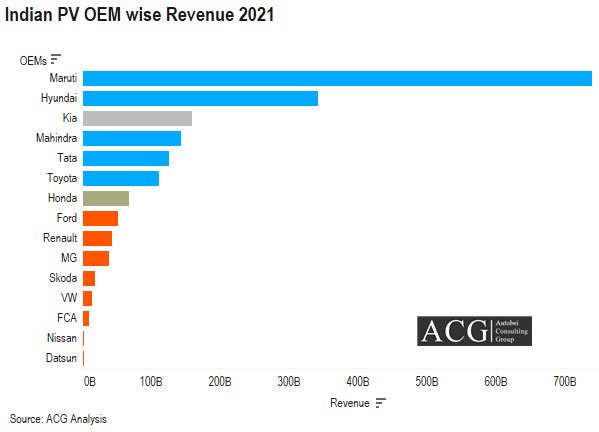
Indian PV Revenue wise Analysis 2021

The study, recently concluded by ACG, has shown that buyers are considering even the smallest aspects when making their purchasing decisions, with nearly 5,500 respondents from diverse backgrounds and age groups. We focused on evaluating the vehicle purchase experience of buyers in the top 25 cities in India, which encompassed both urban and rural areas. The survey also aimed to take note of the buyers’ attitudes, their preferences for channels in acquiring information, the choice of product, the cost-effectiveness of the brands, and, most importantly, the service rendered to customers after the sales cycle has ended.

The study has uncovered several key points that will provide the necessary guidance to potential buyers as we embark on the upcoming developmental period in the Indian automobile market.

  • The SUV segment aims to conquer the market by offering debut car buyers the opportunity to purchase different variants at an attractive price point.
  • There have been various innovative strategies to influence customers’ buying decisions; the best of them has been the venture of offering the “Next best vehicle option.”
  • Potential buyers are now shifting their focus to the product they plan to own, rather than just relying on the brand’s reputation.
  • The premiums of the car are also valued based on the number of best digital features they have. So the presence of digital features in the care is extremely paramount at this time.
  • The rapidly changing market has demanded a change in the used market space. Therefore, employees must now understand what the customer truly expects and deliver it accordingly to ensure a high level of user satisfaction.
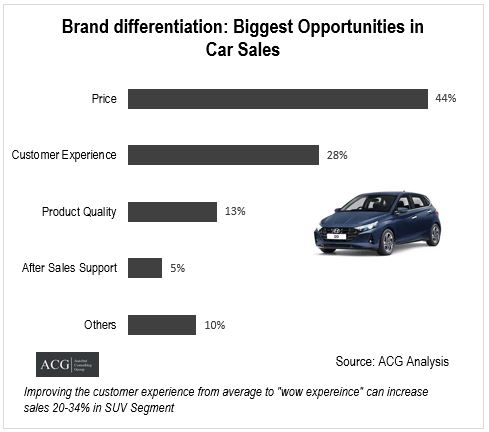
Brand image impact in Indian Car Industry

The way ahead:

At the moment, the ongoing war between Russia and Ukraine has had an impact on various businesses globally. Once normalcy is restored, oil prices are expected to fall back to their previous level. This would represent a significant breakthrough for the Indian car market. The increasing oil prices will enable a sharp rise in the overall sales of electric cars. The study also concluded that there would be an intense demand for personal cars, and this would take the market a long way ahead. It is also believed that there will be no slowdown in business, and even if there is, it will be easily addressed.

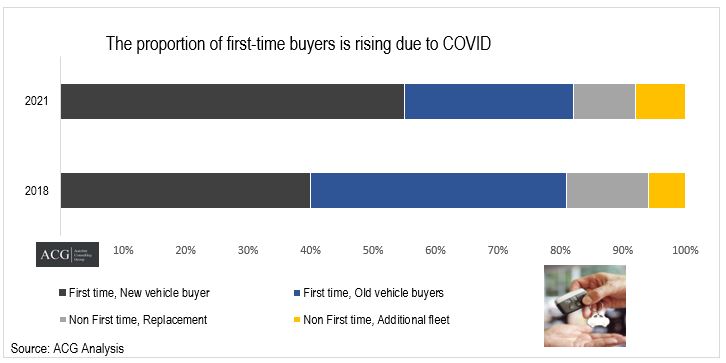
  • Debut buyers – new vehicle buyers
  • Maiden buyers – Old vehicle buyers
  • Non-debut buyers, Replacement
  • Non-Maiden buyers, Additional fleet

First time car buyer analysis in India

Increasing demand for the car, SUV, and MUV, and buyers’ eagerness to own a product:

The Indian automobile customers have shown a greater affinity towards owning an SUV, and for this reason, the SUV has become the most sought-after product in the segment. The buyers are looking to own one between the price tags of Rs. 770,000 and 870,700 INR. The study also revealed that almost 22 percent of people mentioned that they are ready to trade up to own a car in the near future. While many even had a wish to go beyond their budget to make a purchase slightly. There were instances where customers claimed that if their existing car were priced between 500,000 and 600,000 INR, then they would never mind going up by a lakh or two to make a purchase of a vehicle with full-fledged features.

The study’s results further stated that SUV models priced between 110,000 INR and 130,000 INR have established an incredible platform for the OEM, and they are indeed making the best use of it. The buyers are looking for vehicles that offer superior performance and render the best cabin and driveability experience.How SUV Models overlap Car models
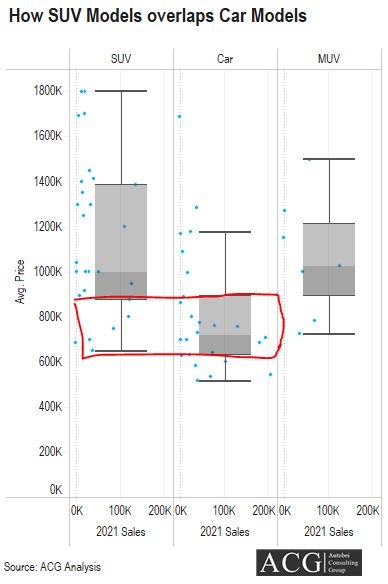
The overall Market Share held by the SUV B, B1 hatchback, and premium hatchback constitutes almost half of the market presence, with just 27 models available in the market.

Impact of the brand on customers’ buying preferences:

The new launches in the market are doing well, and the brand’s reputation has a significant effect on maintaining the sales performance of these new entrants. It is worth noting that the acceptance rate of new entrants is significantly higher than that of existing models in the market.

Sheer competition in the market space:

The last 3 decades have been challenging for automobile brands. The existing domestic brands and reputable foreign brands are all trying their best to establish a foothold in the market. The contemporary market dynamics are incredibly different from what they were before; now, there has been an increasing demand from debut buyers. The not-so-reputed brands were able to carve out a small space for themselves amidst the presence of globally renowned brands and top-notch domestic brands. However, such a mutual presence would not last long, and only the brands that strike the customer’s aspirations will continue to exist.

In this domestic brand space, the top-performing brands enhanced their value from 13% in 2014 to a massive 18% in 2021. This 5% growth rate in less than a decade is a significant performance factor.

A key point to note from the study is that retention rates, particularly in the Indian automobile market, are at an all-time low. The reason for this needs to be ascertained, but it is clear that the buyers are not returning to the brand for which they had made an earlier purchase. The people who responded that they would purchase a vehicle from the same brand stood at an abysmally low turnout of just 10%. This number slightly increased by 11% and rose to 21% in 2021. Astonishingly, the owners of the car, which is priced at 500,000 INR and above, clearly stated that they are not in favor of making the same brand purchase the next time they plan to upgrade. The people with this opinion stood at 32%. During the period from 2014 to 2021, 53 percent of the people did not turn up for the previous brand they had already owned.

Tata Motors, however, brought about a revolution in the Indian market space by coupling their top-notch innovation with the premium touch to their new SUV and car models. This made Tata Motors the customers’ first choice when considering budget-friendly and premium-feeling cars. Tata Motors has now become synonymous with affordability and a brand that caters to the needs of every customer.
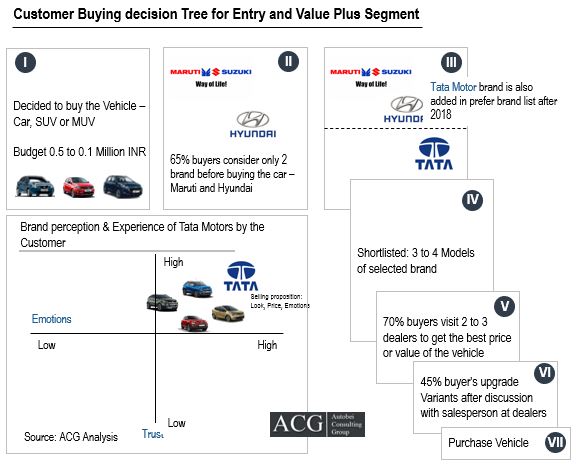
Customer Buying decision Tree for Entry and Value Plus Segment

The Indian automobile market is credited with being one of the largest markets for vehicles. The performance of various brands in the Indian automobile market is dependent on several factors, including customer buying preferences, safety, comfort, and many others.  Almost 65 percent of the survey participants prefer brands with German roots, while others opted for the renowned JLR (Tata) brand. The study has further revealed that the JLR brand will be well-received by the Indian audience in the future and will gradually evolve to become a pioneer in the luxury vehicle segment. The other foreign brands hailing from South Korea and Germany have caught the customer’s eye and have been successful in creating a prominent name for themselves in the Indian market. If we compare the Indian market with that of China, we see a lack of domestic brands catering to the demand for Luxury vehicles, which has led foreign brands to dominate this segment. The study further indicates that customers are willing to go the extra mile by spending a little more to purchase cars from reputable brands.

There is an entirely different buying behavior and decision-making process for rural and urban Indian customers. In India, the market dynamics that influence buyers’ choices are dependent on numerous factors. Many buyers would rely on the words of their colleagues or those around them when deciding to purchase an automobile for personal use. Apart from this, people also choose to gather relevant data from available internet channels and segregate the brands and products that suit them the most.

There has been a sharp rise in the percentage of people who flock to YouTube and other well-known automobile expert channels and social media handles to discover the best brands and models on the market. The buyer will thus use the obtained information to decide on which specific brand to own. This trend is gradually gaining popularity, and currently, 36 percent of people have utilized such e-services available on the internet. Potential buyers will gather all the relevant information from the sites and then reach out to a sales executive to finalize their choice. At the same time, the other group, which constitutes about 27 percent, is not particularly tech-savvy and won’t rely heavily on the abundant information available on the internet to gather details about the product.

The information obtained from the online and offline modes plays an integral role in influencing the buyer’s mindset. Potential customers avail themselves of all the details about the vehicle’s overall performance, reliability, and technical features. Moreover, buyers tend to go through the blogs and reviews written by existing owners. All these layers together give an initial perception to the potential customer about the choice they would make.

Currently, the market trend is being revised daily in the wake of COVID-19. The most sought-after option by buyers has still been the one where the customer directly visits the showroom and interacts with executives to finalize their purchase. Apart from this, customers are trying to gather as much firsthand information as possible by referring to genuine and popular web pages and other online handles. Customers have already had their expectations set before getting their hands on any model. The prime factors that customers consider when making their buying decisions are the brand’s positioning in the market, exterior aesthetics, premium seating, best-in-class features, and, most importantly, the degree of trust a brand has established over the years, which is also known as the level of customer-centricity.

The key factor to note here is that more than 50 percent of the people believe the internet plays a pivotal role in providing the necessary basic overview for most probable buyers. It is also worth noting that some buyers don’t rely on the internet due to the lack of accurate price information on various portals, which itself is a major hindrance. The pricing of automobiles, especially in the Indian market, varies from state to state, depending on tax slabs and other parameters. This has led to a shift in customer preference from online platforms to offline showrooms, allowing them to determine the actual price and plan for ownership based on their financial feasibility. The male population between the ages of 18 and 40 is the ones who prefer to visit the showroom in person rather than surf the details online. In the current scenario, even the female audience is shifting towards online portals for obtaining details about automobiles before making a purchase. They mostly prefer to use automobile websites and phone applications because of the detailed information and transparency they offer. Even the offline setups are not much behind in this run, as there has also been an increase in visiting the car dealers in person, availing test drives, and getting valuable insights from relatives, friends, and many more; such offline engagements have evolved as the top choice for the potential buyers.

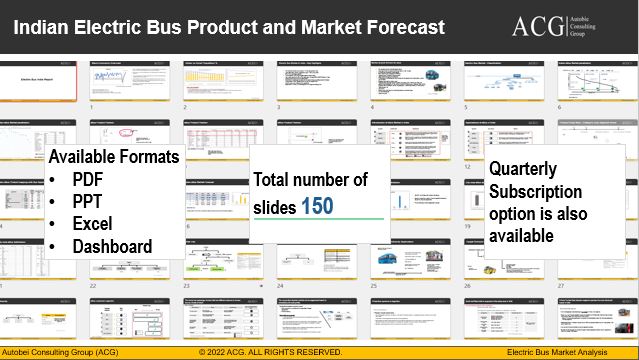
Indian Electric Bus Product and Market Forecast is a special report which covers all the key points of the electric bus market in India. The Electric Bus Market is expected to grow at a CAGR of 71%  between 2022 to 2025. eBus Market is one of the fastest-growing in India in the Electric Vehicle segment.

ACG released the Application wise Indian Bus sales forecast for 2022 to 2030. The key drivers of the ebus are the Indian Government’s commitment to achieving net-zero emissions by 2070, The declining price of the battery, Government policies & Subsidiaries, the Charging  Station network, Increasing Battery life, and range, Advantages of driving ebus and passenger comfort, Passengers willingness to pay more for comfort and safe journey, Private bus operators interest in ebus, Lower TCO and others.

Indian Electric Bus market and Product Forecast

Electric Bus Market overview:

  • The key highlight of buses in India
  • Latest Development in the ebus Industry
  • Total Electric Bus Market – Units and  Value (USD)

Market Attractiveness Index for Electric Buses: Deployment

  • Major Cities
  • Major States
  • Duty Cycle
  • City wise Market size by Bus Application

Application wise Electric Bus Sales and Penetration Forecast:

  • STU
  • Private
  • Staff
  • Educational Institutes (School, College, University, Training Institutes)
  • Last-mile delivery
  • Intracity
  • Intercity
  • Tourist
  • Mofussil
  • Airport
  • Special Application
  • Definition with an example of Bus Applications

Bus Lengthwise Electric Bus Forecast:

  • 6m to 8m, 9m to 11m, 12m, and more
  • Key Influencer and Charaestritic of Bus Application
    • GVW, Price, Length, Engine Power, Torque, Private, and STU

Design and the requirement of the electric buses for different applications:

  • Battery capacity
  • Range, Price
  • Charging time
  • Seating capacity
  • Battery life
  • Bus Length

Electric Bus Product Planning and Strategy:

  • Model wise TCO
  • Key specs and features of ebuses
  • Popular ebus models and brands
  • Product life cycle
  • Upcoming Electric buses and OEMs

Electric Bus Competitor Analysis:

  • Tata Motors
  • JBM
  • Olectra – BYD
  • Ashok Leyland/Switch Mobility
  • Foton – PMI
  • MOZEV
  • Eicher

Major Attributes Relationship Analysis:

  • Duty Cycle
  • Bus Application
  • Cities type: metro, Tier I & State Capitals, and Small Cities
  • Electric Bus Price
  • All major technical specs and Sales

Major Potential Buyers: Private and STU:

  • Intercity Application
  • Intracity
  • School
  • University
  • others

Electric Bus Buyers Analysis and  Purchase Journey:

  • Determining a bus operator’s decision tree to buy ebus
  • Electric Bus procurement process for different applications
  • Purchase preference for Private operators for different application

Route Identification for Intercity, Tourist Bus Applications, and Charging Stations require:

  • Major routes
  • Potential Bus Operators for ebus
  • Key Challenges and Opportunity
  • Bus operator’s feedback and opinion on Electric Bus
  • Major Tourist routes
  • Major Intercity and Tourist Bus operators

Government Policy:

  • Government policies and their impact on Electric Buses
  • States wise EV Policy: Delhi, AP, MP, UP, Gujarat, Karnataka, Goa, Maharastra, Himachal Pradesh, Bihar, Jharkhand, Kerela, Haryana, Punjab, Rajasthan, Uttarakhand, West Bengal, Odisha, Chhattisgarh

Indian Bus Market Analysis:

  • Last 10 years Trend of ICE and CNG Bus sales
  • City wise Bus market size
  • City wise Bus Sales Trend of School, Staff, Intercity, Intracity, Moffusil, Tourist and others
  • Lengthwise Bus sales Trend
  • Indian Mini Bus Market Analysis and Trend

Mini Bus Market Analysis:

  • OEM wise Mini Bus Sales Volume, Market share, and competitive position
  • Major Models of Mini Bus Segment
  • Major Bus Application
  • Key technical Specs
  • Model wise Price

Light Duty Bus Market Analysis:

  • OEM wise Mini Bus Sales Volume, Market share, and competitive position
  • Major Models of Mini Bus Segment
  • Major Bus Application
  • Key technical Specs
  • Model wise Price

Medium Duty Bus Market Analysis:

  • OEM wise Mini Bus Sales Volume, Market share, and competitive position
  • Major Models of Mini Bus Segment
  • Major Bus Application
  • Key technical Specs
  • Model wise Price

Heavy Duty Bus Market Analysis:

  • OEM wise heavy Duty Bus Sales Volume, Market share, and competitive position
  • Major Models of Mini Bus Segment
  • Major Bus Application
  • Key technical Specs
  • Model wise Price

Macro Economy:

  • Indian GDP Growth rate forecast
  • Diesel price hike after Ukrain and Russia issue
  • Oil price impact on the oil import bill
  • Inflation and spending power of customers

Key Drivers of Electric Bus:

  • Growth of Urban population
  • eBus market share of Smart cities, Capital cities, Towns, and tourist places

Advantages of Electric Buses:

  • For Quality of passenger and Drivers
  • Advantages for Environment
  • Safety
  • Productivity of drivers
  • Technology

How to market and  sell the Electric buses in the above bus application

  • Sales Approach
  • Marketing Plan
  • Marketing Campaign

The report gives the following answers:

  • Electric Bus Market forecast for Short, Mid, and Long term?
  • Which eBus segment will grow first and why?
  • Largest Electric Bus segment?
  • How to Create Product planning for buses?
  • What will be the impact of Russia’s Ukraine conflict on the operating cost of Electric buses compared to ICE/CNG Buses?
  • Product and sales planning blueprint

Additional market intelligence information is also available on the following points:

  • Costing of Electric Bus
  • Suppliers of ebus components
  • Homologation process
  • Bus Fleet owner data
  • Hydrogen Fuel technology for long-range duty cycle
  • Electric Bus Feasibility Study
  • Establish greenfield project for Electric Bus
  • IT Solution for  ebuses

Related Reports and Database:

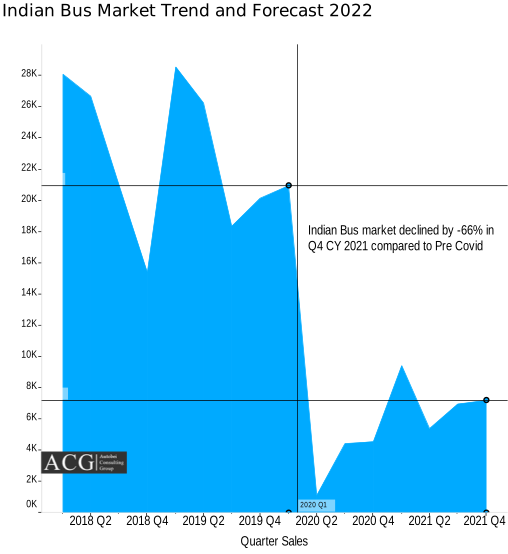
Indian Bus Market Analysis and Forecast 2022 is the detailed Bus report along with the forecast. In the Indian Automobile sector, the Bus category finds a prominent place because of its spread wide range of applications across various stretches. The known fact was that the year 2021, was badly troubled by the outburst of COVID-19. This period caused indefinite trouble for the economy to scale up to its potential thereby bringing all the activities to a halt. Taking a look at how the market scaled for Indian bus sales reveals some astonishing insights. The year 2021 was more fatal to this sector than 2020, as the numbers went down by 6% in comparison to 2020. The sales figures recorded during this period were almost three times less as compared to the usual stats witnessed prior to 2020.

Indian Bus Market Trend Analysis 2021 and Forecast

Till date the Indian bus sector is not able to attract a decent sales volume despite the situation turning to normal. The pandemic seems to come to an end, yet the apprehension in people’s minds about traveling to places continues to remain and this has made the tourist Bus, School, and staff buses sit at the garages for still some time. The current market analysis predicts that the year 2022 might give the much-needed breakthrough for the sales volume of Indian buses and thus handing them a fruitful welcome.

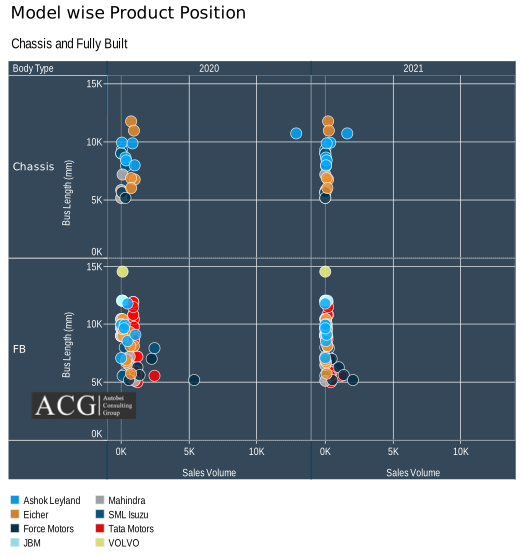
Indian Bus market of Model wise sales and Pricing Analysis:

ACG is tracking model-wise Bus pricing since 2012. It helps to create a Product strategy, Right pricing for targeting potential buyers group. OEM’s market share has changed after  CY 2019, Tata Motors, Eicher, BharatBenz, Volvo, Scania, Mahindra, Force Motors, SML Isuzu.

Our exclusive database gives the Models wise, Applications wise, lengthwise, and seating arrangement of the Indian Bus market.

Model wise Indian Bus Sales Data

Bus OEMs Market Share:

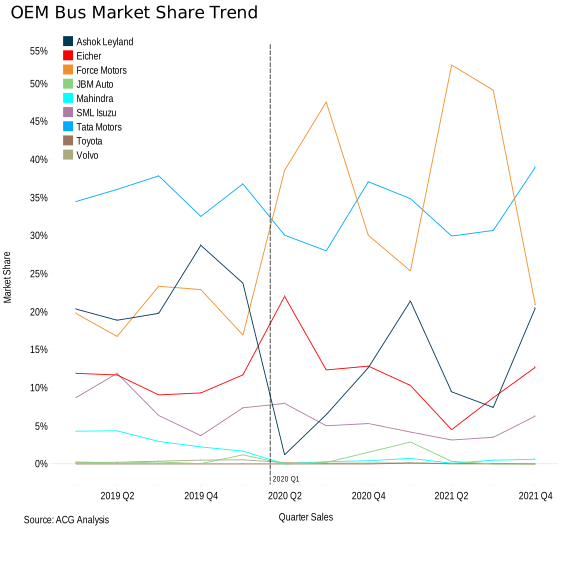
Tata Motors, Ashok Leyland, Eicher increased market share in Q4 CY 2021. Volvo bus is the market leader in the Premium and Luxury Bus segment.

Indian Bus OEM Market Share 2021The performance of the various brands in this segment during the last 2 years was not the ever best, but yet Force motors put up a commendable performance in terms of sales by grabbing a 35% market presence in 2021, and they indeed have added on 14% of sales volume in comparison with 2018. The market was not very conducive for other brands in the segment, as Ashok Leyland, Tata Motors, and Eicher had a dry outing during this period and their sales dipped by 3%, 2%, and 1% respectively. However, the sales of SML Isuzu were brought down drastically and they lost about 50% of their market share to the COVID-19 scare and this was a severe blow to this foreign brand.

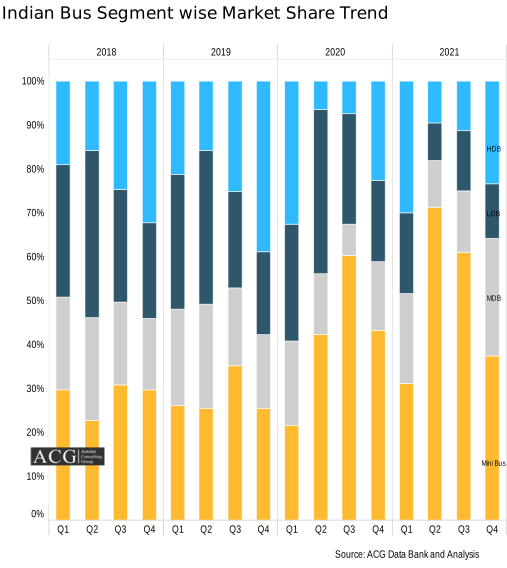
Indian Bus market Segment wise Market share 2021The sub-category in the bus segment i.e the Light Duty Bus is regarded as the prominent contributor for the bus category. The market didn’t even favor this category and their value proportion tumbled down to hand them over a 50% degrowth in the year 2021. Despite the unfavorable market dynamics at the moment, the Minibus segment seems to be doing marginally better than all other segments in this category. Starting from the 3rd quarter of 2021, the market performance has given a hint of getting better. As we see Heavy and Medium duty bus enhanced their market share to a formidable level. Whereas the Minibus couldn’t keep up the momentum and had to see a drastic momentary fall in their sales. Also, the Light Duty bus isn’t performing that well in the market and has been trying continuously to find its position in the current scenario.

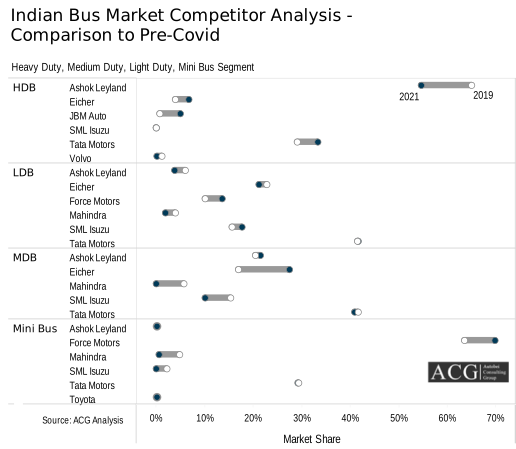
Indian Bus Market Competitor Analysis Comparison to Pre-Covid

Taking a look at the HDB segment gives us a clear verdict of Ashok Leyland being the market giant in this segment with an overall hold of 55% in 2021. It is closely followed by Tata Motors which trials behind the Ashok Leyland by a market share of about 33%. Another key contributor in the segment, Eicher, has enhanced its market position by adding on 3% over the period from 2018 to 2021. Another foreign manufacturer, Volvo, has positioned itself as a premium brand. It registered degrowth starting from 1.6% which has now reduced to 0.2% over the last 3 years.

Getting to the details of the performance of the Medium Duty bus segment shows us that Tata motors continue to have their full fledge control over this segment by being the highest seller with a market presence of 40%. The one in the 2nd position in this segment is Eicher, which has also seen a decent growth of about 10% during the non-COVID times.

Bus chassis is in demand in the last 3 quarters of 2021. The local market and Economical factors are key reasons for this strategic move.

Tata’s sheer dominance isn’t just restricted to one segment but has even spread to the Light Duty bus segment. They have been a consistent top performer for almost half a decade. Other brands in this segment have also grown further as there was a good demand for the vehicles in this segment. So, brands like SML Isuzu and Force Motors have bettered their performance in the market by adding on 2% and 5% respectively in the recently concluded year 2021.

Tata’s prolific run in the previously discussed segments was put to a halt in the Minibus segment. Force Motors has emerged as the key contributor in this segment with a whooping hold of 70% on the market. It has left very little ground to its competitors in the segment and all other brands in this segment are still striving to find their feet. Tata’s however have the vision to establish an invincible hold in terms of market share, and the same is evident from their aggressive new releases and strategic ideas.

Our other reports:

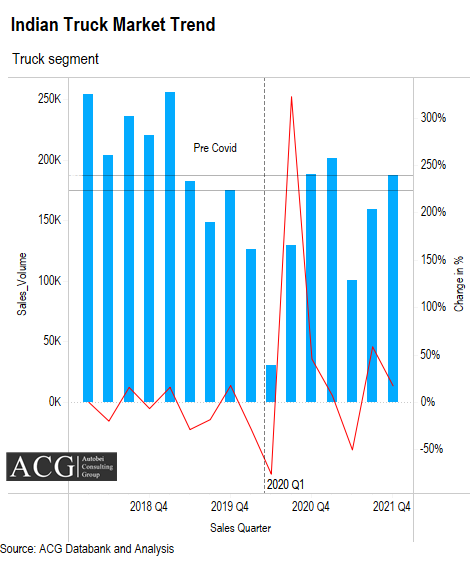
The post-pandemic period aided the automobile industry to rejuvenate itself by boosting its growth and rendering them opportunities to scale better. Taking a look at the Indian truck market, we observe that the overall performance for this sector was better as the sales figure shot to 0.64 million from 0.47 million units starting from 2020.Indian Truck Market Trend Analysis 2021 and Forecast

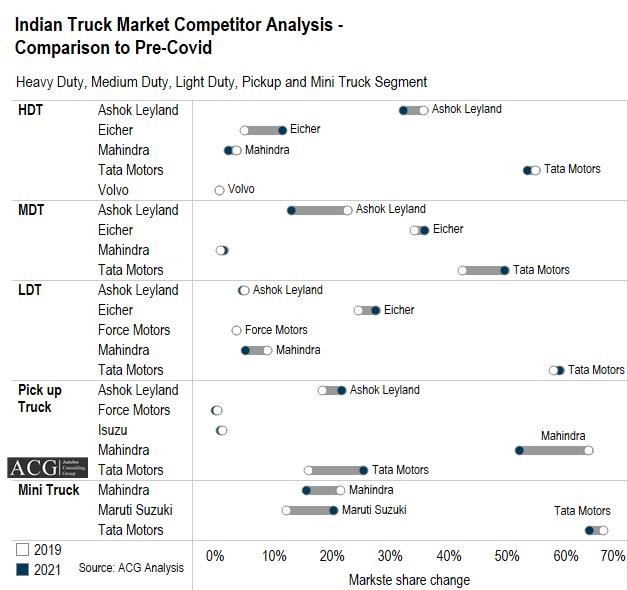
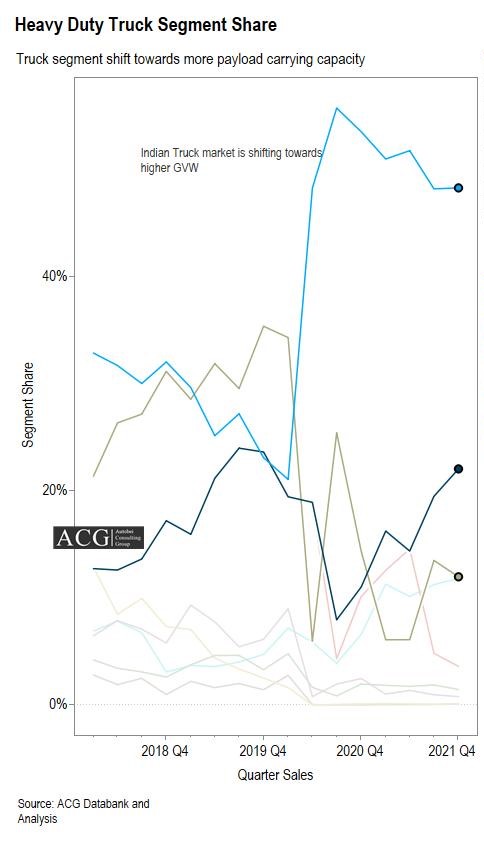
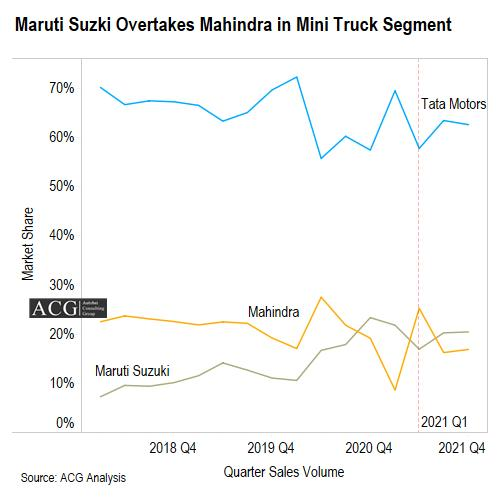
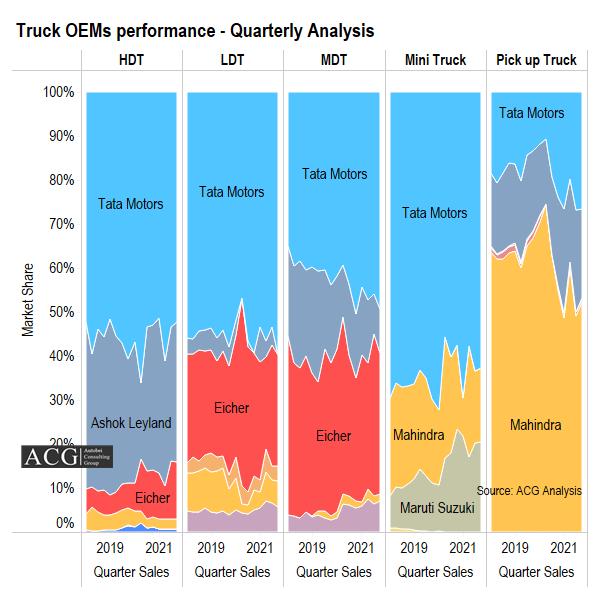
After the Covid impact, some OEMs are performing better than the Pre Covid time. Maruti Suzuki, Ashok Leyland, and Tata Motors increased their market share in the different Truck segments. Mahindra lost in almost every truck segment.

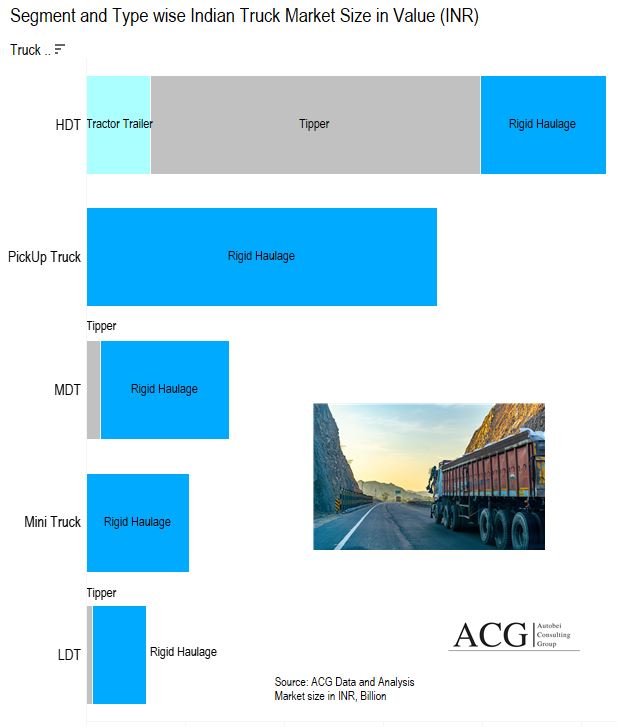
Indian Truck market size in terms of Value (INR):

Indian Truck Market size in terms of value in INR

The Heavy-Duty Truck segment is the largest one in terms of Value. In Tipper segment is the dominant segment with the largest market size in terms of value.

Indian Truck Market Competitor Analysis 2021 and Forecast

The growth rate of the Indian Truck Market recorded in 2021 stood at 37% compared to CY 2020. Also during this period, the Heavy-duty truck segment performed better in the 4th quarter, and this rate of growth is exceedingly well as compared to the pre-pandemic times.Indian Heavy Duty Truck Segment Analysis 2021 and Forecast

The recent rise in the omicron cases globally has played a spoilsport by considerably bringing down the sales of Mini truck, LDT, and HDT. Many customers have pulled from their plans of owning these commercial vehicles due to the COVID scare and the unforeseen future ahead.

In Mini Truck Segment, Maruti Suzuki overtakes Mahindra in Q3 CY 2021.ACG published a report on how Maruti Suzuki’s strategy to become the market leader in this segment.Maruti Suzuki overtakes mahindra in Mini Truck segment

Also, check our exclusive Report on the Indian Electric Truck market Assessment and Forecast

As mentioned earlier the Q4 and Q3 in 2021 paved a way for some tremendous growth across segments. The Indian tipper market saw its growth climbing up by 15%, and even the Rigid Haulage and Tractor segment put up a commendable performance in bringing their sales and recording a growth of 18% and 21% respectively.

The growth rate that was witnessed in the above-mentioned segments couldn’t create magic in the Pickup Truck segment. Ever since the start of 2020, this segment is facing tough times and its market share is diminishing drastically. No considerable growth was recorded even during the Q3 and Q4 of 2021, and this period was almost standstill as far as this specific segment is concerned.

Truck OEMs performance in India Market

Taking a look at the Tipper segment reveals to us that the growth particularly in this segment is not linear and is oscillating from 10 % to 8% throughout the last two years i.e from 2020 to 2021. Majorly, the Tipper Market has its roots in the GVW 18.5T to 34T category and they tend to have a firm hold on its overall operations and business. The current scenario has opened new avenues for the Construction and Mining industry. Nevertheless, the demand has shot up sky-high. This has led to the creation of heavy market demands for the various Tipper models comprising even the premium segment and the MDT tipper. The construction and other activities related to Real estate would continue to excel in the future thus providing a constant growth curve for this segment.

The heavy-duty tipper segment has been backed by various formidable key performing brands in the industry. Tata Motors and Ashok Leyland are the prominent ones in the segment and have always held the top position irrespective of the market situation. Their firm hold on the market is evident from their total Market presence in this segment. Tata enjoys an overall presence of 49%, while Ashok Leyland is in 2nd position with a 40% market share. Tata’s flamboyant run in the market continued even to the 18.5 to 28T GVW segment and their dominance seems to just get stronger shortly. Eicher has also evolved to be a key contributor in the segment by being at the 2nd spot. As we move towards the 34 to 40T segment, Tata has been successful in holding a key spot in this too. And they are even more prominent in this segment as their share stands at a whopping 58%. Another premium brand Volvo is trying to get things right in this segment and has managed to get a 12% market share over the 4th quarter of the last year.

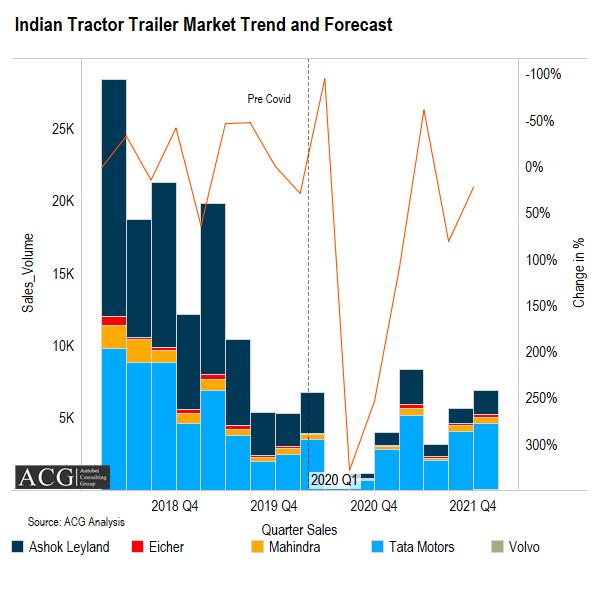
Indian Tractor Trailer Market Analysis and Forecast 2022The market dynamics in the MDT segment are very different compared to the other segments we have just discussed. Tata couldn’t continue their uninterrupted streak of exceeding its market hold. Their market share of 80% in the 2nd quarter of 2019 was reduced to a meager 40% by the last quarter of 2021. This segment is now being led by Ashok Leyland as they hold a market share of about 25% currently. It is then closely followed by Eicher, which climbed to this spot by taking over about 8% from its close competitor Tata motors. Overall, Ashok Leyland continues to hold a vital position even in the 10 to 14.5T segment by being able to turn around the overall market presence of 50% and 74% respectively.
Another prominent player in this list is the Rigid Haulage. Over this segment, the 14.5 to 16.2T has garnered much attention from the customers, and by the virtue of this, it has been able to establish itself as one of the biggest and exceedingly growing segments. These models have found their extensive application in the e-commerce industry, and the growing demand for the same has opened up a new growth journey for this segment.

The credit for being the gigantic segment in the Rigid Haulage goes to the 18.5T to 28T and 45 to 49T segments. Whereas the quick growth in this truck category has been recorded by the 34 to 40T segment as they have consistently maintained their growth curve at 48% for the two consecutive quarters of the year 2021.

The sales volume of Pickup Truck has come down in 2021 Q1 and Q2 but bounced back in Q4 2021. Also, the difference seen between LDT and MDT is not that significant taking into consideration the pre-pandemic time and the last quarter of 2021.

The previously discussed Rigid Haulage segment is experiencing a never-before boom in the market at the moment. And the Tractor trailer model couldn’t get the expected turnover in the present market scenario and its sales figure hasn’t seen a significant rise starting from the 1st quarter of 2018.

Other reports:

Contact info@autobei.com to buy the Full Report

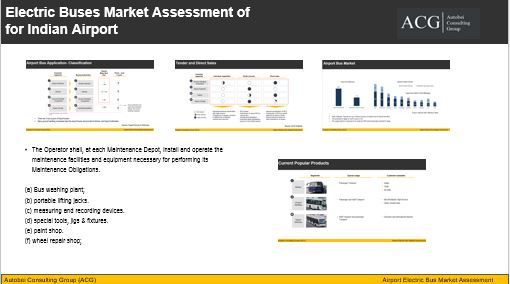
ACG released the latest study on Market Assessment of Electric Buses for Indian Airport. We have identified the key Airports in India for launching the Electric Buses and market potential for the next 5 years.

Market Assessment of Electric Buses for Airport

The key highlights of the Report:

  • The total market size of Airport buses
  • Opportunities and Challenges Analysis
  • The current market size of each Airport bus in India
  • Market share of Electric buses at Airports in India
  • The potential market size of Electric buses
  • Top Airports for Electric Buses
  • Electrification plan of Indian Airports
  • The typical life cycle of buses at the airport
  • How airports authorities, Airlines, and Ground handling companies procure the buses
  • Defined the different applications of Buses at Airport
  • How tender process works at the airport
  • What is the requirement to deploy buses at the airport
  • Current product portfolio and their specification

We have several reports and a Database for Electric Bus Market Strategy