The post-pandemic period unraveled a good growth cycle for the automobile industry specifically for the two-wheeler industry. The statistical analysis underlines that the market shot up by 1.3% in the year 2021 as compared to the year 2020.

However, the industry was able to breathe a sigh of relief as they could reap a good expansion in the export arena by amassing a growth of 48% and 29% in 2020, 2021 respectively. This flawless run of the market was put to a halt in quarter 3 and quarter 4 of 2021 as there was slight degrowth of about 13% for the Scooter vehicle. If this was not the case then the market would have expanded to its ever best.
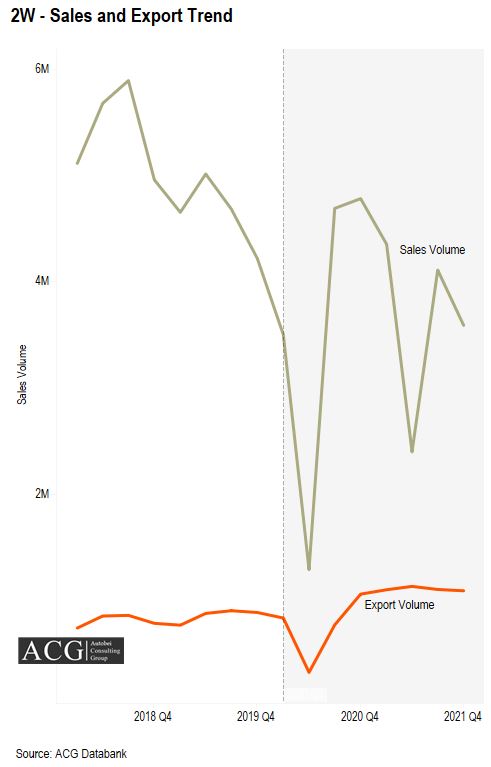
Indian Two Wheeler Sales and Export Trend

Brand Position-based on Customer perception: Motorcycle Segment

the market dynamics of the two-wheeler segment especially in this segment are very unique because of the customer’s mindset, ever-changing options, and the rise of new entrants in the market.

Brand perception has a big impact on Two Wheeler’s buying decision. We have considered the most important factors in our reprinted sample size like Male, Female, Small towns, metro Cities, Villages, Different professionals, and others.

In our full report, we have published all the attributes which influence customer decisions. Such matrices are useful for OEM’s new product launches and brand strategy.

Bajaj Motorcycle is in the midpoint of Resale Value and Product Reliability.

Indian Two Wheeler Brand Perception- Motorcycle

Brand Position-based on Customer perception: Scooter Segment

Brand Position also play important role in buying Scooter. However, the customer preference is different compared to Motorcycle different. Honda is the best in maintenance cost and resale value.
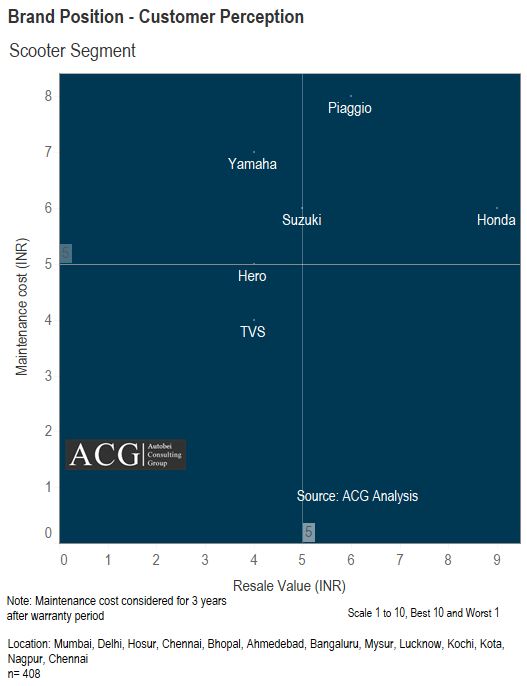
Indian Two Wheeler Brand Perception- Scooter

Another point that grab everyone’s attention is that the post COVID performance of the domestic two-wheeler market is slightly better than what it was during the Peak time of the pandemic, but these numbers aren’t even close to what the two-wheeler market was witnessing during its operational year dating back prior to 2020. There was a sharp downfall of the market by almost 22% in comparison to the above.

Indian Two Wheeler Competitor Analysis:
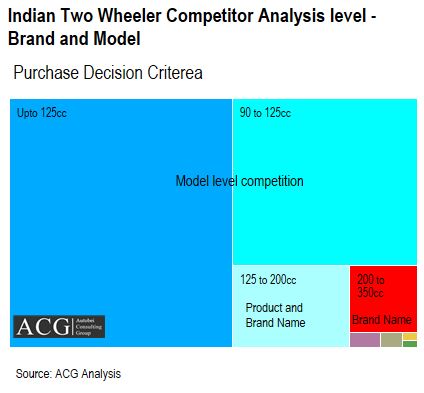
Indian Two Wheeler competitor analysis

The COVID 19 didn’t really miss out to disrupt the entire market segment and it did have a negative impact during the peak time of its spread. While after this impact, there was a contradicting development in regards to the growth of this OEM segment is concerned.
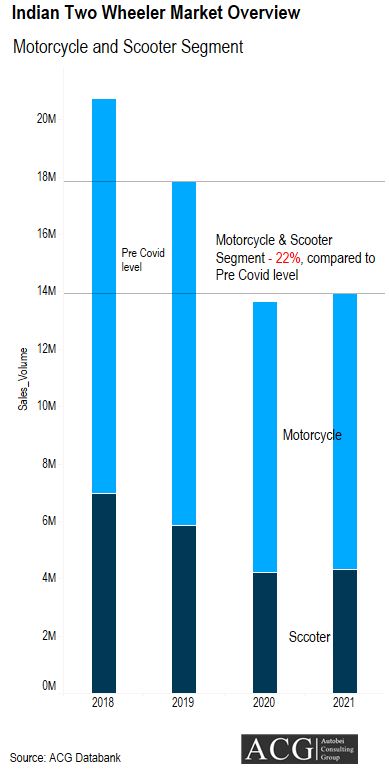
Indian Two Wheeler Market overview 2021 and Forecast

If we dive deep into the two-wheeler industry then we can see that the motorcycle segment too added strengthened its market space by 1.6%, alongside this was Scooter segment which expanded by 2.7% during the year 2021.
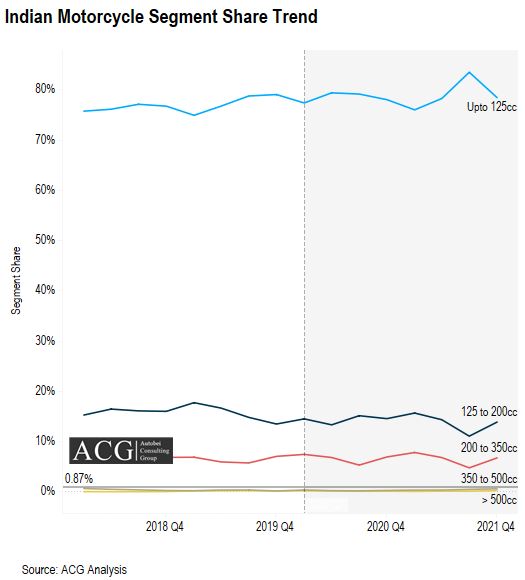
Indian Motorcycle Segment Share Trend Analysis and Forecast

Further, as we try to take a look into the performance of the motorcycle segment, the figures we see are really encouraging and show that this segment has led from the front for the entire two-wheeler industry. The motorcycle segment till the range 125cc got a warm welcome from the customers as it bettered the numbers by adding 2.5% from the previous year. For the range greater than 125cc and less than 200cc the figures show that there was a slight diminish in the growth by about 4.6%. However, for the segment from 200 to 350cc, 350 to 500cc, and above the segment enjoyed an absolute flawless run in the market. The same is evident from the growth figures as the market expanded by 2.1%, whooping 66% and 2% respectively for all the 3 above-mentioned segments.

As Hero found it really hard to maintain its consistent performance in the market and even took a bad hit during this period. Its close competitor, Bajaj, however, enjoyed a growth curve at the same time in the budget motorcycle segment. A positive growth curve was also evident from the rise in the overall market hold of Honda and TVS. Astonishingly, Bajaj, which used to stand tall in the market as far as 125cc to 200cc is concerned couldn’t really reap reach dividends during this period as its firm position in the market declined gradually starting from Q1 of 2020. The same was not the case with other players in the market viz. TVS, Honda, and Yamaha as they continued to steer across a potential growth during this period. Another major player in the 350 to 500cc, continued to be an undisputed king of the domestic arena.
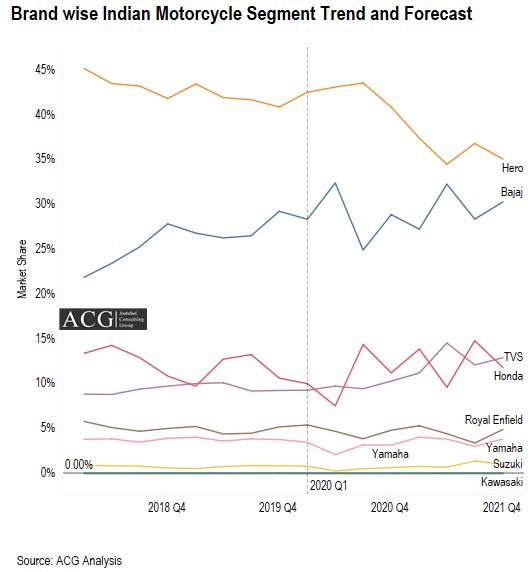
OEMs wise Indian Motorcycle Segment Share Trend

The growth curve recorded in the entry-level segment speaks about the exceeding interest in the customers towards various brands of two-wheelers. TVS seemed absolutely no standstill at all in the OEM as it strengthened its base by another 15% in 2021. The fortune even continued to Honda and Yamaha by giving them a major breakthrough and aiding them to grow by 57% and 40% in the last quarter of 2021. The 200 to 350 cc is seen as a premium segment and here Royal Enfield, Honda has always been able to perform to their potential, and even in 2021, they were able to record 42% and 71% in the last quarter of 2021. So overall both these entities did really well despite the hardships and shot up their sales figure exponentially. During Quarter 4 of 2021 for the 500cc and above segment, Royal Enfield and hero recorded amazing numbers and aided them to close the quarter with growth of 125% and 106% in comparison with the 3rd quarter of 2021.

Indian Scooter Segment Share Trend Analysis:

Ever since the rise of geared vehicles the scooter segment has gradually lost its shine in the market. In our detailed report, we have explained why it happened and forecasted this segment. 90 to 125cc is the main segment of the Scooter market.

But the statistics thus observed are quite contradictory to this claim as the scooters of greater than 125 cc stood tall by being able to put across a fantastic growth of 10%. This wasn’t quite applicable for the base variants as they are still not able to put an exciting sales figure to date. Whereas for the 90 to 125cc there was a respectable turn out of about 3% in the year 2021 compared to its previous. Moreover, the growth in 90 to 125 cc is extremely important for the two-wheeler industry as they play a pivotal role in the domestic as well as an export arena.
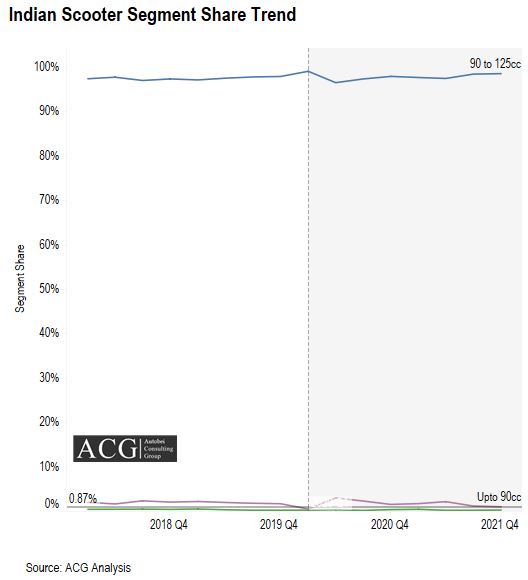
Indian Scooter Segment Share Trend Analysis and Forecast

Brand wise Indian Two Wheeler Segment Share Trend and Forecast:

Market leader Honda of the Scooter segment is losing its grip. The TVS and Suzuki are continuously increasing their market share after Covid 19 impact. Piaggio brand became the first choice of premium scooter buyers. The all reasons behind this trend are examined in our detailed report.
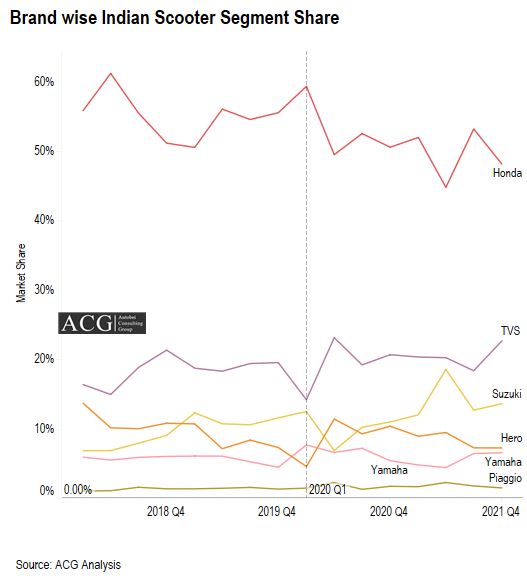
Brand wise Indian Two Wheeler Scooter Segment Share Trend and Forecast

Indian Two Wheeler Export market:

The export market grew by 48% and 29% in 2020 and 2021 compared to the previous year. Two-Wheeler segment export showed excellent growth of 48% in CY 2021. Q3 and Q4 CY 2021 declined export of Motorcycle and Q3 2021 Scooter registered degrowth of 11%.

In spite of the domestic market not handing the required success for the two-wheeler market, the export market came to its rescue and rendered the much-needed breakthrough for this segment. African Nations and a few others in the South Asian region have evolved as the hotspots for the two-wheeler markets. This enables the sales figures in the export category to grow exponentially. The young generation is very much inclined towards owning a two-wheeler that too a sportier one. This trend has served as a boon to the wheeler market while this enabled a substantial rise in the demand for sporty motorcycles and the growth stands at absolute 100% in 2021.
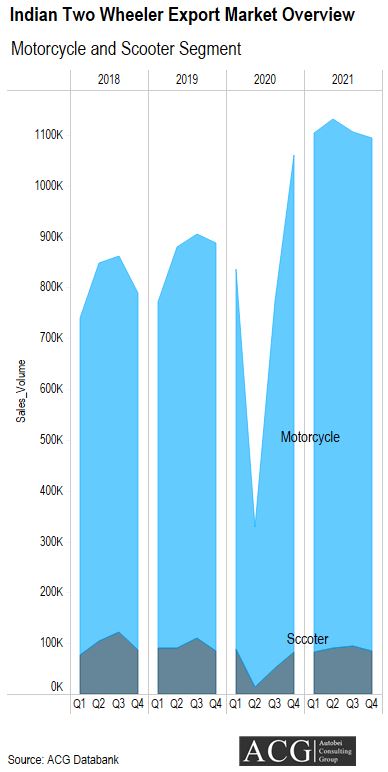
Indian Two Wheeler Export Market overview 2021 and Forecast

Indian Motorcycle Segment Share Trend and Forecast:

The growth was not just restricted to the sporty models but also expanded for 125 to 200 cc entrants by enabling them a growth potential of 61% and 42% despite the spike in COVID during the year 2021.

Indian Motorcycle Export Segment Share Trend Analysis and Forecast

Indian Motorcycle Segment Trend: Export

Bajaj which used to perform decently well had to concede 20% of its existing market share during the last two years. But right after the 3rd quarter in 2021, Bajaj was back to business by conquering its lost share. Their fellow counterparts like Suzuki, Yamaha, and Hero were successful to an extent by being able to get that much-needed growth despite the adversities posed by the pandemic.
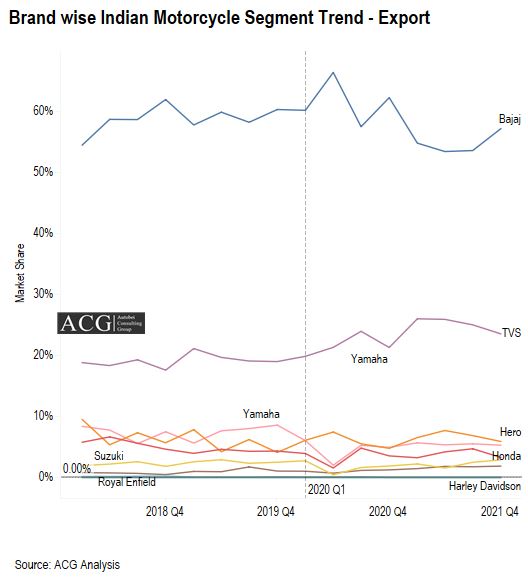
OEMs wise Export Indian Motorcycle Segment Share Trend

Indian Scooter Segment Trend: Export

The last two years of Pre Covid didn’t really give much of an opportunity for this particular market segment. 90 to 125cc showed attractive demand for the export market.
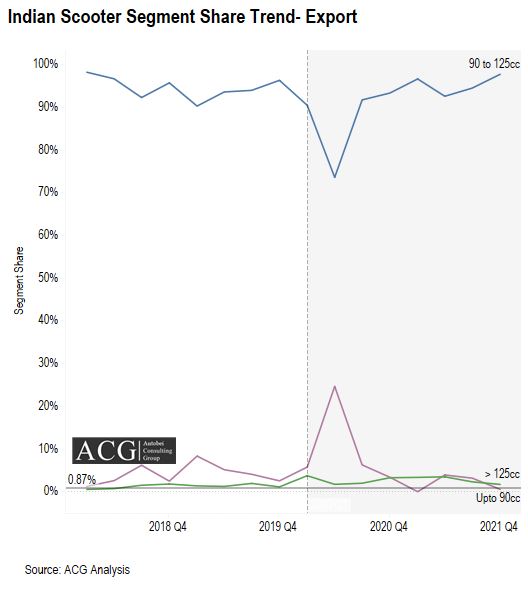
Indian Scooter Export Segment Share Trend Analysis and Forecast

Honda is the market leader in the Scooter export segment. TVS is the second-largest player in scooter export.
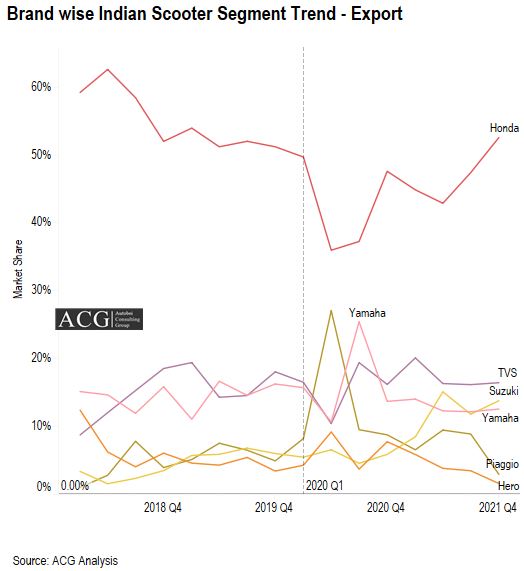
Brand wise Indian Export Scooter Segment Share Trend and Forecast

To buy the full report, kindly contact at info@autobei.com
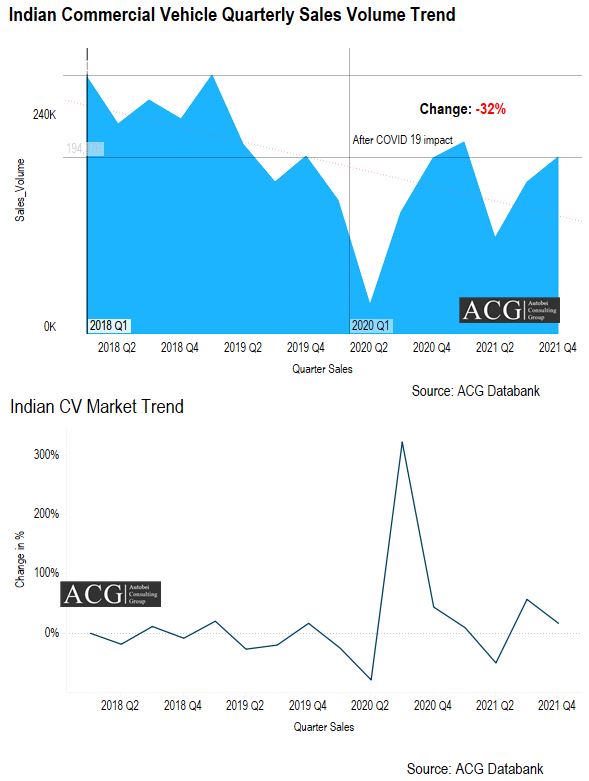
ACG released Indian Commercial Vehicle Market Report 2022 and Outlook. The Indian Commercial Vehicle sales done in 2021 are 0.67 million units compared to slightly more than half a million in CY 2020.

The year 2020 was completely hit by the pandemic. Indian CV had hit the rock bottom owing to the COVID-19. Surprisingly, the year that followed 2020, witnessed an overall boom in regards to the sales figure of Indian Commercial Vehicle. ACG  already predicted a good market growth in the year 2021 for the Commercial vehicles.

Indian Commercial vehicles showed 34 percent growth in CY 2021 compared to CY 2020.

Indian Commercial Vehicle Quarterly Trend 2021

Post Q2 2020, the Commercial Vehicle segment in India received a warm welcome from its buyers, and this shoot up the cumulative unit sales of Commercial vehicles comprising of the Small, Light, Medium, and Heavy-duty segment. Notably, the heavy commercial vehicle segment has topped the list in terms of growth achieved compared to the Ill-fated year of 2020.

OEMs wise Commercial Vehicle Product Portfolio and Planning:

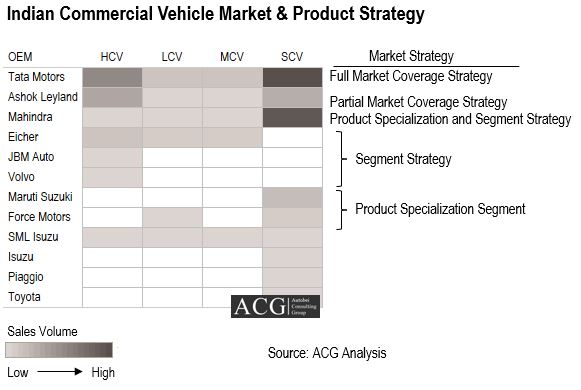
There are mainly 3 kinds of Product Strategies that OEM follows: Full Market strategy, Segment level Strategy, and Application based specialized Product Strategy.

Indian Commercial Vehicle Product Strategy

Heavy Commercial Vehicle Segment (HCV):

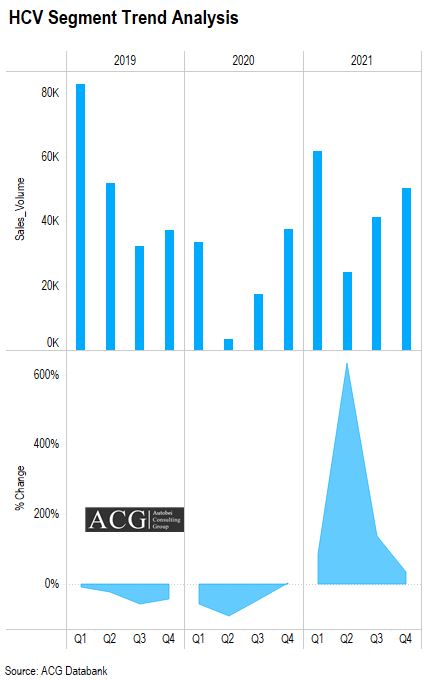
Indian Heavy Commercial Vehicle segment registered 92 percent growth in CY 2021 compared to CY 2020. Diving deep into the statistical analysis of HCV reveals that Tata Motors with 52% presence has established its unanimous hold in this segment and the pandemic seems to have not bothered it.

Heavy Commercial vehicle Trend Analysis 2021

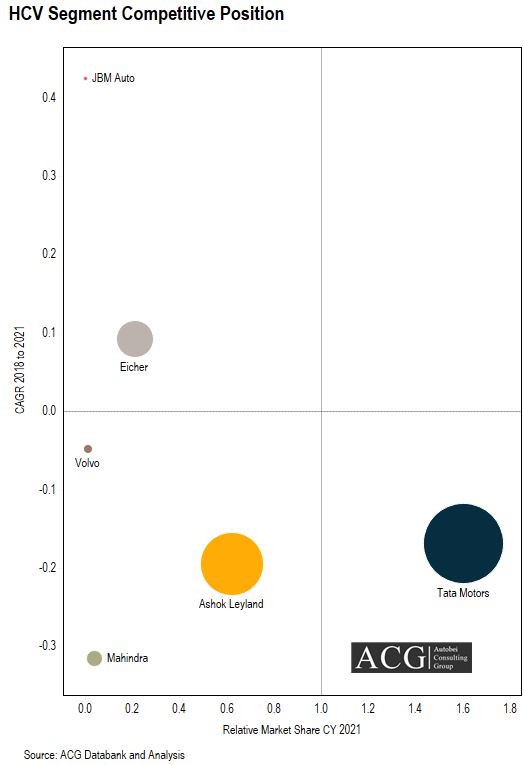
Eicher is the fastest-growing OEM in HCV Segment. It registered 41% CAGR between 2019 to 2021.

Indian Heavy Commercial vehicle competitive position Analysis

While its close counterpart Ashok Leyland has diminished its market share by about 6% during the last 2 years.

Over the years the competition to hold a key position in OEMs is getting intense. And astonishingly Eicher had its last laugh in this domain by evolving as a leading player. Also, it strengthened its presence by adding up 6% more in the last 2 years to its present value in the year 2021. Contrary to this, the other competitors in the market such as Volvo had to lose their share by a marginal value approximating at about 0.5%. Though the value seems to be negligible, it did hit hard for those companies. Shortage of kits due to Covid 19 is also one of the reason to loose market share. Recently, the demand has increased for Tipper models in coal mining application.

Medium Commercial Vehicle Segment (MCV):

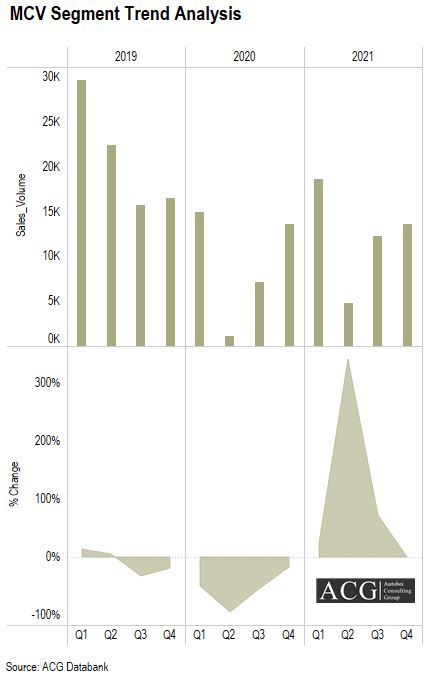
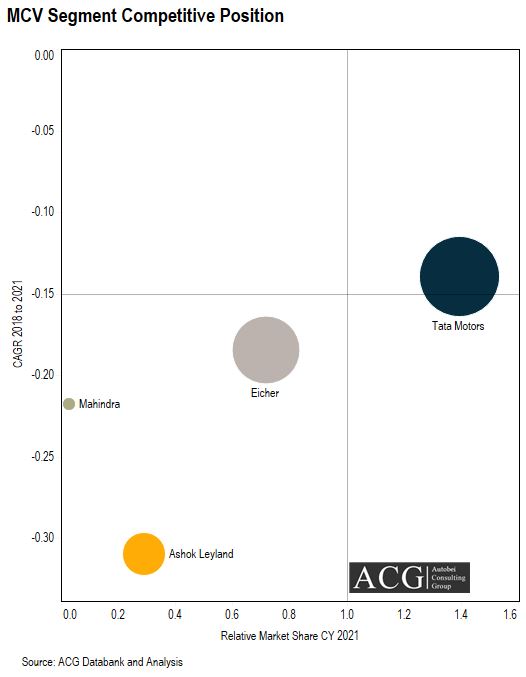
Indian Medium Commercial Vehicle segment registered 35 percent in CY 2021 compared to CY 2020. However, for the Manufacturing commercial vehicles growth was not only good but turned out to be excellent. There was a sharp rise in the demand and within no time a sprawling growth of about 34% was seen in the year 2021.

Medium Commercial vehicle Trend Analysis 2021

Tata’s dominance seemed to have absolutely no stopping at all, as they did turn out their magic by clinching the top position with the exponential growth of about 7% from the previous years. All these made them stand strong in the segment with an overall presence of 46%.

Indian Medium Commercial vehicle competitive position Analysis

The year 2021 proved to be a year that was extremely conducive for OEMs. Eicher was also successful in bettering its presence in the market. It went on to be the second leading OEM’s in the country with a prominent hold of 32% market share. But Ashok Leyland couldn’t replicate the success of Tata and Eicher as they failed to register any growth during this period but in turn had to concede their Market share by 8% over these 3 years.

Light Commercial Vehicle Segment (LCV):

Indian Light Commercial Vehicle segment registered 10 percent growth in CY 2021 compared to CY 2020. The market dynamics didn’t much change for the light commercial vehicles (LCV). The growth saga of Tata and Eicher was uninterrupted and they made the most of the opportunity they got. One can imagine the reckoning presence of both these companies as they share a whopping 80% of business with each other. Overall the hyper-competitiveness in LCV resulted in capturing a 12% market share in the year 2021.

Small Commercial Vehicle Segment (SCV): 

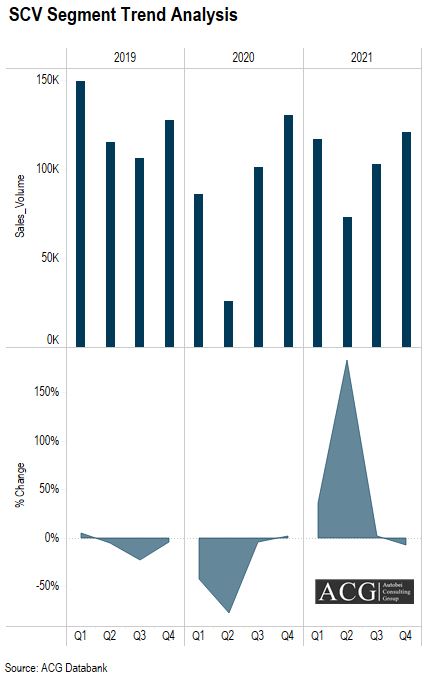
Indian Small Commercial Vehicle segment registered 20 percent growth in CY 2021 compared to CY 2020.

Indian Small Commercial vehicle Trend Analysis 2021

Lastly, we will conclude by taking a look at the performance of small commercial vehicles (SCV) during the post-pandemic period. Numbers suggest that this particular segment also had a good run during 2021 and overall growth of 20% was recorded.

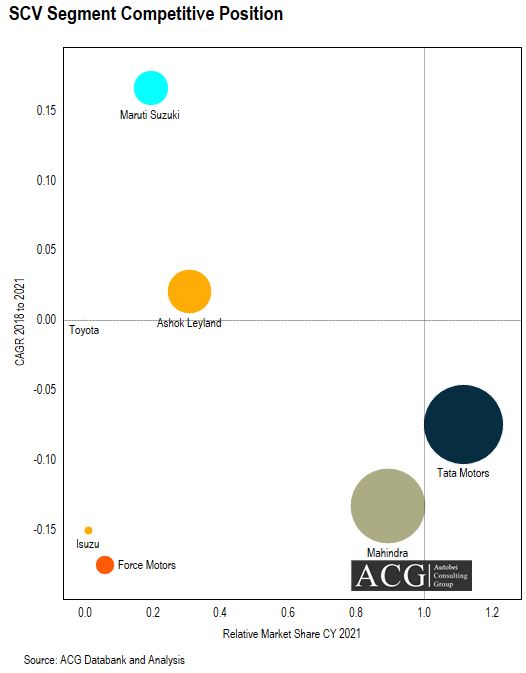
Indian Small Commercial vehicle competitive position Analysis

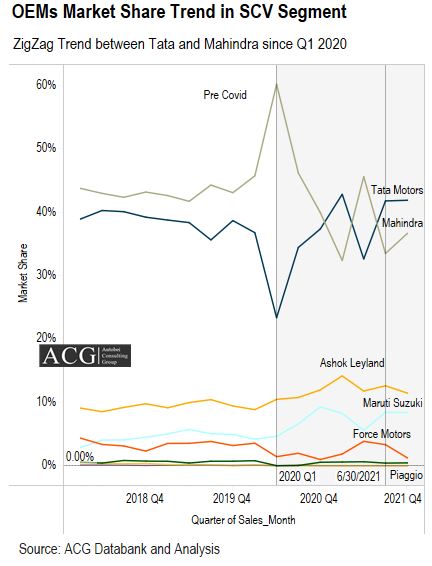
Tata continued to be an undisputed king of the market even for this segment with an unmatchable 40% share in the arena. It was then closely followed by Mahindra with almost 36.2% overall hold in the market.

Indian SCV segment share Trend 2021

Apart from these two prominent players in the segment, Ashok Leyland too tried to find its products feasible traction from the customers and they indeed were successful in stepping up by 3.3% by taking their market contribution to 12.5%. By observing all the growth trends in the Commercial vehicles we can formulate that the post-pandemic period did render an opportunity for the CV to rejuvenate themselves and establish their hold in the market.

To buy the full “Indian Commercial Vehicle Market Report 2022 and Outlook”, please contact us.

We have exclusive Indian CV Model-wise Export Data, please click here to get the detail.

ACG released the Global Dealer Database with key dealer information. The database covered Cars, Buses, and Trucks.

Following are the key details available:

  • Dealer Name
  • Name of OEMs dealership
  • Dealer address including City and State name
  • Dealer contact number
  • Dealer website
  • Dealer email id

The following Countries are included:

  • Brazil
  • Romania
  • Kazak
  • Nigeria
  • Kenya
  • Pakistan
  • Israel
  • Özbek
  • Serbia
  • Bulgaria
  • Turkey
  • Chile
  • Peru
  • Colombia
  • South Africa
  • Argentina
  • India
  • Germany
  • France
  • Italy
  • USA
  • Canada
  • Austria
  • GCC – Saudi Arabia, Kuwait, the United Arab Emirates, Qatar, Bahrain, and Oman

OEMs: Kia, Audi, Honda, Renault, Toyota, Citroen, Chery, Volvo Cars, BMW,
Subaru, Chevrolet, Nissan, Ford, Peugeot, Mercedes Benz, VW Group, Mitsubishi, Jaguar, Porsche, Chrysler, Maruti Suzuki, Toyota, Hyundai, MG Motor, Honda, GM, Haval, Nissan, SAIC, Great Wall, Skoda, Force Motors, Eicher, Foton, Scania, DAF, Geely, Alfa Romeo, FCA, Ferrari, Rolls Royce, Tata Motors, Mahindra, Rolls Royce, and others.

This exclusive database is useful for suppliers’ business strategy, Marketing, Branding companies, Research companies, OEMs, and other stakeholders.

Click here to check our other database.

The Indian Bus Pricing and Product Strategy report gives a key insight into the Indian Bus Industry. Our Model wise and City wise data help us to publish a sample report.

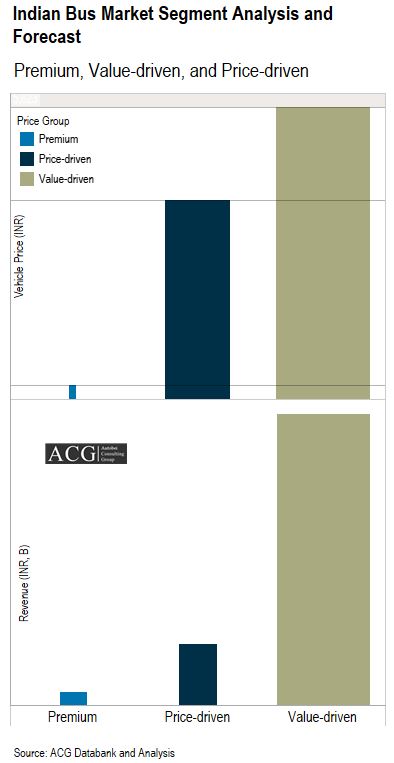
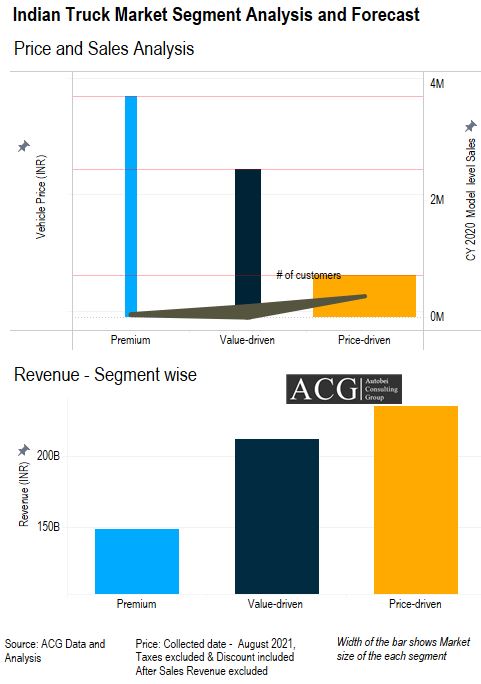
Like our Truck report, the value-driven segment is the largest in the Indian Bus Market in terms of volume. The forecast of Premium, Value-driven, and Price-driven is part of the full report.

ACG Tracking the price trend of the Indian Automotive Industry for more than 10 years. Our report highlighted the key events that influence bus prices in India.

Indian Bus Market Segment Analysis and Forecast

Model-wise Bus Sales Analysis:

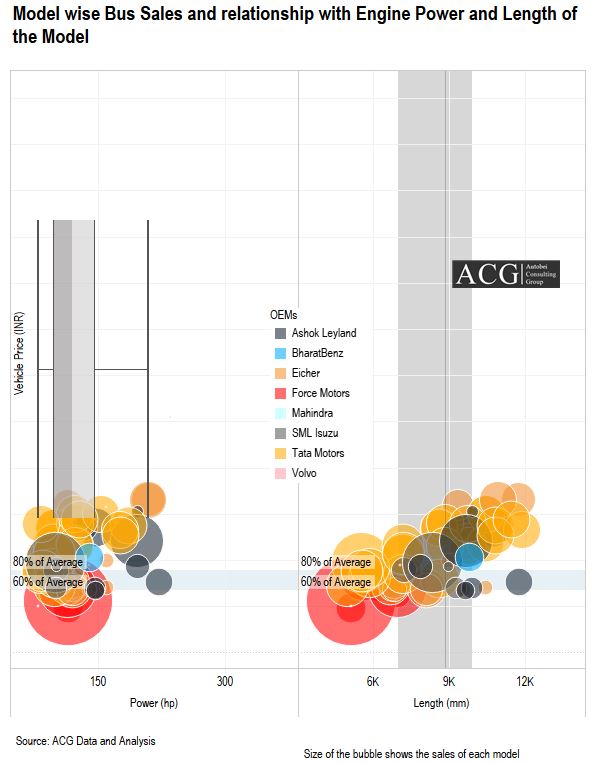
There is a close relationship between Price, Engine Power, Engine position,  Bus buyer’s profile, Brand perception, Application of the Bus, and 20 other specs and features.

Model wise Bus sales and relationship with Engine power and length of the bus

Model-level Bus Application mapping – Price Matrix:

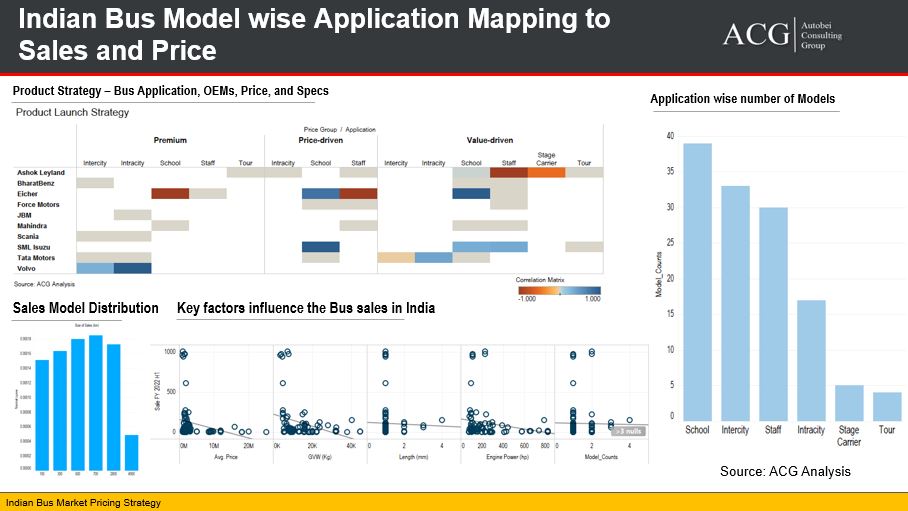
Many variables and parameters impact the OEM’s market share, Including Bus Sales, Product life cycle, Growth, Customer satisfaction, Profit, new players, and launching a new model.

Indian Bus Model wise mapping to its Application

Pricing Strategy of the Indian Bus Market:

The vehicle plays an essential role in the bus buying decision. ACG Analytics analyzed that if the price can be changed by 1 percent, there is a quantum impact on its revenue, profit, Market share, segment shift possibilities, and customer acquisition strategy. Pricing is also a key factor in Brand and quality perception of a newly launched vehicle.

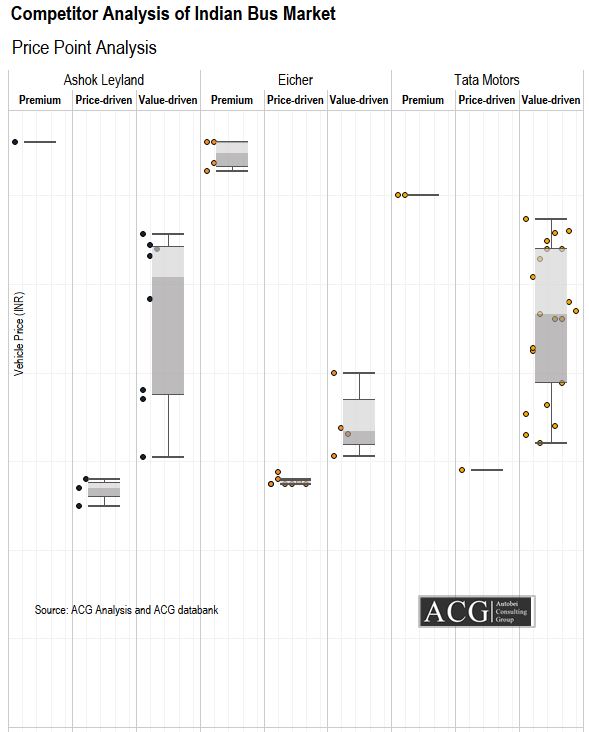
A detailed report provides an in-depth analysis of BharatBenz Bus, Tata Motors, Ashok Leyland, SML Isuzu, Mahindra, Force Motors, Volvo, and Scania.

Indian Bus Competitor Analysis and Pricing Analytics

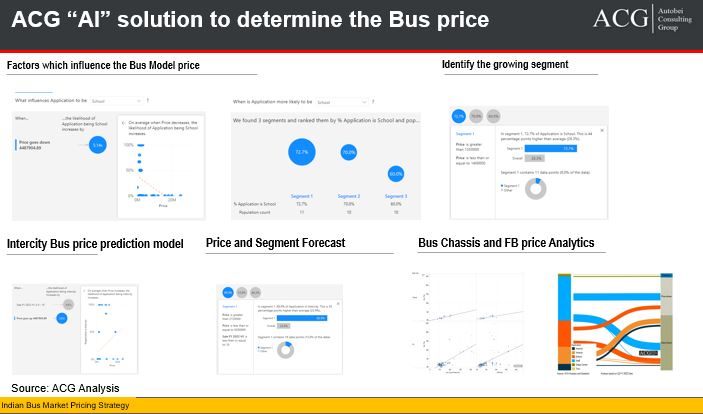
ACG developed unique pricing Artificial Intelligence model to determine the price based on more than 25 parameters including customer feedback and opinion:

ACG Artificial Indian Bus Price determine solution

Key highlights of the Report:

  • Current Indian Bus Market Overview
  • Indian Bus Market Forecast
  • More than 600 Bus sales Model and variants-wise analysis
  • Competitor Analysis of Indian Bus Market and Price Point Analysis]
  • Model, map the best suitable application, and what needs to be changed to increase the market share
  • Premium, Value-driven, and Price-driven segment analysis
  • Price optimization strategy
  • Front and Rear Engine Segment Analysis
  • Major Bus Operators Analysis and their plan to buy new vehicles
  • Bus Length Bus market Analysis – Largest and growing segment
  • Segment-wise Market forecast and growth analysis
  • Add value to the product for each Bus Application
  • Bus customer analytics of STU andthe  Private group
  • Case study of BharatBenz Bus


ACG has released an exclusive market analysis on Indian Truck Pricing and Product prediction.  We map different key parameters which play key roles to influence the purchase decision. The report included all Truck OEMs like Tata Motors, Ashok Leyland, BharatBenz, Eicher, Volvo, Scania, Mahindra, Force, and Piaggio.

Pricing is the function of understanding the customer value, value drivers differ for each segment, and differentiating product offering to maximize value for the segment and adjust the price accordingly.

We have included more than 800 Models-Variants for this special Indian Truck Market Pricing and Product Strategy study.

Truck Application is the major parameter to draw the value. There are 3 key segments in Indian Truck Industry – Price-driven, Value-driven, and Premium. The definition of each segment is specific for the Mini Truck, PickUp Truck, Light Duty Truck, Medium Duty Truck, and Heavy Duty Truck. Further segmentation of GVW based on body type Tipper, Rigid Haulage, and Tractor-Trailer give a key insight of pricing and product strategy of Indian Truck market.

Our Data Source: Model wise Indian Truck Sales and Production Data

Indian Truck market Price Revenue Sales Analysis and Forecast

This report gives and highlights the new Business opportunity by making slight changes in pricing. We use different tools and parameters for each segment to define the value of the Truck Model.

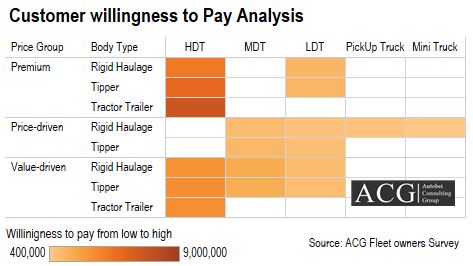
Customer willingness to pay for Truck:

Customer willingness to pay for buying Truck

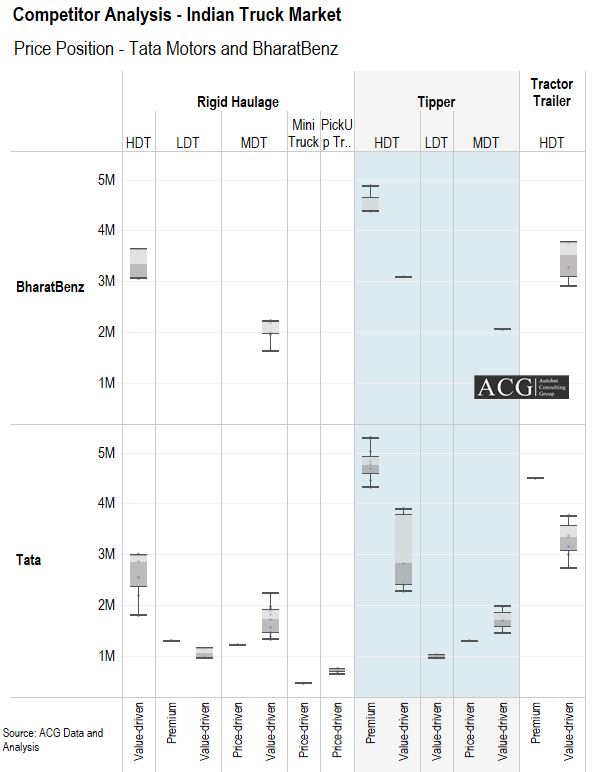
Indian Truck Market Competitor Position:

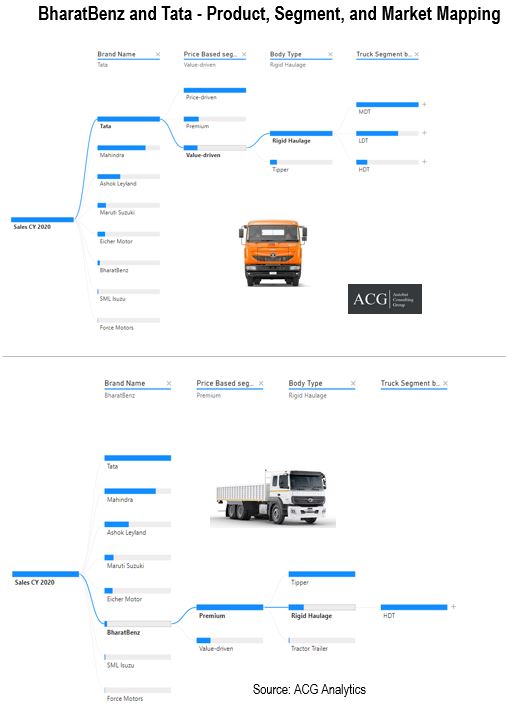
Our study showed that slight price adjustment can increase market share and revenue between 1 to 3 % compared to current price points. BharatBenz can use the Price fence strategy to get a new customer who loves the BharatBenz brand in their fleet.

Indian Truck Market Competitor Position

We included Single Truck owners, Small Fleet own, Medium Fleet owners, and large Fleet owners.

We have examined the competitor landscape of each segment. This report helps OEMs to become the leading player in a specific segment.

BharatBenz and Tata Motors Product_Segment and Market fit analysis

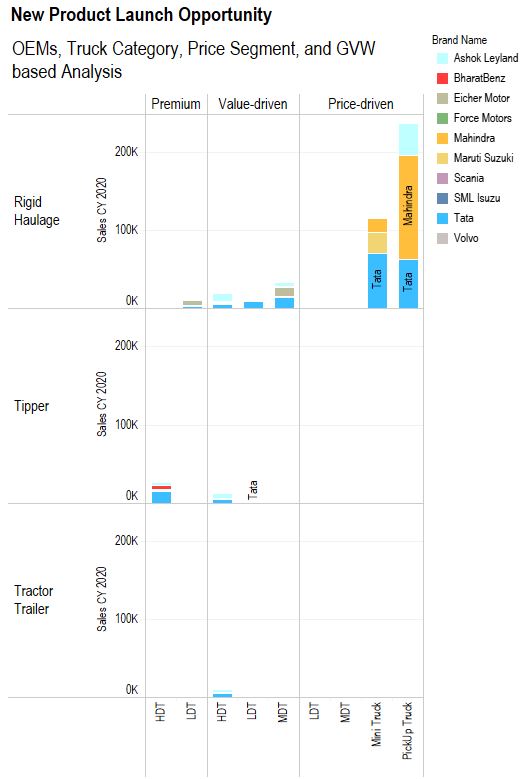
New Product launch Opportunity based on Product Life Cycle (PLC):

All OEMs is having a big opportunity to launch a new product range in the growing segment. ACG considered a special product matrix to assist companies to launch new products increase market share. Price Elasticity, Distribution of Competitive Price, Industry Structure, TCO, and other key factors.

New Truck launch Opportunity

Key Highlights of the Full Report:

  • Indian Truck Market and Price based market segment
  • Segment and Application wise Truck market pricing strategy analysis
  • Understand the Customer value to optimize the price
  • Price forecast
  • How to check price justification of your products
  • How to add value to your new product
  • How to optimize the price
  • Customer point of view on Truck price
  • What shall be the price of the new model?
  • Price position Analysis of Indian Truck Market

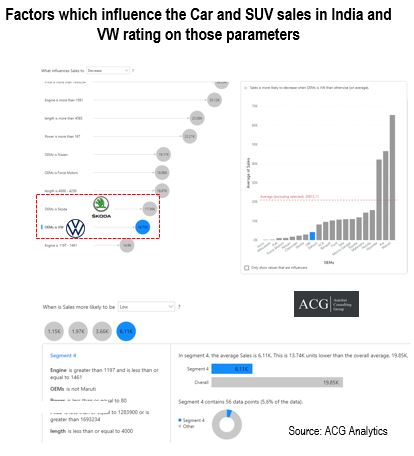
Volkswagen is one of the leading car manufacturers and dominates many major markets in Car and SUV segment. In the majority of markets, VW cars and SUVs are known for mass-market products.

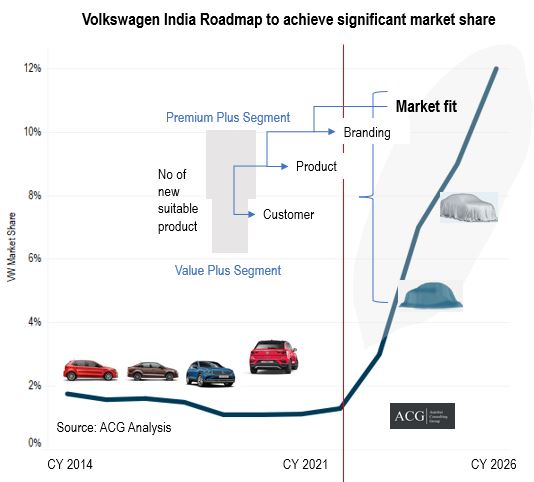
Volkswagen India roadmap to becoming the leading player in India:

Volkswagen India road map to become leading player in India

ACG is assisting OEMs, Automotive Suppliers, Dealers, EVs, and Financial institutes to write growth and success story in India, APAC, African, and the Middle East region. ACG Analytics has identified some major issues with VW strategy.

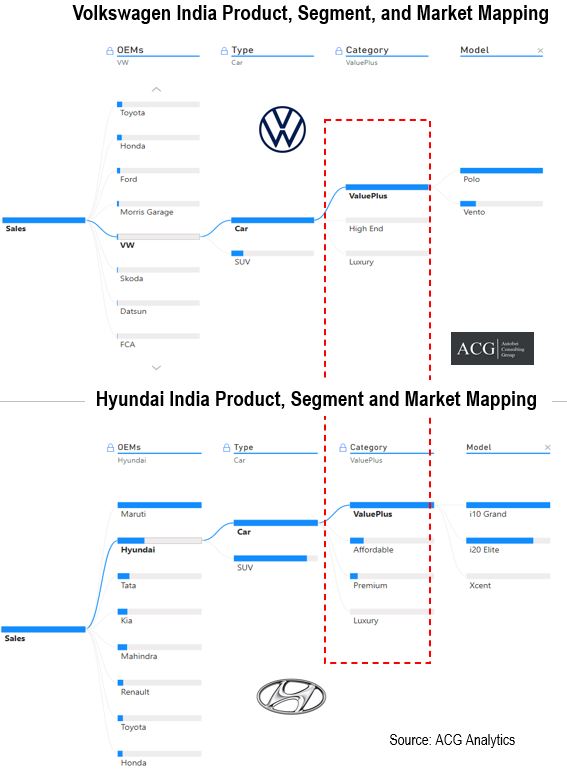
We diagnosis the VW issue from different angles and created the roadmap to be successful in Indian Car markets. Customers, Dealers, Product Analysis, and Competition analysis, and our recommendation are part of the study.

VW India Product and Market Mapping

Customer and Product Analytics to launch new products:

Our Product specs and Features matrix help OEMs to see the market fit and make it more appropriate to increase its sales and product acceptability. This is based on many key parameters like Price, Engine, Power, Customer & Product category.Volkswagen India Product Strategy and Segment Analysis

Key features of the Report:

  • Indian Car and SUV Market Assessment
  • The current status of VW
  • Volkswagen India Product acceptability and Position
  • VW roadmap to achieve significant market share in each segment
  • How to match its global product portfolio to fit into the Indian market
  • How to add value in VW product portfolio
  • VW target segment – their need and wants
  • VW growth plan for next 5 years
  • How to create milestones for the next 5 years
  • New definition to identify the closest competitor of VW on major parameters
  • The key challenge for Volkswagen India and Skoda
  • Opportunities for VW India
  • How to establish its foot in the Indian market
  • Dealer level Strategy
  • Brand and Product Review Strategy Analytics
  • VW After sales experience and expectations
  • Tata Motors, Honda, Hyundai, Maruti Suzuki, and Ford, Car, and SUV Case study

The High price of Electric vehicles is one of the key issues for buyers and OEMs. ACG has conducted a study on the Electric Vehicle Pricing Strategy frame which helps OEMs frame a product’s price with added value. This strategy helps OMEs to justify the EV price and convince potential buyers. This detailed report comes with a dynamic pricing metric that included a key variable to draw the price.

The report is based on 3 key points – What the customer wants, what is the cost, and competitors’ move.  We analyzed how these 3 components intersect and work together to determine the optimal EV pricing strategy. The report is available for Electric Car, Electric Truck, Electric Bus, Electric Three-Wheeler, and Electric Two-Wheeler.

The key features of the report:

  • Define the customer segment based on EV price and value
  • 3 lenses pricing strategy
  • What are the important price variables – Brand perception, Quality, Charging infra, Charging time, Demand, Uniqueness, Competition, Market,  Customer’s  perspective of value, Scarcity,  and Availability
  • How to do pricing economy calculation
  • What is the Product value Drivers, and Non- Product value drivers
  • How to measure the customer willingness to pay with multiple options
  • Relation between price influencers and price variables – Matrix
  • How EV buyers perceive price and value for money
  • What will customers be ready to pay more for?
  • Choosing a different pricing model for your target segment and price discrimination
  • How the value drivers differ by the customer segment
  • EV OEMs need to differentiate their product and service offering to maximize value for your target customer segment and price accordingly
  • Determining your price elasticity
  • Justifying higher prices in a competitive market
  • Find the Ways to add value that boosts margins, not costs
  • Online Vs Channel sales partner (Dealers) and advantages
  • How to apply customer surplus to your business model
  • The new definition of the Customer value equation applicable to the EV segment – Technical, Functional, and Emotional
  • Draw the Price fences and how it works
  • Case Study: How Chinese EV OEMs are targeting customer segments in Europe

The report is available for India, Europe, and the USA

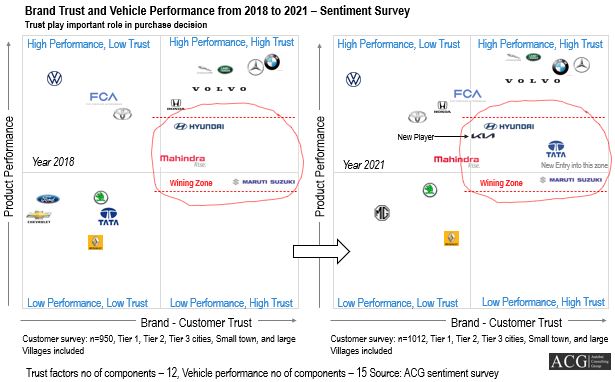
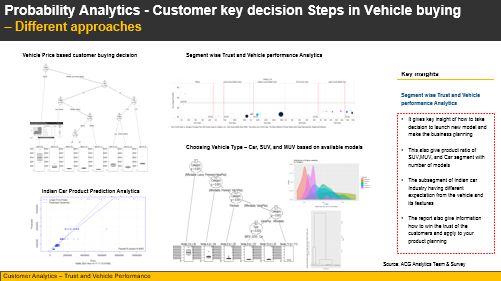
ACG has released the latest study on Indian Car buying Customer Mind Mapping Analytics on the customer buying decision. Several factors have been considered for Product performance and Customer trust. Both factors impact the decision tree of customers. This Analytic report gives the answer “Why only selected Car brands are successful in India and how struggling and potential new OEMs can be successful in Indian Car and SUV market.”

Indian Car and SUV Customer Mind mapping Analytics

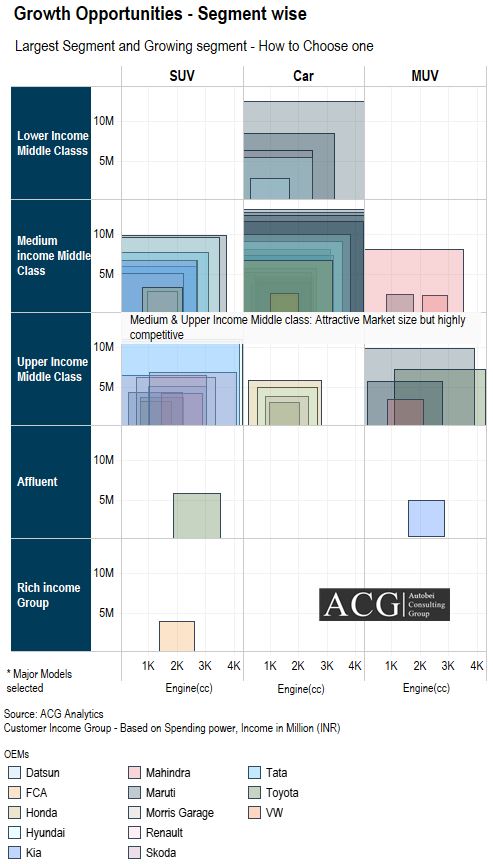
ACG defined the Indian Car segment in five categories:

  • Lower Income Middle Class,
  • Medium Income Middle Class,
  • Upper Income Middle Class,
  • Affluent, and
  • Rich income Group

Every segment is having own definition of Product performance and Trust factor.

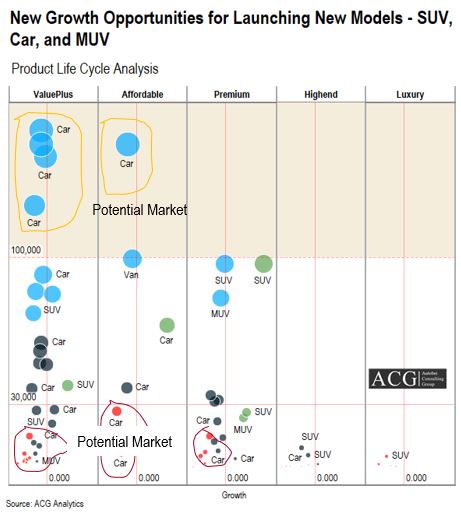
Identify new market segment for launching new Models of Carm SUV and MUV:Indian Car Product life cycle and New model launches strategy

Indian Car OEMs growth opportunities Analysis

Product Analytics, Sub segment-wise Vehicle Customer decision probability Analytics based on various major factors:

Indian Car Purchase decision analysis based on trust and car performance Probability Analysis

The key insights of the report:

  • Definition of the Customer sub-segment
  • Critical Market and Product analysis of Indian Car and SUV Industry
  • How to measure the trust  and vehicle performance to win get the customers
  • The winning spot in the matrix of Brand Trust and product attributes
  • How to Check and review your product and brand position
  • How to move your brand and product to the winning zone of the Industry
  • New Product launching Strategy to be in a winner and profitable zone
  • Get the critical decision point and insert your product to influence the buying decision
  • How customers think before buying a vehicle in India
  • Individual OEMs wise buying decision flow based on available models and customer perception – Tata Motors, Maruti Suzuki, Hyundai, Renault, Mercedes Benz, BMW, Audi, Volkswagen, Skoda, Mahindra, Kia, MG Motor, Honda, Toyota, FCA, Volvo, Citroen
  • Case study of Ford, Chevrolet, VW, Mahindra, Hyundai, and Maruti Suzuki


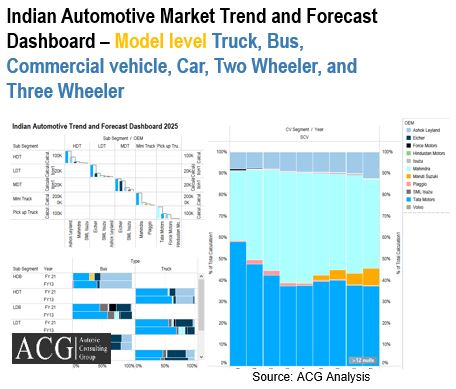
ACG released the latest forecast on Indian Automotive Market 2025. The forecast will be reviewed every month to align with the latest market dynamics. This gives a more appropriate future picture for the Indian Automotive Industry.

Indian Automotive market Forecast 2025

The forecast report is available in a form of a report, Data in Excel, and Dynamic Dashboard.

Following are the key highlights of the forecast:

  • Segment – Commercial Vehicle, Truck, Bus, Passenger Vehicle (Car, SUV, and MUV), Two Wheeler (Scooter and Motorcycle), and Three Wheeler
  • Sales, and Production Forecast Quarter-wise
  • Segment, OEMs, and Model wise Forecast
  • Price Prediction
  • Technology Outlook
  • GDP Forecast, Macro Economy indicators forecast and their impact on Indian Auto Industry

Two options are available – One-time purchase and Quarterwise subscription

The subscription is useful for Product planning, Sales Strategy, Dealer Network, Inventory management, Competitor analysis, Investment decision, and overall business growth

It is useful for OEMs, Suppliers, Financial Institutes, Market Research companies, and other stakeholders.

Indian Commercial Vehicle Model and City Level Truck & Bus Data Forecast 2029. More than 150 Truck and Bus Models and Variants from 1.5T plus GVW to more than 55T GVW are included in this database. The city-wise and Model-wise data help Aftermarket Suppliers and Service providers to target revenue targets, Market Trends, Key Truck and Bus Market size, City-level Market Share, and segment Growth Analysis. It covers 80 to 85% of the total Indian Truck and Bus  Industry volume.

Data Trend and Forecast Year: 2009 to 2029

Commercial Vehicle Segment has been included:

  • Small Commercial Vehicle
  • Light Commercial Vehicle
  • Medium Commercial Vehicle
  • Heavy Commercial Vehicle

This Database plays a key role in creating Electric Truck and Electric Bus product planning and charging infrastructure.

OEMs Included:

  • Tata Motors
  • Ashok Leyland
  • BharatBenz
  • Volvo
  • Scania
  • Eicher
  • Force Motor
  • Mahindra

The following are the key highlights of the database:

Indian Truck Data points included:

  • Types of Trucks with Application-
    • Rigid Haulage
    • Tipper
    • Tractor Trailer, and
    • Special Application
  • Top Cities Markets
  • Average per day vehicle run
  • Application
  • Type of Customers
  • Cities/States
  • Vehicle Price
  • GVW GVW (2T to 55T plus)
  • Payload
  • Wheel Base
  • Fuel Type

Indian Bus Data points included:

  • Types of Buses based on Application
  • Brand (OEM) Name
  • Model Name
  • Bus Type (Length & GVW wise)
  • Bus Applications like School, Staff, Tourist, Intercity, etc
  • Duty Cycle
  • Major Hub/Cities
  • Engine Type (Rear/Front)
  • Floor Height
  • Seat Type
  • Price
  • AC/Non AC

The Data is Useful for:

  • Sales Planning
  • Electric Vehicle Commercial Vehicle Product Strategy
  • OEM Business Planning
  • Dealership/Service station expansion strategy
  • Branch Office opening
  • Man Power planning
  • Product Planning
  • Marketing and Advertising Strategy
  • Product launch strategy

Customize data option is also available based on the requirement

Flexible Car Subscription Business Model Strategy can help to win the market share in the short and long term. As per ACG’s latest survey and business cases, many customers are interested to take the car on a monthly subscription but the current options are not feasible for them.  The subscription model must be an economical, hassle-free model for customers, and Profitable for OEMs, Service providers. ACG help to redesign the Vehicle Subscription model to win the market. The OEMs and other services providers need to make changes in their offering. There are three main components of the Subscription model – What are the contract terms, Price, Customer requirement, and Feasibility 

The business models are divided into 2 main categories:

  • Electric Vehicle, and
  • ICE vehicle

In Our report, the following key points are included:

  • The Global Car Subscription market assessment – Developed and Emerging countries including Germany, Austria, France, UK, USA, China, India, and other key markets
  • How it can help to add new customers?
  • How to do segmentation, and offer the best option among the several ones?
  • How does it create the base with customer engagement, understand the customer needs, Customer delight, and give new opportunities for future business?
  • How to develop a new revenue stream by introducing a vehicle subscription model?
  • What does the winning Vehicle subscription model look like for short, medium, and Long term duration?
  • Real-time business case with customers feedback
  • Customer need and wants to get Subscription services
  • What are the customer’s vehicle preferences for different kinds of needs?
  • How to market and sell the subscription models?
  • Key challenges to make it successful and popular
  • Branding Strategy of the vehicle Subscription model and creating the perception
  • How to implement the entire project and its key components


The Indian Electric Bus market is expected to touch a $98.9 million value in 2022, and it is expected to grow at a CAGR of 59.1% during the forecast period (2022–2030).

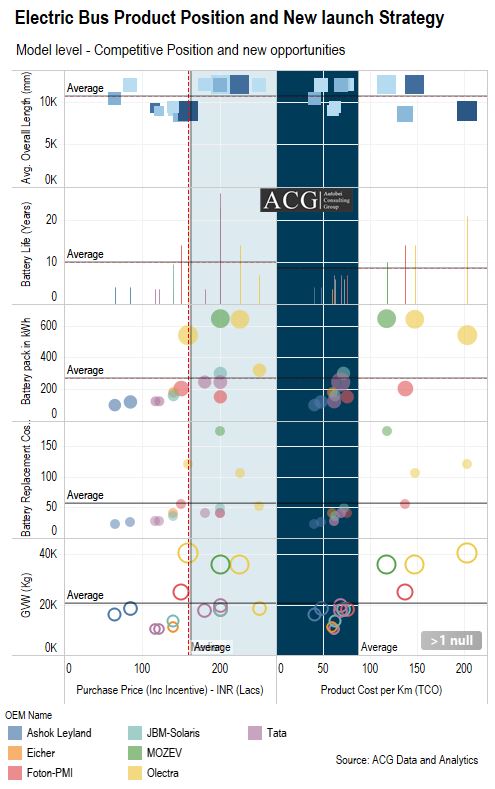
The key market drivers of increasing demand for Electric Buses are Zero Emission commitment, Government initiative (State and Central), Entering New players in the manufacturing of Electric Bus, Buyers confidence, the feasibility of E Bus, Government subsidy, Battery price, Better range, Low Operating cost, Pleasant Journey experience, local manufacturing and have a better ecosystem.Indian Electric Bus TCO Product Analytics and Strategy

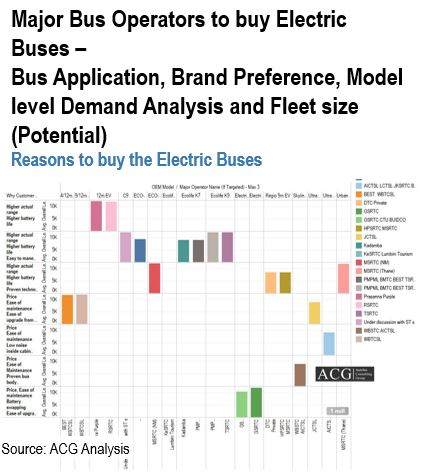
Electric Bus Demand Analysis – Major Bus Operators (Potential Buyers), OEMs, Model-level:Electric Bus Market Analysis and Forecast

The Key Highlights of the report:

  • Electric Bus (BEV & FCEV) Market Overview in India
  • Application wise Electric Bus “Market Fit Analysis” – IntraCity Transport, Special Application – Airport, Defence, Staff Transport, and others
  • The market size of Electric Buses based on: length less than 9m, 9 to 11m, and more than 11m
  • Model wise Electric Bus Sales in India, Product Specification, and Applications of the vehicle
  • Model-level TCO value of Electric Bus
  • Key & Major pocket for Electric Buses in India and their market size
  • Model wise Price Point analysis before and after subsidy
  • Major potential and existing buyers of Electric Buses
  • Statewise Electric Vehicle Policies Analysis and their impact on sales volume
  • Major cities suitable for Electric Buses
  • Hidden Market opportunities for OEMs and Suppliers in E Bus
  • Customer Analytics: The key reason to buy the Electric Bus, Challenges, and Problems (based on Actual feedback)
  • Benchmarking Analysis
  • Electric Bus Tender floating and requirements
  • Upcoming New model launches
  • OEMs covered – Tata Motors, Ashok Leyland, Olectra,  JBM, Eicher Motors, and other new players
  • Electric Bus Cost Analysis
  • Charging Infrastructure for E Buses in India