The Electric Three-Wheeler segment is the most popular and accepted electric vehicle segment in India.  In 2020, the Indian e-rickshaw segment has been impacted due to the recent COVID – 19 pandemic. ACG is expecting a CAGR of 20% register between 2020 to 2025.

By 2025, it is predicted that around 65% of all passenger three-wheeler vehicles and 10% of all three-wheeler carrying goods will be electric. The penetration of the 3-Wheeler electric vehicle segment is equally deep in Tiers I, II, III as well as in small towns. The market share is not impacted by brand names and this allows for local manufacturers to have a stronger hold over the market. In the three-wheeler segment especially, brand name does not play that important role in the buying process. There are exceptional growth opportunities in this segment for existing as well as new players.

The consumer base for this segment mostly comprises the low-income and less educated category. This is in direct contradiction when compared to the Electric Two-Wheeler and Electric Car owners. The reason why the three-wheeler segment enjoys such a tremendous market share is due to the low manufacturing costs of the vehicle. This is achieved largely due to the low maintenance cost and running cost of the vehicle. The electric three-wheelers can run for almost 12 hours daily. When compared to the traditional three-wheeler, the electric alternative expends much less noise, almost none at all. This, in turn, ensures a much more comfortable rickshaw experience for the driver as well as the passenger, which oftentimes tends to get extremely loud.

One of the major issues faced by this segment is the acceptance of the electric alternative. In our entry strategy projects of Electric Two-Wheeler and Electric car, the infrastructure of battery charging points and the initial price of the vehicle were found to be the key issues for buyers. Many manufacturers prefer to lower their costs by utilizing acid lead batteries. Though it may seem like a cost-cutting solution at first, the lithium-ion battery alternative is much more ecologically sustainable and long-lasting. Though the initial cost of the electric alternative is higher than its ICE (Internal Combustion Engine) counterpart, in the long run, the electric option reaps more profit and benefit for the consumer.

A study has shown that in terms of environmental sustainability, comfort as well as profit, the Electric Three-Wheeler performed much better than the ICE vehicle. In this research, we have compiled a report which includes demand analysis, supply and policy growth drivers for EVs such as battery costs, government subsidy and charging infrastructure, besides conducting a segment-wise analysis of the cost of acquisition and operation of EVs compared with existing internal combustion engine (ICE) vehicles.

New Opportunities in India’s Electric Three-Wheeler Market Report Highlights:

  • The market size – By volume unit and in Value
  • Vehicle volume by Li-ion & Lead Acid
  • Key players, Product portfolio, Products specs, and Price
  • Customer profile and customer complaints and pain points
  • Customer acceptance ratio between Brand and local manufacturer
  • TCO Analysis
  • Key Drivers of Industry
  • Organize players (OEM – Mahindra, Lohia) and unorganized players Market share
  • Govt incentive schemes and FAME II description
  • Purchase Analysis and buying process
  • Market Attractiveness Analysis
  • Application wise – Passenger Vehicle, Goods Transportation, and Last-mile transportation
  • Product position, and GAP Analysis
  • Li-ion and Acid battery average price range
  • Battery type of sales, Battery life analysis, Performance, and Warranty period
  • 3 Wheeler vehicle ICE to Electric Vehicle migration expected rate in the next 5 years
  • SWOT Analysis
  • Competitive Analysis
  • Industry Challenges and Risk
  • Macro-Economic Analysis After COVID 19

Lately, the Indian Truck industry has made measurable changes in GVW, rated payloads, regulations, Driveline up-gradations, embracing new technologies, and launched a new product series of Rigid Haulage, Tractor-trailer, and Tipper.

Our new report disclosed all variations and their impact on Indian Truck Industry. For which, we analyzed more than 300 truck models from 2008 and their sales pattern, specifications and features, Product application, Product position by mapping them with customer needs, and future trends. The report shall give you an insight into the complete MAN truck strategy in India and what lessons can be acquired from them.

In the early days of 2020, more than 250 models were available in Indian Truck Industry compared to FY 2013 where only 200 models existed. In every segment, there are many sub-segments and many varied technical parameters. Tata Motors has maximum Truck models and variants to satisfy customer requirements of small, medium, and large fleet truck owners and existing buyers.

Tracing the Indian truck market for over 15 years, we’ve noticed that the market is declining by 31% in FY 2020. Regrettably, the market declined after steady growth during FY 2015 and FY 2019, and thus, the market size was 6,32,062 units in FY2020. This is due to the fact that weaker demand in the second half of the FY 2019 drove a liquidity crunch. Though there was a hope that in FY 2021 Indian truck market might revive, COVID 19 has wrecked it. Thus, the waiting period for revival seems to last longer than one could expect. Indeed, the Indian truck industry began showing progress in Q4 FY 2020; but now, there will be a deep decline in the first quarter of FY 2021.

Tata Motors had an influential market share of around 43% and only major OEMs lost their 17% share between FY 2012 to FY 2020. Mahindra and Ashok Leyland are the second and third largest players with 31% and 15% respectively in the Indian Truck Industry and Eicher remained in the fourth position with a 5% market share.

The heavy-Duty truck segment’s share declined by 3%, Mini Truck by 7%; having said that, Pick up segment’s share increased by 10% during FY 2012 and FY 2010. The CAGR of HD Truck segment was 24%, LDT – 0.3%, MDT 2%, Mini Truck -1%, and Pickup segment and truck industry registered a 4% growth between FY 2012 to FY 2019; but, the CAGR between FY 2012 and FY 2020 in HDT segment was -7%, LDT -4%, -3%, Mini Truck -4%, Pick up 10% and Truck Industry registered -1%.

ACG has categorized the fleet owners in India into five viz, Single Fleet Owner, Small Fleet Owner, Medium Fleet Owner, Large Fleet Owner, and Very large or Corporate fleet owners. Every fleet owner has got their own hindrances and challenges. This detailed report will unveil the facts and predictions on how COVID 19 will impact each fleet owner.

After COVID 19, it will take time to generate sales inquiries, replacement demands from Small, Medium, and Large fleet owners for both the haulage and the Tipper segment will be high, and the infrastructure investments will be hindered for the time being. The prime challenge after COVID19 might be the dealership viability and OEM profitability.

The possibility of picking the demand of the Tipper segment is relatively less; let’s say for the next 2 to 3 months Tipper demand can increase beyond Q3 FY 2021.

Obtaining Investment to buy trucks plays an important role in converting sales inquiry into actual sales. Most of the OEMs like Tata Motors, BharatBenz, Ashok Leyland had signed the strategic financing agreement with banks and NBFCs.

The IMD had announced that the 2020 season follows an unexpected super bumper monsoon of the previous year and that delivered rainfall of 110 percent above the long-period average (LPA). Thus, the retail segment demand is relatively slow compared to corporate and large fleet owners.

Tata Motors has generously launched Saarthi Aaram Kendra for truck drivers to connect with truck drivers. A few other independent non-Automotive companies also took this initiative to serve such assistance for truck drivers on the highway. It offers amenities like a driver rest area, canteen/Dhaba, clean washrooms, vehicle servicing facility, secured parking, and driver training room, and much more.

Likewise, Ashok Leyland took a similar kind of initiative with Apollo Tyre to set a healthcare facility for drivers. It began with the largest Tractor Trailer Hub in Namakkal. The company had already established 31 such centers.

Competitor Landscape: Heavy Duty Truck:

Among Heavy Duty Truck Segments, Tata Motors lost a 9% market share during FY 2012 and FY 2020; but, since FY 2018, the company is gaining its market share year on year. Tata Motors’ sales volume declined by 50% in the last 9 years. Its closest competitor Ashok Leyland gained an 8% market share but it lost a 4% market share in the last 3 years. Eicher launched a new product range in the Heavy Duty Truck (HDT) segment to capture a decent market share in this segment. Eicher JV with Volvo also helped to gain market share in the HDT segment by providing Engine technology. Mahindra and Eicher took 9 years to increase market share in the HDT segment.

Tractor Trailer (TT) :

One of the most impacted segments during FY 2019 and FY 2020 is undoubtedly the tractor-trailer. The Tractor Trailer market declined by 60% in a single year.

Ashok Leyland doubled its market share from FY 2012 to FY 2020. Tata Motors lost half of its market share in the same period. Mahindra and Eicher also increased by 2%. There are 5 sub-segments in the TT and our detailed report provides an analysis of all 5 sub-segments of the same.

Medium-Duty Truck (MDT) Segment:

This segment isn’t any exception for Tata Motors. It lost nearly 7% of its market share in the last 9 years. Eicher is the leading player in this segment with a 34% market share. Ashok Leyland’s performance is the best, for it has increased its market share double the time it registered between FY 2012 to FY 2020. Also, Mahindra launched its new product range in this segment during 2018.

Light Duty Truck (LDT) segment:

In FY 2012, Tata Motors managed to hold a 70% market share; but in FY 2020, it lost 15% of its market share. Eicher’s product suitability and position have helped them in raising their market share by 12% from FY 2012 to FY 2020. Ashok Leyland started to target this segment in FY 2014 and it reached a 5% market share in this segment. Mahindra became a weak player in this segment due to the unavailability of the product range.

Pickup Truck Segment:

The pickup truck segment is the fastest-growing sub-segment of the Indian Truck Industry. The CAGR of this segment is 10% during FY 2012 and FY 2020. Mahindra is a market leader and so their sales are triple the times the second largest player. However, Mahindra had more than 60% of its market share in the last 9 years and meanwhile, Ashok Leyland overhauled Tata Motors in FY 2020.

Mini Truck Segment:

Mini Truck remained as the largest sub-segment. Tata Motors, being the leader of this segment, lost a 7% market share in the last 9 years. Meanwhile, Maruti turned out to be a prominent player in this segment after launching the product in FY 2017. In just 4 years it gained a 12% market share.

Product Strategy and Product Portfolio:

Tata Motors have launched the Ultra T.7 Electric truck Intra; Ultra, and updated Prima product range are the new product portfolio of Tata Motors that shall be grouped under light and heavy truck segment.

These new carriers come with a unique style & look with mild robustness and toughness. Also, they have launched the petrol version of its flagship model of TATA ACE Gold enabling us to compete with Maruti Suzuki carry. All 3 product ranges are considered a bit premium compared to that of the LPT product series.

Mahindra Truck & Bus has launched a new Model -BLAZO X 49 that has a long haulage USP and gives better mileage. FURIO (BS-VI) is yet another product range for 5 to 18T GVW segment with multiple variants planned to be launched in the coming months. They recently entered this segment and have an effective presence in Mumbai, Delhi, Gujarat, Rajasthan, West Bengal, Himachal Pradesh, Jammu and Kashmir, and in the NorthEast region.

The company’s product strategy is to minimize the changes between BS-IV and BS-VI trucks to keep it light among after-sales service. However, at the Mahindra dealership, the workers need better training facilities for BS-VI compliant trucks.

Furthermore, Mahindra is also extending its service touchpoints on highways after successfully creating multiple touchpoints on the busiest Mumbai-Delhi highway which catered nearly 35% of the truck movement in India.

Eicher launched the new truck range in LMD space, with a new Pro 2000 series along with Eicher Live telematics solution for the business owners to manage trips, fuel, and uptime of a range of vehicles.

Eicher launched two heavy truck models as well viz, Eicher Pro 6049, and Eicher 6049 in the HDT segment during 2018. Those trucks possess Volvo Group Engine Management System EMS 3.0 for better fuel efficiency. Nevertheless, to generate 180 to 350 HP, the 5 and 8-liter engines require more power ranging.

BharatBenz has launched 52 variants in 2018 and is planning to launch 42 new models with variants. The OM926 is a widely adopted engine among the Truck segment. Their maintenance cost is relatively less and that depends purely on the type of Model, Application, and driver. However, BharatBenz is focusing on giving better product support to its customers by increasing 27% touchpoints by the end of 2020.

During those times when European OEMs entered Indian Truck foray, they positioned trucks with 28% and 56% better horsepower and 5 to 20% more price range. Later, the Indian market OEMs like BharatBenz and MAN trucks modified their product portfolio, Segment entry, and pricing strategy.

However, in the current portfolio, Indian OEMs have an equivalent product range with similar specs and features. Now, most of the Trucks in the HDT segment are about 200HP and more.

Our detailed report provides an in-depth analysis of each product for every segment like, “what are the advantages of Customers and OEMs?” for which we included Transmission of Eaton, ZF, Allison, and in-house product of Mercedes, FUSO, Cummins engine and Axle of Meritor and Dana.

Meanwhile, among the Mini Truck segment, Maruti, Tata Motors, and Mahindra positioned their product in a different product zone with few overlaps. Super carry, Mahindra Supro, and Tata ACE are some leading mini Trucks in this segment. Under the Pick-up segment, Isuzu seems to have maximum power and torque compared to its competitors like Ashok Leyland DOST, and Bolero.

Under the LDT segment, Eicher Motor has a wide range of products like PRO 2050, 2059, SML Isuzu with Sartaj series, the leading product of Tata Motors LPT, SFC 709, and Tata Ultra series. The segment also has got some CNG fuel option products. However, under the MDT segment, Tata LPT, LPK, & Tata Ultra and Ashok Leyland BOSS, Ecomet has a good mix of product ranges that embrace wide trucks applications, and other features. Indeed, Mahindra Truck entered this segment along with Furio with an average price of 17.8 lacs in Jan 2019 with the AMC option.

Indian HDT Truck market is dominating the industry by 180hp engines with 6X2, 6X4, and 8X2 axle configurations among Tipper and Rigid Haulage segments. When the 31T segment picked up, Rigid Haulage with 8X2 (along with lift axle) and Tipper with 8X4 axle arrangement dropped. However, now the mixed product portfolio is available for different Truck applications with 10X2 and 10X4 axle drives. Besides, the Telematic solution of major OEMs offers both the Medium and Heavy-Duty truck ranges. Nevertheless, these features are used majorly by medium and large truck fleet owners to track the drivers.

Under the HDT Rigid Haulage segment, Eicher launched a new product range with an AMT option also to increase their market share. But, Tata Motors has set its footprint already – Prima truck has a premium position in this segment. BharatBenz also has 2823R, 1415RE, 1617, and 3523R product portfolios. There are a few products with lift axles in the higher tonnage division. Our detailed report provides a “model to model competitive analysis and position”. Ecomet, BOSS, LPT, BLAZO X, Eicher PRO series, Tata Prima and Signa are some influential product platforms. Lately, the HD Tipper product range got upgraded by Tata Motors, Eicher, Ashok Leyland, and BharatBenz. Available Tipper range is anywhere between 200hp and 400hp.

Being the leading player of the premium HD truck segment, Volvo Tipper controls maximum market share in mining applications for its eminent performance and after-sales support. More than 55 products are available in this segment. Also, Box tipper, Rock body, hard rock body models are available in this segment for On-road and off-road applications.

Initially, Tata Motors launched its Prima Tipper with 380 hp (with Allison Automatic Transmission) to top the Premium Tipper segment. But now, the whole prime range is optimized – the HD segment has a maximum share in the tipper segment with more than 16T GVW. Its purchase criteria are different from the Rigid Haulage and Tractor-Trailer segment. Once, MAN launched their major products in the combination of 220 and 280hp – 4X2, 6X4, 6X2, 8X4 drive in Tipper, and Tractor-Trailer/ODC.

Ashok Leyland launched a BS-VI compliance product range with a combination of proven iEGR technology and an SCR system. Eicher Trucks also launched a new product range with BS-VI emission norms. The company is adopting EATS technology and SCR solution.

Tractor-Trailer Applications and Product Portfolio:

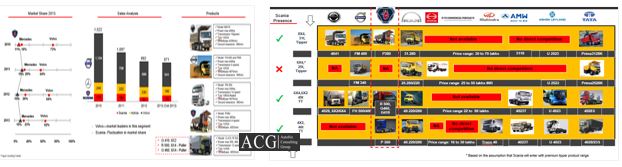
It’s primarily for long-distance, bulk, and heavy transportation goods. Driving comfort, Cabin Space, Mileage, Telematics, and highway product support together define the success of this segment. Also, Tata Motors has a maximum product range in Signa and Prima product series. Eicher PRO 6055, BharatBenz 5028TT, Ashok Leyland 4620, BLAZO 46/50/55, Volvo FM, and Scania G series are some product series models in this segment.

Truck Pricing Analysis:

We are tracking Model wise pricing trends in the Indian Commercial vehicle market from 2008. ACG has analyzed more than 10,000 truck variants from FY 2011. A few quick points- In 1976 Tata Motors truck was 47,000 INR; the Tractor segments’ average price registered 12% to 25% during 2011 and 2019.

The price of Rigid Haulage, Tipper, and Special Application Truck increased by 30% depending on the Model and Brand. The price changes among Mini Truck models are increased by 12% to 20% in the last 6 years. A similar price trend has been recorded in Pick up, LDT, Tipper, Tractor Trailer, 16.2T, 28T, 37T, 40.2T, 49T, 50T, and 55T GVW segments.

Customer segment:

ACG defined 5 customer segments in the Indian Truck Industry. Each segment belongs to a specific Truck price, specs, and features requirement. The new European players focused on large fleet owners of the South and West regions. One of the key challenges BharatBenz faces is “discounts”. When medium and large fleet owners decide to buy more than 10 trucks, discounts will make a big impact on the final price of the trucks.

Indian Truck Market and Product Analysis report Highlights:

  • Indian Truck Market Size in Volume and Value before and after discount
  • Growth Opportunity in the Indian Truck Market
  • Entry Strategy into Indian Truck Market
  • Critical Truck Model wise Analysis
  • Each segment-wise price, growth, market size, OEM market share, Trend, Forecast, and major product presence
  • Fleet owners mapping with Type of Truck models
  • Product grid analysis
  • Truck Application wise analysis
  • Model wise Price trend analysis
  • OEM Strategy Analysis and Target customer
  • The customer buying process and key parameters

Please contact us to get the TOC of the report and Price.

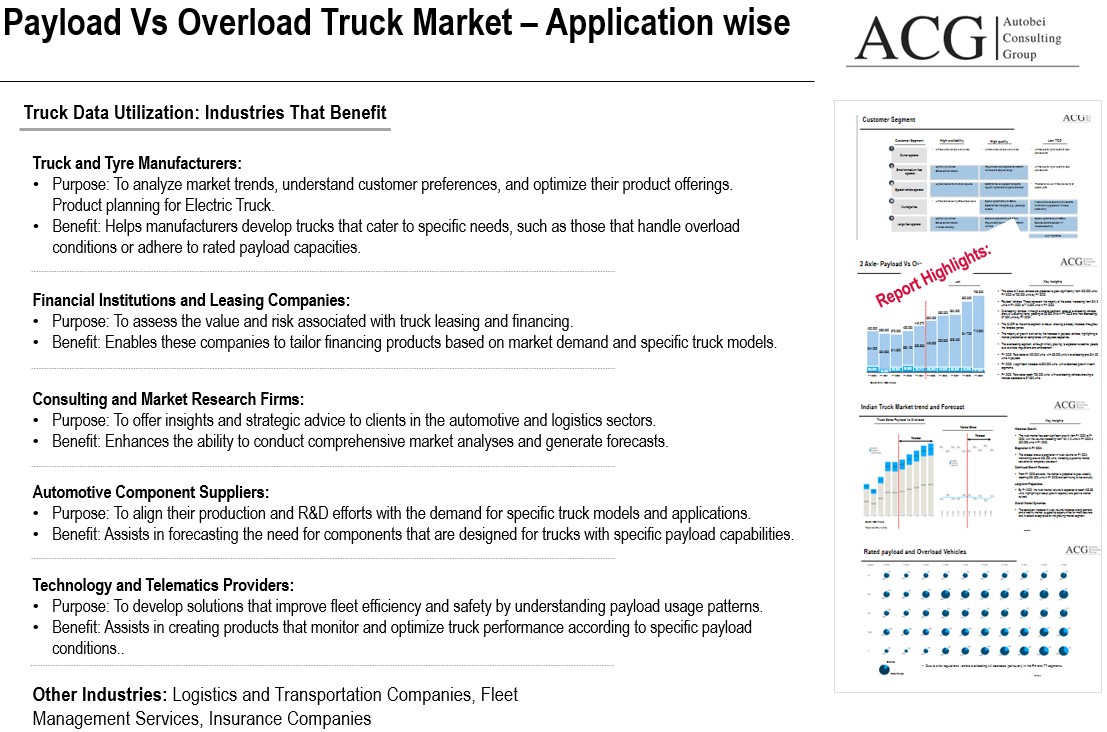
Truck Application is the backbone of product Strategy. The right combination of Truck application, features, Specs, and price will play the most important role in a purchase decision. Design, Introduce, and launch Trucks based application decides its success in the market. Customers choose the truck based on their nature of business and the application of the truck.

Indian Truck overloading and rated payload model wise sales data and forecast


Our latest Market study included the following information:

  • Application-wise Truck  Market Structure
  • Overload vs. rated payload Application-wise Sales Volume
  • Sales Volume Trend – FY 2020 to FY 2024 and Forecast FY 2025 to FY 2030
  • Truck Application wise Market share, and (de)Growth
  • brand and Model-wise market leader mapping with Truck Application
  • Indian Truck Market size based on Application – On road, Off-highway. and Special Application
  • Major Truck Application
  • Model and market share of each Truck application
  • Mapping the most popular and suitable Truck models to the Truck usage/Application
  • State-level major Truck Application
  • Customer experience and perception of major Truck Applications
  • Competitor Analysis based on Truck Application
  • Relationship between truck Model price and its usage
  • Based on Truck Application – Most top 3 critical factors in the buying process
  • OEMs:
    • Tata Motors
    • Ashok Leyland
    • Volvo
    • Scania
    • BharatBenz
    • Eicher
    • Mahindra
    • Maruti Suzuki and
    • Case study of MAN Trucks India
  • Truck Application: Payload Vs Overloading
    • Mining
    • Construction
    • ODC
    • Logistic
    • Parcel & Courier
    • FMCG
    • E-commerce
    • Machine Transportation
    • Port
    • Auto logistic
    • High-Density material
    • Special Applications like Firefighter
    • Waste Management
    • Mounted Crane
    • Pump
    • Transit Mixture
    • Cement
    • Steel
    • Dairy
    • Stones
    • Coal
    • Agriculture
    • Textile
    • Municipal Application
    • Petroleum
    • LPG
    • Bitumen
    • Reefer, etc
  • Truck Segment:
    • Mini Truck
    • Pickup Truck
    • Light Duty Truck
    • Medium Duty Truck
    • Heavy Duty Truck
    • Tipper
    • Rigid Haulage
    • Tractor Trailer

Application wise Indian Truck Market Analysis is our exclusive market assessment.

Indian Commercial Vehicle Industry Trends & Outlook 2020 is our most detailed report. The Indian Commercial Vehicle sector is facing a difficult phase. The emerging multiple factors are prone to bring in fiasco to the Indian automotive market in 2020. It’s regarded that the Indian Auto sector imports about 27% of the vehicles’ components from China.

Indian Commercial Vehicle Industry Trend and Outlook 2020

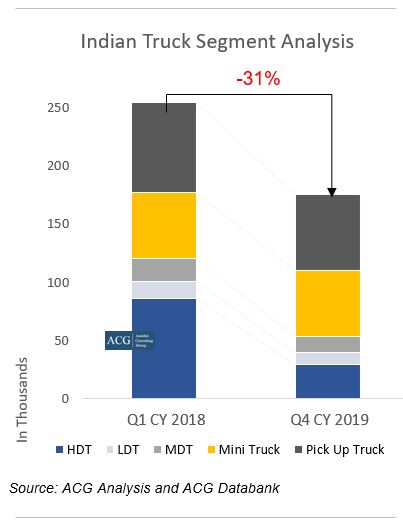
Due to the outbreak of COVID 19, there will be a serious impact on Automotive production. As a matter of fact, the Indian CV market was declined by 15% in CY 2019 compared to that of CY 2018. However, the CV segment registered a 31% degrowth when comparisons are made between Q1 CY 2018 and Q4 CY 2019. In the first quarter of CY 2020, there were some positive indicators symbolized the growth gradually but all of a sudden, COVID 19 boomed its power into the automotive market.

It is expected that the Indian GDP will be dropped to 5.2 in 2020. The outbreak of the Coronavirus has affected almost every sector like Restaurant, Aviation, Real Estate Pharmacy, and there goes an endless list.

Heavy Commercial Vehicles registered the highest degrowth rate around 60%, Medium Commercial Vehicle 37%, Light Commercial Vehicle 38%, and Small Commercial Vehicle registered 10% degrowth in CY 2019.

Our report focuses on outlook 2020 and forecast 2024 volume. All major stakeholders of the CV industry are revising the basics like Customer preference, segment shift trend, regulation changes, acceptance, and adoption of new technology and digitization; OEMs are optimizing the Product portfolio with the implementation of BS-VI.

Whatsoever the situation is, Indian Govt also announced to invest in developing infrastructure for the next 5 years. This will have a positive impact on some specific segments of the Indian CV market. To be precise, the Truck scrapping policy is another supportive measure taken by Govt.

Table of Content:

  • Executive Summary and Introduction
  • Macro Economy Analysis and its impact on CV Industry
  • Market Overview Key Points
  • Segmentation SCV, LCV, MCV, and HCV
  • Impact demand for regulation, Technology, GST and overall key changes
  • Keynotes of Indian Commercial Vehicles
  • Commercial Vehicle—Definitions of segment and sub-segments
  • Impact of Changing Market Dynamics of Indian Commercial Vehicles
  • Short Term, Medium Term, and Long Term forecast
  • Top Predictions for Indian Commercial Vehicle Market
  • CV Trend FY 2008 to FY 2020 and forecast FY 2025
  • Demand Forecast by Segment
  • Past Volumes for the last 10 years / Market Share evolution
  • Segmental movements  analysis and the reason behind it
  • Segmental shifts expected
  • Key Market Drivers and their level of impact on CV Industry growth
  • Future Volumes for segments/applications
  • Segment & Sub segment-wise Trend and Forecast
  • Brand wise Sales and Market share Analysis
  • How Macro Economic Factors Impacting CV Industry
  • How Introduction of BS-VI norms impacting the CV industry
  • PESTEL Analysis of the Indian Commercial Vehicle Market
  • SWOT Analysis of each Sub-segment and CV segment
  • Macroeconomic Trends Impacting the Commercial Vehicle Market in India
  • Technology Trends Impacting the Commercial Vehicle Market in India
  • How Logistics Landscape changing through Digitalization
  • Telematics Analysis in CVs: Fleet Management solution- Impact and Acceptance
  • Indian Electric Vehicles (EV) opportunities & Challenges for Commercial Vehicle segment
  • Electric Bus Market Analysis
  • Other CV segments
  • Regulation Impact
  • Role and acceptance of IoT and Big Data in Indian Commercial Vehicle Industry
  • Payload tonnage shift Truck
  • Operator Business Model in the CV Industry
  • Market Opportunities
  • Indian CV Technology Overview—Technological Progress, Latest Trends,
  • New Safety Norms Impact
  • Vehicle Buying criteria – SCV, LCV, MCV, and HCV
  • Legislative and Regulatory Scenario in the Indian CV Industry
  • GST Impact Analysis
  • Impact of Axle Load Regulation Analysis impact
  • Truck Body Code description and its impact Analysis
  • What is Vehicle Scrappage Policy, its impact – Commercial and environment
  • Other regulations
  • Logistics Industry Analysis
  • Indian Trucks— Application wise
  • Industry Structure—Goods Carrier
  • Application Split for Truck Industry (Mini, Pickup, LDT, MDT, and HDT)
  • Application and Sales Analysis based on GVW
  • Major Core Segments of Parcel Logistics
  • Heavy Machinery Industry
  • Construction Materials
  • Fruits, and Vegetables
  • Agriculture Transportation Products
  • Cement
  • Tankers and Bullets
  • Industrial Goods
  • Automotive Vehicle transportation
  • Mining Industry
  • OEM Landscape
  • Indian Commercial Vehicle Market Structure
  • Small Commercial Vehicle Segment – By units and Value
  • Light Commercial Vehicle Segment— By units and Value
  • Medium Commercial Vehicle Segment—By units and Value
  • Heavy Commercial Vehicle Segment—By units and Value (Rigid Haulage, and Tractor Trailer)
  • Bus Segment—Segment wise
  • OEM market share
  • Commercial Vehicle Market—Forecast and Trends
  • Growth Opportunity Analysis
  • Strategic Imperatives
  • Smart Cities Plan
  • Smart City Impact on CV segment
  • Urbanization Growth Analysis 2030

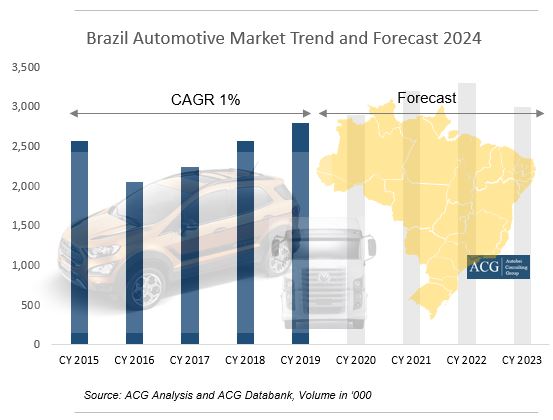
When Automotive markets like India, China, Russia registered negative growth in 2019, Brazil gave a positive sign and successful Outlook. The Brazil Govt launched a new overarching policy in 2018 for the automobile industry and called the same as the “Route 2030” Program. This served as a roadmap for producing the technological and energy-efficient vehicles in the Brazilian automotive sector. The government is willing to grant up to R$ 1.5 billion per year in tax credits to companies that invest at least R$ 5 billion in the research and development sector.

Brazil Automotive Market Report 2020 and Forecast

The Brazil Auto output rose from 2.3% to 2.94 million units in CY 2019. Hence they registered a 9% growth in CY 2019. From the year 2016, it’s evident that they constantly exhibit steady growth which is presumed to remain till 2020. The outlook for Brazil’s automobile industry this year is believed to go beyond fortune. Since inflation in Brazil is below target, it’s reckoned that this will create clear financial conditions. Furthermore, this will aid to increase the spending power of buyers.

However, there lies a determining factor -unemployment which shall influence the economic elements of a country. The Brazil Automotive market dominates other Premium Brands and product varieties. Thus Chinese players find it difficult to infiltrate among the Brazilian Auto markets like Russia and Africa. Geely is grabbing a better spot in the SUV segment.

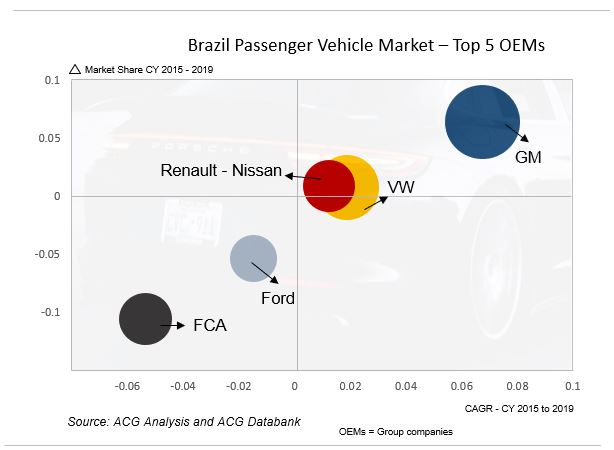
Brazil Passenger Vehicle Competitor Analysis

On the other hand, the passenger vehicle segment registered a 2% growth in CY 2019. The CAGR from 2015 to 2019 reached 8%. However, the Brazil Car segment registered a 5% growth in CY 2019. The CAGR from 2015 to 2019 dropped to 2% adverse. Like every other major market, SUV in Brazil grew by 17%. General Motors and Volkswagen increased their market share by 7 and 2% respectively in the last few years due to the conventional product position.

Lately, in 2018, VW added a 4 percent market share thus taking the economy from 15 to 19%. FCA lost 5 percent segment share in the last 5 years. Similarly, other German OEMs like BMW and Mercedes could not improve their performance in the last 3 years in the SUV segment. Top 5 Automotive Groups viz., FCA, Renault-Nissan, Hyundai – Kia, Honda, and VW yielded a 74% market share. The CAGR for the last 5 years of FCA, Renault, Nissan, Hyundai Kia is 30, 34, and 18% respectively. Economists at U.S. bank Citi on Wednesday lowered their 2020 Brazilian economic growth forecast from 1.6% from 2.0%. The outbreak of coronavirus is perceived as the cause that lowered the Brazilian economic growth.

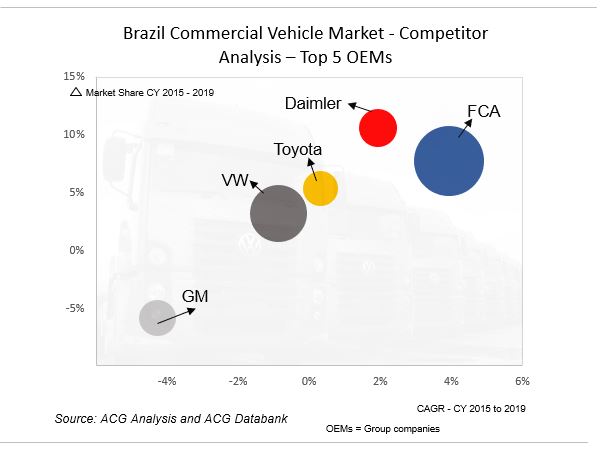
Brazil Commercial Vehicle Competitor Analysis

The report reveals that Brazil Truck market grew by 33%, Light Truck market by 8%, Bus market by 42% and overall Brazil Commercial vehicle market rose to 13% in 2019. The popular driveline in the Heavy Truck segment is 6X2, 6X4 and 4X2. Above 350hp, Volvo and Mercedes are popular in the respective segments. However, the Volkswagen Group remained the market leader for a prolonged period in Brazil. On the other hand, in Heavy and Extra Heavy Truck segment MAN, Scania, Volvo, and Daimler ruled the OEMs sector.

New Opportunities in Brazil’s Automotive Market Report Highlights:

  • Brazil Automotive Market Trend and Forecast – Sales, Production, and Export
  • Car, Commercial Vehicle Model wise Sales, and Production Forecast
  • Market Gap analysis
  • OEM and Model wise Competitor Analysis
  • Pricing Analysis of Car, SUV, Truck, and Bus
  • TCO analysis
  • Customer Insight
  • Brazil Auto market Product Analysis, Strategy, Top vehicle
  • Entry Strategy
  • Case Study – MAN – VW acquisition
  • Key Macro Economy Indicators
  • Customer buying behavior and expected changes in the next 5 years
  • Doing Business Guide in Brazil
  • Market Dynamics
  • Brand Position and Perception
  • Dealer network
  • Customize Consulting Option is also Available

Indian Truck market Analysis and Outlook 2020 comes under standard reports and available at 1,500 USD.

This study aims to explain the Indian Market’s scope of the Truck Industry from 2020 to 2025 after the consolidating multiple Market dynamics. The factors include regulations norms, Slowdown in demand, customer sentiments and their preferences, fluctuating vehicle prices, freight rates, new product launches, GDP drop, price inflation, China’s Coronavirus impact, segment & sub-segment shifts, investment on infrastructure, overall manufacturing growth/degrowth, mining, and logistic Industry’s impact are the factors taken into consideration. These factors are highly affecting Indian CV Industry.

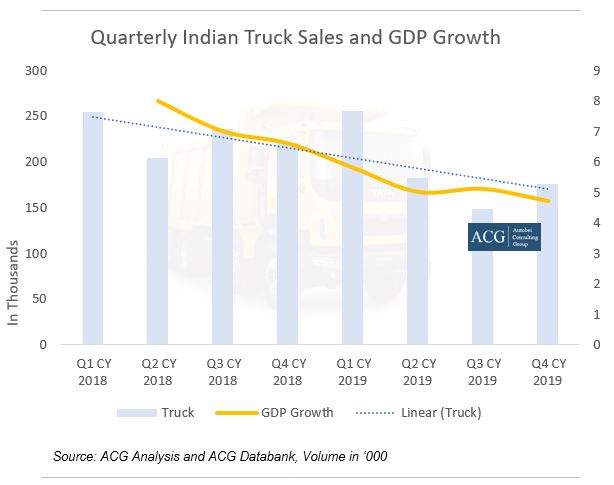
Indian Truck Sales Analysis - Quarterly and GDP growth

Indian Truck Industry growth was declined by 17% in CY 2019 compared to that of CY 2018. Similarly, the HDT segment registered a 36%, MDT segment 13%, LDT 11%, Pick Up 7%, and Mini Truck 7% degrowth in CY 2019 compared to that of CY 2018. In the Heavy-duty segment, Tata Motors, Ashok Leyland, Mahindra, Eicher sales revenue was declined by more than 35% in just one year span. Whereas, in the LDT segment, Tata, Mahindra, Eicher, SML Isuzu faced a steep fall and witnessed double-digit degrowth in CY 2019.

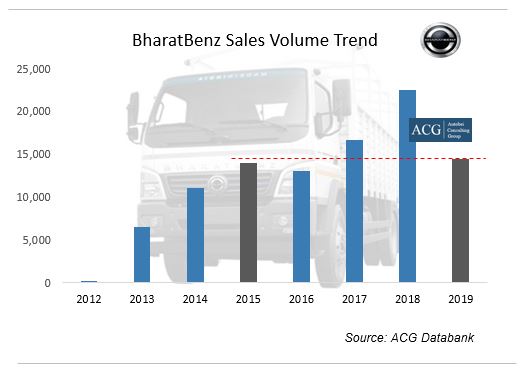
Daimler India is in a contrary spot; it’s rolling back to 2015:

Bharatbenz Truck Sales 2019

BharatBenz volume declined by 36% in CY 2019 compared to CY 2018.

Indian Truck Segment Analysis - Quarter wise

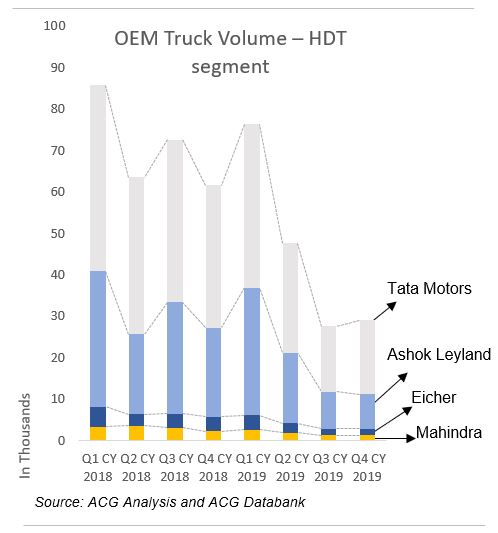
In the Heavy Duty truck segment, Tata Motors, Ashok Leyland, Mahindra, Eicher deals declined by over 35% in only a solitary year. In the LDT fragment, Tata, Mahindra, Eicher, SML Isuzu chose twofold digit degrowth in CY 2019.

OEM Truck Volume – HDT segment

Due to the coronavirus, the oil costs plunged. This could decrease the working expense of the Vehicle and would additionally have a serious effect on the unequivocal truck region and a bit like compartment transport is rising to organize sway on the Indian Truck deal.

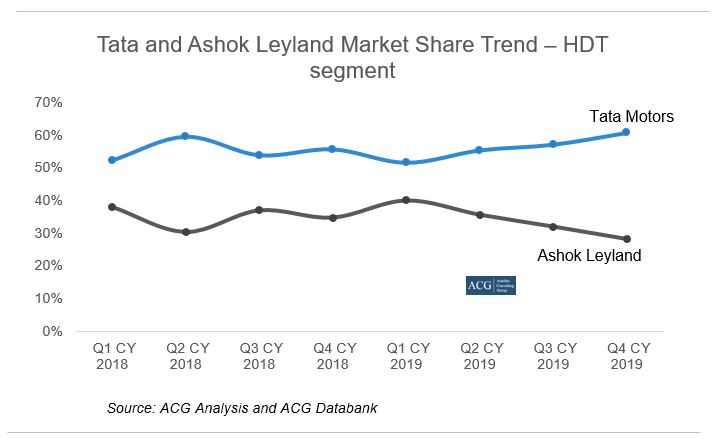
Among the HDT segments, in the last 4 Quarters of 2019, Tata Motors increased a 9% market share and Ashok Leyland remained losing 12% of its market share. Construction and Mining sectors showed slightly better growth in Q4 2019 compared to Q3 2019.Tata and Ashok Leyland Market Share Trend – HDT segment

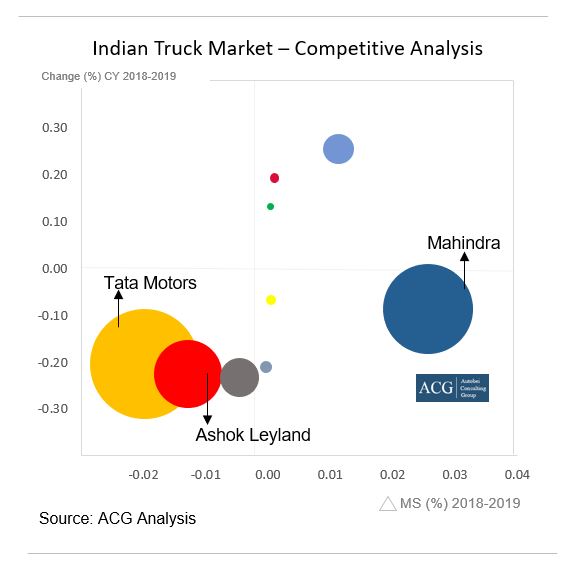
The manufacturing sector recorded degrowth invariably. Every week the retail inflation increased and weak customer sentiments made a huge impact on the market’s growth.Indian Truck Market Competitive Analysis

Due to coronavirus, the oil prices dropped. This could reduce the operating cost of any Vehicle. The Indian economy forecast for the year 2020 is expected to reach around 5.8%, which is a 0.9 percent drop from the previous estimate.

For 2021, the economy might reach 6.5% to 7%. This clearly depicts that the Indian economy will reach the worst possible point. However, there are a few growth signs evident in some sectors. Coronavirus would also have an indirect impact on the truck segments and other segments like a container where the conveyors will face a direct impact on Indian Truck sales.

India Automotive Industry’s emission norms are shifting from BS-IV to BS-VI and are effective from April 2020. The BS-VI norms demand innovations and new vehicle diagnostics (OBD). Furthermore, implementation of the BS-VI norm might raise the cost of all segment Small Commercial Vehicle, Light Commercial Vehicle, Medium Commercial Vehicle, and Heavy Commercial Vehicle segment. Depending on the type of vehicle, OEMs, and their advancement, the cost of a vehicle will vary. Some of the OEMs had already implemented BS-VI technology in their practice. It is expected that the price increase of those OEMs who had already implemented BS-VI technology in their practice, will be utterly less as compared to that of other OEMs. There will be some modifications in the design architecture of the vehicle which will make the investment horizon (ROI) longer and that will incidentally affect TCO.

The revised axle load norm that was declared in July 2018, had an immediate effect and increased the vehicles’ permissible GVW and payload capacity by approximately up to 16%. This regulation brought some challenges for fleet owners. The maintenance cost has increased without affecting the freight rate, thus dropping the profit. It eventually increased the demand for high GVW vehicles. Truck body code significantly improves the quality of a vehicle among OEMs and other local bodybuilders. Vehicle scrappage policy, which aims to promote the replacement of old vehicles under the incentive scheme, is quite questionable. The Ministry of Road Transports and Highways has a clear set of a regulatory roadmap emphasizing quality, safety, efficiency, and environment.

Awareness of technology, and realization of long-term “TCO benefits” will drive a customer to invest in value-added features, switching from the traditional price-based buying approach to the cost-value approach but this is limited with specific customers group. Indian OEMs are profoundly investing their money in product up-gradation to enhance performance and features to shall endure the tough competition and to meet customers’ expectations.

To withstand such a turmoil situation of the industry, the Indian Commercial Vehicle OEMs will have to focus on value trucks targeting the right set of customers and business models. The rising conflux of technologies in the automobile industry provides a platform for various stakeholders to offer a solution-based operating model

Advancement of purchases owing to BS-VI norms will partially be balanced by the liquidation of BS-IV inventory in fiscal 2020; Dealers rising fiscal 2020 at elevated levels of inventory are expected to reach lower levels, as dealers liquidate BS-IV inventory and thus leading to lower wholesale offtake compared to that of retail sales.

Please contact Info@autobei.com to purchase Detailed Report.

Russian Truck market remains the most massive Truck market in Europe. It registered a 2% degrowth in 2019 compared to 2018, because of the higher worth realization of used trucks by the customers. The used truck market additionally registered integer growth in 2019 compared to 2018. 13,800 buses were oversubscribed in Russia in 2019, which is 6.3% more than the amount of 2018. The leading cities Moscow, St. Petersburg, etc are the key drivers for the bus sales growth. In the premium section, Volvo, Mercedes, DAF are the most popular brand and in Russian, Kamaz and GAZ are the popular brand’s names.

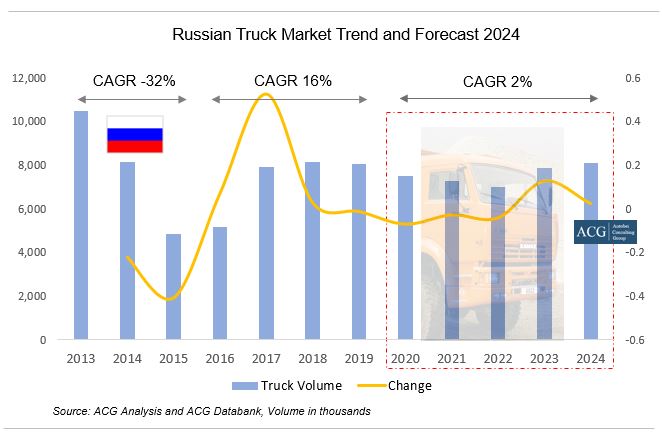
Russian Truck Market Trend and Forecast 2024

CAGR between 2013 to 2015 was 32%, from 2016 to 2019 it was 16% and the forecast for the next five years represents an increase of 2%.

As per Rosstat, Russia’s gross domestic product grew by 1.3% in 2019. It’s expected that the gross domestic product grew by 1.35 in 2019. It’s expected that the gross domestic product growth is going to be beneath 2% in 2020 and 2021, which compares with an official distension rate of 2.5% recorded in 2018 and was that the weakest annual growth since Russia emerged from the financial condition in 2016.

Manufacturing Production in Russia enlarged 3.90% in Jan of 2020 over an equivalent month within the previous year.

Russia has enlarged its transport infrastructure defrayment commit to seven trillion roubles ($110 billion) for the future 5 years. Hoping that enormous investment and infrastructure outcome can boost the sluggish economic process. Russia’s financial organizational has cut interest rates by 25 basis points to 6.25%, the fifth-rate cut in 2019 and its lowest level since before the 2014 Russian money crisis.  Oil costs slump and coronavirus impact has an effect on the Russian economy for the brief term. In recent weeks, as china reports additional infections the rate for the ruble had a swayback.

The three queries shaping the Russian trust market:

  • What is a suitable product for sales and purchase
  • What is the suitable price range which comforts consumers according to their preference
  • Is it an alliance or partnership OEMs

Russia continues to be a coffee price market and this can be the benefit for native OMEs like Kamaz or GAZ to fulfill the client’s needs, However currently massive fleet owners began to expect additional advanced trucks and prepared to procure higher specs.

Russia continues to be a coffee price market and this can be the benefit for native OMEs like Kamaz or GAZ to fulfill the client’s needs, However currently massive fleet owners began to expect additional advanced trucks and prepared to procure higher specs.

Long haul truck and Traction truck are the key segments for nearly all OEMs. The native OEMs are attempting to create a balance between technology and supply value.

Foreign players are begun to dominate some specific truck transportation sectors like Inter European transportation, Bulk wood transportation, and mining section. Daimler is penetrating the Russian truck market through the jointly developed product which varies with Russia’s prime producer of heavy freight trucks, Kamaz. This product is principally targeting the budget truck sector in Russia. The company additionally acquired a 15 % stake last year to stay an eye on future strategy in the CIS region. Kamaz oversubscribed around 30,504 trucks in 2019 and expected to sell 29, 000 units of trucks in the domestic market and around 6,709 units for export in 2020.

Domestic players like Kamaz are attempting to penetrate the additional traction sector by significant products like KAMAZ 5490. European OEMs are the main players during this section. Kamaz is attempting to decrease the truck break down the level and increase driving comfort by joint development with Daimler. Kamaz is the market leader in more than 14T GVW sections such as Kamaz 43118, 5490,65115,6520(Tipper), Mercedes actors, Volvo-FH &FM, New-gen MAN TGX & DAF XF product arrives in the prime portfolio.

Behavior and qualitative analysis of customer purchase:

In our study, we tend to have an extended discussion with Russian fleet managers/ decision-makers regarding their demand and “why they like specific truck models“. The Russian truck market dynamics are completely different from alternative rising markets like China, Brazil, and India.

In our study, we’ve got compared regarding the whole perception of Premium (European), Chinese and Russian brands underperformance, variations, quality, reliability, TCO, product life cycle, target section & appropriate application.

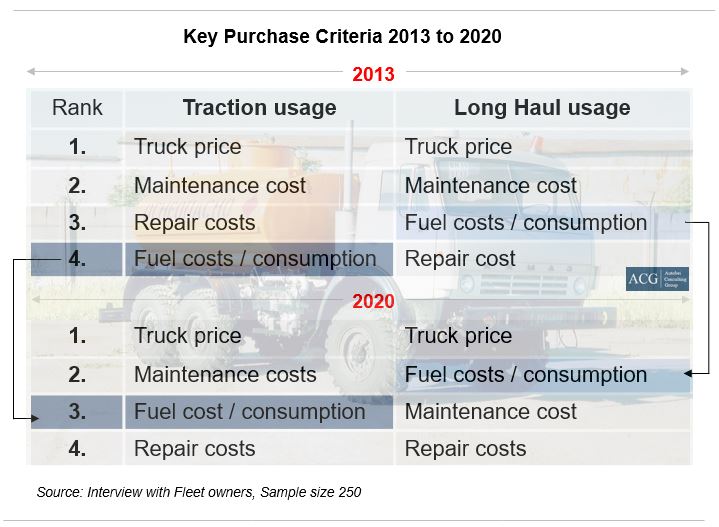
We have conducted this study in four major Russian cities. They had completely different purchase aspects and at the end of the day, the result concluded that in traction sector TCO, reliability and quality after-sales are prime three parameters out of ten in purchase criteria.

Russian truck segment and mapping with target customer segment

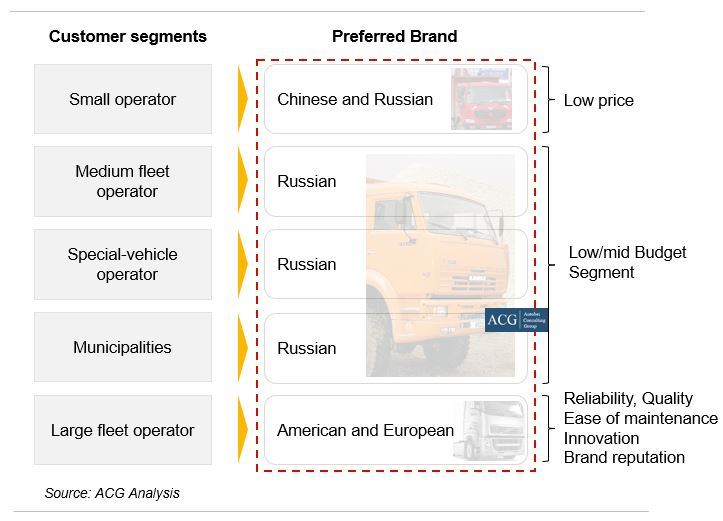
The Chinese brand is most popular among the clients because of its low value, overloading capability, up to service network and quality. The major reasons for purchasing Russian products are simply fixable, strong vehicle & road capability advantage. The European brands position themselves as prime quality, performance, extreme reliability, and user-friendliness.

Key Truck Purchase criteria in Russian Truck market

Fuel consumption, driving comfort, service after sales are playing a crucial role to shop for traction trucks. Used premium trucks meet these consumers’ expectation and it also comforts the driver’s trip to central European countries. However, the key challenges in the Russian ground are lifecycle, product history, High maintenance, cost of repair and product compatibility.

Key highlights of the report:

  • Russian Truck market Trend (Market size) and Forecast 2024
  • Model wise Truck sales, Production, Export, Import, Engine, Transmission, Production plant, Model nameplate, Key Application, and Price point
  • Truck Segment Analysis – Light Duty Truck, Medium Duty Truck, and Heavy Duty Truck
  • Customer (Fleet Owner) survey – Qualitative analysis
  • Low cost, Budget, and Premium Truck segment – Price, Specs, features, Product life cycle, Forecast, TCO
  • Truck Application Analysis – Dump truck, Traction, Haulage, Special Application etc
  • Truck Price Analysis
  • Competitive analysis – Asian, European, and American brands
  • After-Sales Analysis
  • Brand Strategy, and Product Position
  • Key Economy indicators Forecast


In our latest Indian Electric Two-Wheeler Report, we have also included customer survey and feedback of existing users of Electric Two wheeler also. We have discovered many key findings in our qualitative analysis.  The after-sales revenue analysis of dealers also covered in this latest report.

Key Highlights of the report:

  • The current market size of Electric Indian Two Wheeler – Scooter and Motorcycle – Volume and value – Segment Share, Development, Growth analysis, and Demand Analysis
  • Market Key Drivers, Restraint, and challenges
  • OEMs sales Strategy Analysis of Electric scooters and Motorcycle
  • Trend and Forecast 2015 – 2030
  • Chinese OEMs entry Plan
  • TCO analysis with battery replacement cost
  • Roadmap for EV Two Wheeler
  • Entry and Business expansion Strategy
  • Major Cities and State for Electric Vehicle
  • Battery Analysis – Type, Charging capacity and time, changeable, Price, Suppliers, etc
  • Motor Placement type market size: Hub Type, and Chassis Mounted
  • Major players and Competitive Analysis – Price, Product Position, Product Portfolio, Brand Position, and customer segment
  • Why Non- core Automotive Players are popular
  • Business Opportunities for Electric two-wheeler manufactures and suppliers
  • Charging Infrastructure challenge
  • Charging infrastructure business case – Investment and ROI
  • State-wise Electric Vehicle Govt policies
  • Operating running analysis and comparison between Electric Two Weeler and ICE Two Wheeler
  • Vehicle and Customer mapping-  Customer Buyers segment of EV Scooter and Motorcycle, Customer satisfaction Analysis, Customer key motivation to adopt Electric Two-Wheeler, Customer expectation
  • Retail, and Corporate customers segmentation and their purchase criteria
  • Customer segment Group – Age-wise, running km wise, Income, City type (metro. Tier I, II, III, Rural) and lifestyle
  • GAP analysis
  • e scooter and e motorcycle Feasibility Analysis
  • Marketing Strategy for EV Two Wheeler
  • Electric Two-Wheeler costing analysis – Components, manufacturing, Channel sales partner, Manpower, Production Strategy
  • Conclusion

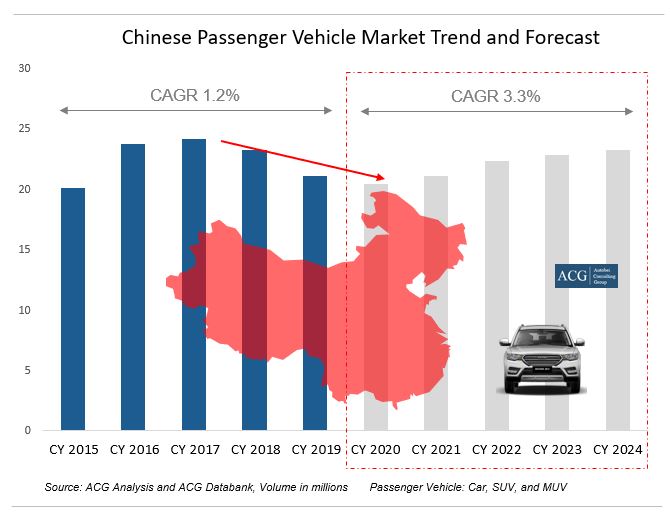
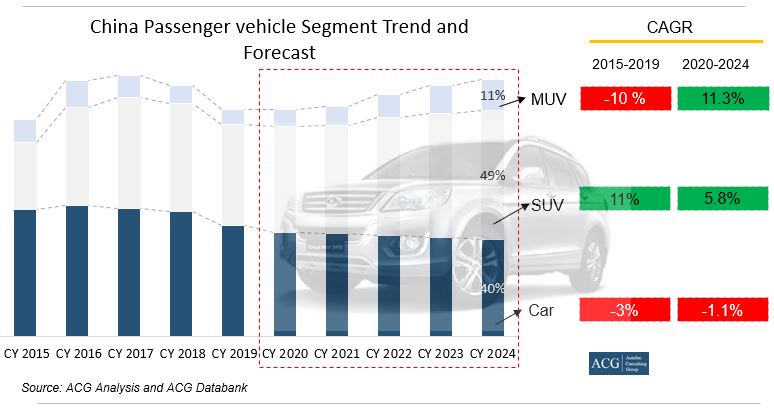
How the Chinese car industry is going to shape its future is our latest detail Study on China Car Industry. The Chinese car market is the world’s biggest passenger car market. It grew into one of the largest Auto markets and has remained the same till now. The China passenger vehicle Industry registered a 1.2% CAGR from 2015 to 2019 and expected to register a 3.9% CAGR in the next 5 years.China passenger vehicle market trend and Forecast

In 2019, the Chinese Passenger vehicle Market recorded a 10% fall compared to 2018. The outlook for the year 2020 China car market is critical considering the latest market dynamics. The Chinese Industry is expected to show a 3 to 4% degrowth in 2020.

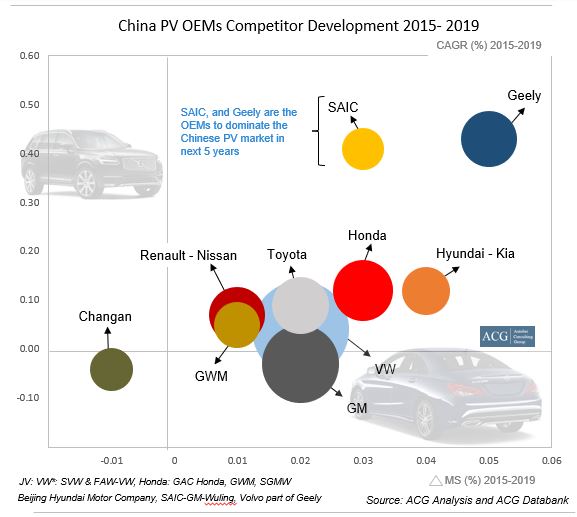
In the Passenger vehicle segment (Car, SUV, and MUV), the Honda, Geely, BMW, Mercedes, Baojun, Roewe, Volvo, Cadillac, and MG are considered the top players as per CAGR and Sales analysis from 2015 to 2019. The overall segment registered a 1.2% CAGR in the last 5 years. In the next 5 years, it’s expected to rise and reach almost 3.3% CAGR.

Chinese Brands like Haval, Geely, Changan also started to dominate the Russia Car market in 2019. It shows how Chinese brand perception is going to change in major auto markets like Africa, Russia, India.

China passenger vehicle competitor analysis report

Car Segment:

VW, Honda, Toyota, Nissan, and Buick are major players with a combined market share of 53% in 2019. Premium German automakers Audi, BMW, and Mercedes were also top players in this category. The segment noted a -3% CAGR from 2015 to 2019 and expected to decrease further i.e -1.1% CAGR from 2020 to 2024.

SUV segment:

The SUV segment showed 11% CAGR from 2015 to 2019 and expected to fall and reach 5.8% CAGR from 2020 to 2024. VW, Haval, and Geely are considered the top 3 players of this segment with a combined market share of 23% in 2019.

VW registered 34% CAGR from 2015 to 2019. They also added a 5% market share in the last 5 years. Geely’s performance is excellent with a 6% increase in its market share from 2015 to 2019. BMW, Jeep, Skoda, MG further registered a double-digit CAGR growth from 2015 to 2019.

MUV Segment:

The MUV segment is dominated by Chinese, American, and Japanese players. The MUV segment registered -10% CAGR from 2015 to 2019 and expected to show an immense growth of 11.3% in the next 5 years. This forecast estimate is based on a new customer survey and a new product range plan. Customers perceive MUV as more spacious and more convenient than SUV. Similarly, customer centricity was observed in the US market.

Currently, the Chinese car segment is encountering some challenges. As a result, the consumer confidence index was fallen due to the China-US Trade war; however, the US has given some signs to lower this pressure this year. New emission standards in China, tighter restrictions on buying cars in the biggest cities, rising inflation, and a growing used-car market all these would give a negative impact on car sales in the domestic market.

Segment share of Car, SUV, and MUV:

In 2019, the Car, SUV, and MUV had 48%, 44%, and 8% segment share respectively. It is anticipated that this will become 40%, 49%, and 11% by the end of 2024.China Car, SUV, MUV segment trend and Forecast

Customer behavior pattern and Product Strategy:

The overall pace at which Chinese consumption has grown is hard to imagine; just a decade ago, urban Chinese had no enough money to cover their basic needs like food, clothes, and housing and now, half are living in relatively well-to-do households, where they get ample funds from perks like regular meals, premium products, latest electronics, and holiday travel. China maintained stable employment factors last year.

China Car target customers and Product Strategy

Currently, urban consumers are now the prime drivers of the Chinese economy, with their spending account crossing over 60 percent of GDP growth. In the next 5 years, the Tier II system is believed to engage actively to drive the economy.

It is expected that the new employment factor will continue to score more than 13 million jobs for the five consecutive years. In December 2019, the Consumer Price Index (CPI) rose by 4.5 percent year-on-year, with an increase of 4.2 percent in the urban sector and 5.3 percent in the rural sector.

In 2019, the per capita consumption of the whole country was 21,559 yuan, which is a trivial increase as compared to the same period of last year, but a steep increase i.e 5.5 percent after deducting the price factor.

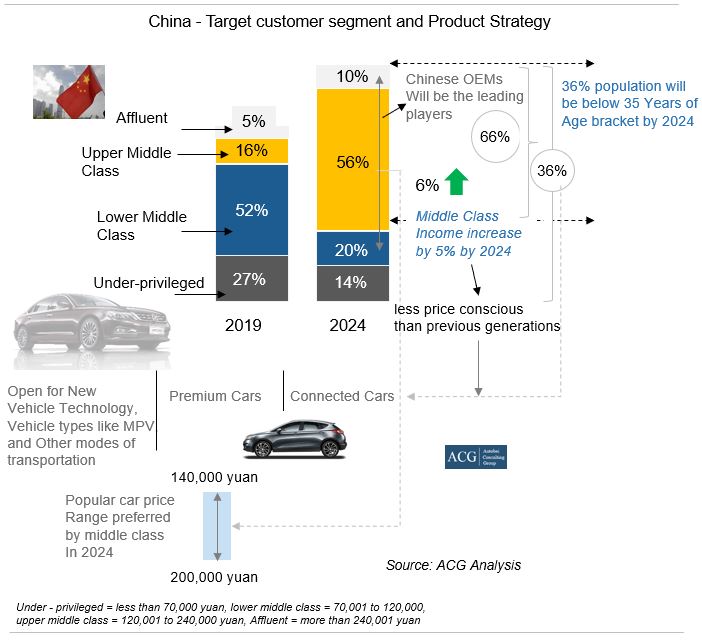
In the coming decade, household consumption will grow by an average of 6% annually; which will be mainly powered by upper-middle-class people who will expand to represent an estimated 56% of households by 2024. The new job creation and population movement from rural to urban areas, where incomes are higher will be their key drivers. The resulting income growth will elevate underprivileged and lower-middle-income households to an upper middle class and affluent respective with income support of around 66% of the total population.

New Customer segment:

China has got the world’s most fascinating customer base. They have the youngest buyers for a premium vehicle. It is expected that Chinese OEMs will be the first choice for most of the middle-class buyers.

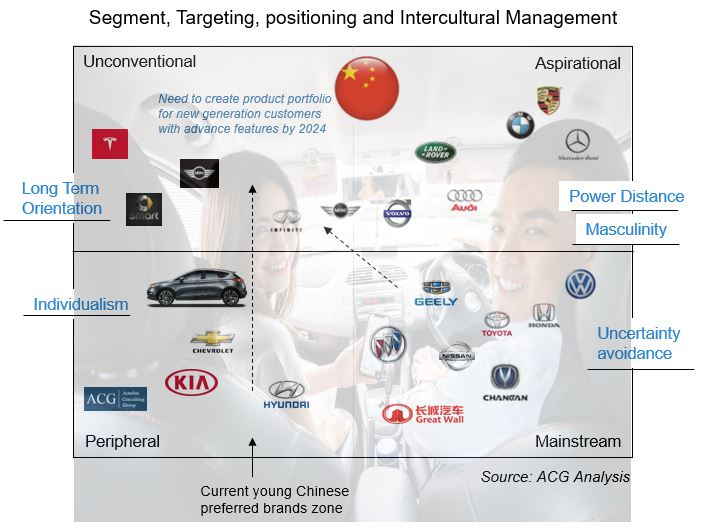
Segment, Targeting, Positioning, and Intercultural Management of Chinese Car Market

They will have high expectations for products and services and China meets their interests. The current product portfolio of Car demands to be upgraded upon considering the new generation i.e Chinese customers’ lifestyle and purchase pattern. The new generation obtains meaningful financial support from their parents and grandparents, and they grew up in a short period with rapid improvements that are steered by a quality life empowered by technology and digitization. They’ll continue to depend on technology and digitization as they begin to enter the workforce with them. They will consume a higher rate than their predecessors, seeking instant gratification to maintain higher standards for convenience, quality, and variety. This group is comparatively less price-conscious than the previous generations.

Companies must develop premium and personalized products and services to meet these higher standards that might influence the buyers. Digital media will play a significant role than kith and kin. They would be ready to adopt any new technology vehicles. The communication strategy reports convincing the new generation. These young and digital-savvy consumers are more open to new things than older consumers are. These traits create opportunities for new business models to attract buyers. Also, more two-child families will form in the coming decade, leading to an increase in the demand for specific products and services for growing families. It is expected that the average premium buyer of a premium vehicle in China will be less than 35 years old. It is predicted that about 30 percent will be first-time buyers in China for premium vehicles.

Brand Strategy:

Our study showed that customers are becoming more loyal to a specific brand name. Our study suggested how companies can change their advertising, and corporate communication strategy to make it more effective for the next 5 years.

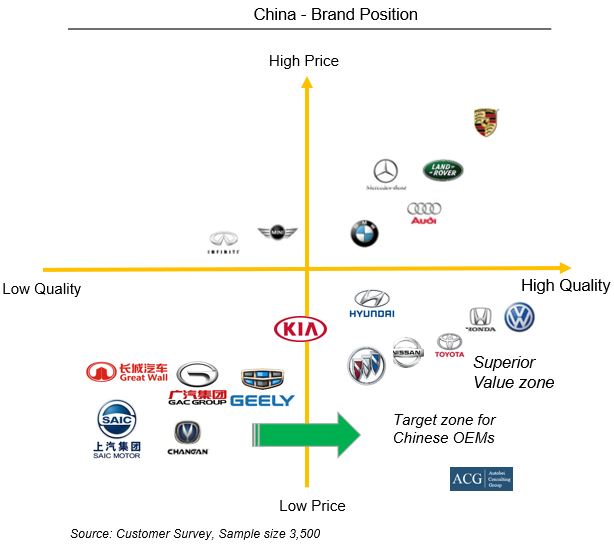
China Brand Position

OEMs Strategy:

Chinese OEMs are aiming to increase market share in the domestic market. They are acquiring reputed brand names like Volvo, Hammer, MG to use expansion on new markets. The middle class is their target segment; VW and Toyota successfully won the Chinese market especially the middle-class market with the right strategy appealing the consumers’ demand.

Key Highlights of the report:

  • China Passenger Vehicle Market size Trend and Forecast
  • OEMs sales, market Share Analysis
  • Model wise Sales Analysis and positions of the models
  • Challenges and Opportunities Analysis
  • Mass, Premium, and Sports Car market Analysis
  • Competitor Analysis
  • Customer Survey
  • Product Strategy and Product Planning
  • Vehicle Pricing Strategy
  • Customer Group and mapping with Vehicle type, Price and Social parameters
  • Customer demand Analysis
  • Brand Strategy for foreign and Chinese OEMs
  • Regulation impact on vehicle Sales
  • After Sales Analysis

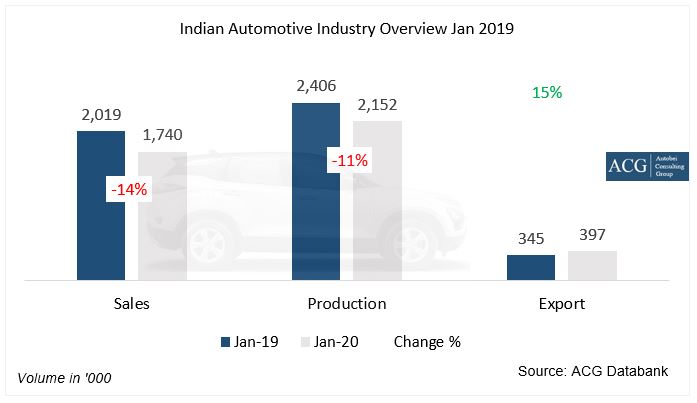
Indian Auto Industry dropped to 14% and Product volume 11% degrowth whereas, export registered a 15% growth in Jan 2020. The economy started to reveal some positive signs of revival at the beginning of the year. The truck segment is suffering heavily due to an economic downturn.

Indian Automotive Industry Analysis Jan 2020

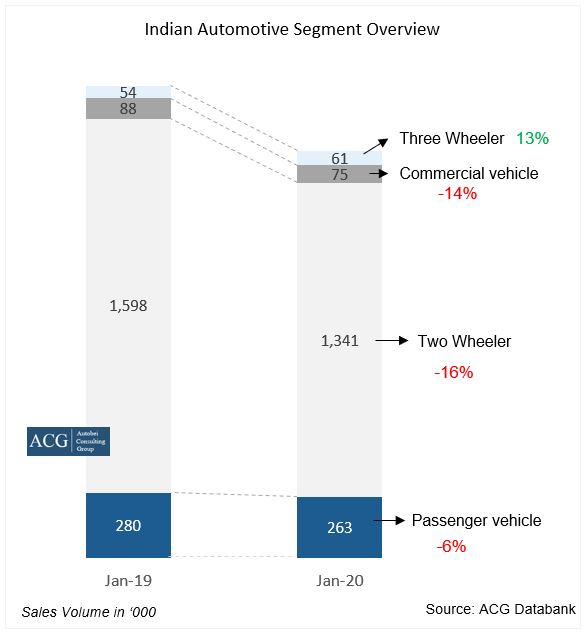
In the Passenger vehicle segment, cars registered 8% and Van registered 28% degrowth in Jan 2020. However, SUV and MUV registered showed minor growth of 3% which is slow compared to the previous growth trend. Honda cars had lost around 5% share but Maruti Suzuki tightened its hold on the car segment getting 11% market share in just one year. In the SUV and MUV segment, Kia Motor grew the third-largest player with an 18% market share, and Hyundai added around 4% market share in the same segment in Jan 2020. Maruti and Toyota are the biggest losers in Jan 2020 in SUV/MUV segment.

Indian Automotive Segment wise Analysis Jan 2020

Indian Commercial Vehicle recorded 14% degrowth in Jan 2020. LCV noted marginal degrowth but the MHCV segment registered 35% degrowth in Jan 2020 compared to Jan 2019. Light Bus segment registered 11% growth and light-duty truck showed marginal degrowth of 1.5% in the first month of CY 2020. MHCV Bus recorded 49% growth and the MHCV truck segment was noted 44% degrowth in Jan 2020 compared to the same month of the last year.

In the MHCV Bus segment, Ashok Leyland lost a 6% market share and its main competitor Tata Motors gained around 7% in the last one year. This progress made Tata Motors the market leader in this segment. In the MHCV Truck segment, Ashok Leyland once again lost 11% market share, and Tata Motors gained 4% market share from Jan 2019 to Jan 2020. In the Light Bus segment, Force Motor gained a 7% market share, but Tata Motors lost 7% market share.

In Light Duty Truck, Mahindra gained around 45% market share including 3% in the last one year and Tata Motors added a marginal market share. Indian Two-wheeler segment recorded 16% degrowth, particularly the Scooter segment registered a double-digit negative growth of 16% and the Motorcycle segment 15% degrowth in Jan 2020 compared to Jan 2019.

In the Motorcycle segment, Baja Auto reported an excellent performance but in Jan 2020 it lost 2% of its market share. TVS also lost a 2% market share in Jan 2020. Hero and Honda were two major players in the Scooter segment that held a combined market share of 66% whereas, Hero MotoCorp lost a 9% market share, and Honda gained a 10% market share in the Scooter segment in Jan 2020.

Three Wheeler Passenger vehicles recorded 19% and Three Wheeler Cargo recorded 10.6% degrowth in Jan 2020.

Key highlights of the report – Monthly Subscription:

  • Indian Automotive Industry market analysis monthly and cumulative
  • Segment Analysis – Car, SUV, MUV, Van, Truck, Bus, Commercial Vehicle, MHCV, LCV, Two Wheeler, and Three Wheeler
  • Latest Development in Indian Auto Industry
  • Coronavirus impact on Indian Auto Industry
  • Sales volume, and Market share analysis
  • Model wise analysis
  • New product launch impact
  • Changes in market dynamics

ACG expects that Indian Heavy Duty Truck Market started to register growth in the third quarter of CY 2021. The latest development of the construction, Mining Industry, and manufacturing expected growth prepare some ground to support the Tipper segment and Tractor segment.

Key highlights of the report:

  • Pan Indian and State level Volume forecast
  • Truck Type – GVW and body type
  • Premium, Budget segment Analysis – Key Products, Market share, USP, etc
  • Challenges and Opportunities
  • OEM Strategy Analysis
  • Customer insight – Their sales plan for next year
  • Coal, limestone, Iron ore, OB, Real estate, Logistic, and Infrastructure Construction
  • Tender Analysis
  • Mapping Customer / Project for Truck sales
  • Other Equipment like new, imported, Lease, Rental, and used
  • Equipment fleet operators
  • Business Operations of fleet operators
  • AMC offering by OEMs
  • Replacement cycle
  • Truck age based on uses and type
  • Vehicle prices and discount
  • Running or coming up the project – Project size, Ownership, types of project
  • Fleet portfolio of Contractor
  • States of mines and the required number of the vehicle for operation
  • Key strategic contractors/customers

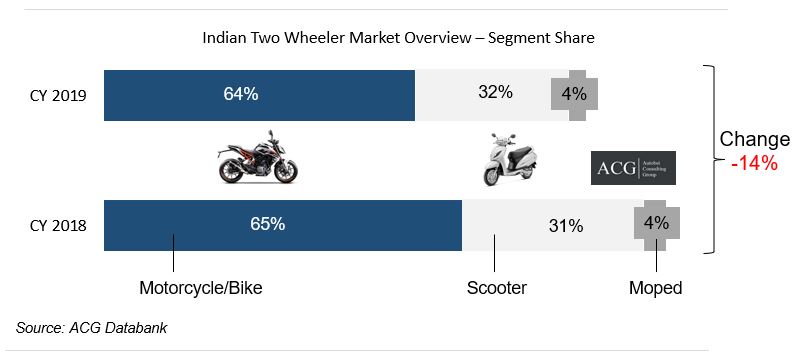
ACG proclaimed the Indian Two-Wheeler Market report 2020 and Forecast. Unquestionably, the Indian Two Wheeler Industry registered 14% degrowth in CY 2019 compared to that of CY 2018. The Motorcycle segment became an underachiever and dropped to 13%, while the Scooter segment to 16%.

Indian Two Wheeler market Overview and Segment market Share

The Rural demand was put under pressure in 2019. Suzuki and TVs Brands grew popular among the Rural market in the Motorcycle segment. The main reason behind the degrowth shall be blamed on the economy’s sluggish growth employment issue and other negative predilections of the market.

Implementation of Bharat Stage VI norms in FY 2021 would shoot the price up to 20%. But, if the OEMs try to implement the same to 2W customers, then eventually, the sales of Two-Wheeler vehicles will land in the slow lane in 2020.

Motorcycle Segment:

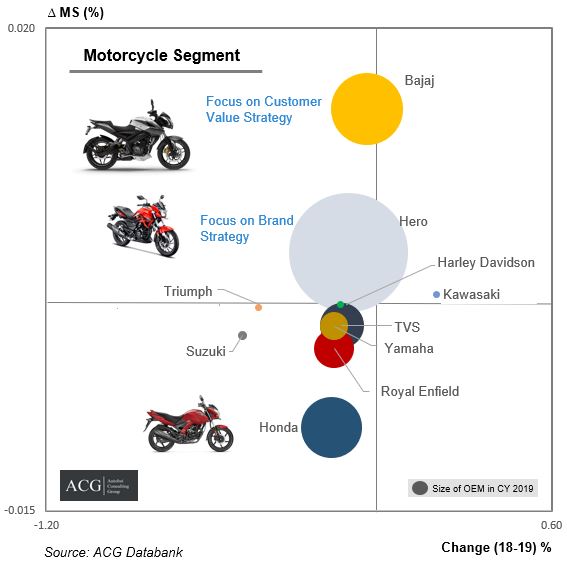
HeroMoto Corp rules around 51% market share of the Indian Motorcycle market. Bajaj, being the second-largest player, increased its market share from 17% to 19% in CY 2019. On the other hand, Bajaj Auto registered the lowest possible degrowth in the Two-Wheeler segment. The Bajaj Auto seems to follow a better Customer value, for the company is giving better features and specs at a given price. Premium Brand Kawasaki registered a 30% growth in CY 2019 compared to CY 2018.

Indian Premium Motorcycle Brand Royal Enfield sales were declined by 18% in CY 2019. Triumph Motorcycle sales were perceived as a 44% fall in CY 2019.

Indian Motorcycle Market Analysis 2020 and OEM Strategy

Scooter segment:

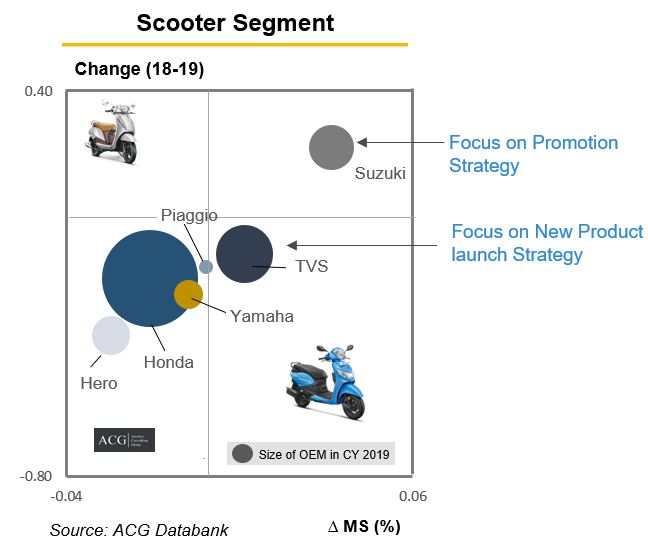
Suzuki and TVS achieved their desired result by the end of CY 2019 with a gain of 4% and 1% market share. Except for Suzuki, all other scooter OEMs recorded negative growth.

Indian Scooter Market Analysis 2020

Compound Monthly Growth Rate Analysis:

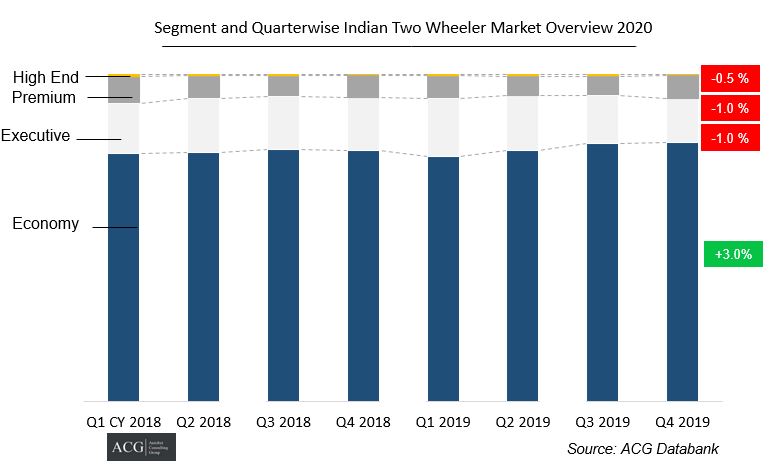
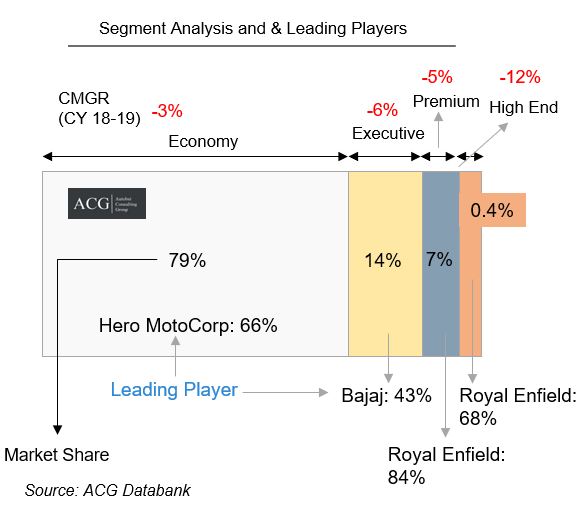
The CMGR of Economy, Executive, Premium, and High-End segment recorded a 3, 6, 5, and 12 percent degrowth respectively. In the last quarter of CY 2019, sales of the Economy segment increased. This segment gained a 3% share in Q4 CY 2019 compared to Q1 CY 2018.

Quarter & Segment wise Motorcycle Industry 2020

HeroMoto Corp, being the leading OEM manufacturer gained a 66% market share. The executive segment was fluctuating in a zigzag manner. Hence, this segment lost a 1% market share. Bajaj Auto turned to be the segment leader with 43% market share. But, on the Premium Segment, they lost a 1% market share. Royal Enfield became the leading manufacturer with 84% market share whereas its high-end segment is almost stagnant.

Segment Analysis and & Leading Players

Key highlights of the report:

  • Indian Two Wheeler market size in Volume and Value
  • Indian Two Wheeler Segment Analysis and Market Share
  • Motorcycle and Scooter Markert Analysis, Sales, Production, and Export Analysis
  • Model wise Specs, Price Analysis, and Features
  • Customer Mapping mapping with Models and Group
  • Middle class, Low income, and Upper-income class customer analysis
  • Top Cities and Key models Sales