ACG released Indian Bus Market Analysis 2020 and Outlook report. It covers all critical areas of the Indian Bus Industry. While the Commercial Vehicle, Two Wheler, and Truck segments reported significant degrowth in CY 2019, the Indian Bus market holds a 2% growth in CY 2019 compared to CY 2018.

Indian Bus Market Overview CY 2019 and Outlook

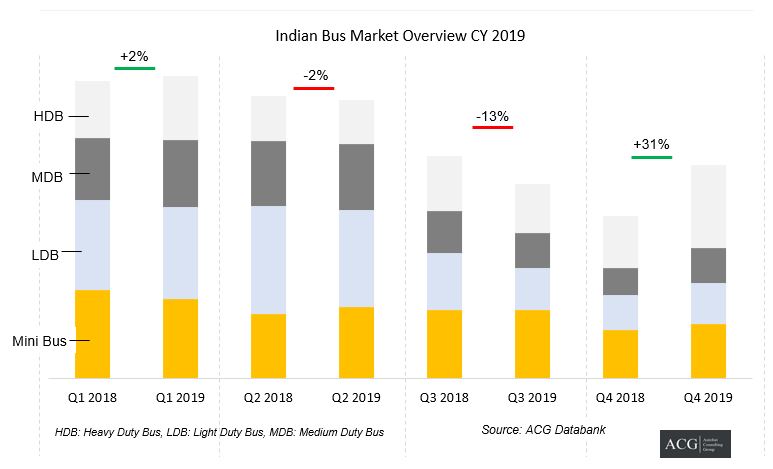
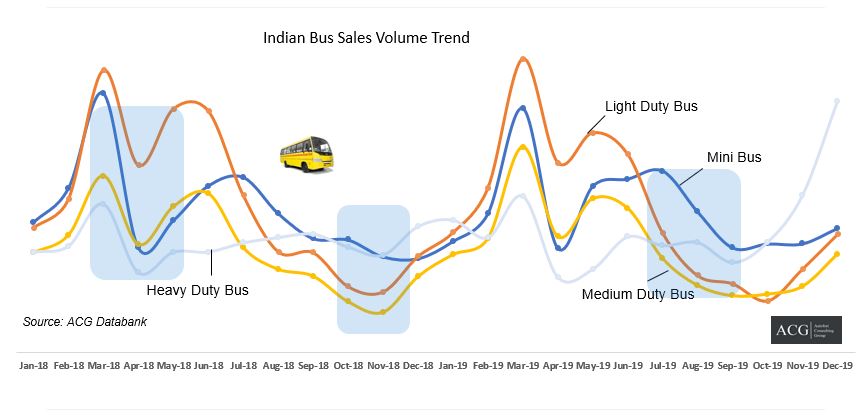
The Indian Bus market size grew to 94,000 units in CY 2019 and it’s observed that Q3 CY 2019 was the worst quarter of 2019. In Q1 CY 2019, only the Minibus division registered degrowth and in Q2 CY 2019, light-duty and heavy-duty bus segments recorded substantial degrowth.

In Q3 CY 2019, all segments attained a downfall but, somehow, in the last quarter of CY 2019, all bus segments showed growth compared to Q3 2018.

Indian Bus Sales Volume Trend Analysis CY 2019

Segment Analysis:

The Bus Industry registered a 2% growth in CY 2019 compared to CY 2018. There are no variations in Mini and Medium Duty Bus segment share, however, Light duty Bus lost a 2% share, and the Heavy Duty Bus segment gained a 3% segment share in CY 2019.

OEMs Market Share Analysis:

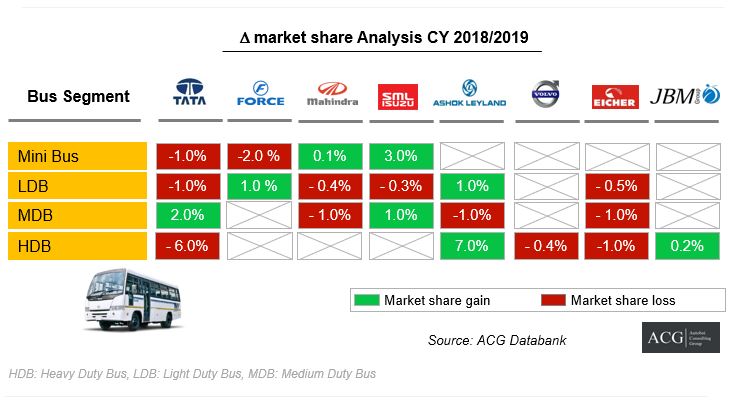
Under Heavy Duty Bus segment, Ashok Leyland gained a 7% market share, Tata Motors lost a 6% Market share, Eicher and Volvo lost insignificant market share in CY 2019. Ashok Leyland registered a 29% growth in CY 2018 compared to CY 2018.

OEM wise Indian Bus Market Share Analysis 2019

Under the Medium Duty Bus segment, Ashok Leyland, Mahindra, and Eicher lost a 1% market share, but SML Isuzu and Tata Motors gained a 1% and 2% market share in CY 2019.

Under Light Duty Bus Segment, Ashok Leyland, and Force Motors gained a 1% market share; whereas Tata Motors lost 1% share, Mahindra, SML, and Eicher as well lost some insignificant market share. And, Ashok Leyland registered an 11% growth in CY 2019 comparted to CY 2018.

Coming to the Mini Bus segment, Market leader Force Motors lost a 2% market share, whereas SML Isuzu gained a 3% market share.

Market Dynamics:

The bus segment works on different market dynamics. Due to inflation rise, Traffic conjunction, upgraded Buses, many commuters began to use public transport for their daily use. STU like BEST, UPSRTC, and State Govt added Bus fleet in their portfolio. E-buses are also proposed by many organizations in densely populated cities like Surat, Bhopal, Delhi, Tamilnadu, and Agra.

Implementation of FASTag plays an important role in the bus preference for Intercity. Companies like Eicher, Ashok Leyland, and Tata Motors launched new bus models with new features & BS-VI emission norms. Now, it’s perceived as the most comfortable mode of transportation by passengers and Drivers.

Regulation:

New motor vehicles following Emission Standard Bharat Stage-IV norms, manufactured before the 1st April 2020 shall not be registered after the 30th June 2020: Provided that the new motor vehicles of categories M and N comply with Emission Standard Bharat Stage-IV norms, manufactured before the 1st April 2020 and sold in the form of drive away chassis, shall not be registered after the 30th September 2020.

There are new announcements declared by the Ministry of Road Transport And Highways on Self certification for Bus body code, Fully built bus, vehicle location tracking, and tourist buses.

Case Study: BharatBenz

Though BharatBenz has launched buses with superior comfort for Drivers and passengers with good pickup. The Bus is most suitable for the School and Staff bus application. However, there are certain issues concerning the growth of this bus. For instance, in case of breakdown, an electronics diagnosis system installed on the bus will detect the problem. However, only limited workers are available on the roadside, and the maintenance cost is high as well.

Key Highlights of the report:

  • Indian Bus Market Size in Volume and Value
  • OEM Strategy Analysis and Market share
  • Top Selling Bus Models and their USP
  • Budget, Premium, and Luxury Bus market Analysis
  • Product Analysis – Product portfolio
  • Fleet operators  survey, Driver Survey, and, Passenger Survey
  • Segment – School, Intercity, Intracity, School, Tourist, Govt, STU, Private, Defence etc
  • Bus market Competitive analysis
  • Segment-wise presence analysis
  • Last 10 years trend and Forecast 2025
  • Lengthwise Bus market Analysis, Size, Market Share
  • State-wise Bus Market Assessment
  • Engine Power, AC, Non AC bus Sales volume
  • Most popular route
  • TCO Analysis of different application
  • Seating capacity wise wise Analysis
  • Manual, Automatic, and Semi-Automatic Transmission market Analysis
  • Bus Business Model

ACG provides different types of Critical and customizes Databases of the Indian Automobile Industry. The database plays an important role to assess the market and segment size, Product Pricing Strategy, Customer Analytics, and segmentation, Business Strategy, Investment decision, Production Planning, New Product launches, Product planning and Product life cycle, Branding Strategy, Marketing Plan, Sales Planning, Competitor Analysis, Financial Forecast, Key Business Decision, Policies, and other key decision.

The following databases are available for OEMs, Auto Components, Financial Institutes, Dealers, marketing Companies, Research & Consulting firms, and other stakeholders.

Who Supplies Whom

  • Model and Segment wise Suppliers Data
  • Vehicle Cost Data
  • OEM Tie Up and/ or Available in Open market

Sales, & Production, and Export Data – OEMs and Model and variants level

  • Car, SUV, and Van database
  • Indian Truck Data – Tipper, Tractor, Rigid haulage, and Special Application
  • Indian Bus Data – Intracity, School (Education Institutes), Staff, Intercity, Tourist, Electric Bus, and Defence
  • Indian Two and Three Wheeler Data – All sub-segments included

Vehicle Product Data: Model-level

  • End Customer Price and Discount – Car, Truck, Bus, Two Wheeler, and Three Wheeler Data
  • Power Train Information
  • Key Technical Vehicle Data
  • Key Features of the Vehicle
  • Best and Worst Features
  • Product Life Cycle

Indian Automotive After-Sales Data:

  • Spare parts Pricelist and margin
  • Supplier of Parts – Distributors, Retailers, and Manufacturers
  • Revenue Data by garage and Company Authorized center
  • Parts Rating based on reliability and Durability
  • Online/Digital market scenario

Electric Vehicle Data – OEMs and Model Level 

  • Sales and production of Car, Electric Bus, Two Wheeler, and Three Wheeler vehicle
  • Pricing Data and incentive
  • City-level Sales Data
  • Electric Vehicle Cluster Sales Data
  • Parts and Battery Suppliers of Electric vehicle
  • Brand perception rating
  • Business case
  • Running Cost Analysis
  • Application wise and Customer segment-wise Potential Sales Forecast
  • EV Cost Data Sheet

To get more information and Customize data, Please contact us.

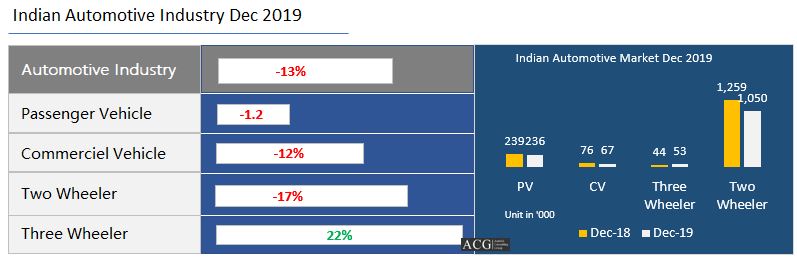
ACG let out the Indian Automotive Industry’s Analysis report Dec 2019. The year 2019 was one of the worst years, particularly to the automobile Industry. Besides 2007 which was then considered, one of the worst years for the Global Auto Industry. Since, in the past year, the Indian Auto Industry has registered 1.4% degrowth. Only SUV/MUV and Three- Wheeler segments showed stable growth. The GDP growth decline, negative impact of the market, negative results of the Macro Economy are all the reasons why the industry witnessed a sudden drop. Due to the implementation of BS-VI emission norms, 2020 is believed to witness an inevitable loss.

Indian Automotive Analysis report December 2019

Govt has announced that it will put money of 100 lakhs crore into the developing infrastructure/construction projects. This would set us free momentarily whilst the worst hit of the commercial vehicle segment. The Dec month is normally perceived as the moderate month for most of the Automotive segments that don’t hit the sales sector. Eventually, OEMs give enormous discounts and run campaigns to fabricate the demand.

Sales: In Dec 2019, Indian Automobile Industry registered 13%, Commercial Vehicle 12%, Passenger vehicle 1%, Two-Wheeler 17% degrowth whereas Three-Wheeler registered 22% growth.

Production: In Dec 2019, Indian Automobile Industry registered 14%, Commercial Vehicle 27%, Two- Wheeler 13% degrowth, Passenger vehicle 4%, and Three-Wheeler 6% degrowth compared to Dec 2018.

Export: In Dec 2019, Indian Automobile Industry registered 9%, Passenger vehicle 10%, Two-Wheeler 22%, and Three-Wheeler 5% growth but, Commercial vehicle accounted for 27% degrowth.

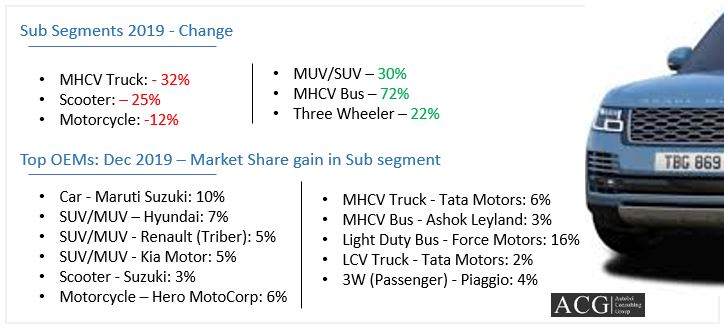
In the Passenger vehicle segment, the car segment showed 8% and Van showed 53% degrowth; on the other hand, the SUV/MUV segment showed excellent performance for it has raised its growth by 30%. This crystal clearly reveals customer preference in the changing pattern.

Sub Segment Analysis and OEM Market Share December 2019

In the Passenger car segment, Maruti gained a 10% market share, Hyundai lost 7%, Honda cars also lost 2%, Tata & Toyota lost 1% market share in Dec 2019 within a period of one year. Ford and Mahindra topped the losers list in terms of degrowth in Dec 19 month comparatively to the same month of the previous year. Suzuki, Skoda, and Volkswagen are the only three players who registered growth in Dec 2019. In the SUV/UV segment, Renault Triber outperformed with its aggressive pricing strategy and grabbed a 5% market share in Dec 2019. In other OEMs, Hyundai, Kia, and MG Motor also accounted for their sales with a positive market share. On the whole, Renault registered the highest growth in its segment of 34.9% growth in Dec 2019. In the MHCV Bus segment, Ashok Leyland increased its segment share from 45% to 48% and Tata Motors lost 2% market share in Dec 2019.

The Medium and Heavy Bus segment registered 72% growth in Dec 2019 compared to that of the Dec 2018 report, which is a good sign for the automobile industry. In the LCV Bus segment, the segment leader, Force Motors regained their fame with 51% market share for growth raised around 86% in Dec 2019 which actually had only 34% segment share in Dec 2018. Unfortunately, Tata Motors lost 12% of its market share. LCV Bus segment showed a 28% growth in Dec 2019 compared to Dec 2018 report. Medium and Heavy Duty truck segments registered 43% degrowth in Dec 2019 compared to that of Dec 2018. In this segment, Tata Motors increased its segment share from 50% to 56%, whereas Ashok Leyland lost a 9% market share in Dec 2019. But Eicher is showed steady growth and gained 3% of the market share in the MHCV truck segment.

Key Highlights of the Annual Subscription report:

  • Monthly Indian Automotive Market Analysis
  • Market Driver and Challenges
  • Key finding
  • Market Share – segment and OEM wise
  • Govt policies
  • Electric vehicle Analysis
  • All major segment Included like passenger Vehicle, Commercial vehicle, Three Wheeler, and Two Wheeler
  • Sales, Production, and Export


ACG released the latest Indian Two Wheeler variant-wise Sales and Product Data.

The Indian Two Wheeler market is the largest Automotive segment in India. More than 19 million Two-wheelers have been produced in FY 2023. The Scooter and Motorcycle segments are too dynamic for new Variants launch and Phaseout variants. Some variants contribute more than 60% of sales of their parent Model and some just 1 percent. Variants target some specific customer groups based on their needs and wants. There are two main categories of Two Wheeler in India:

  • Motorcycle
  • Scooter
  • Moped

Based on Fuel:

  • ICE
  • Electric Two Wheeler

Following are the key highlights of the Scooter and Motorcycle Data:

  • Brand (OEM)
  • Model Name
  • Variant Name
  • Type
  • Segment – Commuter, Executive, and Premium
  • Customer segment – Urban / Rural / Off Road / Racing
  • Engine description
  • No.Of Cylinder
  • Engine in CC
  • Engine – Bore X Strock
  • Engine – Power KW
  • Engine – Torque (In Nm)
  • Max Speed-Km/Hr
  • No.of Valves/Cylinder
  • Engine Management System
  • Variable Valve Timing
  • Kerb Weight
  • Transmission
  • Clutch Type
  • Final drive
  • Engine oil Capacity
  • Final Drive Oil Capacity
  • Front and Rear Suspension
  • Wheel Base
  • Ground Clearance
  • Fuel Tank Capacity
  • Acceleration
  • BS-VI compliant
  • Fuel System
  • Electricals
  • Tyre Size – Front & Rear
  • Brake Type – Front & Rear
  • Product (Model) USP
  • Special Features
  • Warranty
  • Extended Warranty
  • The price difference from BS-IV to BS-VI change
  • Engine oil cost /Lit
  • Replacement Interval in KM
  • Min Maintenance cost

Brands Included:

  • Hero MotoCorp
  • Honda Scooter
  • Yamaha
  • Baja Auto
  • Kawasaki
  • Royal Enfield
  • Suzuki
  • Triumph
  • Harley Davidson
  • Piaggio


This report Importance of small commercial vehicles in last-mile delivery focus on the opportunities the last mile delivery could provide, and common challenges India faces for the same. The current and most popular topic among retailers is last-mile logistics. This is classified into three major sectors, viz. E-commerce, Retail, and bulk goods delivery. These three are considered the prime influencers of last-mile delivery. We mapped these three sectors to the available trucks like Mini, pickup, Three Wheeler, and other electric vehicles.

Additionally, this report will reveal the key parameters that Autobei Consulting Group utilizes to analyze value propositions and why manufacturers, Suppliers, and other logistic companies seek ACG to find the analytics, right marketing strategy, and segment analysis. This segmented analysis of Small commercial vehicles will reveal why there’s a greater possibility for automotive’s financial growth in India.

The E-commerce business is yet functioning on the conventional model of a communication system. Thus, arise the cause for one common communication platform between a customer and fleet operator. We carried out a survey on this and it’s been perceived that 80% of the fleet operators are up for it – to use an application for daily business purposes. One of the reasons why this hasn’t been in practice is ’cause fleet utilization is less than 30%.

Indian Commercial vehicle market Analysis and Forecast 2024

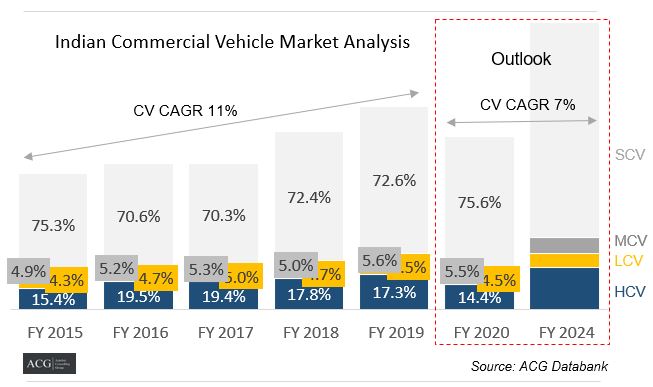
Small or light commercial vehicles are considered to be the largest segment in the automotive industry that encompass commercial vehicles. To be precise, SCV contributes 73% of the total Commercial vehicle sales in FY2019. The compound annual growth rate is computed as a 10% increase from FY2015 to FY2019 and is further expected to raise the CAGR by 8% in the next five years. The market size of the small commercial vehicle segment accounts for USD 3.5 billion in FY2015 and USD around USD 5.2 Billion in FY2019.

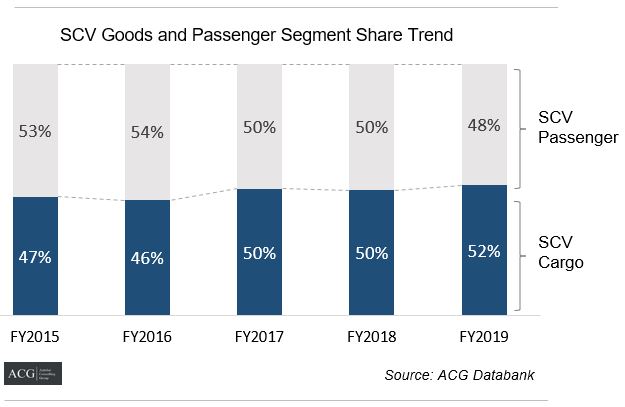
Similarly, Small commercial vehicle’s cargo segment’s share has been increased from 47% to 52% while on the other hand, the passenger segment’s share got dropped from 53% to 48% during the period FY2015 and FY2019. Thus, at the end of the year, Cargo is reckoned as the biggest segment that accounted for around 50% of the total market sales in FY2019.

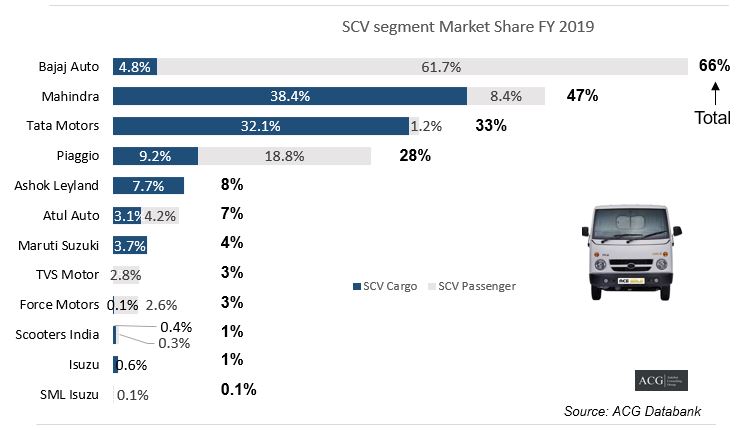
Bajaj Auto, Mahindra, Tata Motors, and Piaggio are the top players in the SCV segment.

SCV segment Share FY 2019

Considering all aspects of logistic vehicles, we’ve drawn the conclusion that three-wheeler goods vehicles will be the best choice for the retail business. The goods transport charge shall begin from 100 – 200 rupees and since the maintenance cost is low for three-wheelers, this has grabbed the attention of consumers in the retail business. It’s believed that these will rule the retail business for its highly feasible for small loads and have got better mileage and a reasonable yet affordable price. One major advantage of utilizing three-wheelers for last-mile delivery is that most of the drivers are owners of their vehicles. This affirms the success of last-mile delivery. On average, it’s observed that a three-wheeler load vehicle would run an average of 50 kilometers and thus tentatively monthly revenue would account for 15,000 to 20,000 rupees. Currently, the 3W cargo is having just 30% of fleet utilization as per our study.

SCV passenger and SCV Cargo segment share trend

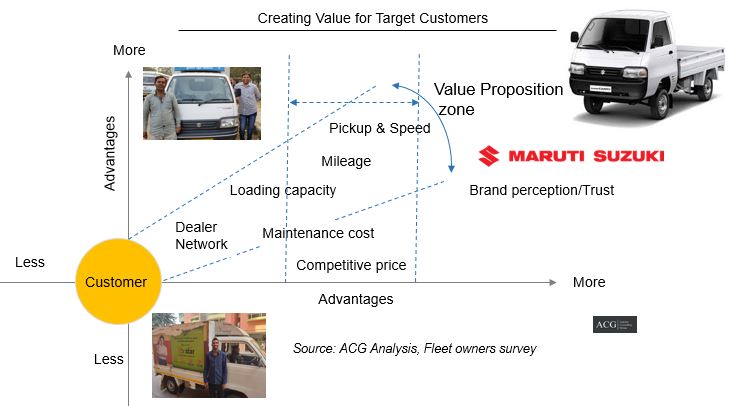
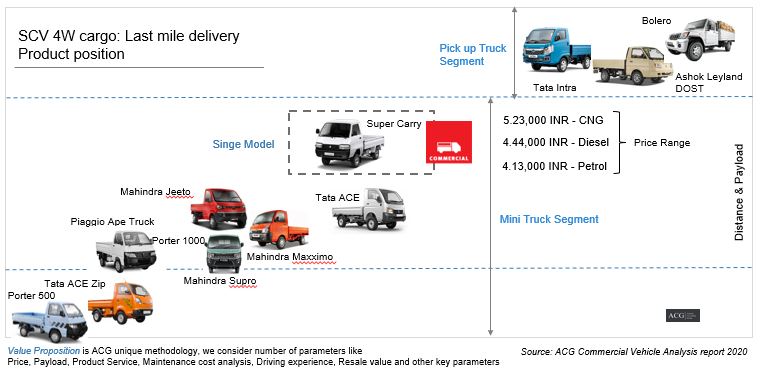
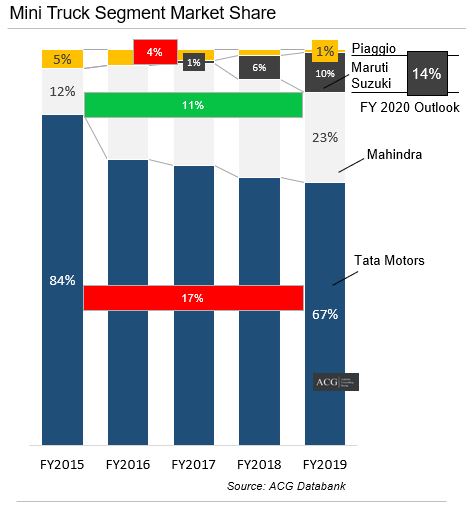
Besides, four-wheeler load vehicles are highly suitable for bulk transportation in its category and long-distance transportation of goods. The average daily distance of four-wheelers in the last mile delivery is around 100 kilometers. The owner of the vehicles would mostly be those who run small businesses. In the last three years, Maruti Super carry raised its share by 10% with just a single vehicle and has tied up mostly small-scale business dealers. It’s expected that Maruti Super carry will acquire a 14% market share anytime soon.

Initially, Maruti offered a 12-inch tire in Super carry. But, this hadn’t pleased the mini truck consumers and eventually, they were destined to replace them every so often. The company identified the issues and began to offer a 13-inch tire.

Maruti Suzuki Super carry Product strategy

The appropriate competitor of super carry would be Tata ACE. These vehicles have satisfactory consumers and people prefer them for the driving comfort it proffers.

SCV 4W cargo Last mile delivery Product position

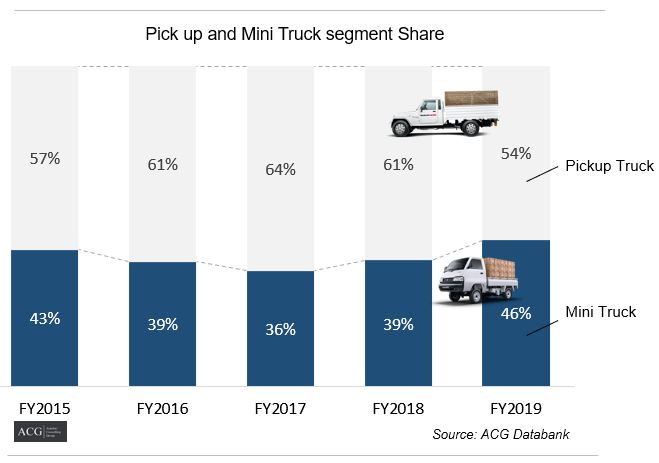
Well, the market dynamics and product availability played a significant role in grabbing a larger portion of segment shares. The large pickups say 2 -3.5T of small commercial vehicle’s cargo segment has managed to grab 54% of the total SCV’s segment shares. On the other hand, passenger vehicles of the SCV segment are reckoned as the highly regulated segment and three-wheelers are reckoned as their tough competitors.

Pickup and Mini Truck segment share

Tata Motors preside over the market in the sub 2T truck category and the SCV Passenger segment as well and the wonders will never cease; Maruti is leading the industry and has pushed the Tata and Mahindra back. Maruti super carry has managed to attract the consumers in India.

Indian Mini Truck Segment Analysis

Indian consumers are mainly opting the mini truck for the overall super carry’s performance is considered as the prime value proposition. To analyze the value proposition in-depth like Price, Discount, Payload, Maintenance cost, number of trips, After Sales Support and others, ACG makes use of a variety of key parameters. The new launch Tata Intra, and DOST performance together inhibit the growth of other light commercial vehicles especially the Mahindra cargo segment (2-3.5T category). However, Tata Intra, fortunately, has managed to attract the Bolero Maxi Truck customers and Ashok Leyland Dost customers (in 2-3.5T category).

Pickup Truck OEM Market share

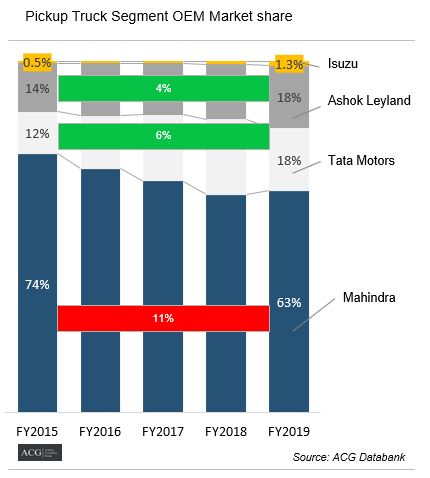
Tata motors have lost 17% of their market share in the past 5 years, whereas Mahindra gained 11% of its share. No matter what, Mahindra Bolero is the first choice of consumers in the pickup segment. Nevertheless, it has lost 9% of its market share from FY2015 to FY2019 due to the other brands, viz DOST, Intra, and Isuzu and it seem that Tata is aggressively trying to grab its market share from Mahindra Bolero.

Autobei Consulting group primarily helps the manufacturers and Suppliers to carry out the market assessment, rural sales analysis, macroeconomic analysis and indeed we make detailed Segment analysis.

Report Highlights:

  • Small Commercial Vehicle Market Size (In Volume & Value), Trend and Forecast 2024
  • Last-mile delivery market analysis
  • Passenger and Goods vehicle Market Analysis
  • Fleet operators types, Business, Challenges, and Opportunities
  • Technology (IoT, Delivery App) Analysis and its acceptance
  • Application of the vehicle
  • Key Models and Price, Sales, Features, and Specs
  • Type of customer in SCV segment
  • Fleet owners Survey
  • Purchase Pattern Analysis
  • Product Portfolio, Product position, and Brand Strategy
  • After Sales Analysis – Model wise maintenance cost
  • Electric Vehicle penetration analysis in SCV segment

ACG released the latest truck buying pattern data for India. We conducted a large-scale survey in every state and Fleet hub in India to better understand Fleet ownership, Truck pattern trends, and forecasts. Our survey included qualitative analysis behind the trend and forecast. The data helps create a blueprint for sales, understanding truck fleet buying trends, target segments, and the business, product, and after-sales strategy.

The survey included the following categories:

  • Single Fleet Owner
  • Small Fleet Owner
  • Medium Fleet Owner
  • Large Fleet Owner
  • Very Large or Corporate Fleet Owner

The percentage split for the above is for the MDT, HDT-Rigids & Tipper, and HDT-Tractor Trailer segments.

Sales and PARC data for 2014, 2015, 2016, 2017, 2018, 2020, 2021, 2022, 2023, 2024, and 2030 are included.

Separate fleet owner data is also available with ~ 35,000 fleet owners.

  • Key person or decision-maker
  • Large Fleet owners’ Details with the number of trucks
  • Company Age
  • Truck and Bus Application
  • Vehicle Type and Brand Mix
  • LCV and HCV product data
  • Major cities are covered

We are releasing the Indian Automotive Report Analysis 2020 with Quality insight and Quantitative analysis. Data presentations and Interpretation gives you a clear picture of the Indian Auto Industry.

2019 was the tough year for Indian Automotive Industry and expected to revive in FY 2021. ACG considers several factors to analyze the market.

Highlights of the report:

  • Indian Automotive Industry size in Value and Volume
  • Key Changes in Industry
  • Current Status of Indian Automotive Industry, Economy, Consumer insight & sentiments, Financial Analysis, and Expected future trend
  • Economy, Budget, and Premium segment Analysis
  • Country Analysis – India
  • Electric vehicle – Three Wheeler, Car, and Two Wheeler
  • Sales, Production, and Export Trend and Forecast
  • Segment: Passenger Car, Two Wheeler, Three Wheeler, Commercial Vehicle, Truck, and Bus
  • Best selling Models Analysis – Sales Volume and Market Share, and their USP
  • OEM wise Sales and Market Share Analysis
  • OEM Business Strategy Analysis
  • Company Analysis
  • Product Portfolio Analysis
  • The new regulation impact analysis like BS-VI on Sales and Price increase
  • New Product launch plan and their impact
  • Chinese players impact on Indian Automotive Industry

ACG released the revised Global Automotive forecast report 2020. Every country and segment is going through different and unique market challenges and opportunities. Following are there are the key highlights of the report:

  • GDP and Overall economy forecast
  • Global Automotive market overview
  • Sales, Production, and Export Data
  • Country-wise Market outlook
  • Electric vehicle forecast
  • Key Segments: Passenger Car, Commercial vehicle (Medium. Heavy and Light Duty), Truck, Bus, Two Wheeler, and, Three Wheeler
  • OEMs/Brand and Model level market trend and forecast
  • Market Dynamics Analysis
  • OEMs Strategy for 2020 and beyond
  • New Models launches strategy, and Impact
  • New Regulations, and its impact
  • Technology Trend
  • Qualitative Analysis
  • Consumer insight 2020

Advantages:

  • Investment plan
  • Human resource management
  • Production and Sales planning
  • Product strategy
  • Marketing plan

ACG has released the analysis report of the Indian Automobile Industry lately in Nov 2019.
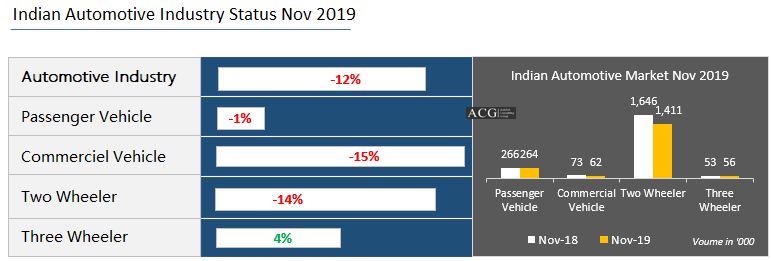
The report subsumed both automotive factors and market dynamics of the Indian automotive industry. The market dynamics embracing qualitative and quantitative analysis are laid out distinctly. The report Nov 2019 bespeak negative growth in all major categories of Automobile industry compared to that of Nov 2018’s report.

Indian Automotive Market Analysis Nov 2019

Sales: By report 2019, Automobile Industry has gauged 12%, Commercial Vehicle 15%, MHCV 26%, LCV 5%, Passenger vehicle 1%, Two-Wheeler 14% degrowth whereas three-Wheeler gauged for 4% growth.

Bus MHCVs and LCV segments recorded 63% and 23% growth respectively on Nov 19 compared to Nov 18. Truck segment is critically suffering which accounted for 33% registrations, which is 5% degrowth on Nov 19 compared to Nov 18.

Production: In Nov 2019, Indian Automobile Industry is recorded for 1%, Commercial Vehicle 16%, MHCV 45%, LCV 3%, Two-Wheeler 2% degrowth, albeit Passenger vehicle is recorded for 4%, and Three-Wheeler 7% growth compared to that of the Nov 2018 report.

Export: By Nov 2019 report, Indian Automobile Industry recorded 18%, Passenger vehicle 20%, Two-Wheeler 22%, and Three-Wheeler 2% growth. While MHCV is registered for 48%, LCV 8% and Commercial Vehicles accounted for 29% degrowth.

Passenger vehicle segment has increased its share from 13% to 15%,
while commercial vehicle and Two-Wheeler Industry has lost 1% and 2% market share respectively in Nov 2019 compared to that of Nov 2018 report.

OEM Performance – Key findings:

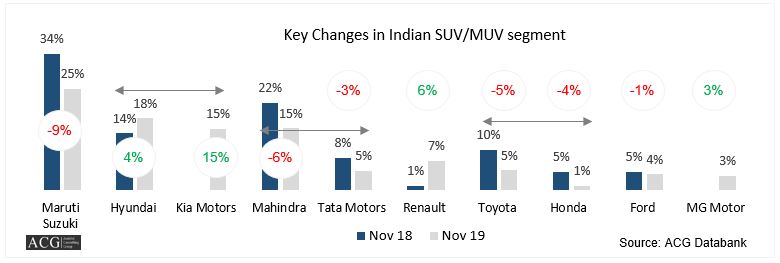
Indian UV Market registered 33% Growth in Nov 2019. Renault Triber begins to be a key model to increase its market share from 1 to 7%. Once Mahindra was imposing the Indian UV market, but now it’s constantly losing the grip and has lost a 6% market share in Nov 2019.

Indian SUV and MUV Market Analysis Nov 2019

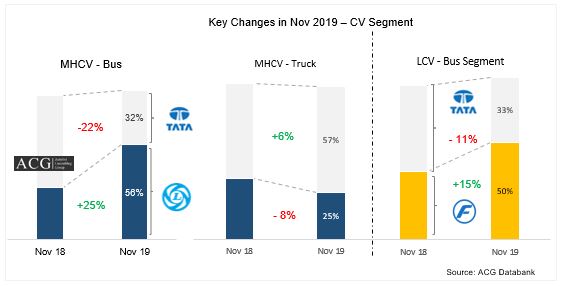
In the MHCV Bus segment, Ashok Leyland increased 25% market share which is an exceptionally excellent upshot, and its nearest competitor Tata Motors lost 22% market share.

Indian Commercial vehicle Market Analysis Nov 2019

In the MHCV Truck segment, Ashok Leyland lost 8% market share whereasTata Motors increased 6% market share. Volvo & Eicher Trucks increased 1% market share as well.

In the LCV Bus segment, Mahindra increased its market share by 15% but Tata Motors lost 11% market share. In the LCV Truck segment, with tenacious advertising, Tata Motors increased its market share by 2%.

In the Two-Wheeler Scooter segment, Honda once again increased its market share and moved from 51% to 58%, likewise Suzuki from 9% to 12% but Hero lost 5% of its market share.

The U.S. car market is one of the largest in the world. Almost all global brands have a presence in this developed economy and mature market.

The overall size of the car, SUV, MUV, and Pickup market was about 17.2 million units in 2018. Ford, FCA USA, and GM Pickup/SUV had a combined market share of 59 % in 2009, which slipped to about 54 % in 2018. The forecast for the car segment for the year 2019 is not quite certain. However, ACG forecasts that the car segment will end 2019 with single-digit degrowth.
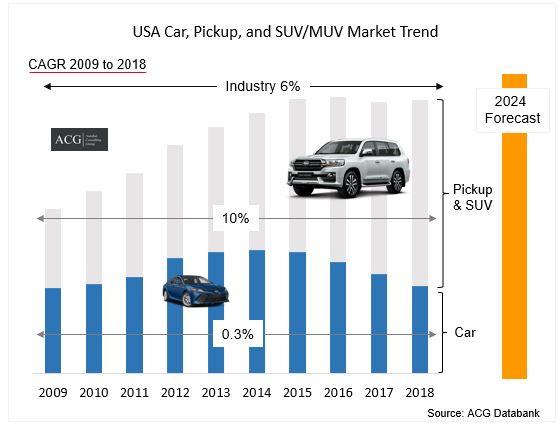
USA car suv muv and pickup market trend and Forecast

Segment-wise Market Forecast:

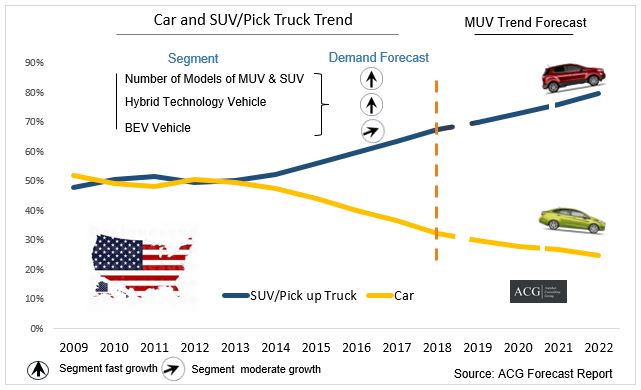
Safety and comfort for the family are the key reasons for the adoption of the MUV vehicles, multiple purpose suitability of Pickup truck, and lifestyle. In the next five years, MUV will certainly be the first choice of major customer groups. The average distance covered by the Americans is about 14,000 miles per year, as mentioned by the U.S. Department of Transport. This is one of the major reasons as to why Americans prefer bigger vehicles. SUV MUV and Car forecast of US market
GM, Ford, and Toyota are the top 3 OEMs Group in the U.S. :
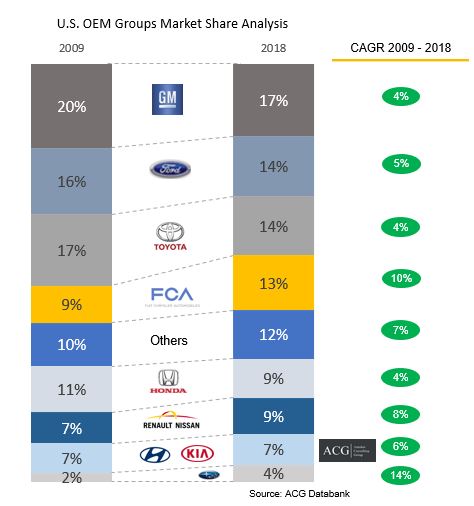
US car market share by OEMs Group

It looks that Detroit is in the grip of a car recession that is marked by the collapse in the demand of traditional sedans, other types of car bodies which accounted for 52% of the market about 10 years ago. The buyers have made a mass exodus out of the classic family cars, and into the sport utility vehicles or the SUVs. The top-selling car models like the Honda Accord and the Ford Fusion marked a record low of more than 25% of the total sales in the United States in the year 2018, and things will only get worse. The customer experienced that they are getting a better value proposition in MUV vehicle irrespective of the price tag.
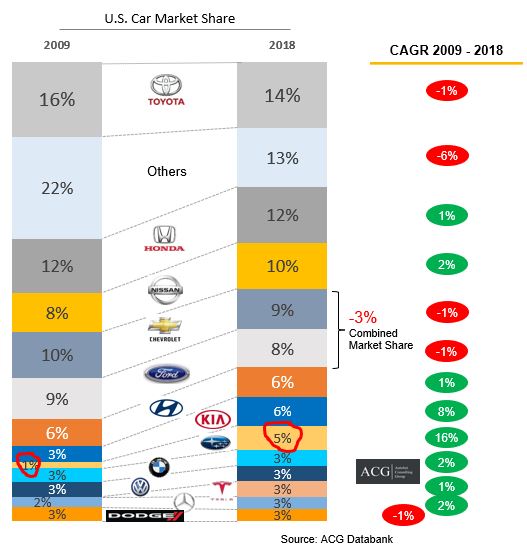
US Car Market share and CAGR analysis

Industry Trend Analysis:

We have carefully examined the influence of the vehicle attributes, brand loyalty, Product portfolio, product line characteristics, emotions, as well as dealerships. We have found that nearly all of the loss in market share for U.S. manufacturers can be explained by the changes in basic attributes of the vehicles such as price, size, power, operating cost, resale value, reliability, transmission type, and body type. The US manufacturers have improved the attributes of their vehicles but not as much as compared to the Japanese and European manufacturers which are exactly why the result.

The Japanese automakers are manufacturing light trucks in the United States for the avoidance of tariff and the introduction of the minivans, SUVs, and pickups, while the European premium OEMs are entering into SUV segment also.

GM, Ford, and Toyota, Honda are all losing their market share in the last 10 years in the Pickup and SUV segment. By launching new models and offers, Nissan and FCA USA are increasing their market share of the light truck/SUV segment.

Rate of unemployment, the sentiment of consumer, disposable income, and availability of credit are the positive key supportive indicators of the U.S. Auto market. The recent data clearly shows that the car industry is going to down by about 1 to 2 % in the year 2019. The overhang of tariff wars, as well as the buying pattern move for the used cars, has some impact on this downfall, but it is not the key reason.

ACG analyzed what is the impact of new technologies like driverless vehicles as well as the preferences of millennial and Gen Z consumers, new regulations which are the contributors in the driving of the future demand.

Now, the point to stress is to what are the factors that are influencing the U.S. car industry. ACG developed a completely new research model that combines macro-level qualitative as well as quantitative factors. Now, for seeing the broader and macro-level picture, we have considered several other factors such as customer expectation, changes in their needs and their wants. The customers, technology as well as the Industry structure are changing at a rapid pace which are also to be kept in mind. The auto industry of the U.S. is also going through disruption and it is essential to redefine the mobility frame.

There are some customers who also prefer to buy the used vehicle or simply take it on lease or rental. The United States of America is having multiple ethnics in the country with several Asian and American origin people. Each of them follows different criteria for buying the vehicle. Asian people prefer Japanese vehicles whereas, on the other hand, the American people prefer the Pickup and SUV of American origin of the U.S. like FCA USA, GM, and Ford.US Car market Gap analysis - Japan, German, and US OEMs
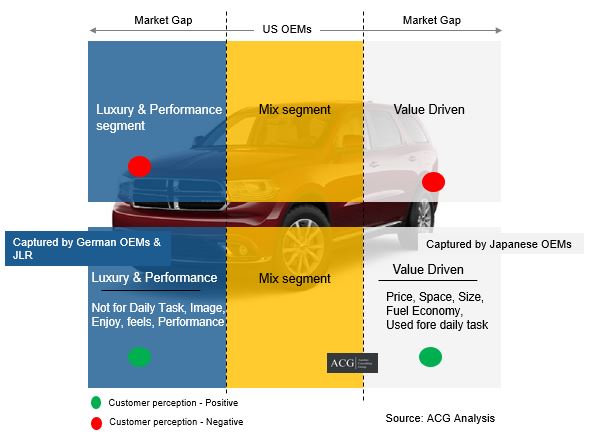
In the year 2009, the car segment was having about 52 % segment share which has come down to about 32 %. SUV, MUV and the Pickup segment had about 48 % segment share which gained about 20 % market share in the year 2018. The choices of the customers are shifting towards SUV and the Pickup segment slowly. We spent a lot of time among customers in the U.S. for a clear understanding of their pulse for knowing the exact reasons behind this shifting trend. The customers themselves became advocate to recommend other customers to go for the SUV/MUV/Pickup vehicles.
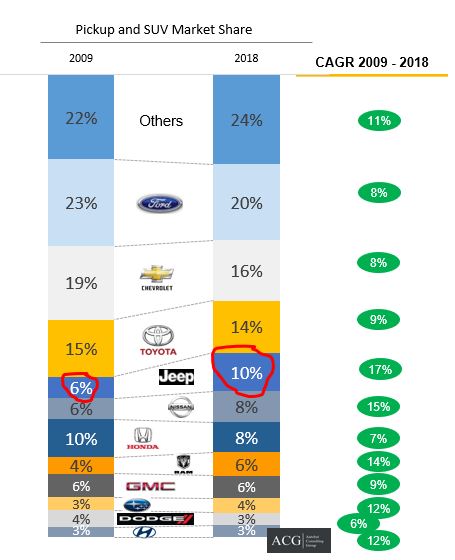
Pickup and SUV market share and CAGR in US market

Now, there is the new trend of the expectation of the customers that are required to be added in customer preference that is the introduction of new technology such as connected vehicles, great digital experience, and autonomous vehicles. The OEMs should make it a point to add these features in their product portfolio. These features not only attract new customers but also plays a vital role in helping the brand to shine and position appropriately.
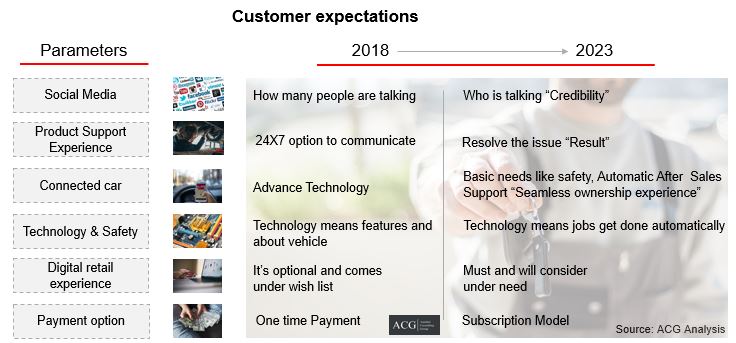
Customer Communication and purchase pattern analysis in US Automobile market


The car market of the United States is a classic example of where “Value” is more important that “Price tag”. The top ten vehicles of the market are having inversely proportional relation with the volume of sales with some minor exceptions.

The buying of the new car is probably the next big investment after real estate. So, people give a lot of preference for value and not price. The vehicle here is not only the technical subject but also the emotional aspect as well since most of the customers associate emotions with the same as well.
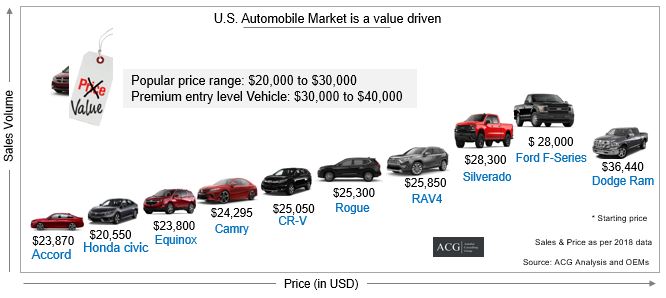
Best selling car and Pick up model in US

The car market of the United States is in transition state and OEMs, suppliers, as well as other stakeholders, need to have a clear understanding of the pulse of market movement. This, in turn, is quite helpful to create business strategies for the next ten years. In the next ten years, the U.S. automotive industry will get a new shape.

Customer Perception and The Customer of The Future:

Japanese and Korean automakers have developed a perception for the manufacturing of affordable cars with a value pricing strategy that comes with the latest technology, advanced features, reliable performance, and striking exterior and appealing interior with competitive prices. Premium car but at affordable price. The automakers of the United States may have lost the market share because of the low-value proposition of their cars and brand loyalty of the customers towards the Japanese and European automakers.

ACG did not conduct any survey but discussed with the customer to read between the lines and get the pulse of the customers. Most of the U.S. customers are ready to adopt autonomous vehicles if they are convinced that these autonomous vehicles technology is safe and secure enough for operating on their own.

Tesla, on the other hand, registered excellent growth. It added 2 % thereby an increase from 3 % to 5% market share in the year 2018 that is in just one year. The reason behind this growth was due to its customer attraction of electric technology, screen display and a number of other good features whereas the other OEMs were not offering such features by that point of time in 2018. After the year 2018, all the other OEMs also started to offer most of those features in their vehicles and as a result of which the charm for the Tesla vehicles became weaker as per the study conducted by ACG.

As per the ACG customer survey, more than about 80 % of the younger millennials cite technology and infotainment features as the ‘must-haves’ at the time of purchasing a car while on the other hand, 61 % of car buyers use video for research. The key to a successful car marketing campaign is creativity for tugging on the heartstrings of the customer and be memorable.

Brand Strategy:

It is essential for the OEMs to create the future of a car brand that has several unique & different attributes rather than the traditional attributes. The OEMs that have a stronghold in software & hardware technology, Understanding Customer needs, deliver a simple solution of a complex issue, and Personalized communication will be considering the key attributes for the definition of a car brand.

Saying 50- or 100-years legacy will not be a catchy word in this regard. Brand loyalty is inextricably related to developing, maintaining, as well as protecting the market share. Mannering and Winston (1991) found that a significant fraction of GM’s loss in market share during the 1980s could certainly be explained by the stronger brand loyalty which the American customers developed toward Japanese vehicles as compared with the loyalty that they had for American vehicles.

Product strategy:

The OEMs need to create the product strategy in three phases

  1. Short term
  2. Medium-term, and
  3. Long term strategy

Every section has its own impact on its market share and creates a base of loyal customers. The most basic attributes of new vehicles such as price, size, power, operating cost, reliability transmission type and the type of body are changing and they influence the purchase decision.
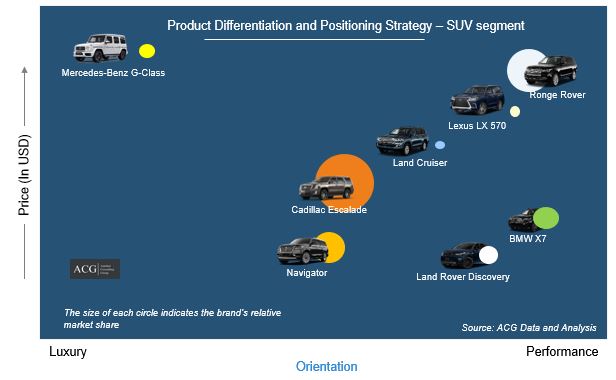
US Car Market Product position

Economic theory suggests that the product line rivalry might be an important feature of competition in the market of the passenger vehicle. This is because the customers have very strongly varying preferences. These preferences can be met with a shorter product life. ACG analysts stress the fact that it is of immense importance for the automakers to develop attractive product lines that can anticipate and very quickly respond to changes in the preferences of the customers.

The Japanese automakers had a short product life cycle so that the new technology, and features, can be integrated easily, and quickly in the new product portfolio. Ford also realized the same and has a plan to launch new products with a shorter product life cycle from the years 2020 to 2023.

The introduction of key features such as tire pressure sensor and transmission knob by the automakers creates a lot of buzzes which in turn plays a crucial role in the acceleration of the sales.

Auto Movements in the United States:

The automakers of the United States are facing several issues in the domestic market. The OEMs such as General Motors had decided to close their five plants in North America for which about 14,000 workers lost their jobs. Most importantly, as a result of this decision, some models are also discontinued.

On the other hand, the German and Japanese OEMs investing in the market of the United States because it is the second-largest car market and quite attractive for foreign OEMs as well. The customers have welcomed foreign brands because of the fact they deliver good value.

The OEMs are focusing on electric vehicles, autonomous vehicle and the development of cars that are well connected with digital technology. For the purpose of winning such challenges, the companies are investing, making JV, alliances, and mergers with the other OEMs as well as technology companies such as Microsoft. In the present scenario of the market, the life of the technology and products are quite short. The OEMs also need to invest in a clear and complete understanding of the customers and what exactly do they want. The customers are certainly at the center point and play a crucial role in affecting all of the other parameters. The OEMs need to create a joint venture for the short term objective.

In recent times, Toyota and Tesla signed the partnership contract with Panasonic for the development of Li-ion battery for the electric vehicles and a VW Ford partnership for the development of the pickup trucks and Vans. On the other hand, Honda and GM came together along with the Toyota and Mazda joint venture for the purpose of developing autonomous vehicles. FCA and PSA have confirmed that they are doing a 50/50 merger for the purpose of developing the new technology to jointly developed Electric vehicles and advanced front-wheel-drive platforms to be integrated into the cars for the U.S. market.

These JV/Alliances also clearly indicated that the brand position, image as well as the reputation play a much more important role in the buying process as compared to the specifications and features of the products.

Key Highlights of the report:

  • The U.S. Car, SUV, Pick up, and MUV market trend and Outlook
  • Value, Premium, Luxury, and Sports & high end
  • The market size in volume and value
  • Market Forecast
  • Key Drivers of the Industry
  • Macro Economy Analysis
  • New Regulations and its impact
  • Customer preference and choice
  • Customer buying process
  • Customer feedback
  • Product Strategy, Position, Differentiation, and Product life cycle change
  • Price and Segment Analysis
  • OEMs Strategy Analysis
  • Brand perception and Strategy
  • Advertising impact on purchase – Digital, TV, and Print
  • Customer preference analysis of value, Premium, Luxury, and High-end cars

Please send your requirement to nidhi.singh@autobei.com for customizes reports.

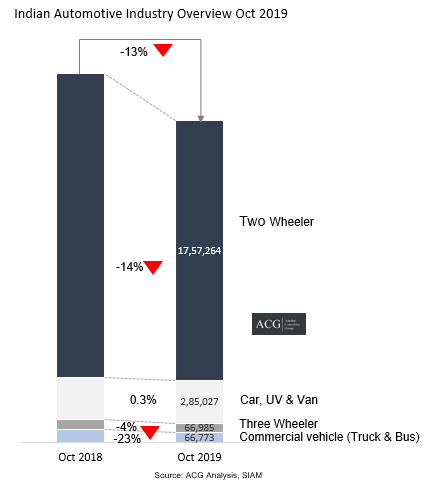
Indian Automotive Industry total sales declined by 13 percent to 21,76,136 units in October from 24,94,345 units, Production declined by 26 percent, and Export registered 2.7 percent growth during the corresponding month of the previous year.

Indian Automobile Market Analysis October 2019

Indian Passenger vehicle sales of 2,85,027 units in October 2019 marginal growth as compared to the same month in 2018.

Truck and Bus sales were down 25%, and 2% from last October to 61,819 and 4,954 units, while commercial vehicle sales declined 23% to 66,773 units. STU Bus order gives some space to take a breath for CV Industry in this slowdown.

Two Wheeler and Three Wheeler sales were down 14% and 4% to 17,57,264 and 66,985 units in October 2019 compared to the previous year.

In Passenger Vehicle, Maruti Suzuki increased market share from 55% to 61%, and Toyota 1%. Hyundai lost 2% market share, Honda 1%, Tata Motors 2%. Other players like Nissan, Renault, Fiat, Mahindra lost market share in October 2019 compared to October 2018.

Ford showed 56% degrowth which was highest in this segment. On the other hand, Toyota registered a maximum positive growth of 35% in Festive month in October 2019 compared to October 2018.

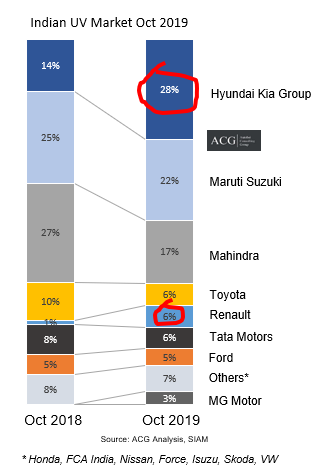
Indian MUV Market Analysis October 2019

In the Utility vehicle segment, Kia and Hyundai group sales in October 2019 were up 144% and market share increased from 14% to 29%, Market leader Maruti Suzuki lost 2%, Renault Triber helped the company to add 5% market share, MG Motor also captured 4% market share in October 2019.

Our latest Customer buying behavior showed that SUVs of Kia and Hyundai target different customer groups. There is no internal competition within a group.

Get our Annual Subscription for critical monthly Indian Automotive Analysis.

Key Highlights of the Annual Subscription:

  • Monthly, Quarterly, half-yearly, and yearly Automotive Market insight
  • Segment Car, SUV, MUV, Van, Two Wheeler – Scooter, Motorcycle, and Moped, Commercial Vehicle – Truck (Mini, Pickup, LDT, MDT, HDT, Tipper, Tractor Trailer, Rigid haulage), Bus – Application-wise, length and GVW wise, Three Wheeler – Cargo & passenger, and Electric vehicle
  • Market Forecast & Demand Analysis
  • Current Market scenario
  • Newly launch product impact and coming up product
  • Pricing Analysis
  • After Sales Analysis
  • Campaign Analysis
  • Customer purchase pattern
  • Sales, Production, and Export
  • Brand Analysis and Market share analysis
  • Business and Market Strategy review
  • Macro Economy indicators analysis

Customize Annual Subscription also available as per requirement.

India Lubricants Market Analysis is our latest set of critical data of Lube oil, Automobile Industry, and Qualitative market dynamics.

Following are the key highlights of the Engine Oil Data and Report:

  • The segment covered: Commercial Vehicle (Truck & Bus), Passenger Car, andTwo Wheeler
  • Engine Oil
  • Transmission and Hydraulic Fluid
  • Gear Oil
  • Other Product Types
  • Segment and Model wise Sales and Production data and forecast
  • Sump size details
  • Engine Platform
  • OEMs lube recommendation: Viscosity Grade and performance level – Oil Brand, Grade, and price
  • Replacement Interval
  • Distribution strategy
  • Customer psychology to buy lubes
  • Customer satisfaction
  • Purchase criteria
  • Distribution strategy of lubes suppliers
  • Brand perception
  • After Market dynamics