Ashok Leyland holds around 17% of India’s truck and bus market. Everyone knows the model names. But our data shows which variants actually carry the volume.
That is what Ashok Leyland variant sales data shows. The answer is narrower than most people expect. Here are two examples, one pickup and one bus.
Truck Segment: Bada Dost, one variant leads every series
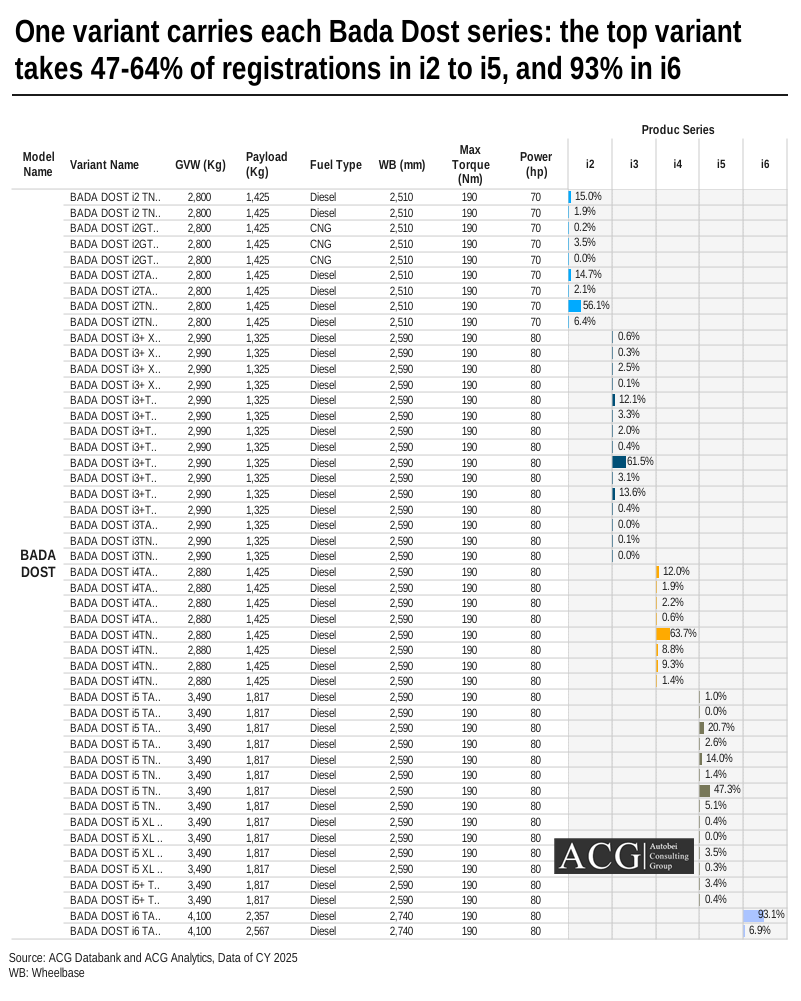
Bada Dost looks like a wide range. There are five series (i2 to i6) and dozens of variants. In practice, each series runs on one hero variant.
- In i2, i3, and i4, the leading variant holds 56%, 62%, and 64% of its series. i5 is the least concentrated, at 47%.
- The top three variants take 82-87% of every series. Everything below them is a long tail of variants with 0-5% each.
- i6 is the extreme case. Two variants split the series 93% to 7%.
- CNG exists only in i2, and it is marginal at under 4% of the series.
Within a series, GVW, payload, wheelbase, torque, and power are identical. The split comes from body type, trim, and configuration.
Meanwhile, the payload ladder explain you who buys what. Rated payload runs from 1,325-1,425 kg in i2 to i4, to 1,817 kg in i5, and 2,357-2,567 kg in i6. All series use the same 190 Nm torque, with 80 hp (70 hp in i2).
Bada Dost is a cab-over pickup built for buyers who have outgrown a small pickup but don’t want a small truck’s running costs. Typical applications are intercity freight, high-volume local distribution, and loads that fill the deck before they hit the weight limit. Its closest rivals are the Tata Intra and the Mahindra Bolero/Maxx. Both are strong, but the Bada Dost goes after the heavier end of that segment.
Bus Segment: MiTR, school and staff buyers choose differently
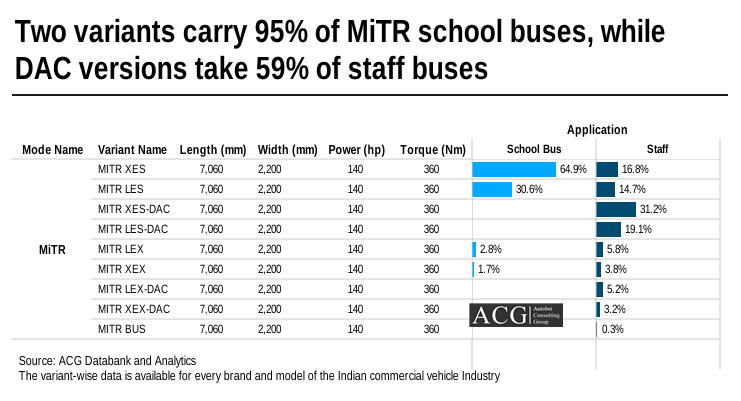
Every MiTR variant shares the same length (7,060 mm), width (2,200 mm), power (140 hp), and torque (360 Nm). The vehicle is the same, but the buyers are not.
School bus
- XES takes 64.9%, and LES takes 30.6%. Together, that is 95.5%.
- LEX and XEX share the last 4.5%.
- None of the DAC variants appear in school buses at all.
Staff bus
- The DAC variants take 58.7% in total. XES-DAC alone is the largest at 31.2%, and LES-DAC adds 19.1%.
- Plain XES and LES come next at 16.8% and 14.7%.
- The base MITR BUS is just 0.3%.
In short, school operators buy a narrow range, while staff operators spread across nine variants. Even so, the XES and LES families (with and without DAC) account for 82% of staff buses.
Why variant-level data matters
A model-level number only tells you how big a nameplate is. Variant-level data tells you what is really selling.
- OEMs and dealers see which variants to stock, price and push.
- Suppliers can size component demand per variant, not per model.
- Financiers can price residual values on the variants that actually trade.
- Investors and consultants can read product mix and strategy, not just totals.
These two charts are one pickup and one bus. We cover every brand, model, and variant, including specs, price, application, and parc data, in Excel and in deep analytics form.