When people decide on an electric car, they think in two ways. One way is quick and runs on feelings. The other is slow and runs on numbers.
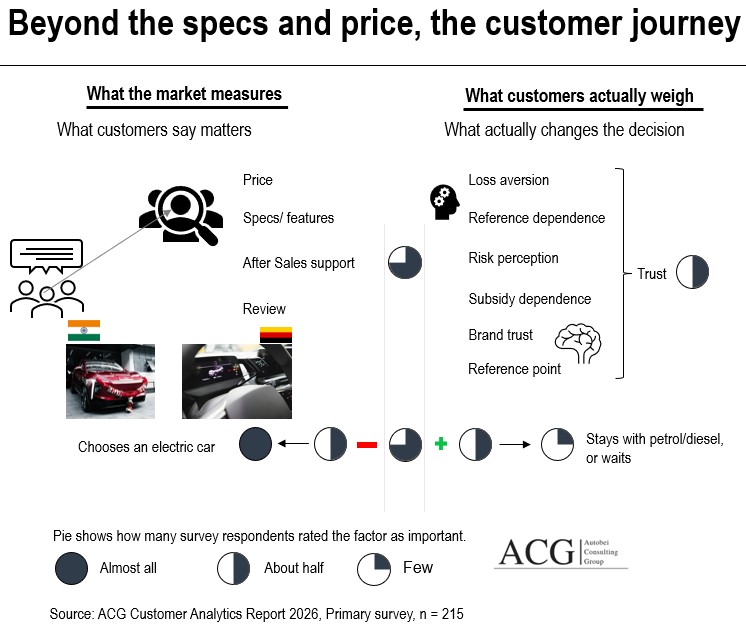
The market mostly looks at the slow way: price, specs, features, after-sales support and reviews. These matter, but they only bring the customer to the door.
What decides the “no” is hidden. It is the fear of losing money, the habit of comparing with a petrol car, scary stories, doubt about subsidy, and trust in the brand. All of these come down to one question: “Can I trust that this will work out for me?”
So most customers don’t say no to the electric car. Instead, they stay with petrol or diesel, or they wait. We see this pattern in both India and Germany.
Two ways customers decide
Every buyer decides in two ways, often without noticing.
The quick way is the gut. Within a second, it reacts with feelings, stories and whatever comes to mind first. Questions like “Will I regret this? What will people say? Do I trust this brand?” come from here.
The slow way is the calculator. It takes effort. It asks, “Does the extra price pay back? What do the specs say?”
Two things matter here. First, most buyers don’t use the calculator unless they have to. They accept the story the gut gives them. Second, when a question is hard, the gut quietly swaps it for an easier one. “Is an electric car right for my life in the next five years?” becomes “Do I feel safe with it?”
An electric car is a big, new and unfamiliar purchase with many unknowns. This is exactly where the gut takes over.
Interest is high until a price appears
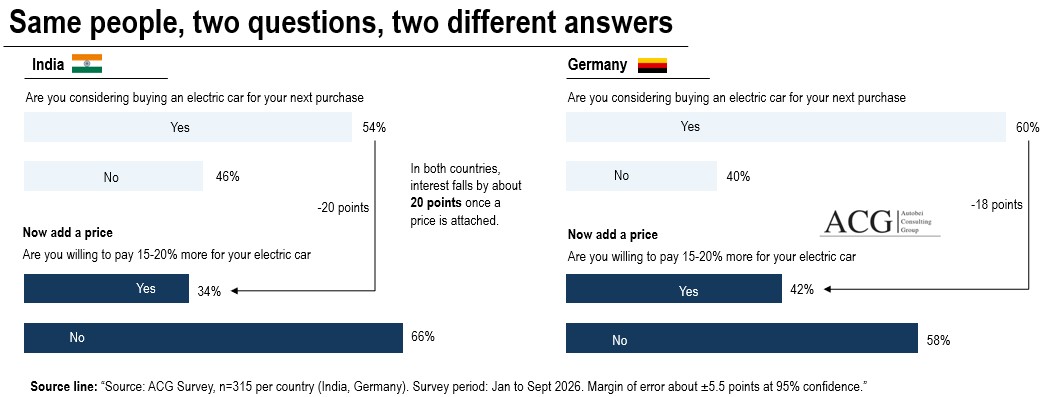
To see this in numbers, we asked the same people two questions. We surveyed 315 people in India and 315 people in Germany between January and September 2026.
- Are you considering buying an electric car for your next purchase?
- Are you willing to pay 15–20% more for your electric car?
In India, 54% are considering an electric car. However, only 34% are willing to pay 15–20% more. That is a drop of 20 points.
In Germany, 60% are considering one. With the higher price, 42% still say yes. That is a drop of 18 points.
In both countries, interest fell by about 20 points once a price appeared. Saying yes to the idea is easy. Saying yes to the price is much harder.
Key insights: what really decides the “no”
The market measures what is easy to measure
Price, specs, features, after-sales support and reviews are easy to ask about and easy to compare. Customers will say these matter, and they do. But they are not what ends the decision.
The “no” is made on the hidden side
Customers rarely name the hidden factors. Still, these factors push the decision towards “stay with petrol or diesel, or wait”. Customers feel them, even when they can’t explain them.
A loss feels bigger than a gain
An electric car usually costs more today and saves money later. The extra cost is certain and comes now. The saving is uncertain and comes slowly. So even a customer who agrees that “it pays back” can still feel the extra cost more.
Nobody judges the price alone
Customers always compare with something, usually the petrol car. They think, “petrol price plus extra.” The first comparison they make sets the feeling of fair or expensive.
Scary stories feel more likely than they are
People judge risk by what they remember, not by what is common. One strong story about a fire or a breakdown stays in the mind longer than a hundred good experiences.
A subsidy can make the price feel unreal
When the price depends on a subsidy, customers ask, “Is this the real price? Will it last?” If the subsidy changes, their comparison point moves, and the electric car suddenly feels more expensive. Some customers prefer to wait and see.
When unsure, customers lean on trust
Brand trust is the shortcut people use when they can’t check everything themselves. After-sales support and reviews are really the visible side of the same thing. They matter because they build trust.
What this means
Interest is not intent. A customer who says “I’m considering it” has not decided anything yet. The price question shows how much of that interest is real.
A small price gap is enough to lose many people. We did not test a big premium. Even at 15–20%, most people in India said no, and so did most people in Germany.
The “soft yes” group is the real opportunity. These people like the idea but hesitate when money comes in. They don’t need more specs. They need to feel safe about the decision, and that is about trust, risk and what could go wrong.
India and Germany look alike. The pattern is the same in both countries. The small differences between them are within the margin of error, so we do not claim that one country is more eager than the other.
A customer chooses an electric car when the reasons to buy are stronger than the hidden brakes. Most of the time, the brakes win, and the answer is “not now”, not “never”.
The answer to a hidden fear is not one more spec. Instead, it is something that makes the customer feel safe: a clear promise, honest information, and proof from people they trust.
Customers know electric cars, but not deeply enough
We asked the same people one more question. Do you know about electric car technology as well as you know about petrol and diesel cars?
Most said yes: 70% in India and 56% in Germany. However, when we looked closer, they know only the basics. They know the car runs on a battery, and they know the running cost is low. Their knowledge stops there.
Petrol and diesel cars feel different. People have lived with them for years. They know how these cars behave and what they cost over time. With an electric car, they can’t make the same comparison.
So the decision stays unfinished. Basic knowledge is enough to create interest. It is not enough to feel safe about buying. To overcome the hidden fears, customers need much deeper knowledge.
This gap is where many “not now” answers come from. The full report shows how to close it.
Customers know electric cars, but not deeply enough
We asked the same people one more question. Do you know about electric car technology as well as you know about petrol and diesel cars?
Most said yes: 70% in Germany and 56% in India. However, when we looked closer, the knowledge was shallow. In both countries, about half of the people only know the key information about electric cars. They know the car runs on a battery, and they know the running cost is low. Their knowledge stops there.
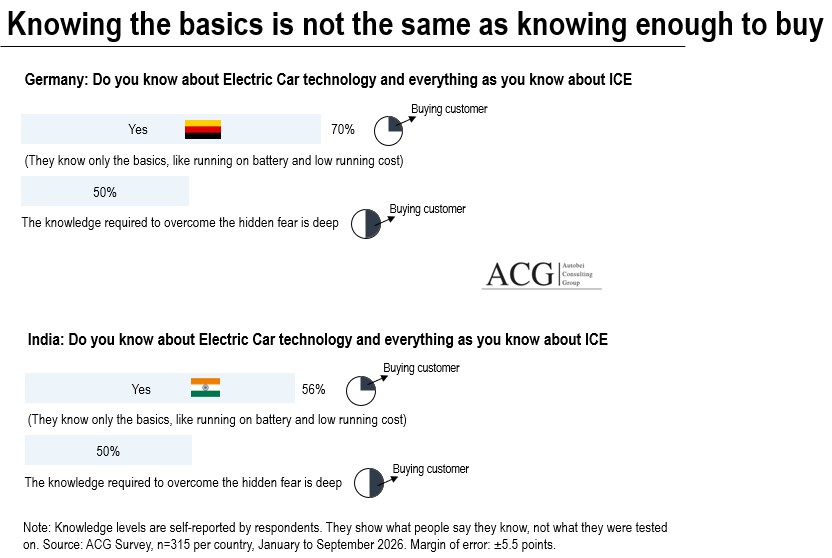
Petrol and diesel cars feel different. People have lived with them for years. They know how these cars behave and what they cost over time. With an electric car, they can’t make the same comparison.
So the decision often stays unfinished. Basic knowledge is enough to create interest. It is not enough to feel sure about buying.
Knowledge does not decide everything, though. A person who knows the technology does not always buy. A person who knows little does not always say no. Some buyers have the money and want the status, so they buy without knowing much. However, these cases are small.
For most customers, a gap in knowledge is one more reason to say “not now”. The full report shows how to close it.
Chinese brands in Europe: stop selling on “cheaper”
Chinese OEMs have a familiar playbook. Enter a market with a lower price and win share. In many industries, this works.
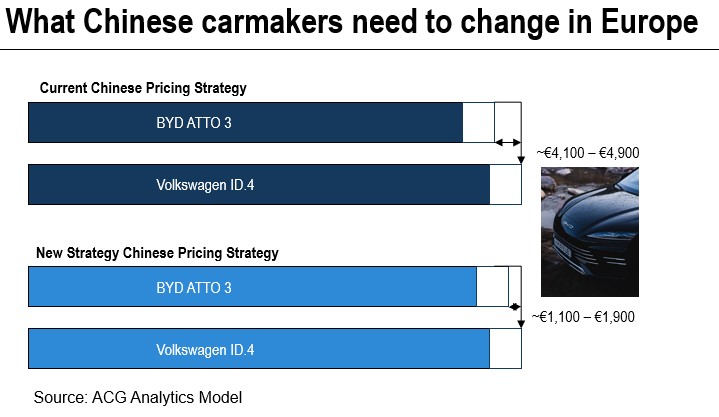
For electric cars in Europe, it works less well. The BYD Atto 3 sits about €4,100 to €4,900 below the Volkswagen ID.4. That gap is the old strategy in one picture.
Earlier in this article, we showed that price and specs are not everything. They are the visible part of the decision. They bring a customer to the door, but they don’t close the sale. The “no” is made on the hidden side: doubt, comparison with petrol, and trust in the brand.
A low price speaks only to the visible side. It does nothing for the hidden side. In fact, it can make things worse. A very cheap electric car can make a buyer ask, “Why is it so cheap? Can I trust it?” Customers in this segment want a car they can rely on. They are not looking for the cheapest one.
Every customer also has a limit on what they will pay. Price is only one thing behind that limit. Brand name, service and what the customer expects from the car move it too. So a business should start with what customers are willing to pay and work back to the price. “How cheap can we be?” is the wrong first question.
A big gap also leaves money on the table. If customers already trust the car, the lower price gives away margin for nothing. That money could pay for the things that build trust: warranty, service and dealer support.
The new strategy on the slide closes the gap to about €1,100 to €1,900. This is not a call to simply charge more. Our survey shows that even a 15–20% premium loses many people. So a higher price needs proof behind it:
- A clear and long warranty
- Visible service and repair support
- A believable answer on what the car will be worth later
- Honest information on how the car performs over the years
In short, Chinese brands should compete on being trusted, not on being cheap. Price should follow trust, not replace it.
This article is a short version of our full report. The full report goes deeper into the hidden factors, how they differ between India and Germany, and what carmakers can do about them.