Nobody can test a truck tyre before buying it. The tyre carries the load, the driver, and the delivery schedule for months. The verdict comes only after thousands of kilometres. So fleet owners do what most of us do when proof is slow. They ask someone they trust.
That’s why trust in truck tyre brands is built by people, not advertising. A brand becomes trusted when the most experienced person in an owner’s circle recommends it. For a tyre company, that recommendation is the winning position.
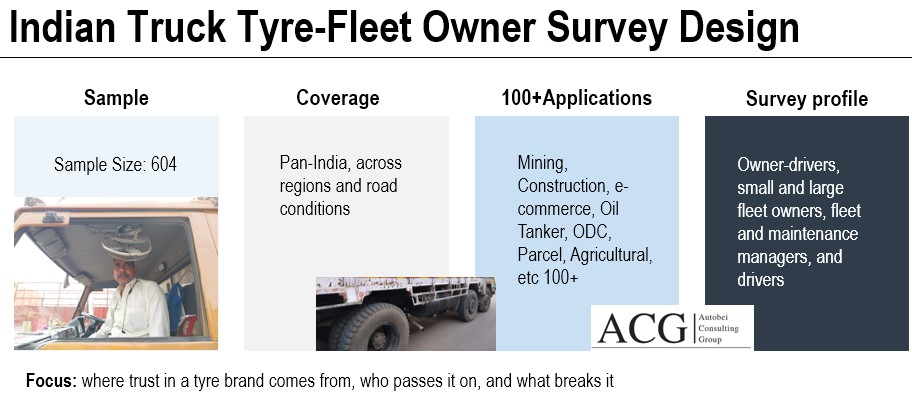
We surveyed 600 truck owners, fleet managers, and drivers across India to see how this trust forms. This page shows what we asked and why it matters. You can request the full survey, report, and key insights at the end.
Who did we ask? Where trust in a tyre brand comes from, who passes it on, and what breaks it
Whom do fleet owners trust when choosing a truck tyre brand?
A truck owner rarely decides alone. The brand that comes up in a chat with a senior driver, a trusted mechanic, or a dealer carries more weight than any advertisement. The same goes for a fellow owner who has run the same route for twenty years. When that person says, “this tyre will not let you down,” the decision is mostly made.
WhatsApp groups are one of the main channels for this. Fleet owners and drivers keep groups for their route, town, or transport association. In these groups, they share what they see on the road: which tyre lasted, which one failed, which dealer helped, and which one did not. A single post from a respected member can reach hundreds of owners in minutes. It can also damage a brand just as fast. For a tyre company, these groups work as an informal review system that it does not control.
Why is the best truck tyre different for every application?
There is no single best truck tyre. A tyre that does well on a highway can fail early on a mining haul road. Owners know this from experience. The best tyre is the one that suits the application, the load and the road.
To see how far this goes, we examined around 100 types of truck applications and load patterns. Each one differs in load, route, road surface, speed, and stop-start cycle. Two trucks of the same model can need very different tyres. One may carry steady loads on highways, and the other may haul heavy material over broken roads.
This changes how trust works. Owners trust the brand that gets their own application right. A recommendation counts only when it comes from someone who runs similar work. A long-haul driver is a weak guide for a tipper owner.
There is one exception worth noting. Some tyre brands work well across several applications and truck types. Owners who run mixed fleets often keep one or two such brands on most of their trucks. These brands earn trust faster, because every owner in the network can speak from their own experience. We asked which brands owners rely on across more than one application, and what makes those brands work in so many conditions.
Why does a recommendation beat a brand claim?
Every brand claims long life, strength, and value. Owners have heard it all. A claim is easy to make and slow to check. A recommendation from someone who paid for the tyre and ran it on the same roads is proof they can use.
A tyre earns that recommendation kilometre by kilometre. A tyre earns that recommendation kilometre by kilometre. Delivering the promised mileage comes first. Surviving cuts and heat on bad roads, and taking a retread, come next. Service when something goes wrong far from home completes the picture. Each of those experiences becomes a story that one owner tells the next.
What do drivers and workshops say builds trust in a tyre brand?
Beyond the survey, truck owners, drivers and workshop engineers share the same pattern every day. These field voices are not survey results. Still, they show how trust is built and lost on the ground.
- Trust follows the person who inspects, not the person who sells. A tyre engineer who checks tread depth at three points, spots uneven wear early, and advises across brands gets listened to.
- Care decides a tyre’s reputation. Owners who pull a tyre for retreading at 3 to 4 mm of tread, rotate tyres, and check cold pressure with an accurate gauge report much longer life.
- Long life is the story that gets repeated. Operators quote 1.5 to 1.8 lakh kilometres from premium drive-axle radials. Those numbers travel by word of mouth and set the bar for every other brand.
- Fast claim handling is a trust test. Transporters judge a brand by how quickly it settles a defect such as an air bulge in the casing.
- Steer tyres wear fast on tight-turning trucks. Drivers notice, and they judge the brand on how well it copes.
How much can the wrong tyre or poor maintenance cost a fleet owner?
A tyre choice does not end at the purchase. Poor tyre maintenance, the wrong tyre for the job, and bad axle alignment can cost a fleet owner between ₹10 lakh and ₹20 lakh per truck over a single truck life cycle.
Many owners blame the brand when a tyre fails early. Often the cause is the match between tyre and application, a pressure error or a misaligned axle. That is why trust matters so much. An owner who trusts the person advising them is more likely to fix the real problem and less likely to switch brands for the wrong reason.
Why do fleet owners hesitate to try tubeless or a new tyre?
Tubeless tyres show how trust and money meet in one decision. On paper, the case is strong. Field accounts describe lower rolling resistance, diesel savings on long trips, and tyre life of around 1.8 lakh km on heavy tractor-trailers. One operator reported using about 270 litres of diesel on a trip where tube-type tyres used 300.
But the owner still hesitates. A tubeless pair costs over ₹51,000, far more than a tube-type set. One deep side-cut from a stone, a bolt, or a broken leaf spring can end the tyre, because it cannot be safely repaired. So the owner pays more today for a benefit that shows up over months, and the risk lands on the first bad road.
The same hesitation applies to any new tyre. It may be a new pattern from a known brand, or a first trial of a brand the owner has never run. Before spending, the owner asks three things. Has someone I trust run this? What happens if it fails? Who stands behind it?
We used both situations as a case in the survey. We asked:
- Have you used tubeless tyres, and on which axle and application?
- What stopped you from trying one, or made you go back to tube-type?
- Who would need to recommend a new tyre before you try it?
- Would you try it on a few trucks first, and what proof would make you fit it across the fleet?
- What do you expect from the brand if it fails early?
Can credit terms and easy replacement outweigh the brand?
In some cases, tyre purchases start with a worn set, damage, or a breakdown. At that moment, the owner turns to a trusted person and a seller they know. Two things then decide the sale, and neither is the brand name.
Do small fleet owners pick credit over brand?
Small operators often run a single truck or fewer than five trucks. For them, cash flow matters more than the brand. Freight payments arrive late, and a full tyre set is a big outlay. A seller who offers 60 days of credit can win the sale even with an unfamiliar brand.
That tells us something. If small owners buy on payment terms, the brand is affordable, but it is not yet trusted. We separated the two by asking:
- How many owners buy on credit, and for how long?
- If a seller offers 60 days, how often does the brand stop mattering?
- How does this change for one truck, two to four trucks, and five or more?
- Do owners return to the same brand once they can pay cash?
How does easy replacement build trust in a tyre brand?
The other question owners ask is simple. If this tyre fails early, will the company replace it with a new one without a fight? Owners remember brands that swap a faulty tyre fast, without long inspections or arguments over pro-rata value. They also remember the opposite, and they tell others.
How much will owners pay, and which brand do they prefer by application?
Price decides whether trust turns into a sale. The answer also differs by application. A highway owner, a tipper owner, and a tanker owner do not value the same tyre in the same way. So we asked about willingness to pay and brand preference application by application, after the respondent had seen the benefit and the risk.
How much more will owners pay for a better tyre?
- For your application and load, what is the most you would pay over your current tyre price for a tyre that lasts longer: no extra, up to 5%, 5 to 10%, 10 to 15% or more than 15%?
- At what price does a tyre for your work seem too cheap to trust, a bargain, getting expensive, and too expensive?
- Would you pay more for a tubeless tyre, and what saving would justify it?
- Would you pay more for a brand that replaces a faulty tyre quickly, and how much?
- Does your answer change with payment terms: cash, 30 days, or 60 days?
- Does it change by axle: steer, drive, or trailer?
Which brand do owners prefer in each application: MRF, Apollo, BKT, or others?
For each application and sub-application, we asked which brand owners prefer, which they used in the last two years, and which they would try next. The brand list covers:
- Brands: MRF, Apollo, JK Tyre, CEAT, TVS Srichakra, Birla Tyres, BKT, Bridgestone, Michelin, Goodyear, Continental
- Imported Chinese brands (examples) and Other brands, including retreaded tyres
The survey covered:
- In which applications do owners prefer MRF, in which Apollo, and in which BKT, JK Tyre, CEAT, or others?
- Does a brand preferred in long-haul also win in tippers, tankers, and container and port work?
- How much more will an owner pay for the preferred brand in their own application?
- What do owners say they pay for in a brand: mileage, strength, retreadability, easy replacement, or the dealer’s trust?
- Do fleets using several brands assign each one to a particular application or axle?
The gap between what owners pay for a trusted brand and for the same tyre without the name shows what trust is worth in rupees.
Why do Chinese tyre brands struggle to win trust in the Indian truck tyre market?
Chinese tyre brands often compete well on price and availability. Yet many struggle to win Indian fleet owners. Trust here passes from person to person. A brand with few long-standing users and few trusted recommenders has a hard time getting started, however good the product may be.
The survey covered:
- How aware are owners of Chinese tyre brands, and how willing are they to try them?
- What worries them most: durability, batch consistency, load and heat performance, retreadability, warranty or service?
- Who encourages or discourages a trial: the dealer, the mechanic, the senior driver, or the owner’s own experience?
- What would make a trusted person recommend such a brand: a trial on their own trucks, proof of mileage, a service guarantee or a known dealer network?
What turns interest in a new tyre brand into a purchase?
Owners may say they are open to a new brand. Then they buy the one their trusted mechanic or dealer recommends. Trust is what turns interest into a purchase.
We asked how many owners who said they would switch brands had actually switched. We also asked what stopped the others: price, availability, dealer push, or no trusted recommendation. Finally, we asked what would make them try a new brand on a few trucks first.
Why does industry expertise change what a survey can tell you?
A survey is only as useful as the questions behind it and the people who read the answers. This study was designed and read by a team with deep experience in commercial vehicles and tyres. That experience shows up in three ways.
- We know what to ask. We understand how a long-haul truck differs from a tipper, and why an axle position changes tyre wear. So the questions fit the owner’s real work and not a generic template.
- We know how to follow a conversation. An owner’s first answer is rarely the full story. When someone says a tyre “did not perform,” we know to ask the next question. Was it the load, the road, the pressure, or the alignment? Each answer leads to the next, and the chain leads to the real cause.
- We know what the answers mean. A number on its own can mislead. A low score for a brand may point to a dealer problem, a wrong application, or a missing service promise. Industry knowledge lets us tell these apart and turn findings into clear actions.
The result is a report you can act on. It tells you what owners said, why they said it, and what a tyre company can do about it.
How can you get the full survey, report, and key insights?
This page covers only part of the study. The full questionnaire, the report with application-wise and region-wise breakdowns, and the key insights on building trust among truck fleet owners are available on request.
Contact us to get the full survey, report, and key insights, or to talk about how your tyre brand can earn the recommendation of the people fleet owners trust most.