A quick note: this is just an example. We hold registration data for every brand, mode,l and variant, from 2010 to the current year. Specs, features, and applications are mapped to each variant, so volume can be read alongside the use case it serves.
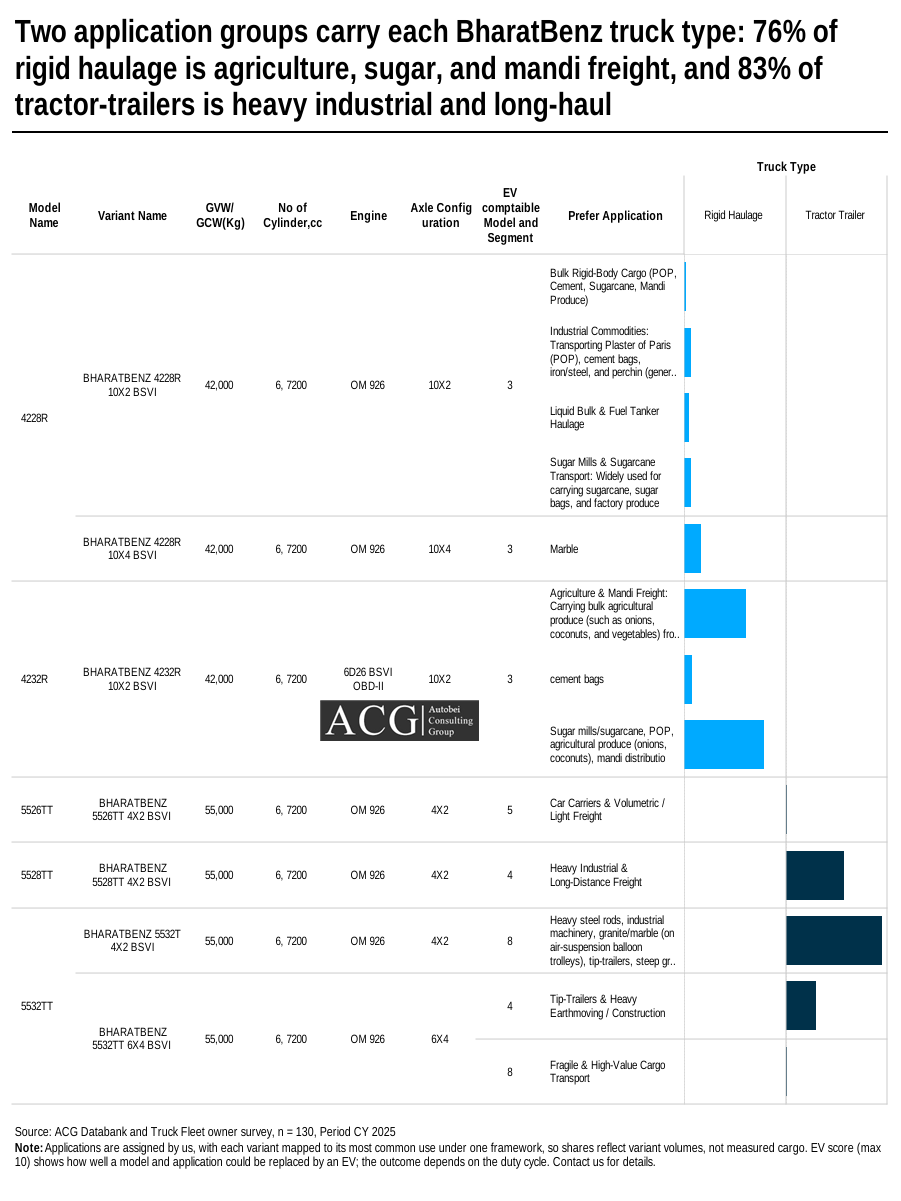
BharatBenz truck applications are concentrated in a few jobs. In rigid haulage, agriculture, sugar, and mandi freight account for 76% of volume. In tractor-trailers, heavy industrial and long-haul freight account for 83%.
Rigid haulage: one model, three jobs
The 4232R carries 80% of rigid volume, and two applications explain most of it.
- Sugar, POP, agricultural produce and mandi distribution lead at 42.45%.
- Agriculture and mandi freight follow at 33.21%.
- Cement bags add 4.09%.
The 4228R holds the remaining 20%, split across several smaller applications. Marble leads at 9.06%, followed by sugar mill transport (3.91%), industrial commodities (3.55%), liquid bulk and fuel tankers (2.66%) and bulk rigid-body cargo (1.07%).
Rigid haulage here is a seasonal, commodity business. The loads are heavy and recurring, and the routes run from mills and factories to wholesale markets.
Tractor-trailers: heavy industrial freight dominates
Three models split the volume, and the largest share goes to one.
- 5532 on 4X2 leads at 51.69%. It serves heavy steel, industrial machinery, granite, marble, and steep routes.
- 5528 takes 31.17% in heavy industrial and long-distance freight.
- 5532 on 6X4 adds 16.36% in tip-trailers and earthmoving, plus 0.49% in fragile cargo.
- 5526 is a niche at 0.29%, for car carriers and light-density volumetric cargo.
Together, the 5532 and the 5528 carry the segment. Specialised applications such as car carriers and fragile cargo account for less than 1%.
What the operator survey adds
An operator survey explains why the mix looks this way. Fleets generally run within legal load limits, because overloading raises tyre, spring and fuel costs faster than it raises revenue. Each model has a defined job. The 5528 is the balanced long-haul workhorse, the 5532 is the choice for the toughest routes and heaviest cargo, and the 5526 is bought for fuel economy on volume cargo. The survey results describe reported practice and are not official claims from BharatBenz.
What this means for decision makers
- OEMs can align product and positioning with the few applications that carry volume.
- Dealers can match stock and sales effort to the buyer’s cargo.
- Suppliers can plan parts and bodybuilder demand by application, not only by model.
- Financiers can price risk by the cargo and route behind each truck.
- Investors and consultants can see how concentrated each truck type is, and where the niches are.
Registrations show where volume sits. Specs, features, and application show why.