ACG is going to release the European Electric Truck Market Assessment and Outlook Report focus on Product, Customers,  Segment, Competitive Analysis, Sales & Branding Strategy.

Key Highlights of the report:

Market Assessment:

  • The Global Electric Truck and Fuel Cell Technology Market overview – Market size and Outlook – Short, Medium, and Long term
  • European Electric and Fuel Cell Technology Truck market assessment – Trend and Forecast
  • Transportation system and suitability of E-truck
  • Market Challenges and key growth drivers
  • E- Truck Business Model
  • Entry Strategy into Electric Truck segment – Country-wise Analysis
  • Competitive Analysis – Mercedes Benz, Volvo, MAN, Scania, Volta Trucks, Arrival, Iveco, DAF
  • Local Government policies and regulations impact Analysis

Product Portfolio and Strategy:

  • Electric Truck Product position – Price, Key specs, Features, Charging Range, Battery size, and Charging time
  • Electric Truck USP Analysis
  • GVW  and vehicle Type wise best Suitable application – Logistic, E-commerce, Last-mile delivery, Construction, Mining, and Long Haul
  • TCO Analysis – Model and Application wise product suitability
  • Detailed pricing Analytics and Different business cases
  • E-Truck Segment Share Forecast – Country wise
  • Battery Supply and technology to increase the range
  • Recycling of Battery

Also Check: Indian Electric Truck Market Analysis

Customer Analytics:

  • Customer needs and Demand Analysis
  • Customer mind mapping decision journey
  • Potential and existing customers expectations
  • Market Demand and fit analytics
  • How to handle the price issue with customers

Charging Infrastructure:

  • How to built Charging infrastructure and points to cover maximum charging points
  • Key strategic points to set up charging points in Europe
  • Inter and Intra Truck Applications
  • Duty Cycle Analysis
  • Infrastructure charging point cost analysis

E-Truck Sales Strategy:

  • Create the Sales Tools specialty for Electric Truck
  • Digital Sales Strategy and how to implement it
  • Channel Sales  Strategy

Brand Strategy:

  • How does Brand perception make an impact on E Truck Sales
  • How to create a brand image that impacts your target customer segment
  • Creating brand architecture for establishing and new players in Electric Truck foray
  • How does brand image balance the high price of the E truck

Future Prediction of the Indian Automotive Market is our exclusive Analytics report on Indian Automotive Market.

Segment covered:

  • Car
  • SUV
  • MUV
  • Scooter
  • Motorcycle
  • Truck Haulage
  • Tractor Trailer
  • Tipper
  • Bus and
  • Electric Vehicle

Key Highlights of the report:

The report is divided into the following parts:

  • Product Management: Product Features, Product Specs, Technology, Portfolio, Pricing Forecast, the Best combination of all key product attributes for “Value for money” ” product life cycle analysis – Current life of all models and expected new product range to replace the current product range, Variant Analysis, Technology cost analysis, Digital Technology implementation and how it changes the product portfolio, Top 5 features of the vehicle in each segment
  • Market Development: Competitor Analysis, Growth expectation,  Segment definition, Expected Largest and growing segment, After Sales Market development, Sales Strategy and most effective way of selling products, Dealer role in sales and expected changes to interact with customers, Sales, and Production Forecast
  • Brand Image: What are the parameters to define the brand perception and image, Role of brand image to be successful in the market, Brand architecture components
  • Customer Centricity: Customer Satisfaction and Customer Delight, Customer segmentation, Customer expectation from existing and new products, How customers plan, think, and buy the product, How to identify the potential customers and strategy for new customer acquisition, Top Customer-centric OEMs

Indian Automotive aftermarket trend & challenges report gives the complete insight of Industry. The onset of the previous decade marked a period of tremendous development for the Indian Automobile industry. This can be owed mainly to the introduction of a wide range of product launches which has been possible in its entirety due to technological advancements in the field. An example of this technological boom is how commonplace Bluetooth connectivity and mobile charging have become in almost all cars today. The present scenario points to a spiked growth in the industry by the year 2030 and is expected to achieve the most prominent and advanced machines of all time. The analysis that we at ACG have arrived at has indicated a strong need to heighten the quality of product service and maintenance centres in order to keep at bay with the progressing scenario balanced with customer satisfaction.

Indian Automotive After Sales Analysis Report

Two major issues that plague the current automobile scenario are service and maintenance. These need to be dealt with in the most efficient and satisfactory way possible. In spite of companies trying their best to satisfy the customers’ need after the sales is done, their satisfaction is still not reached exemplary benchmarks. When these two parameters of service and maintenance are observed, the company concentrates on quality as well as time and financial constraints to ease these off the customers’ backs.

The question, however, that remains at large is this.

How do authorized dealers in the department of spare parts and other services?

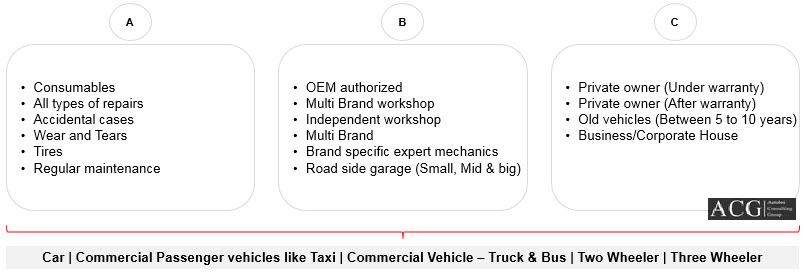
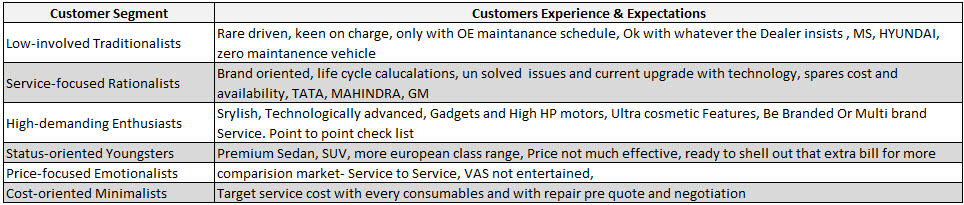
In order to satisfy our customers, the foremost criteria would be to clearly define and identify the various segments, and specialized analysis is carried out in each segment to understand where the break down is happening. The analyses needs to understand that perspectives on importance and priority differs with each customer and one needs to primarily meet their basic needs and expectations. Dealers need to strike the right balance between the various priorities and find the perfect mix of quality, technology, features, vehicle type, warranty period, and service delivery time. One important aspect which could dictate this market though is heavily constrained by the OEM workshops is the warranty period. Customer segment and customer expectationsHowever, today most customers are able to make informed, intelligent decisions towards best maintenance options and service centre availability. Although, there is a major lack of assistance technically available in their locality. This is the major reason why most authorised service centres and large workshops today perform poorly. An analysis conducted at ACG reveals that an increase in profit revenue from 30 to 40% is highly recommended.Customer Segment and habits

Another major issue that customers file complaints against is the level of transparency that goes into after sales services. This needs to be rectified immediately. This leads to talks surrounding additional hidden costs that the customer may not be aware of. Also notable is the fact that a multitude of offers are not being implemented even at the operational level. One notable complaint is the failure of maintaining a 24*7 service delivery for vehicles that have faced a break down.

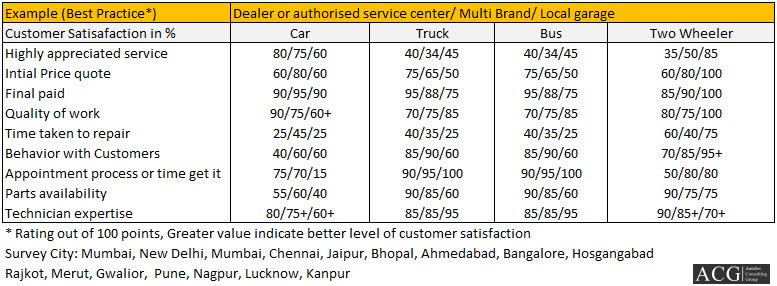
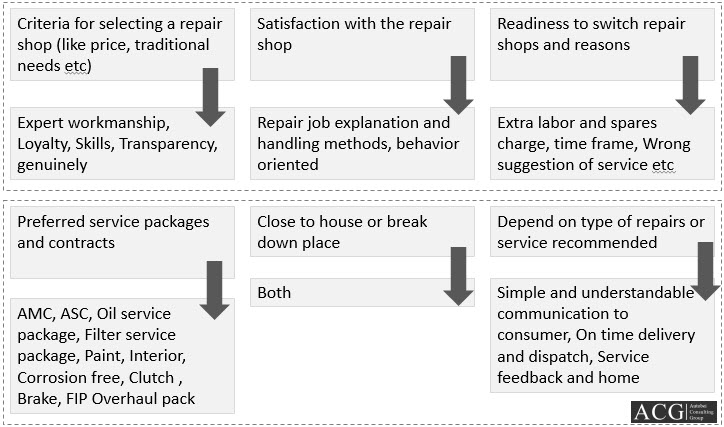
As technology advancements have made huge strides forward, revise cost also varies along with it. Though technology has given rise to more long lasting and fast moving parts, maintenance cost as well as labour costs incurred in the same boggle the customer. This sort of expenses will only hinder the customers’ financial limitation. Hence, it becomes essential to understand few major parameters for satisfying the customer after sales. They are given in the following figure.

After sales Customer satisfaction Survey_ACG

Multi segment concept and best implementation ways

Our study carries with data collection methodology of different organized and unorganized segments, Durability and Availability of Spare parts, Mechanical Skills, Work Procedure, Job Card, Work Quality, Time Duration for Repair, Types of available maintenance and contract etc. If these constraints are taken into concern in every service centre, customers can be satisfied in every way.

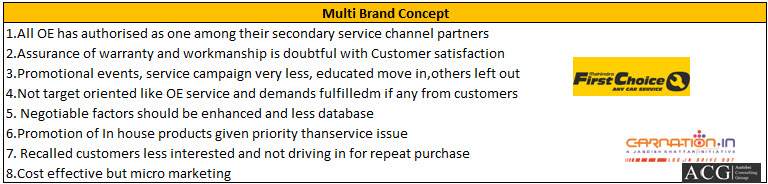
Another finding about why Multi Brand Service centre could not make its existence in India, however the market potential and growth is very attractive for multi brand?

Multi Brand service concept in India

Carnation was a good initiative in the multi brand foray, but lack of spare parts availability and paper work completion takes time which builds up frustration in customers. As of with the feedback received by most customers, it is believed that Independent workshops are either expensive or less qualitative in servicing after warranty period  and are usually approached by their own experience, recommended by friends or relatives.

Spare parts is one of the important parameter in After sales. In our study we have defined the best business practice.

Automotive Spare parts Business practice

To learn more about customers’ specific desires and requirements, we examined the six segments in terms of the following categories: General preferences regarding cars, two wheeler, Truck, Bus (CV) segment

Automotive service option and concept

Once you define the parameter then you can think about commercial and advantages of service package. Best fit package always work for customers.

Type of Service packages and their criterea

Automotive after sales terminology

Many OEMs are venturing into Indian market and establishing their service network. But to strengthen independent workshops or road side garage we need to support newly initiated OEMs for enhanced product support. Please contact us for more detail and complete analysis.

Key question this report will answer:

  • What is the current and future structure of the Indian automotive aftermarket? Who are the key stake holders?
  • Major market trends?
  • What are the key drivers?
  • Industry challenges and opportunities?
  • Competitor landscape?
  • What is the short and long term outlook for the Indian automotive aftermarket Industry?

Tata Group is an iconic brand based out of India. The Tata brand is respected and trusted worldwide.

Tata Motor Automotive business is primarily divided into two main categories:

In the last few years, Tata Motors experienced losing its grip on some of the automotive segments and sub-segments of Cars,  Trucks, and Buses.
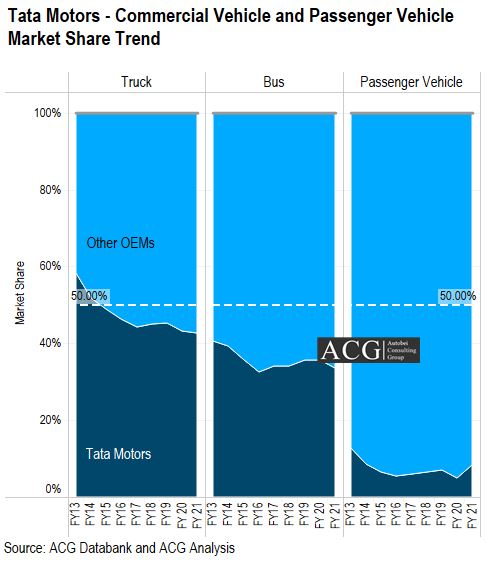
Tata Motors Commercial Vehicle and Passenger Vehicle Market Share Trend Analysis

Tata Motors increased its market share by launching a new product range in the SUV and Car Segment.
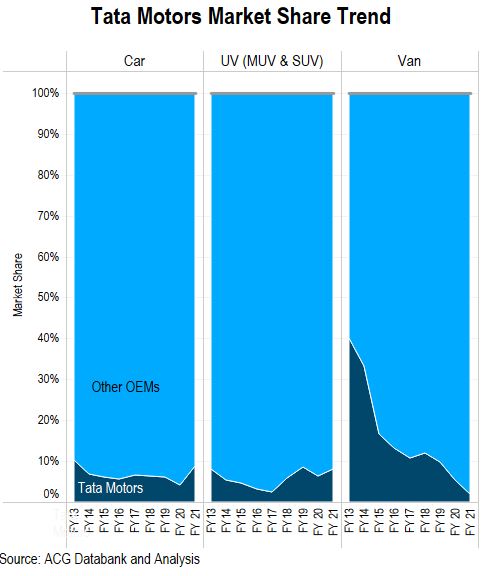
Tata Motors Car SUV and MUV Market Share Trend Analysis

There are basically five main components a business relies on:

  • Brand Experience, perception or image
  • Customer’s consideration to Trust, like, and buy it
  • Customer Satisfaction
  • Rich Products portfolio,..no but the suitability of product as per customer needs, demands, and expectation

Tata Motors greatly started to focus on its Product range, Price point, Features, Design, Style, Customer segment, and Dealer involvement.

Tata Motors, a company formally known to have established an offering of affordable product range, appears to have been drifting away from that image. The company now manufactures vehicles for ValuePlus, Premium, and High-end segments in the passenger Vehicle category for medium Middle, Upper Middle Class, and Affluent income classes. There is no product available for lower and Elite class income class.  Launching new models for these two income group customers could increase Tata Motor’s market share by 5 to 7%.
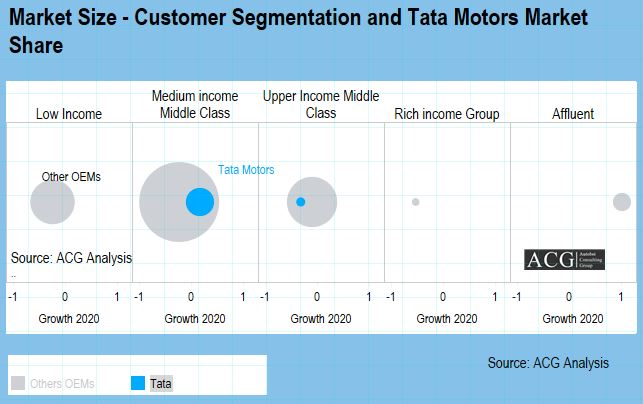
Market Size - Customer Segmentation Analytics and Tata Motors Market Share

The Medium income Middle-class customer segment owns 67% of sales of cars, SUVs, and MUV shares and is one of the most significant segments in the Indian PV segment. At present, Maruti regulates this segment with 12 models while Tata has only 4 models.
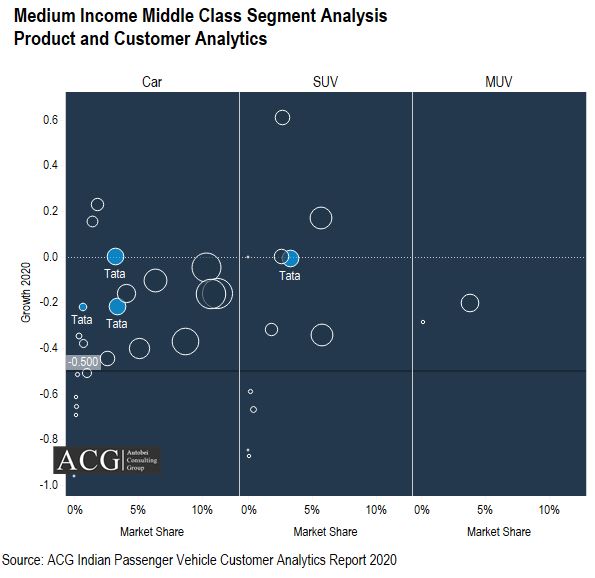
Medium Income Middle Class Segment Analysis- Product and Customer Analytics

In this segment, the Relative market share of Tata Motors climbed from 11 to 17.5% between 2017 to 2020. However, Tata remains the second-best performer in this segment by increasing 6% relative market share with just 4 models.

Tata Motors Segment, Product, and Market Analysis: Upper Income Middle-Class Group:

The Upper-income Middle-class group customer contributed 11% segment share in Tata Motors SUV Sales in 2020 as per ACG Customer Analytics Report 2021.
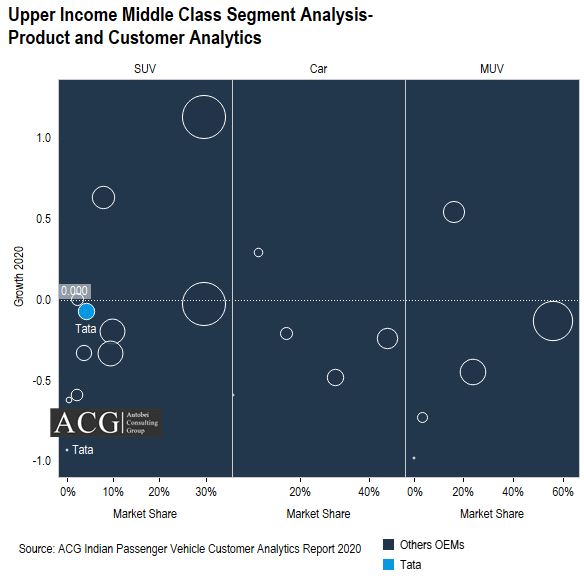
Upper Income Middle Class Segment Analysis-Product and Customer Analytics

Most of the customers of this income group still prefer Hyundai and Kia SUV brands. Tata Motors dominates over 5% market share and its relative market share increased from 12.8% to 14.7%. Harrier is playing a significant role in the customer journey. It brings customers to the point where they like the vehicle design, look, and style of the Harrier or Tata’s product range (Connect with Harrier). This induces them to buy and become curious to know about the other Tata’s products also. It is creating the base for 4 customer attributes: Benefits, Capabilities, Differentiation, and Value proposition. Now it is accelerating the other model sales like Tiago, and Nexon.

Current Scenario of Tata’s Product portfolio, and Position:

Each of these newly launched cars and SUVs within these segments is targeting a different group of income Group, Lifestyle, Age, and some are focused on family, some are focused on sporty, etc.

Tata Motor’s main point of difference within this group of competitors is its commitment to functional “Made in India” design at a relatively affordable price like Tata Harrier, Tata Nexon, Tata Tigor. Another reason is the aggressive sales team from dealers.
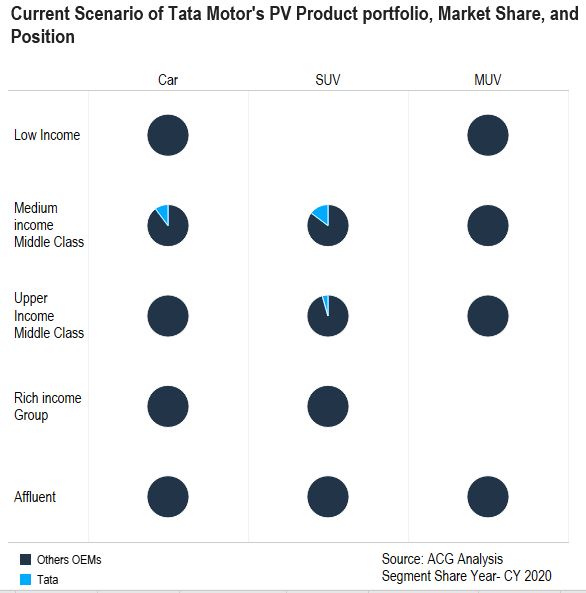
Current Scenario of Tata Motor's Product portfolio, Market Share, and Customer Analytics

We have surveyed to know “Why do you buy a Tata”? In most of the answers, the Model name supports the corporate brand Tata, like People, who love “Tata Harrier” design, Style, size, and features. As per our Survey, 67% of customers changed their steering from other brands to Tata Harrier.

Tata Motor was not rated specifically high on any of the attributes in 2013, this implies a possible problem within the Product quality and the brand image and we saw the major changes in some of the attributes in 2021. This upgrade helps the Tata brand to gain double-digit market share in some specific segments.

Tata Punch launched Impact Analysis:
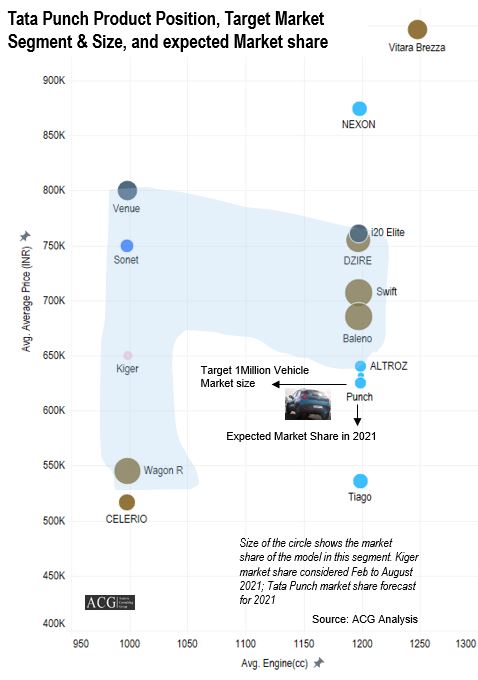
Tata Punch product position and its impact on Indian Car market

Tata Motor’s Commercial Vehicle Business Strategy:

A commercial vehicle is a different game with a variety of different rules, and it functions on various other measurable market dimensions. Tata Motor is also undertaking different market and product strategies for its Truck and Bus Business segment.
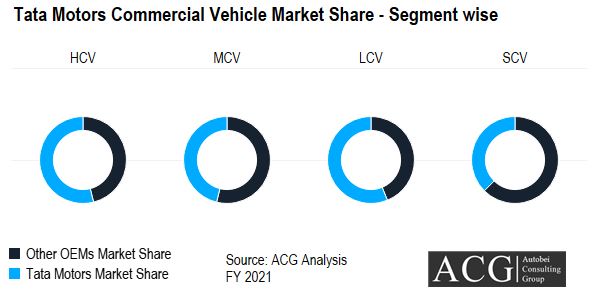
Tata Motors Commercial vehicle Segment wise Market share FY 2021

Tata Motors is a market leader in most of the Commercial Vehicle sub-segments. In the Overall CV segment, its market share is stagnant at around 42% from the last 5 years.

In the Truck Segment, Tata lost 1% market share, while in the Bus segment, its market share is almost stagnant. Under the CV segment, Tata Motors is continuously launching new products and upgrading the current product portfolio by adding new features.
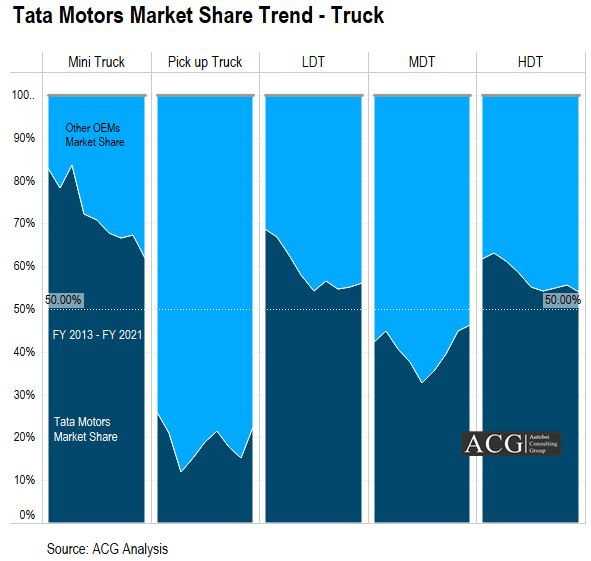
Tata Motors Truck Market Share Trend Analysis - Mini truck_Pickup truck_ Light duty truck_Medium Duty Truck_Heavy Duty truck market share

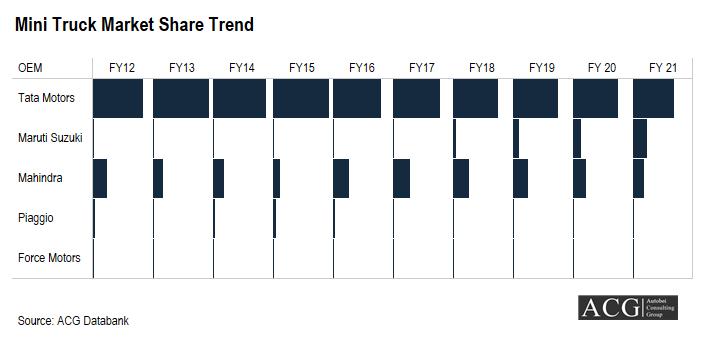
In Mini Truck, Tata ACE is one of the top-selling products from the very commencement of this segment. But now it is challenged by a new player in this segment—Maruti Suzuki’s Super carry. Due to its torque, it became the first choice for e-commerce application users.

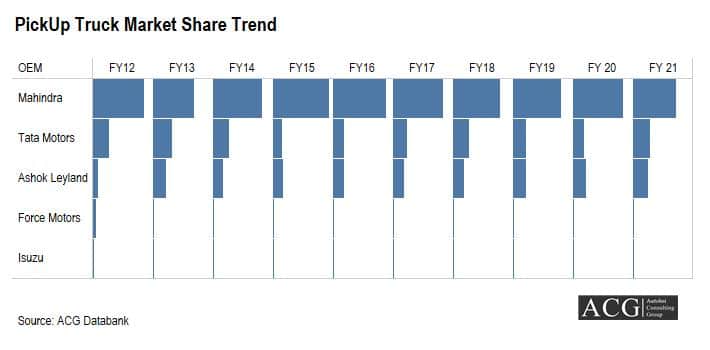
There are two key competitors of Tata Motors in the Pickup segment, one is Mahindra and the other is Ashok Leyland which is very aggressive to gain market share in this segment. This is a growing segment in India. Customers are looking mainly for bigger vehicles for city-level applications.

LDT and MDT are smaller segments compared to Small trucks and Heavy Duty Trucks. Currently, in both segments, Tata Motors is in a dominant position. In Heavy Duty Truck Segment, Tata Motors has maintained more than 50% market share for over a decade. This is the segment where the company can upgrade the product features to increase the productivity of the drivers.

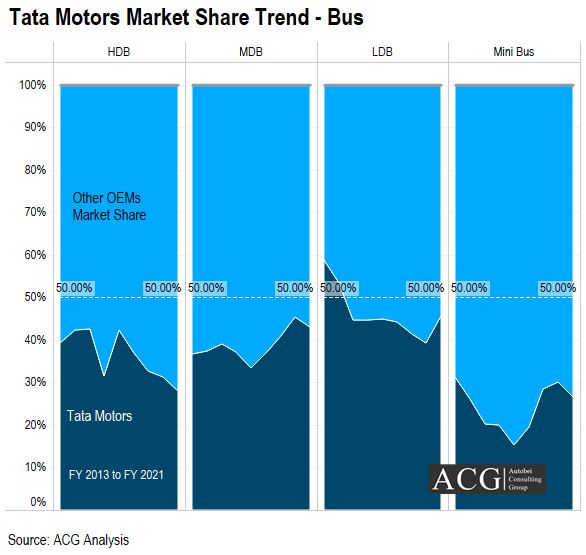
The company is the second-largest OEM in the Heavy Bus segment. Based on the different applications of the buses, Tata Motors needs to add new features to attract customers.
Tata Motors Market Share Trend Analysis Bus segment

There are some possibilities to increase the quality at an extra price. In this segment, the company could work on Electric Buses. Eicher Motors is targeting this segment by launching new products.Tata Motors Bus Market Segment Analysis
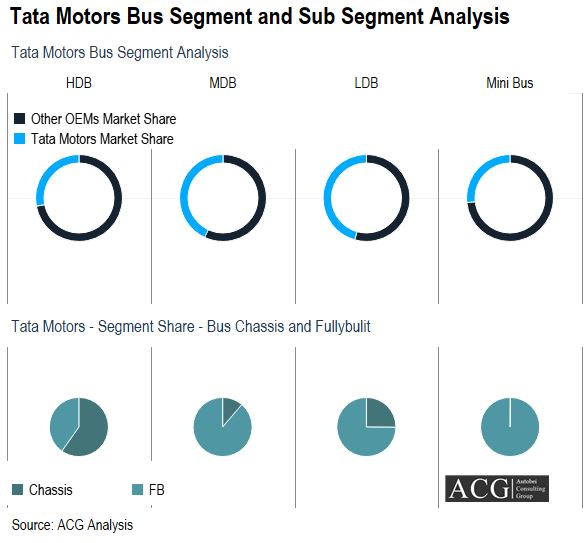
The Medium Duty Bus segment is dominated by both Tata and Eicher. Both are targeting a different segment. The light-duty bus segment is also dominated by Tata and Eicher. In this segment, the purchase criteria differ from those of heavy Duty Bus segment.

The Minibus segment has only one major player which is Force Motors with a 72% market share. The Traveller’s comfort driving features, the number of variants available, and its turning radius made it exercise control over this segment. Tata Motors tried hard to acquire the segment share but still, it is struggling even after some good products.

Contact Info@autobei.com to buy a full Report.

ACG helps companies to enter into the fast-growing Indian Electrical Vehicle market. EV segment gives tremendous opportunities to Traditional players and new entrants. Currently, Electric Two-Wheeler and Electric Bus segments are having an effective presence of new players. We help to create a complete blueprint of Electric vehicles.

The following points are covered with Entry Strategy for Electric Vehicle Manufacturer consulting services:

  • Market assessment of EV – Electric Two-Wheeler, Electric Bus, Electric Three-Wheeler, Electric Car, and Electric Truck
  • Frame: Technology, Market, Product, Grid Management, Product Demo & Testing, and Go-to-market
  • Mapping with your company strength or product portfolio or Brand reputation or business synergy
  • Setup company in India
  • Find local partner if interested in JV or partnership business model
  • Import rules and select port
  • The strategic location of manufacturing or assembly unit
  • Project cost and ROI Analysis
  • Find local suppliers
  • Break-even analysis
  • Risk Analysis
  • Revenue sources
  • Sales strategy
  • Developed Channel sales
  • Create Product portfolio
  • After-sales revenue
  • Charging station infrastructure strategy
  • Customer buying pattern analysis

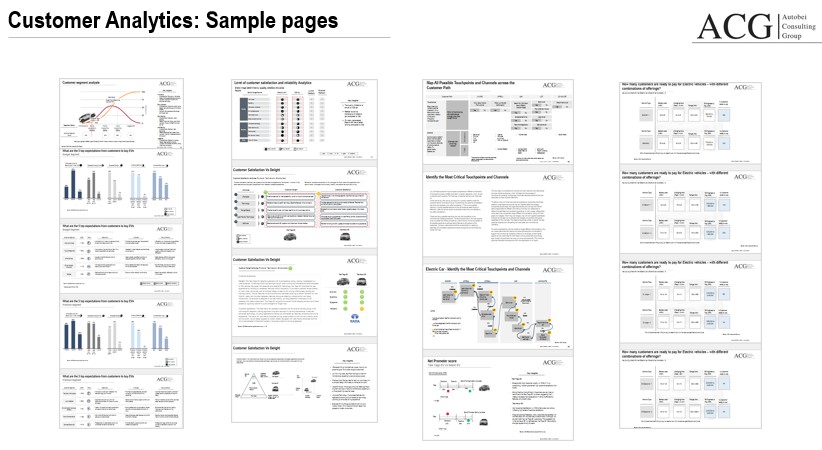
Key Highlights of the “Customer Analytics – Electric Vehicle” Report:

  • Descriptive Analytics-Exploratory, Description, and Causal Research
  • Try to understand the potential buyers of EV
  • Level of customer satisfaction and reliability Analytics
  • What is a “Customer Satisfaction” and “Customer Delight” for EV?
  • Create Customer mind mapping of Electric Vehicle and Charging infrastructure
  • Define the customer’s segment based on different relevant parameters
    Current user of Electric Vehicle– Application of vehicle, their overall experience for EV, and feedback to improve the experience.
  • Survey Geography: Metro Cities, Tier1 and Tier 2 Cities, Towns, and villages (close to the cities)
  • How customer preferences are changing towards Electric vehicles?
  • How many customers are ready to pay for Electric vehicles – with different combinations of offerings?
  • How brand and brand perceptions are influencing buyer’s decisions for every segment?
  • What are the 5 top expectations from customers to buy EVs?
  • Based on Survey – How customers are comparing EVs with IC vehicles?
  • What are the ideal product specs, features, Price, and other attributes of each vehicle
  • Best uses or Applications of Electric Vehicle – Electric Two-Wheeler, Electric Car, Electric Bus, Electric Light Commercial vehicle, Electric Three-Wheeler, and Electric Truck

Electric Vehicle Customer Analytics

How this survey help companies to make the blueprint for EV Strategy:

  • To Create Product Portfolio and Management
  • Future Prediction
  • Factors that influence or change the demand for your products
  • EV Price point for each segment
  • Sales Strategy
  • Advertising Budget and define the theme
  • Entry Strategy
  • How to target the segment and its market size
  • Competitor insight


The Indian Electric Truck Market Assessment Study is divided into 5 key categories- Mini Truck, Pick up Truck, Light Duty Truck, Medium Duty Truck, Heavy Duty Truck

The Study gives the answer to the following question:

  • How to enter into Electric Truck Market?
  • How profitable is an electric truck compared to a diesel model?
  • What could be the Market share of eTruck in India?
  • How to find Customer Segments?
  • What are expected the Specs, Features, and Price of the vehicle?
  • Sales Forecast  – Short, medium, and Long term?
  • What are the Key advantages to promote etruck in India for OEMs, Dealers, Suppliers, Customers, Financial firms, and other Industries
  • Actual TCO Analysis and compared with Diesel models?
  • Electric Truck life cycle and cost analysis?
  • Is etruck a profitable option?
  • How do OEMs need to invest to create a complete eTruck logistic solution?
  • How do Electric trucks impact OEM’s brand perception and image?

Key Highlights of the report:

  • Introduction of Electric Vehicle – Market, Technology, and Key components
  • Sub Segment: Rigid Haulage, Tipper, and Tractor-Trailer and CAGR forecast for next 20 years
  • Indian Electric Truck Market size – Volume & Value
  • Market Opportunities for battery electric vehicles (BEV) and electric vehicles using fuel cell technology (FCEV)
  • Driving force behind the growth of eTruck in India
  • What are the advantages of Electric Truck compared to Fossil Fuel
  • What kind of Electric truck can be offered  for various applications and customer segments
  • Battery life, Type of Battery, Battery life, expected uses of battery after life cycle, Battery capacity requirement different segment types of Electric Trucks
  • How Charging Infrastructure works for eTruck  – Location, Charging time (AC, DC, fast, and Slow), and optimize the charging time
  • Key features of Electric Trucks for Drivers, Fleet owners, and Logistic companies
  • Route and Application wise Plan solution
  • The best suitable application Analysis for eTruck
  • Maintenance cost and frequency
  • The actual cost to fully charge electric trucks?
  • The workshop requires, and Staff Training
  • Driving experience and its impact on productivity
  • Uptime  of Electric Truck and its contribution to profit and customer satisfaction
  • Business Model of Electric Truck
  • The expected customer segment for eTruck, Purchase criteria, Customer buying mapping, Key buying issues, opportunities, and challenges
  • How to create eTruck package more attractive
  • Future of Heavy Electric Truck Market
  • Payback time analysis for each segment
  • What is the most cost-effective way to run an electric truck?
  • Servicing requirements of an electric truck?
  • Impact on Dealer revenue and OEMs Sales
  • State-level Electric Vehicle policy and its impact on the Truck segment
  • Payload Analysis suitability of eTruck

Additional Chapters of the report:

  • Feasibility Study of Electric Truck
  • Business Plan for different applications

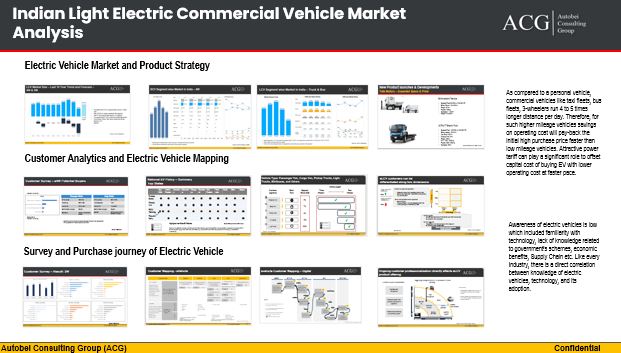
ACG Electric Vehicle EMobility center released the latest report of Electric Commercial Vehicle Market Analysis. The report provides key insight into the eLCV Market Size (In Volume & Value),  Current key players in each segment, Brand Perception, Customers requirement, Demand Analysis, Business model of each category, TCO model wise analysis, and all other key information.

Indian Light electric commercial Vehicle Market Analysis and 2030 forecast

Key Highlights of the report:

Indian Light Electric Commercial Vehicle Market Trend and Forecast – Two Wheeler, Three Wheeler, Electric Car, Truck, and Bus.

  • Mini Truck,
  • Pick up Truck,
  • Light Duty Truck,
  • Medium-Duty Truck,
  • Heavy Duty Truck – Tipper, Rigid Haulage & Tractor Trailer
  • Mini Bus,
  • Light Duty Bus,
  • Medium Duty Bus, and
  • Heavy Duty Bus
  • Passenger Vehicle and
  • Cargo Vehicle
  • Electric Car
  • Market Size (Pre Covid & Post Covid) and Forecast
  • Segment Trend and Outlook
  • OEM wise Sales
  • OEM Segment Market share and Growth Analysis
  • Product Specs
  • Features, Application
  • Brand Perception
  • Duty Cycle Analysis, and
  • Pricing Analysis
  • Electric Commercial Vehicle Market size in India current and future demand – Expected Market Size & Share by 2030
  • Segment & Application wise adoption rate of Electric Commercial vehicle
  • Current & Expected Major Players and their Key Customers
  • Growth Driver – Short & Long term
  • Challenges and Opportunities
  • Basic Electric Vehicle requirement in terms of product specs, Features, and Price – Three Wheeler, Two Wheeler, and Four Wheeler
  • Segment-wise and Application Electric Vehicle Product roadmap
  • Current customer requirement and market demand Analysis
  • Create product portfolio for next 10 years
  • TCO Analysis and compare with IC vehicle
  • Last-Mile Delivery
  • The rise of e-commerce: increased freight demand
  • Logistics
  • Construction
  • Rigid haulage
  • Bus Application
  • and Others
  • Case Study of a most suitable application
  • TCO Analysis of Electric Truck, Bus, and Three Wheeler
  • Application wise like FMCG, Furniture, School, Daily passenger transportation, etc
  • Separate Analysis for Three Wheeler Cargo and Three Wheeler Passenger Vehicle
  • Comparison with IC vehicle
  • SCV Vs LCV Analysis for Electric Vehicle
  • The Purchase Decision factors and mind  mapping
  • Commercial Factor and Viability Analysis
  • Range and charging infrastructure
  • Considerations for eLCV adoption
  • Potential Customer Survey
  • OEMs Competitor Analysis
  • New Product launches & Developments
  • OEMs Alliances and Suppliers
  • Product Road map
  • SWOT Analysis
  • Business Model Analysis for various Applications
  • Application and Model wise
  • Branding strategy
  • Marketing Budget
  • Media plan
  • Advertising strategy
  • Marketing Strategy
  • Product Launch Strategy
  • Pre-sales
  • EV After Sales requirement
  • Country Profile
  • Macro Economy Trend and Forecast
  • COVID 19 impact on Indian Social and Economy life
  • Rural Vs Rural Population
  • GDP Forecast and impact on eLCV Market

Please get in touch with us to get the sample report.

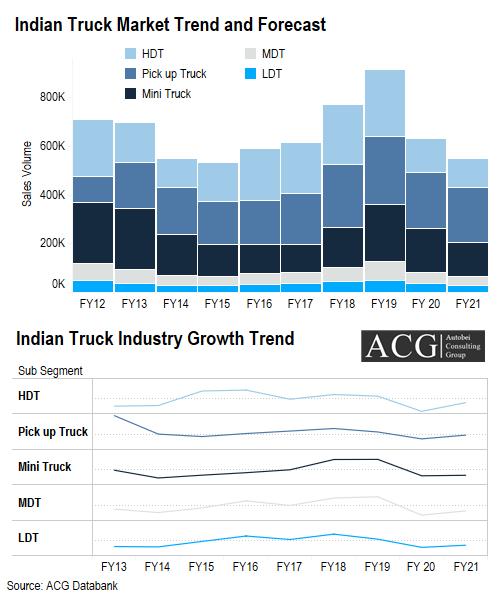
The Indian Commercial Vehicle, in particular, the Truck Industry is facing a downswing since the third quarter of FY 2020. With just less than half a million sales done in FY 2021, the Indian Truck market registered a negative Compound Annual Growth Rate (CAGR) of 3% between FY 2012 to FY 2021.Indian Truck Market Trend and Forecast FY 2021

Model wise Truck Sales Data and product Strategy:

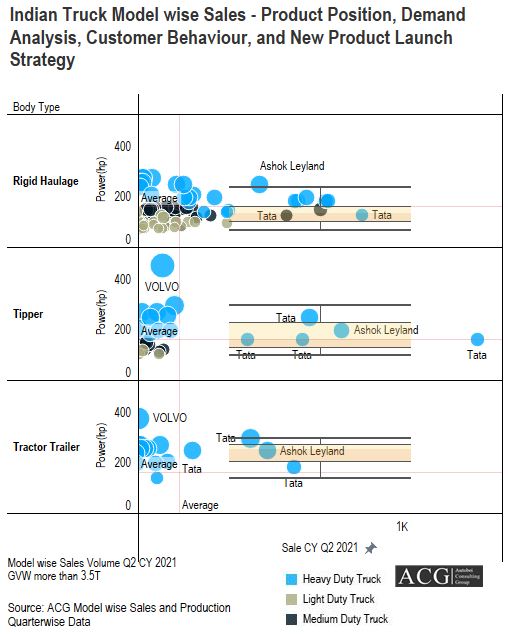
Indian Model wise Truck Sales Data Q2 CY 2021

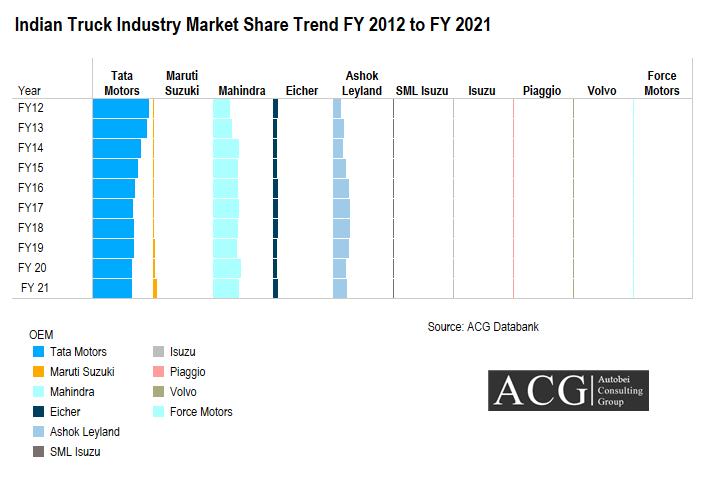
Tata Motors is a market leader accounting for 43% market share in FY 2021, after losing 18% market share in the past 10 years. The company registered a CAGR of -6.6% from FY 2012 to FY 2021, appearing to topple its annual growth. Ashok Leyland, Mahindra, Maruti Suzuki, Isuzu, and Volvo however registered positive annual compound growth in the same period. With Mahindra, Ashok Leyland, and Maruti Suzuki adding 9%, 7%, and 5% respectively in the last 10 years, appears to straighten the market growth for them.Indian Truck Industry Market Share FY 2012 to FY 2021The key reason behind gaining the market share is firstly the entry into a new segment and secondly launching a new product range with competitive price. It is undeniable that the new generation massively influences not only the purchase decision but also the changing vehicle purchase cycle. Customers seek out to test other brands available and this led to increment in Mahindra, Ashok Leyland, and Maruti’s market share in Indian Truck Industry Trend.
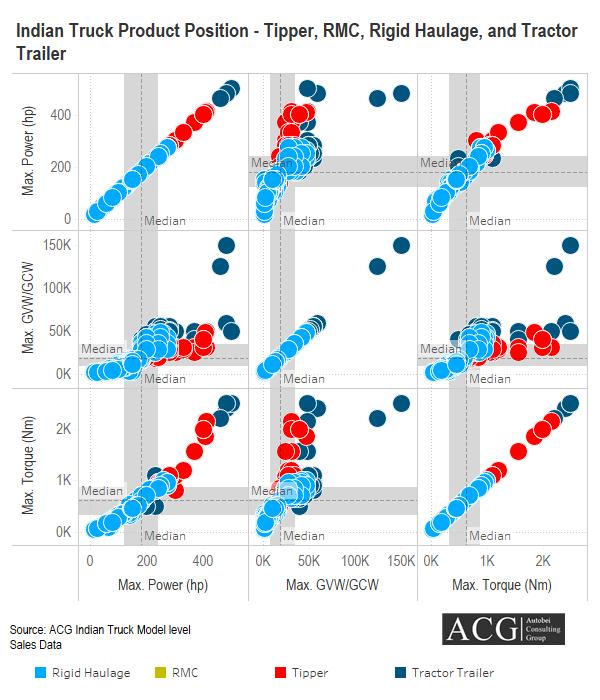
While currently the entire world is brought to a stand-still position, OEMs launched a new products range. Trucks are designed for demanding applications such as courier and parcel, poultry, white goods, agri-perishable, e-commerce, FMCG, Garbage Dumper, auto parts, and reefer.

Customers are anticipating efficient solutions about transportation and not just vehicles. To meet the customer expectations, OEMs are providing the After Sales Service, Digital technology solution, and advanced technology at affordable prices.

Tipper, Rigid Haulage, and Tractor-Trailer:

The Tipper segment just had a 9% segment share in FY 2021. The Tractor Trailer segment is also terribly affected by multiple factors and concluded FY 2021 with a 3% segment share.

After launching new products with improved payload capacity, consumers began to move to higher tonnage tippers to get better TCO.

In the Overall Truck segment, Tata Motors rules around 57% market share, Ashok Leyland is the second largest OEM with a 29% market share. and  Eicher increased its market share from 5% to 8% in just one year in the Tipper segment.Indian Tipper Rigid Haulage and Tractor Trailer competitor product analysis

In the Heavy Duty Tipper segment, Tata Motors rules 60% and Ashok Leyland rules 30% market share, In the premium Tipper segment, Volvo is having more than 90% market share.

The rigid Haulage segment tops the Indian chart being the largest segment in Indian Truck Industry. 90% of sales come from the Rigid Haulage segment. Tata Motors, Mahindra, and Ashok Leyland are amongst other leading players in this segment.

The tractor Trailer segment got shrunk. It happened due to the launching of heavy Duty Rigid Haulage and the changing market dynamics. Tata Motors emerged to be the market leader possessing 64% and Ashok Leyland with 27% market share in FY 2021.

Segment level Analysis:

Heavy Duty Truck (HDT):

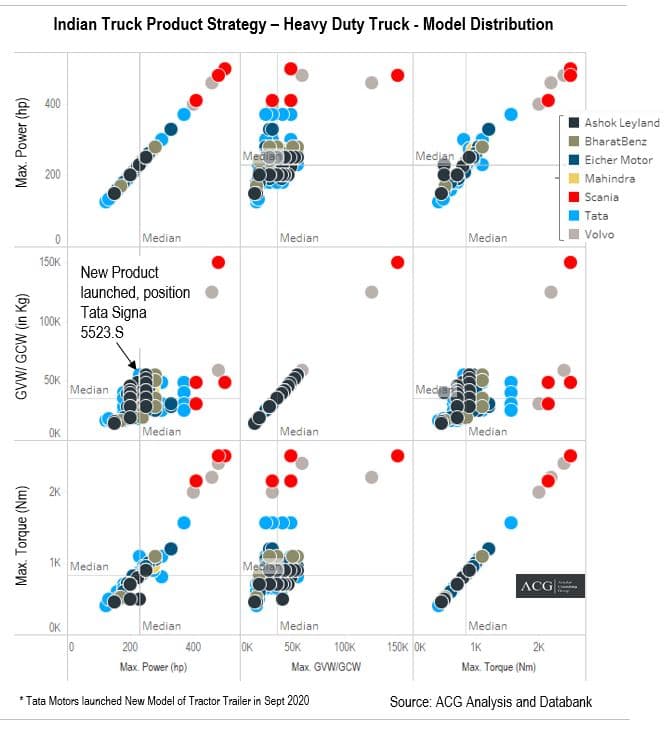
Except for Pickup trucks, the all-sub segment of the Truck Industry registered negative CAGR from FY 2012 to FY 2021. The Pick segment registered 8% CAGR. The HDT segment recorded a CAGR of -7%. While, MDT, LDT, and Mini Truck registered -6% CAGR in the last 10 years.Indian Truck Product Strategy – Heavy Duty Truck - Model Distribution

In FY 2016, HDT was the largest segment in the Indian Truck market with a 36% Segment share. However, in FY 2021 it had only a 21% share. On the other hand, demand for Mini and Pick Up Truck expanded because of increased usage of the trucks.

After FY 2019, HDT turned out to be the most affected segment with degrowth of 50% and 15% in FY 2020 and FY 2021.

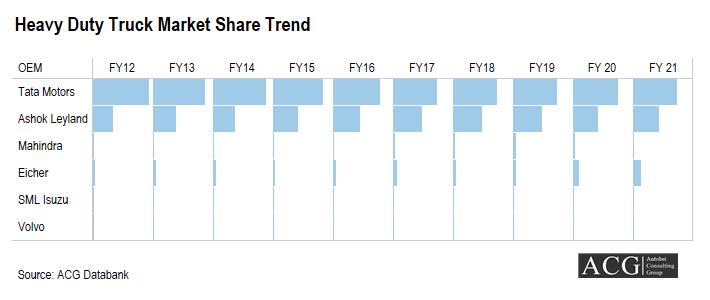
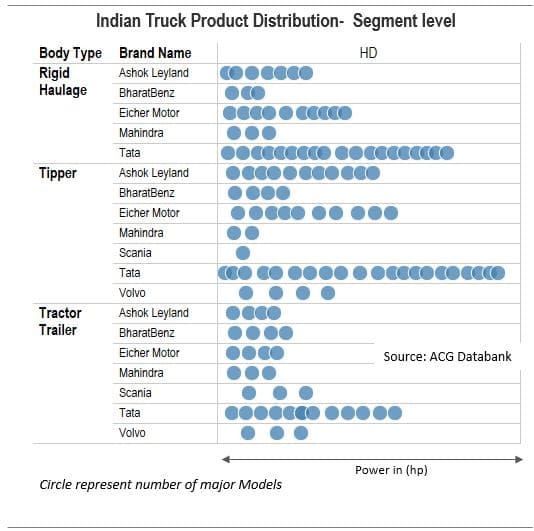
Tata Motors is the leading player in the HDT segment but lost a 12% market share in the last 10 years. BharatBenz is also one of the reasons that some of the volumes have been shifted to BharatBenz’s sales pocket. Eicher is aggressive to gain market share in this segment. The company increased its market share from 3% in FY 2012 to 7% in FY 2021 with a CAGR of 5%.

Indian Truck Product Distribution - Heavy Duty Segment

Volvo Trucks registered the largest degrowth in the last two years mainly due to weak demand in some specific segment.Indian Heavy Duty OEM wise market share Trend FY 2021

Medium-Duty Truck (MDT):

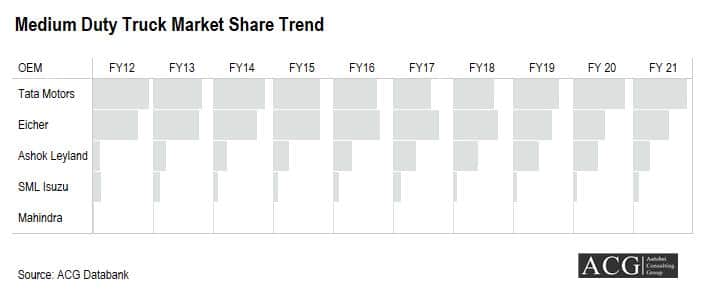
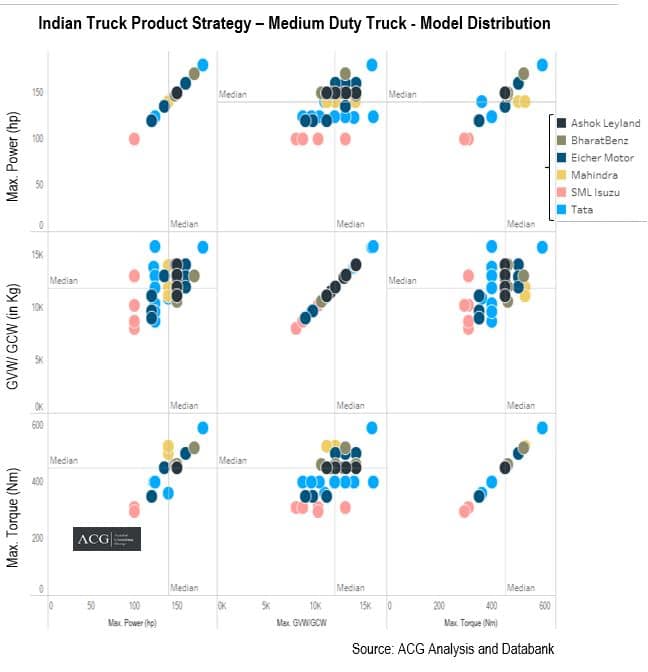
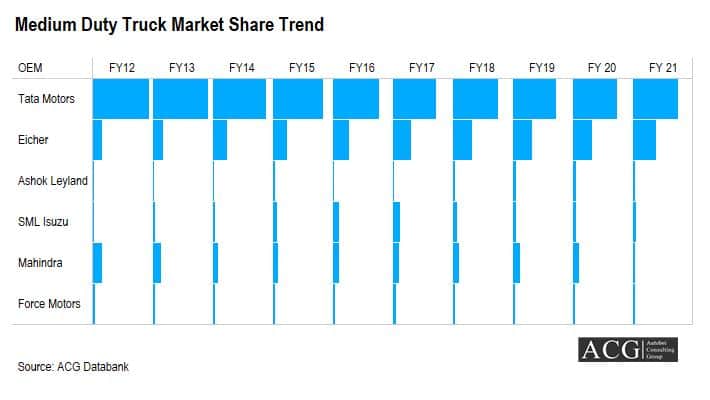
Tata Motors managed to achieve momentum in this segment. In FY 2016, FY 2017, and FY 2018 Eicher had been the leader in this segment. After FY 2018, Tata is ahead of Eicher with a 46% market share in FY 2021.Indian Medium Duty OEM wise market share Trend FY 2021

Eicher lost its grip in this segment having to maintain only a 31.5% market share in FY 2021. Ashok Leyland focused on this segment and gained a 9% market share with a 4% CAGR in the last 10 years.

Indian Truck Product Strategy – Medium Duty Truck - Model Distribution

Light-Duty Truck (LDT):

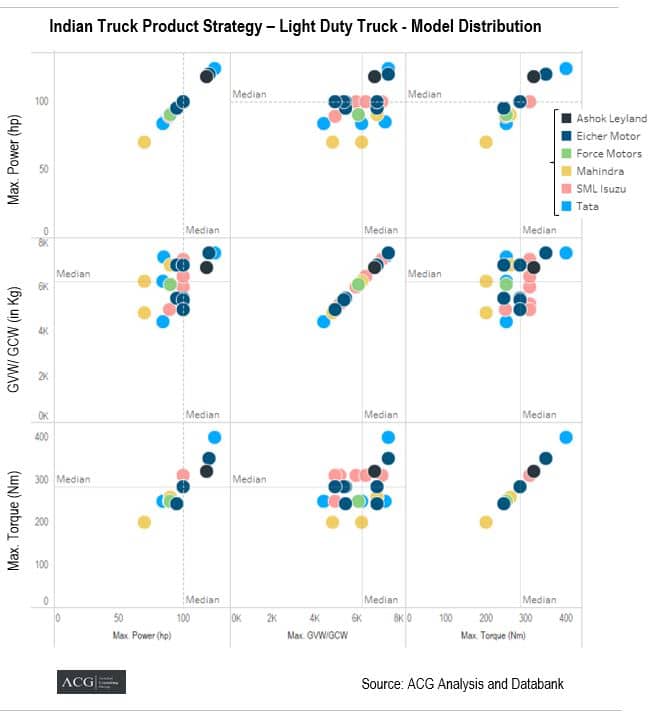
In FY 2012, Tata Motors had a 70% market share. But in FY 2021, it has only a 56% market share showing a slump of 14%.Indian Light Duty OEM wise market share Trend FY 2021

The company lost 14% market share in the last 10 years. On the other hand, Eicher’s new product launches helped it reach 29% from the 13% market share in the last decade. SML and Isuzu registered 3.8% and 1.2% CAGR between FY 2012 to FY 2021.Indian Truck Product Strategy – Light Duty Truck - Model Distribution

Pick Up Segment:

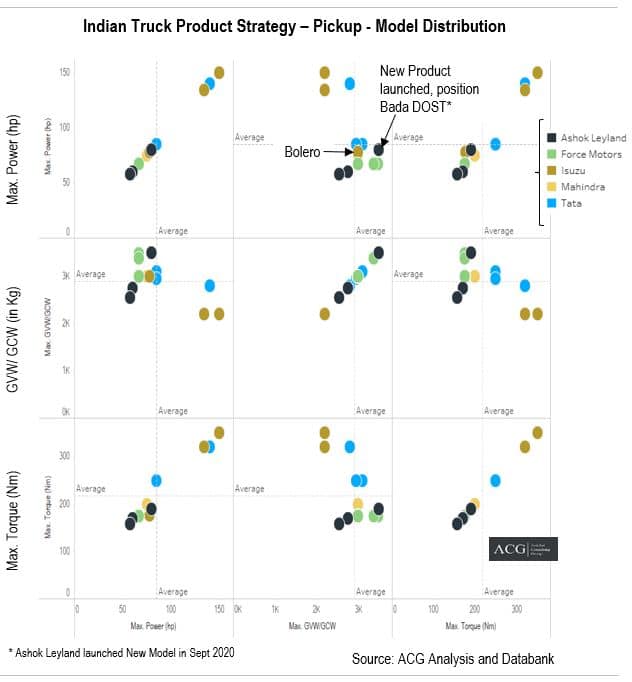
This is one of the fastest-growing and currently the largest segments in the Indian Truck Industry. Due to its size and company product portfolio, Isuzu launched its Pickup truck in this segment. Due to its quality and performance, it is estimated to make a pronounced presence in this segment.Indian Truck Product Strategy – Pickup Truck - Model Distribution

Tata Launched Tata Intra’s product range and Yodha to gain market share. Ashok Leyland also launched Bada Dost to target a new customer segment for Driver cum owner but the better driving experience.

Indian PickUp Truck OEM wise market share Trend FY 2021

Mini Truck:

In FY 2021, Mini Truck is the second-largest truck segment. Unfortunately, the pandemic induced cessation of its growth. Customers switched to buying Pickup trucks instead of Mini trucks to get more applications and better business.

Indian Mini Truck OEM wise market share Trend FY 2021

Tata Motor is the market leader with a 62% market share. The company lost 12% market share in the last decade.
After the entrance of Maruti Suzuki, Tata Motors lost 9% and Mahindra lost 11% market share. Maruti’s product position and specifications helped the company become the fastest growing OEM in this segment with a 21% market share.

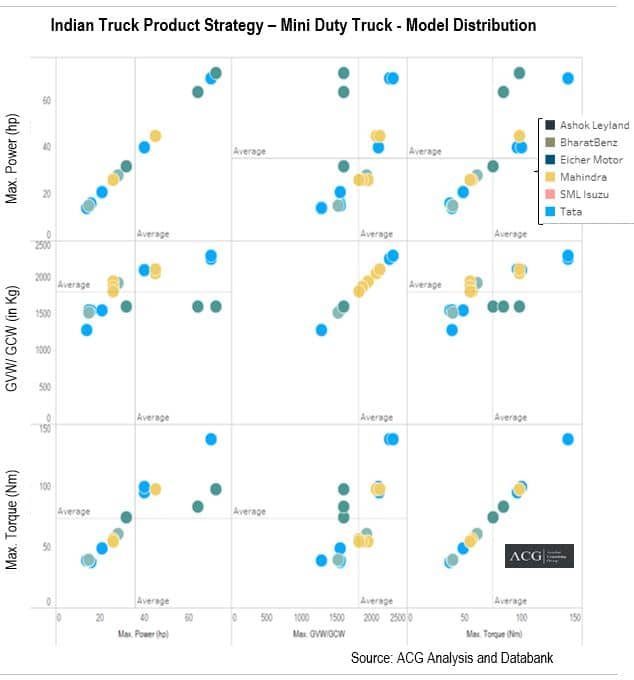
Indian Truck Product Strategy – Mini Truck - Model Distribution
Outlook:

Though the year 2020-2021 brought the whole world to a halt and toppled the industrial economy like never before. Demand in some sectors like construction, mining, and e-commerce, and commercial vehicle sectors is going to pick up in short to medium duration.

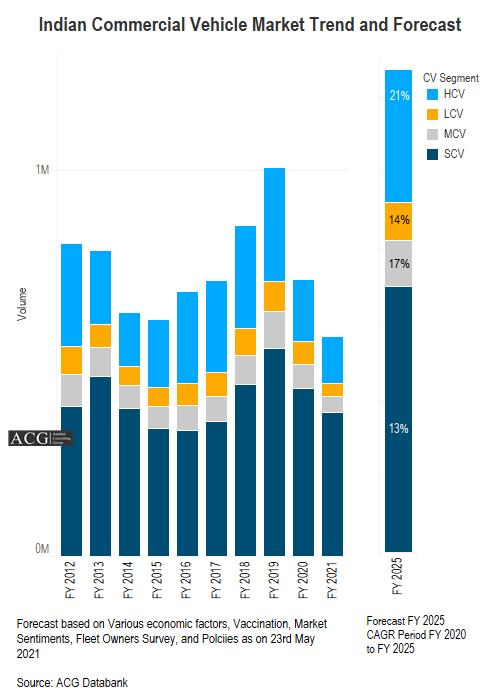
The Indian Commercial Vehicle sales done in FY 2021 is slightly above half a million, and this is the worst performance considering the entire decade. CV Export and the Production stood at  0.62 and 0.05 million units respectively in the FY 2021 and this further is the lowest figure recorded in the Recent past.Indian-Commercial-Vehicle-Market-Trend-and-Outlook-FY-2025 Forecast

The Pandemic has proven to be the worst nightmare for business transactions across the globe. It has left the growing business stranded and the established business units clueless at the moment. It would be a herculean task for all the businesses to get back on track and get back their momentum. If we take a glance at the Automotive sector, specifically the Industry comprising of Commercial vehicles faced the wrath of this infectious virus as it witnessed getting transitioned to its worst-ever position in a significant time. The sales of the Commercial Vehicles procured in FY 2021 were able to match the statistical equivalent of just 50% in total units that were procured in FY 2019.

The sales of the Commercial Vehicle would show the economic health of the country. The Pandemic hit situation didn’t give any scope for the OEMs segment to acquire their old base of clients.

Insight: Model wise Indian Truck and Bus Sales and Production Data FY 2021 and FY 2022

Segment wise Indian Commercial Vehicle Market Report FY 2021 and Outlook

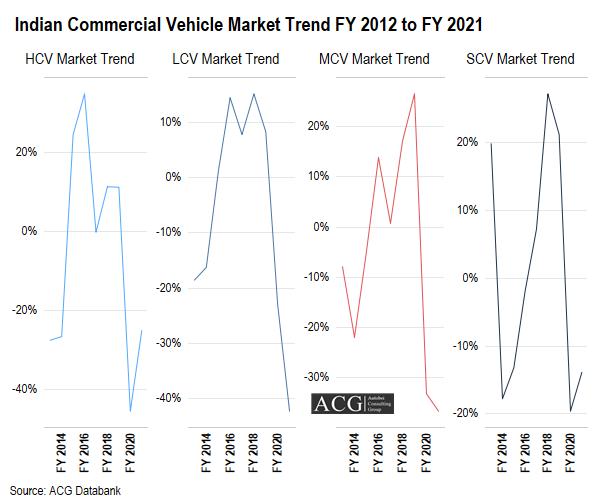
The Compound Annual Growth Rate (CAGR) of the Indian commercial automotive sales stood at a negative curve of -4% during the 10 years starting from 2021. It is expected that  Heavy Commercial Vehicle will register 21%, Medium Commercial Vehicle 17%, Light Commercial Vehicle 14%, and Small Commercial Vehicle Vehicle register 15% in FY 20205.

There has also been a significant decline in the overall segment share of -12% for HCV, -3% for LCV and MCV individually. Contrastingly small commercial vehicles showcased a 18% improvement in the decade.

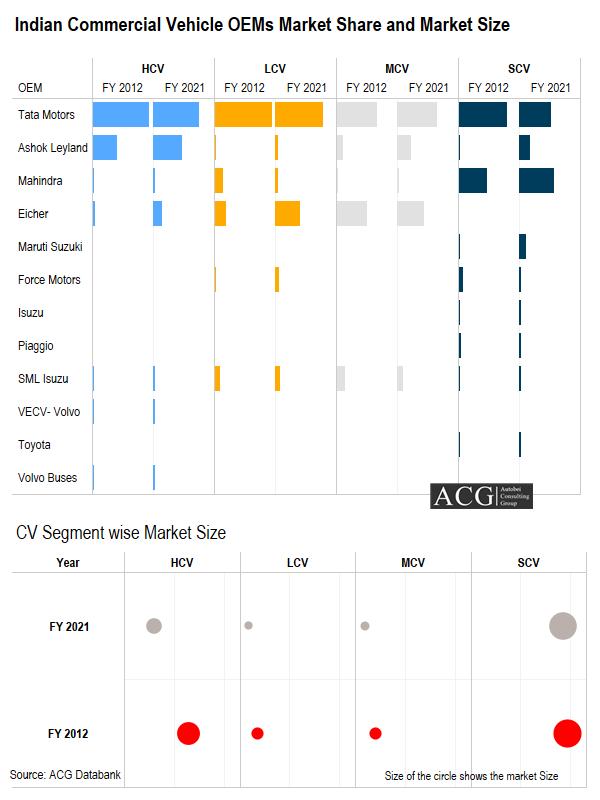
Post the Pandemic, the recovery rate looked even more worsening as we saw the Indian CV industry further dipping down on its growth potential by a negative gradient of 29 and 21 in the FY 2020 and FY 2021 respectively. Though the value diminishing has been a common phenomenon everywhere, but noticeably LCV and SCV performed slightly better than the HCV and MCV.Indian Commercial Vehicle OEMs Market Share and Market Size

Tata Motors, which is widely acclaimed for being the Indian brand that gives utmost importance to value for money couldn’t turn its magic in the CV segment, as it put up a dismal performance in the decade by amassing a CAGR of -7.2%. Whereas the premium segment was slightly successful in getting the last laugh, as Volvo climbed up and showed up 6.5% CAGR from FY 2012 to FY 2021. Other decent performers then would be the Mahindra which showcased a growth rise of 1.2%, and Eicher was a negative growth of 3.2% taking into consideration the previous 10 years.

But, in the commercial vehicles industry, the Indian players continued to rule the market as we saw Tata Motors had a flawless regime by amassing 42% hold in the year 2021 and it faced a marginal drop of 16% considering the overall performance of the decade. Though they have tightened their hold on the existing market, their contemporary rivals have given it a tough time to cope with the existing situation. Despite the challenges surrounding them, they have kept the innovation at the core and have ensured to storm the market with their best-in-class products.

The established players too had a marginal rise when it comes to the enhancement of their Market share. The likes of Mahendra accelerated a market share of 10%, and the Ashok Leyland shot its growth to an additional 5% during the stint of ten years. Even these two have kept the innovation at the heart of everything and have been evolving continuously to throng the market with renowned products over various segments. Their ability to render a much-needed solution enabled them to speed up their growth strategy and tighten their market hold.

Even the Pivotal manufacturers of the Indian commercial vehicle segment loosened their overall command on the Market by close to, 20% in FY 2021 in line with FY 2020. Volvo Truck growth declined by 92% in FY 2021 compared to FY 2020. Maruti Suzuki tried to maintain its growth by amassing 36% in FY 2021 compared to the last financial year despite the worsened situation.

Heavy Commercial Vehicle Segment:

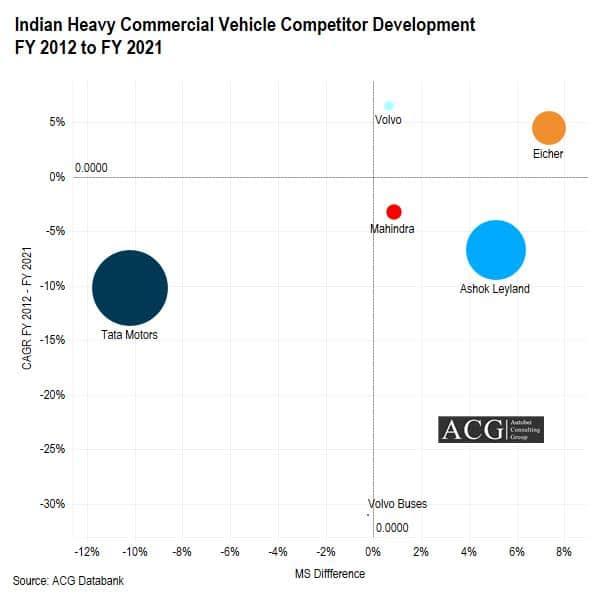
The new BSVI adoption into the existing market has brought about a transformation regarding various operation-related things. One such thing can be the measure to Curb the new axle load norms. The established players like Tata ensured their flawless operations at the place, despite seeing a dip in the overall share during this period. The annual growth rate recorded during this decade astonishingly was in the negative gradient of 10%.Indian Heavy Commercial Vehicle Competitor Development FY 2012 to FY 2021

The premium Vehicle manufacturers, have tried in all sorts to restore the market conditions and have even rendered an opportunity to other counterparts by uplifting them. One such example would be the growth of Eicher fuelled by Volvo which handed them a Cumulative 7% growth during the period, and its growth rate is at the constant rate of rising and recorded as 4% at the moment.

Medium Commercial Vehicle Segment:

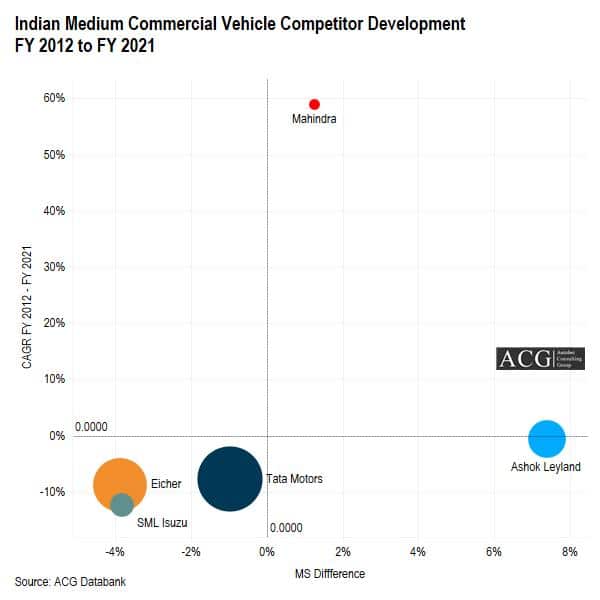
The flag bearer of this segment would undoubtedly be the senior player in this domain i.e Tata Motors, and as already mentioned its Uniqueness in New Product launches, Price, Continuous innovation has made them get almost close to 50% of the market share.

Indian Medium Commercial Vehicle Competitor Development FY 2012 to FY 2021

The growth rate didn’t quite reflect the same identical growth or expansion as it was yet in the negative gradient. The other manufacturers in the leaderboard didn’t quite put up a commendable performance worth mentioning. And notably, Eicher faced a 4% fall in the existing market scenario.

Light Commercial Vehicle Segment:

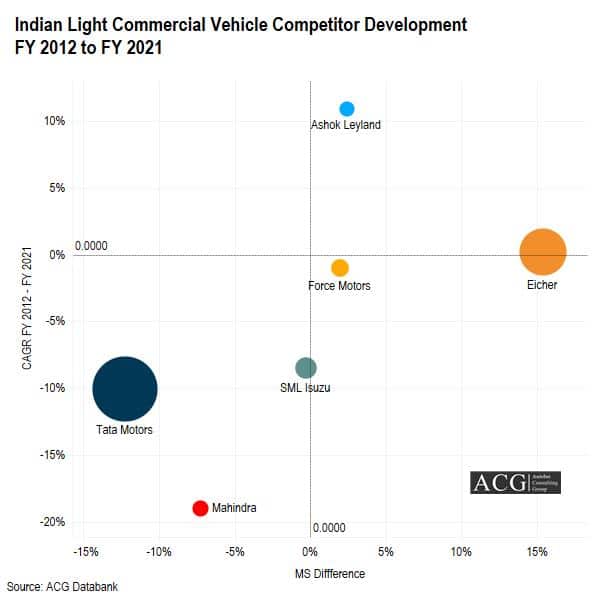
This segment too suffered more or less the same sort of disownment in the Market. Eicher was able to reap good results here, as it enhanced its overall market share which was at just 13% in 2012 to a whopping figure of 29% in a decade’s time.Indian Light Commercial Vehicle Competitor Development FY 2012 to FY 2021

Numerous factors contributed to this astounding success and TCO value can be one such. Apart from this development, Tata too conceded a sharp decline in its segment share by 12% between FY 2012 to FY 2021. This further affected the growth rate to decline to a negative curve and recorded a growth of -10% in the decade starting 2012.

Small Commercial Vehicle Segment:

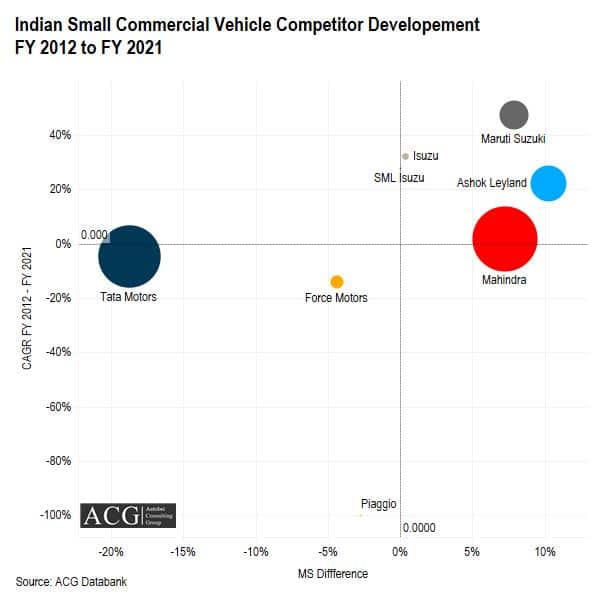
As Pandemic continued to worsen the potential of almost all the sectors in the automotive sector, but this Sector didn’t quite receive the same sought of harsh treatment from it. As the figures suggest a significant amount of value being conceded and losing up to the wave of the virus but it seems to negligible when the value is holistically compared with its other counterparts. The Mahindra continued to be the best performer by amassing a 40%+ expansion in its operative space and even shot up to its growth rate to 2% during the period.Indian Small Commercial Vehicle Competitor Development FY 2012 to FY 2021

Other potential segment leaders like Ashok Leyland tried to emulate the strategies like Innovativeness, brand positioning, presenting a whole renewed range and this, in turn, yielded them a fruitful return as they want to climb to 12% from their initial pace of 2%. During the last 10 years, they were even successful to put across a CAGR of 22%. The Household brand of the Indian Automotive sector, the Maruti Suzuki had a perennial run in the space as they again touched an appreciable growth rate and even created a record of their own by ensuring a 47% CAGR in the recently concluded decade.

Positive aspects in the current Market scenario:

  • After assessing the available data, and further analysis has strongly predicted the potential of market expansion by a value greater than 9% or more in the year FY 2022
  • The Present Monetary year is forecasted to witness economic growth starting from 9% to 11% in terms of GDP expansion.

Hurdles in the path ahead:

  • Getting the people to the showrooms and enhancing sales will be an unattainable task at the moment, considering the rapid rise of cases.
  • The Transport organization has incurred an irreparable finance crunch.
  • The costing of the vehicle is yet again a tricky challenge
  • A pandemic can again bring the world around to a standstill position
  • The Dealer’s might rethink the Gain factor

ACG released the latest version of the Indian Electric Two-Wheeler Product and Market Report.

Key Highlights of the Report:

Market Overview

  • Indian Electric Two-Wheeler Market size in volume and Value
  • Market Forecast – Short, Medium, and Long Term
  • Key Growth Drivers, and Challenges
  • Scooter Segment Market Size, Market share, Growth, and Forecast
  • Motorcycle Segment Market Size, Market share, Growth, and Forecast
  • Mass, and Premium price Market and Product Segment Analysis
  • Challenges to get finance for EV purchase
  • Largest and Fast-growing Segment Analysis

Product Strategy and Analysis

  • Key Product Product position and mapping with customer need
  • Application, or Usage Type Model wise Analysis
  • Price Position
  • Top-selling models, specs, Features, Price, and Subsidy
  • Running cost Analysis – IC vs Electric Two-Wheeler
  • High Speed and Low-Speed vehicle
  • Segment Analysis – Private usage, School purpose, Last-mile delivery
  • New Product launch segment roadmap
  • Target segment and configure the product specs and features
  • Competitor Product Analysis
  • New Model launch plan for next 2 years
  • Charging Infrastructure Challenges

  Customer Analytics

  • Customer Voice – Metro, Tier I, Tier II, and Tier III
  • Brand perception to buy influence buying decision
  • Customers preference to buy Electric Two-Wheeler
  • Models mapping with different usage or application
  • New Segment Potential Analysis for growth opportunities
  • Indian Electric Two-Wheeler manufacturer company Analysis
  • Customer pain points

 Government Policies, and Regulation

  • Electric vehicle Policies for Two Wheeler segment
  • Statewise Electric Vehicle policies and its impact on sales
  • Govt support to manufacturing EV components in India
  • Expected Govt policies and regulation roadmap for next 10 years

 Technology Analysis

  • Current Electric Two-Wheeler Technology Analysis
  • Future changes and implementation of Technology Features
  • Battery Technology, Charging information system, payment option, Logistic related, Purchase option

Optional Section

  • India Economic Profile
  • Battery Technology
  • EV Supplier Database
  • Electric Vehicle Feasibility Study
  • Indian EV market Entry Strategy
  • Qualitative Analysis


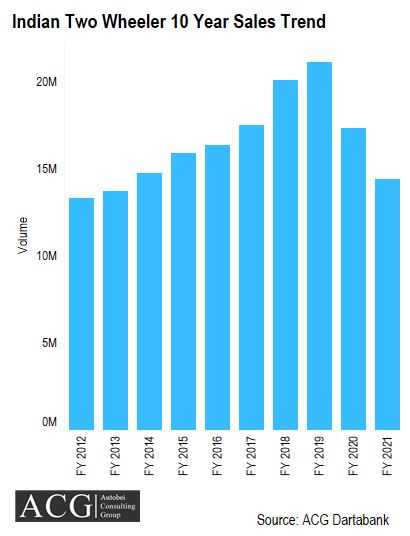
When we take a look at the two-wheeler sector performance in the Indian scenario the compound annual growth rate stands at 1.3%, and this is the cumulative growth depicted considering the data from the last 10 years i.e the financial year between 2012 to 2021. Considering the products that had a good run in the market during this tenure are the Scooter with a 6.4% CAGR, Moped flaunted a negative dip with -2.5% and overall the Motorcycle segment didn’t quite find an Avenue for growth as it saw its CAGR in a very worsened state of 0.1% in the recently concluded decade.

Indian Two Wheeler Sales Trend Analysis

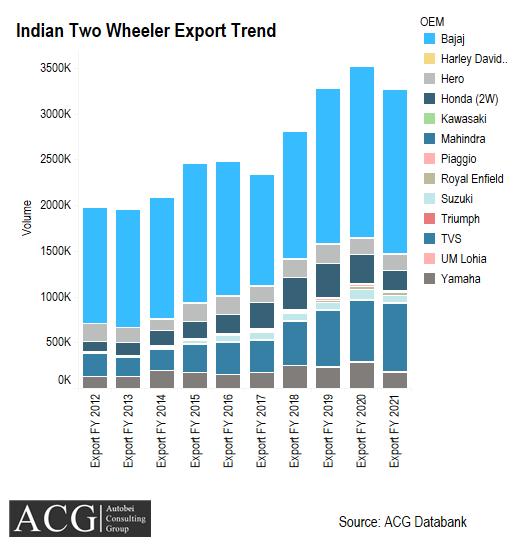
Pandemic played a spoil part in numerous industries across the nation and globe. Although predictions made it clear that Post pandemic period will bring about a booster for the industry, the same was not evident in the statistical figure as it suggests the 2 wheeler Market of India saw its all-time low of -18% in the year 2020 despite a sharp diminish in the COVID effect, and the number currently stands at -13% and is anticipated to worsen as the year proceeds further owing to the rise of cases because of the advent of the mutant variant of virus in the Indian population.Indian Two Wheeler Export Trend and OEM wise Market Share FY 2021

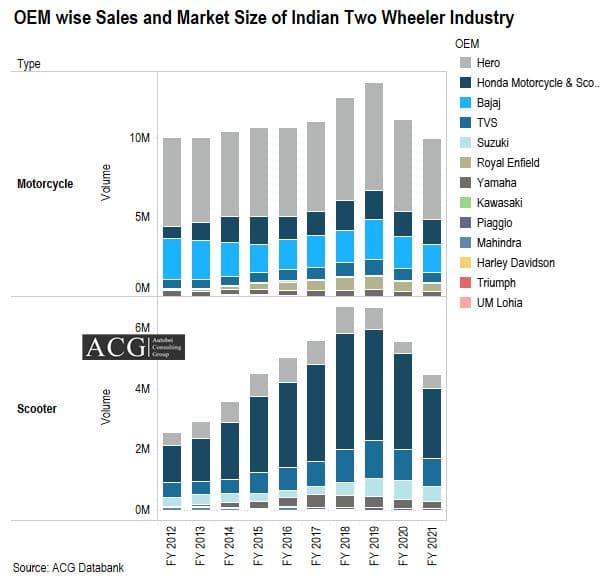
However, the Two-wheeler industry was able to garner some sort of relief for itself as the Royal Enfield rose to the epitome of performance by amassing the growth rate of 24.7% when all its competitors were struggling to even get a marginal growth for themselves. The path taken by Bullet bikes was then followed by the Honda brand as it witnessed an upliftment at a rate of 7.6%. But the progress of other brands in the two-wheeler segment wasn’t that encouraging.OEM Indian Two Wheeler Sales Volume from FY 2012 to FY 2021

The Hero Motocorp which flaunts the name of having the highest shares of the vehicle in the Indian market lost its stronghold on the Market and even its growth factor dipped to -0.8% in the last decade.

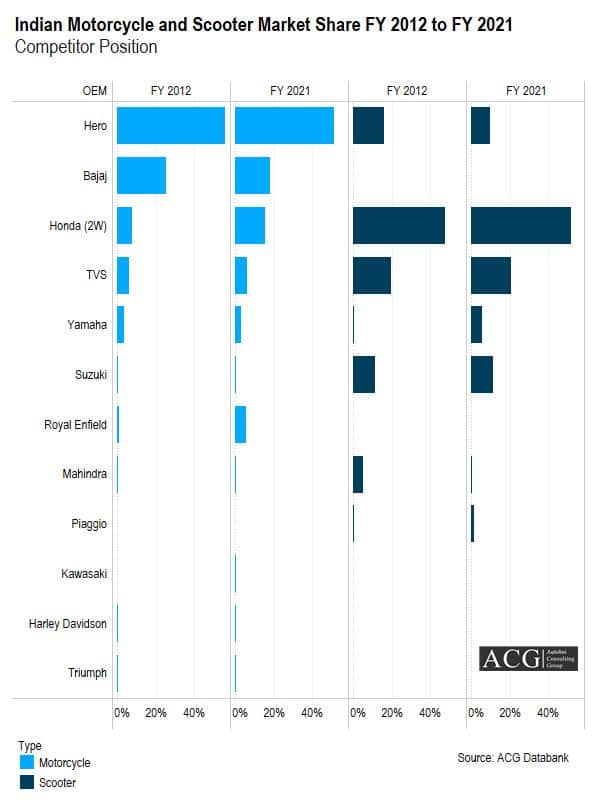
This precedent of losing the market hold resulted in an overall decrease in the Growth rate of contemporary giants like Bajaj Auto and Hero Motocorp as they went onto be poorer by 7% and 8% for the decade. Whereas the growth curve is seen by Royal Enfield at 3%, and Honda at 11% was a sigh of relief for the market when everything else failed to capitalize for them.Indian Motorcycle and Scooter OEMs Market Share Analysis of last 10 Years FY 2021 to FY 2021

The Motorcycle sector’s leaderboard has immense competition, and it’s bound to change for every quarter as it’s been evident considering the last few cycles. During these tough times, Hero continued its flawless run in the segment by collecting an overall hold by banking a percentage slightly above 50% in terms of its brand presence and striked an annual growth rate of -5.3%.

There are vital factors that collectively contribute to deciding the top performer position like budget vehicles, a trust created by the brand and its customer retention policy, and the specifications the brand offers. As Hero ticked all of these boxes and established itself as the brand that would cater to all the customer’s requirements, and this factor has completely reduced their degrowth rate which used to be at 2 digits to just at 5% and this Trend was only witnessed that too at the starting of the decade i.e in the initial year of 2012.

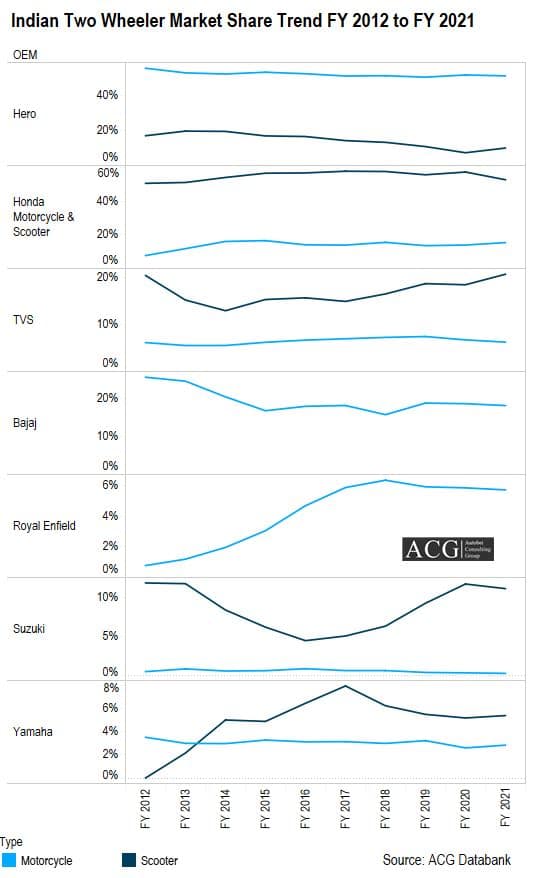
From then on till now, there has been absolutely no turning back for Hero. Post pandemic period posed a challenging phase to them as they lost the market hold by a marginal value of 15 and 12% in FY 2020 and 21, this further affected their Growth rate and scaled-down it to as low as -1%. In terms of growth progress, Bajaj has followed the footprints of Hero and has evolved incessantly to become the highest market share Holder only after Hero by amassing a Market hold of 18%. However, their performance over the last decade wasn’t that consistent as they let off go of the market share by 7%. The other competitors in the segment weren’t that far behind as Honda showed a market potential of 8%, and followed by Royal Enfield with a grip of 5% in the pandemic hit phase.Indian Motorcycle OEMs Market Share Trend FY 2021 to FY 2021

When we take a complete overview of the Scooter sector, it can be observed that its growth had a phenomenal rise to 6% in the decade. Despite a hardcore competency by the rivals in the segment, Honda was successful and emerged to be crowned as the Top brand in the category for the decade, even they were able to enhance their hold on the contemporary market by tightening their grip by 4% in 2021. TVS climbed upto reach the second spot by their impeccable strategy and striking the best inline technology advancements in its products, this enhanced their hold by an additional 1%. When all the competitors were trying their best to carve a position for them in the market but the established player which carries its own legacy and goes by the name Hero Motocorp failed due to its incompetency by putting up a dismal performance and even got dethroned from the 2nd spot and was pushed down to the 4th Spot in the market. Their mediocre sales also handed them a defeat in terms of the market hold by letting off go 6% of its share in the last decade.

Please contact us to get the full Indian Two Wheeler market Report FY 2021 and Forecast