Indian Two Wheeler Product and Market Analysis is the most detailed report which covers all segment, Brand, Market Dynamics, Trend, Product age, Product life cycle, Aftersales, Buying behavior, Production forecast, Export analysis, Sales, Marketing Strategy, Sales Strategy, Dealer Network, Role of the Internet to buy the vehicle, Model wise critical analysis and its mapping with customers, etc.

The Indian (2W) industry enrolled sales in volumes of ~ 15.1 million units in 2020-21, which was a degrowth of 13% over the earlier year FY 2019-20. The 13% degrowth recorded by the 2W business is comparatively less to the growth expected that enlisted some time ago.

Buying behavior Analysis:

Indian Two Wheeler Market Report FY 2016

Indian Two Wheeler Export and OEM wise OEM Market Share:

Buying behavior Analysis:

The Scooter segment has demonstrated a 20% degrowth, though Motorcycles have demonstrated 11% degrowth this year.

The Indian and foreign 2W organizations concentrate more on exports, particularly from India, the Asia Pacific (Vietnam, Thailand, Indonesia, the Middle East and Latin America, and so forth), and African nations where the 2W business sector is exhibiting colossal potential. Piaggio has as of late dispatched its Vespa model and plans to fare its units from India. Then again, Mahindra needs to resuscitate its brand position, product value, and in particular, its Brand Image in the present business sector.

Entry, Executive, and Premium Segment segment share is changing every year.

Two Wheeler market is too dynamic. Customers are shifting from one parameter to another one frequently and choose a product that gives some value.

Report Highlights

  • Indian Automobile Industry overview
  • Two Wheeler Industry Analysis
  • Segment Analysis
  • Pricing Strategy
  • Customer behavior
  • Product portfolio analysis
  • Brand Strategy
  • Market Drivers – Segment wise
  • Historical & Future Trend Analysis
  • Competitive Landscape
  • Macro Economics Analysis & Industry
  • Company Business Reviews

The contemporary world of today has snatched the opportunities from various Industries by jeopardizing their growth potential and have left them stranded. Despite all the hurdles that are drawing the progress of the Auto industry sector to the negative curve, but one forecast has really created a ray of hope as it predicts a fantastic potential for expansion of the Indian Auto sector in the 3rd Quarter of 2022. The current scenario for the Auto industry isn’t encouraging as the pandemic has posed a great threat to its expansion, yet customers have shown their interest in procuring three-wheeler, two-wheeler, four-wheeler, Trucks, and Bus.Indian Auto Industry Market Trend Report FY 2021 and Outlook

The upcoming months in the years 2020 and 2021 would open new avenues of growth for the Auto sector and at the same, it will be equally tough for it to cope up with the existing market. These challenges will not only be limited to this sector alone but will also trouble the New investors, Employees, Transporters, Dealers, Advertising agencies, suppliers, and a lot of other domains.

In case there is a sharp diminish of the contagious COVID in the 1st quarter of FY 2022, then this would result in bringing about a growth anywhere less than 10% in the 2nd quarter. The anticipated GDP for the FY 2022 stands within 9 to 11%. In fact, the Inflammation and the price slash from the OEMs would orchestrate to cause certain hindrance for the sales of Automobiles and certain procurer related products. The paramount thing that needs to be observed from the initial Pandemic days is that it did not cause much damage to the Village population of the nation, and this, in turn, resulted in boosting the sales for the Auto sector across those regions. However, the present situation is contrary to the previous as the current wave has sent Shockwaves across the nation and would cause major damage to this sector in FY 2022. There seems to be no end to the misery of the Auto sector as the Government’s decision to halt production at the manufacturing units, Shutting down showrooms across India are likely to hit the market even more. The analytics and the data have showcased a very soaring start to the 1st quarter of 2022 and it would need to fight out the fallout in demand and the depreciating economic conditions. The key facts from the history of the Auto sector market have revealed that April month offers very little scope for sales and we can further deduce that this would recur in 2022 thus hitting the all-time low. Besides the Fuel costs are on the rampant rise in recent days, this would surely make the end-users think twice before opting for an Automobile.

The competition from other sectors will also bring cause a big hurdle for the Auto Sector, as the OEMs are having an eye on Market expansion by releasing a wide range of units.

When we take a look at the FY 2021, the sharp fallout in sales figures is very evident. Sales pertaining to Indigenous Automobile diminished by 13.6%, whereas the production and export value witnessed a backslash by 14 and 13% respectively.

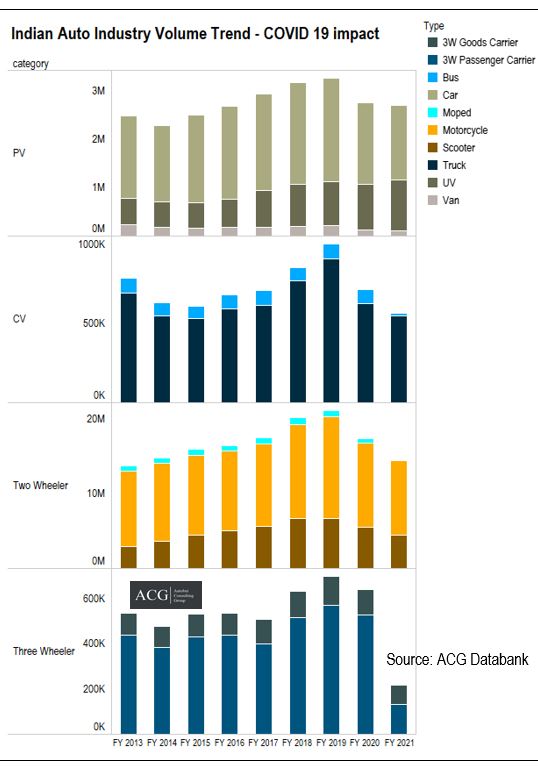
Indian accounted for the manufacture of about 23 million automobiles, out of which 22 million units were marketed and procured by Indians, and the remaining 30 lakhs were sent to other nations owing to the sales demand.Indian Auto Industry Volume Trend of last 10 years

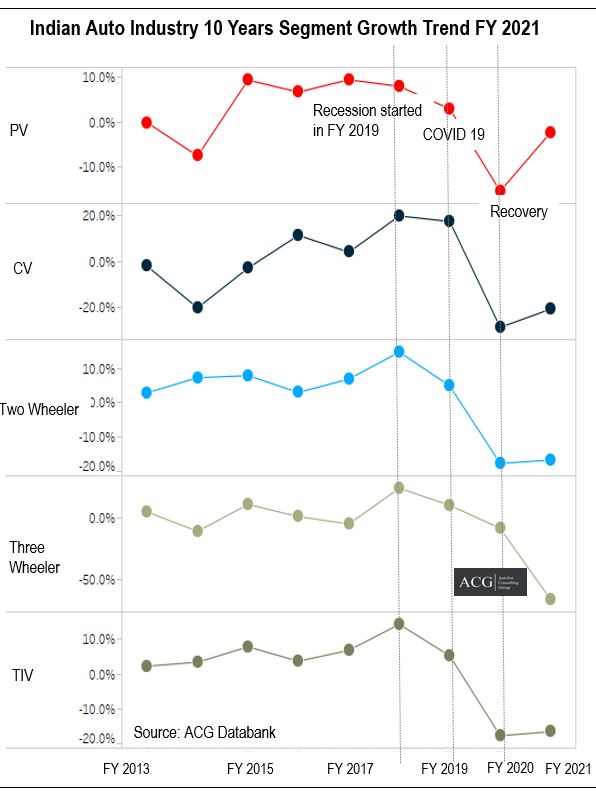
The statistics of the last decade i.e from FY 2013 to FY 2021 haven’t been a fruitful outing for Auto. The Compound Annual Growth Rate of Indian market stood at just 0.5%, the Indian commercial vehicle segment too had a sluggish journey as the sales figure dipped to negative and was at an all-time low of -4%, Passenger vehicle sector and two-wheeler too failed to capitalize the Market as it just amassed a growth of 1%, the Three-wheeler segment, however, had a disastrous decade as the figure went well past zero and stood at -9%.

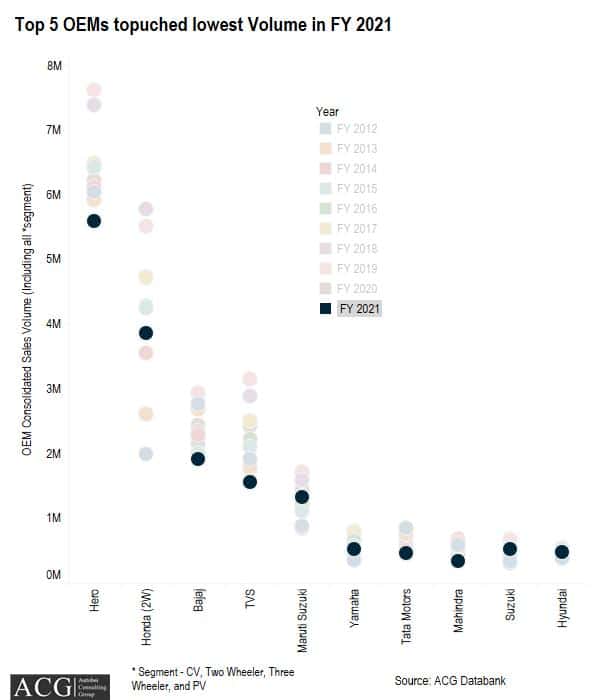
The FY 2020 which was unanimously declared as the worst nightmare for the Auto sector growth has also created few infamous records for itself. The sales figure of 2020 is the lowest in the entire decade, and the units sold during this year are equivalent to just 50 percent of the annual sales of FY 2019. However, as the saying goes that ‘every cloud has a silver lining’ the 2 wheeler sector alone scaled up its growth to an amazing level when compared to the last decade.Indian Automotive OEMs consolidated Sales Performance in FY 2021

In the 21st century, Transportation has acquired an Integral status, and the COVID disease led the customer to rethink the convenience of travel and many even made their mind to own a personal 4 wheeler of their own to ensure a safe journey.

Global Light Electric Commercial Vehicle Market Report is our latest report which covers COVID 19 impact and Outlook.  eLCV market has started to show tremendous growth in the next 5 to 10 years.  Vehicle feasibility is playing the most important role in purchase decisions.

As per the ACG study, eLCV product feasibility rate depends on the application of the vehicle. Government policies and regulations are also important to penetrate its presence or replace ICE vehicles.

Also, get insights – Electric car Business Model

Key highlights of the Report:

  • Global eLCV Market size – Volume and Value
  • Region – APAC, China, Japan, Europe, Africa, Latin America, GCC, and others
  • Vehicle Type: Goods and Passenger vehicle
  • Key players in each segment
  • eLCV Segment Analysis – Growing segment, Most competitive segment, Expected largest segment, Price sensitive  segment, and others
  • Product Technical requirement for each category and application
  • Product-wise technology Assessment
  • TCO Comparison Analysis – ICE and Electric vehicle
  • eLCV Product Life cycle
  • Key Challenges and Opportunities for Transporters
  • SWOT Analysis
  • various Business Case Detailed Analysis for various scenarios
  • Brand perception influence to buy the eLCV vehicle
  • Charging infra requirement to penetrate the vehicle population
  • Pricing Point Analysis for next 5 years
  • eLCV Supplier data

Premium and Luxury car Sales in India are an attractive segment in India. Young professionals and Medium Business owners are attracted towards the Premium and Luxury car segments. The city-wise Data is key to Sales planning, Advertising & Promotion, New Car launches, and dealership strategy.

OEMs:

  • Volvo (ICE & Electric )
  • Mercedes Benz
  • BMW
  • Audi
  • Jaguar Land Rover
  • Porsche

Type of Vehicle:

  • SUV
  • Sedan
  • Hatchback

City-level Indian Premium and Luxury Car Data give a key insight into the Indian Car market.

Key Highlights of Data:

  • OEM/Make Model, and City level of historical and future demand forecast
  • Top Sales Variant
  • Sales units, Sales in Value, market share and growth Analysis
  • Product Portfolio
  • Product USP
  • Brand Strategy- Brand Position
  • City-wise Sales Trends and Sales Volume
  • Key Model contribution in each city
  • Segment-wise demand forecast
  • Customer preference for Brand and model
  • Brand perception study
  • Competitive Analysis of the Indian Luxury Car market
  • Key Challenges and New opportunities in this segment
  • Launching Strategy of Electric Car in Premium and Luxury car segment


Indian Automobile Vehicle PARC or vehicle in use Data. Car, Truck, Bus, commercial vehicle, Two-wheeler, three-wheeler model-wise, state-wise, and type-wise data.

Indian Automobile Industry is the third largest market and is expected to reach 15 lakh crore or USD 1807.23 Billion. Indian Automobile produced over 25.9 million units annually in FY 2023. India leads the world as the largest manufacturer of two-wheelers (Scooter, Motorcycle & Moped), producing over 21 million units annually. Two-wheeler and Passenger car segments control more than 75 per cent share in the Indian Automobile Industry.

The truck, Bus and Agricultural Tractor segments also come in the Top 3 positions in the world.

  • Duration: FY 2008 to FY 2024
  • Format: Excel

All segments of Indian Automobile are covered in this data –

  • Commercial Vehicle
    • Truck
      • Tipper
      • Rigid Haulage
      • Tractor Trailer
      • Others
  • Bus Segment:
    • Intracity
    • Intracity
    • School
    • Staff
    • Tourist
    • STU
    • Others
  • Passenger vehicle,
    • Car
    • SUV
    • MUV
    • Sedan
    • Hatchback
    • Van
    • Luxury Car
  • Two Wheeler,
    • Scooter
    • Motorcycle
  • Three Wheeler:
    • Passenger 3W
    • Goods Vehicle

Data also included:

  • Vehicle Type
  • Model name
  • Make/OEM

This data helps to estimate and create revenue in the aftermarket. It also helps in the Vehicle parts production plan, Parts Demand Analysis, Logistic Solution,  Parts Retail Distribution Strategy, Vehicle in-use data, Forecast Analysis, Historical Data, Segment Shift Analysis, and other key information for the business decision.

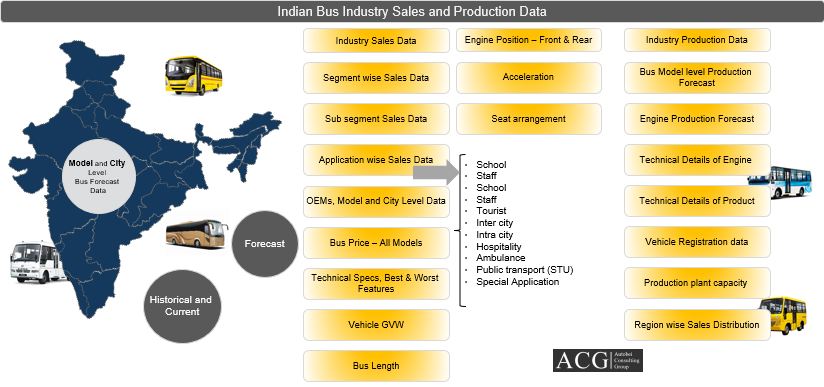
ACG Market intelligence unit released Indian Bus Market Forecast. One of the key features of the database is that it gives you access to prepare Electric Bus product planning.

Key highlights of the report:

  • Long, medium, and Short term forecast
  • Total Industry volume Sales and Production
  • Segment and Sub-segment
  • Application/uses: School, Staff, Intercity, Intracity, Tourist, Hospitality, Ambulance, and others
  • Volume, Market share, and Growth
  • Key customer detail in each segment and Application
  • Trend Analysis
  • Forecast data contain Price, Features, Duty cycle, and Technical specs also.
  • Model-level Forecast and Product portfolio availability
  • E Bus Sales Forecast
  • Key Market drivers
  • New players planning
  • Upcoming new models launched
  • Product shift analysis
  • Customer behavior shift study
  • Model-wise Best and worst features
  • Tata Motors, Mahindra, Ashok Leyland, Eicher, Volvo, Force, BharatBenz, Mercedes, Volvo, Corona, Olectra, and Others

Application Model wise and City wise Indian Bus trend and Forecast

The database is helpful for:

  • Business planning
  • Electric Vehicle Product planning & Charging infrastructure
  • Product Strategy
  • ManPower planning
  • Competitor Analysis
  • Suppliers Strategy

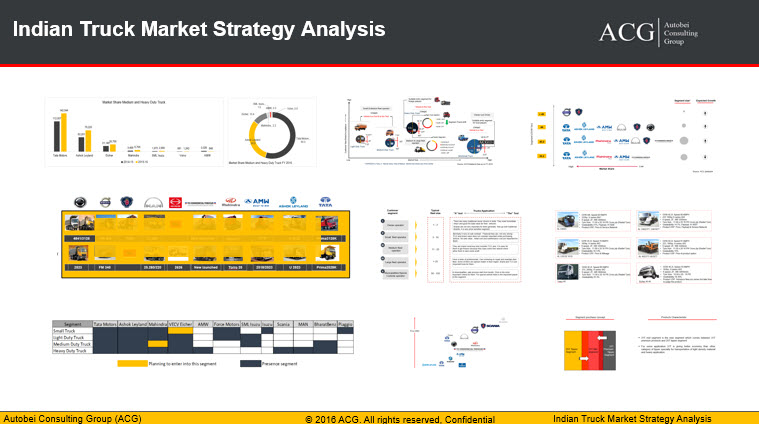
Indian Truck Industry Strategy Analysis Report is our most detailed Market Intelligence report on Indian Truck Market. A comprehensive view of India’s different truck segments and analyses the various brands in each against their presence in the market. In the small truck segment, the major players like Tata Motors, Ashok Leyland, Mahindra, Force Motors, Isuzu, and Piaggio have already stamped their presence into this segment.

COVID 19 has impacted Truck Sales volume heavily after March 2020.
Most Detail Indian Truck Market Strategy Analysis Report 2017

In the Light Duty Truck segment, Most of the key players in the truck industry are already present in this segment, while sadly none of the remaining brands (European) are planning to enter into this segment. This scenario is almost opposite to the Heavy and Medium duty truck segment.

In terms of their success stories, the small truck segment has reached gold with its extremely pleasing, skyrocketing figures. This success can be attributed to having offered price-sensitive solutions to customers concerning both pricing of local parts and support after-sales. Presently, this segment looks forward to upping its stakes to the more ludicrous Medium Budget segment by the year 2024. By this year, the entire dynamics of this segment are expected to change and undergo a major makeover. This segment is dictated entirely by the Indian OEMs. Isuzu is a company, clearly defined by the quality of both the vehicles and parts.

A recent study conducted by ACG revealed that this company was in all the customer’s good books as they are highly satisfied with its performance. This highly recommended trait of it is one of the main reasons it has escalated to where it is now, powered by a multitude of awareness campaigns and people’s support. One of the only drawbacks we at ACG had realized with regards to this company is that they would highly benefit from a more focused and widespread PR campaign specializing in the arenas of showcasing and advertising. This segment’s customers are main drivers who are mandated to run the business on a daily basis, which also owes to the great success of this segment. The pioneers of this segment are Mahindra, closely followed in popularity by Tata Motors and Ashok Leyland.

Though their figures show a tumultuous behavior over the years individually, with respect to the other segments, their growth has been spectacular. The Light Duty Truck segment, however, has seen a fairly constant behavior over the years. Following the profitable scenario of the small truck segment, the Heavy Duty Truck segment has shown the next considerable growth growing linearly and almost equalling their small truck counterpart in the year 2017-18. The Medium Duty Trucks however as their name suggests have shown mediocre behavior over the years and have managed to maintain their state homeostasis. Individually, this happens to be the situation here concerning the Indian market scene. Small trucks have seen an incredibly doubled acceleration in their figures. The Light Duty and Medium Duty Truck segments have seen constant numbers at this time.

The Heavy Duty Truck segment, on the other hand, have also shown considerable degrowth amounting to almost 14% in FY 2021.

Check here Model wise Sales Data also

Mini/Pick up Truck Segment Analysis:

The small truck segment is an extremely price-sensitive one and this is one segment where customers expect to receive local parts and support after-sales. It needs to make the transition from being a low budget segment to a medium budget one and this is attempted to be done by the year 2024, considering the ever-changing market dynamics scenario. Currently, this segment is being dominated mainly by Indian OEMs. According to a study conducted by ACG, most of its consumers are satisfied by the performance and quality of Isuzu, Tata, and Mahindra vehicles. Based on the recommendation, sales are driven and it has seen some flourishing business. Though they are receiving commendation for their products, Isuzu needs to buckle up their awareness campaign and move forward attempting to spread the news of their new launches and features.

The pioneers of this segment are Mahindra. The runner-ups are Tata Motors and Ashok Leyland.

Light Duty Truck segment:

The major dictator of this segment is Tata Motors who have seen a degrowth of almost 16% and market share moved from 55% in FY 2020 to 56% market share in the year FY 2021. In second place with a huge gap in between is VECVs- Eicher which has also seen a slight growth accounting for 29 percent market share. All the other companies namely, SML Isuzu, Mahindra, Force Motors and Ashok Leyland have very minimal shares.

The Light-duty truck segment is run by the Indian OEMs, like Tata Motors as the pioneer of this segment. Other top players include Eicher and SML Isuzu. With better after-sales support, TCO, and a better life cycle this could move from its status of being low budget into a medium budget model. Those who use these vehicles range from truck owners and drivers. The usage as such is mainly on a short-term basis.

Medium-Duty Truck:

From being a predominantly low budget segment, this is forecast to move to the status of the medium budget by the year 2024. The market is led by Tata Motors which grasp a major 41% of it, with Eicher Motors closely following with a similar 31% market share. The remaining share is distributed among two major players, namely, Ashok Leyland and SML Isuzu. Pioneers like Eicher Motors and Tata Motors have seen a notable change in their share. However, Ashok Leyland has lost by more than 7% in market share. The major characteristic of this segment is that the fleet size is comparatively bigger, coupled with better vehicle handling and usage. However, they have very little consideration for TCO, product lifecycle, payload, etc.

Heavy Duty Truck:

This was a predominantly Medium budget segment, which is expected to move onto being a High Budget segment by 2024. The key dictators of this segment are Tata Motors which capture an astounding 58% of the market, going down in the market share by almost 2% in FY 2021 compared to FY 2021. Ashok Leyland comes in a close second with a market share of 31% has lost in the market by almost 5% over the past year. Companies like Mahindra & Mahindra, Volvo, and VECV capture the minuscule shares of the truck market.

Above all this, the segment is a highly competitive one with the presence of a multitude of European players like BharatBenz, Scania, and Volvo. The segment is divided into Tippers, Rigid Haulage, Tractors, and Special Vehicles. However, a major proportion of the European players happens to be tippers owing to reasons of application, TCO and performance of a vehicle. BharatBenz, on the other hand, has made an impressive stand in the Haulage segment also. Customers of this segment are open-minded about considering new brands and their business propositions are also open on a long-term basis, which adds to the success of this segment. Haulage falls in between low and medium-budget segments concerning budget positioning while the tipper positions itself between the medium and high-budget segments. Companies like Scania and Volvo are in the premium segment. Volvo leads ODCs and the mining application segments.

Table of Content:

1.    Indian Truck Market Overview
–    Economy
–    Market Size
–    Segment overview
–    Major players
–    Key Market Dynamics

2.    Segment Analysis:
–    Small/Mini Truck
o    By Units
o    by Worth
o    Segment growth
o    Segment Share
o    Segment Drive-line analysis
o    Price range
o    Product Application analysis
o    After sales and product support analysis
o    Used vehicle Analysis
o    Trend Analysis
o    Buyers profile
o    Segment Dynamics
o    Forecast

–    Light Duty Truck
o    By Units
o    by Worth
o    Segment growth
o    Segment Share
o    Segment Drive-line analysis
o    Price range
o    Product Application analysis
o    After sales and product support analysis
o    Used vehicle Analysis
o    Trend Analysis
o    Buyers profile
o    Segment Dynamics
o    Forecast

–    Medium-Duty Truck
o    By Units
o    by Worth
o    Segment growth
o    Segment Share
o    Segment Drive-line analysis
o    Price range
o    Product Application analysis
o    After sales and product support analysis
o    Used vehicle Analysis
o    Trend Analysis
o    Buyers profile
o    Segment Dynamics
o    Forecast

–    Heavy Duty Truck
o    By Units
o    by Worth
o    Segment growth
o    Segment Share
o    Segment Drive-line analysis
o    Price range
o    Product Application analysis
o    After sales and product support analysis
o    Used vehicle Analysis
o    Trend Analysis
o    Buyers profile
o    Segment Dynamics
o    Forecast

3.    Product Analysis
–    Product segment
–    Application wise
–    Price-wise
–    Type-wise
–    Category wise
–    Engine-wise
–    Transmission wise
–    Fully built
–    Chassis
–    Cabin & Chassis
–    Product Gap analysis
–    Product USP
–    Product Age
–    Product Life Cycle Analysis
–    Market acceptance Analysis
–    Customer Survey and Feedback Analysis
–    Mapping of application and model

–    Vehicle Type:
o    Tipper
    Product portfolio
    Key Models
    Technical Analysis
    Price range
    Application
    Sales and Market share analysis
    Competitive Analysis
    After Sales Analysis
    Customer profile
    Buyers pattern

o    Rigid Haulage
    Product portfolio
    Key Models
    Technical Analysis
    Price range
    Application
    Sales and Market share analysis
    Competitive Analysis
    After Sales Analysis
    Customer profile
    Buyers pattern

o    Tractor – Long Haulage
    Product portfolio
    Key Models
    Technical Analysis
    Price range
    Application
    Sales and Market share analysis
    Competitive Analysis
    After Sales Analysis
    Customer profile
    Buyers pattern

o    Special or Customized Application
    Product portfolio
    Key Models
    Technical Analysis
    Price range
    Application
    Sales and Market share analysis
    Competitive Analysis
    After Sales Analysis
    Customer profile
    Buyers pattern

4.    Customer Behavior
–    Psychology
–    Behavior parameter forecast
–    Trend Analysis
–    Customer profile
–    Truck buying factors
–    Segment and Application Wise Brand Recall

5.    Product Segment Analysis:
–    Low Budget
o    Definition
o    Price bracket
o    Major Models
o    Application suitability
o    Customer segment
o    Segment Trend
o    Segment dynamics

–    Medium Budget
o    Definition
o    Price bracket
o    Major Models
o    Application suitability
o    Customer segment
o    Segment Trend
o    Segment dynamics

–    High Budget
o    Definition
o    Price bracket
o    Major Models
o    Application suitability
o    Customer segment
o    Segment Trend
o    Segment dynamics

–    Premium
o    Definition
o    Price bracket
o    Major Models
o    Application suitability
o    Customer segment
o    Segment Trend
o    Segment dynamics

6.    Zone wise Truck Market Analysis
–    North zone
o    Market size
o    Market trend
o    Market forecast
o    Market dynamics
o    Market share
o    OEMs wise analysis
o    Major Application
o    Demand Analysis
o    The Major States for Truck sales
o    Customer behavior

–    South zone
o    Market size
o    Market trend
o    Market forecast
o    Market dynamics
o    Market share

–    East zone
o    Market size
o    Market trend
o    Market forecast
o    Market dynamics
o    Market share
o    OEMs wise analysis
o    Major Application
o    Demand Analysis
o    The Major States for Truck sales
o    Customer behavior

–    West zone
o    Market size
o    Market trend
o    Market forecast
o    Market dynamics
o    Market share
o    OEMs wise analysis
o    Major Application
o    Demand Analysis
o    The Major States for Truck sales
o    Customer behavior

7.    State-wise Analysis
Karnataka
o    Market size
o    Market Forecast
o    Market Dynamics
o    State Macro Economy
o    Market Trend
o    Truck Application analysis
o    OEMs wise plotting against market dynamics
o    Sales Strategy
o    Top Players
o    Upcoming New Projects
o    Product and Segment category demand analysis
o    Network Analysis

Andhra Pradesh
o    Market size
o    Market Forecast
o    Market Dynamics
o    State Macro Economy
o    Market Trend
o    Truck Application analysis
o    OEMs wise plotting against market dynamics
o    Sales Strategy
o    Top Players
o    Upcoming New Projects
o    Product and Segment category demand analysis
o    Network Analysis

Kerala
o    Market size
o    Market Forecast
o    Market Dynamics
o    State Macro Economy
o    Market Trend
o    Truck Application analysis
o    OEMs wise plotting against market dynamics
o    Sales Strategy
o    Top Players
o    Upcoming New Projects
o    Product and Segment category demand analysis
o    Network Analysis

Tamil Nadu
o    Market size
o    Market Forecast
o    Market Dynamics
o    State Macro Economy
o    Market Trend
o    Truck Application analysis
o    OEMs wise plotting against market dynamics
o    Sales Strategy
o    Top Players
o    Upcoming New Projects
o    Product and Segment category demand analysis
o    Network Analysis

Uttar Pradesh
o    Market size
o    Market Forecast
o    Market Dynamics
o    State Macro Economy
o    Market Trend
o    Truck Application analysis
o    OEMs wise plotting against market dynamics
o    Sales Strategy
o    Top Players
o    Upcoming New Projects
o    Product and Segment category demand analysis
o    Network Analysis

Himachal Pradesh
o    Market size
o    Market Forecast
o    Market Dynamics
o    State Macro Economy
o    Market Trend
o    Truck Application analysis
o    OEMs wise plotting against market dynamics
o    Sales Strategy
o    Top Players
o    Upcoming New Projects
o    Product and Segment category demand analysis
o    Network Analysis

Delhi
o    Market size
o    Market Forecast
o    Market Dynamics
o    State Macro Economy
o    Market Trend
o    Truck Application analysis
o    OEMs wise plotting against market dynamics
o    Sales Strategy
o    Top Players
o    Upcoming New Projects
o    Product and Segment category demand analysis
o    Network Analysis

Madhya Pradesh
o    Market size
o    Market Forecast
o    Market Dynamics
o    State Macro Economy
o    Market Trend
o    Truck Application analysis
o    OEMs wise plotting against market dynamics
o    Sales Strategy
o    Top Players
o    Upcoming New Projects
o    Product and Segment category demand analysis
o    Network Analysis

Chhattisgarh
o    Market size
o    Market Forecast
o    Market Dynamics
o    State Macro Economy
o    Market Trend
o    Truck Application analysis
o    OEMs wise plotting against market dynamics
o    Sales Strategy
o    Top Players
o    Upcoming New Projects
o    Product and Segment category demand analysis
o    Network Analysis

Rajasthan
o    Market size
o    Market Forecast
o    Market Dynamics
o    State Macro Economy
o    Market Trend
o    Truck Application analysis
o    OEMs wise plotting against market dynamics
o    Sales Strategy
o    Top Players
o    Upcoming New Projects
o    Product and Segment category demand analysis
o    Network Analysis

Uttaranchal Pradesh
o    Market size
o    Market Forecast
o    Market Dynamics
o    State Macro Economy
o    Market Trend
o    Truck Application analysis
o    OEMs wise plotting against market dynamics
o    Sales Strategy
o    Top Players
o    Upcoming New Projects
o    Product and Segment category demand analysis
o    Network Analysis

Jammu & Kashmir
o    Market size
o    Market Forecast
o    Market Dynamics
o    State Macro Economy
o    Market Trend
o    Truck Application analysis
o    OEMs wise plotting against market dynamics
o    Sales Strategy
o    Top Players
o    Upcoming New Projects
o    Product and Segment category demand analysis
o    Network Analysis

Gujarat
o    Market size
o    Market Forecast
o    Market Dynamics
o    State Macro Economy
o    Market Trend
o    Truck Application analysis
o    OEMs wise plotting against market dynamics
o    Sales Strategy
o    Top Players
o    Upcoming New Projects
o    Product and Segment category demand analysis
o    Network Analysis

Maharashtra
o    Market size
o    Market Forecast
o    Market Dynamics
o    State Macro Economy
o    Market Trend
o    Truck Application analysis
o    OEMs wise plotting against market dynamics
o    Sales Strategy
o    Top Players
o    Upcoming New Projects
o    Product and Segment category demand analysis
o    Network Analysis
o

Orissa
o    Market size
o    Market Forecast
o    Market Dynamics
o    State Macro Economy
o    Market Trend
o    Truck Application analysis
o    OEMs wise plotting against market dynamics
o    Sales Strategy
o    Top Players
o    Upcoming New Projects
o    Product and Segment category demand analysis
o    Network Analysis

West Bengal
o    Market size
o    Market Forecast
o    Market Dynamics
o    State Macro Economy
o    Market Trend
o    Truck Application analysis
o    OEMs wise plotting against market dynamics
o    Sales Strategy
o    Top Players
o    Upcoming New Projects
o    Product and Segment category demand analysis
o    Network Analysis

Bihar
o    Market size
o    Market Forecast
o    Market Dynamics
o    State Macro Economy
o    Market Trend
o    Truck Application analysis
o    OEMs wise plotting against market dynamics
o    Sales Strategy
o    Top Players
o    Upcoming New Projects
o    Product and Segment category demand analysis
o    Network Analysis

Jharkhand
o    Market size
o    Market Forecast
o    Market Dynamics
o    State Macro Economy
o    Market Trend
o    Truck Application analysis
o    OEMs wise plotting against market dynamics
o    Sales Strategy
o    Top Players
o    Upcoming New Projects
o    Product and Segment category demand analysis
o    Network Analysis

8.    Pricing Trend Analysis: MRP & Discount Trend
–    Small Truck
–    Light Duty Truck
–    Medium-Duty Truck
–    Heavy Duty Truck
Competitive price position of Tata, Ashok Leyland, BharatBenz, AMW, MAN, Piaggio, Force Motors, Mahindra, Volvo, Scania, SML Isuzu, Isuzu, Eicher

o    Tipper
o    Rigid Haulage
o    Tractor

9.    Business Environment:
–    Major challenges
–    Opportunities
–    Global Impact
–    Business Sentiments
–    Political & Economy
–    FDI and Exchange rate

10.    Major Export Market:
–    OEM Analysis
–    Key Export Markets

11.    Application Industry Analysis
–    Construction
–    Road
–    Real Estate Development
–    Port
–    Mining
–    Logistics
–    E-Commerce Industry and its impact on Truck Industry
–    Cement Industry
–    ODC
–    Light & Heavy Machinery
–    Manufacturing Industry
–    Local Transport

12.    Used Truck Analysis
–    Market size
–    Commercial and Technical challenges
–    Buying pattern
–    Trend Analysis
–    Business practice
–    Advantages
–    Disadvantages
–    Finance challenges

13.    Advertising
–    Truck Industry traditional way
–    Most effective ad strategy
–    Competitor Ad strategy
–    Print
–    Electronic
–    TV Commercial
–    Digital

14.    Company Analysis
–    Tata Motors
o    Latest Developments
o    Product portfolio
o    Product age
o    Product lifecycle
o    Application analysis
o    Strategy
o    Segment Analysis
o    Customer profile
o    Brand perception
o    USP
o    Key persons

–    Ashok Leyland
o    Latest Developments
o    Product portfolio
o    Product age
o    Product lifecycle
o    Application analysis
o    Strategy
o    Segment Analysis
o    Customer profile
o    Brand perception
o    USP
o    Key persons

–    VECV Eicher
o    Latest Developments
o    Product portfolio
o    Product age
o    Product lifecycle
o    Application analysis
o    Strategy
o    Segment Analysis
o    Customer profile
o    Brand perception
o    USP

–    VECV Volvo
o    Latest Developments
o    Product portfolio
o    Product age
o    Product lifecycle
o    Application analysis
o    Strategy
o    Segment Analysis
o    Customer profile
o    Brand perception
o    USP
–    Scania Commercial Vehicles India Private Limited
o    Product portfolio
o    Latest Developments
o    Product age
o    Product lifecycle
o    Application analysis
o    Strategy
o    Segment Analysis
o    Customer profile
o    Brand perception
o    USP
–    MAN Trucks India
o    Product portfolio
o    Product age
o    Product lifecycle
o    Application analysis
o    Strategy
o    Segment Analysis
o    Customer profile
o    Brand perception
o    USP
–    AMW Motors
o    Product portfolio
o    Latest Developments
o    Product age
o    Product lifecycle
o    Application analysis
o    Strategy
o    Segment Analysis
o    Customer profile
o    Brand perception
o    USP
–    Force Motors
o    Product portfolio
o    Latest Developments
o    Product age
o    Product lifecycle
o    Application analysis
o    Strategy
o    Segment Analysis
o    Customer profile
o    Brand perception
o    USP
–    Piaggio
o    Product portfolio
o    Latest Developments
o    Product age
o    Product lifecycle
o    Application analysis
o    Strategy
o    Segment Analysis
o    Customer profile
o    Brand perception
o    USP
–    Mahindra Truck & Bus
o    Product portfolio
o    Product age
o    Product lifecycle
o    Application analysis
o    Strategy
o    Segment Analysis
o    Customer profile
o    Brand perception
o    USP
ACG is an expert in Electric Vehicle Business plans for the Indian market. The EV plan is available for Two Wheeler, Three Wheeler, Truck, Bus, and Car segments. There are two versions available of the Business plan- the Standard and Customize plan. We also prepare the Business plan for other traditional vehicle segments, Suppliers, and Dealer Businesses.

1. Executive Summary

  • Market Overview
  • Problem
  • Market & competition

2. Business Opportunity

  • Solution of Problem
  • Our Business solution
  • Validation
  • Future strategy & Plans

3. Detail Market analysis

  • Key Market highlights
  • Current and Forecast of Market size
  • Segment and Subsegment Analysis
  • Competitor Analysis
  • Product Analysis
  • Pricing Analysis
  • Product and Market Challenge
  • Our Business Solution benefits
  • Gap Analysis
  • Brand Analysis
  • Our Product USP

4. Execution

  • Budget
  • Market & Sales Plan, Target Market Share
  • Target market segment
  • Technology
  • Product Costing
  • Production Plant setup cost
  • Implementation
  • Contingency plan

5. Financial Chapter

  • ROI
  • P&L
  • Projected revenue and Profit
  • Expenses

6. Our Recommendation

7. Conclusion


ACG released The Rise and Fall of Indian Bus Market during the Pandemic report.

If there’s any year in the books of history that brought the entire world to a standstill position, then that era can be undoubtedly labeled as the COVID hit the year of 2020. This grueling period had its Ill effect on each and every various sector across the globe, and the Automobile sector tops the list.

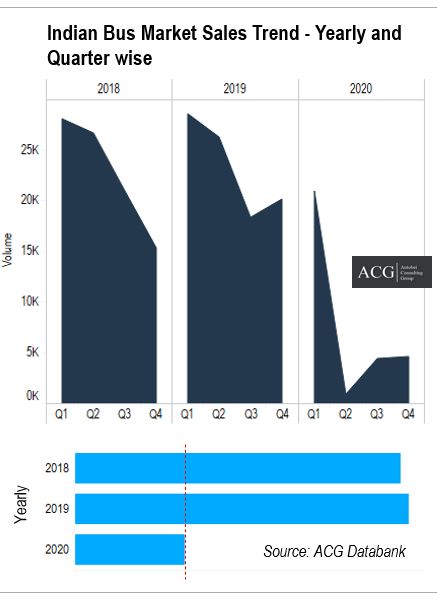
Coming to the Indian scenario, the bus division was absolutely one of the most affected categories in the automobile market. Indeed, it witnessed a humongous downfall in the total marketed units for CY 2020. The corona factor can be termed as the major game spoiler for the Bus sector of India, as it scaled down the percentile share of the sector by 67% from the previous year.

Despite all these adversities, there was a sharp rise of a marginal percentage in regards to the market expansion from 2018 to 2020. The market positioning was in a respectable place by amassing close to 94,000 sales in the previous year, but soon during the pandemic, this number came down heavily to a mere value of 31,000.Indian Bus Sales Trend and Forecast CY 2020

Autobei Consulting Group has presented a prediction model which depicts the rise in total sale units to 12,00,000 in the next 5 years.

The compound annual growth rate, for the last 2 years is not at all encouraging as the value is now in the negative scale and stands at -42%, but the future market scenario, increasing demands, and expansion of the market will all togetherly culminate to boost the CAGR at 80% in the next half a decade.

Also read: Indian Bus Market Report 2019

The present scenario has given a very little scope for travel, as the people have developed various apprehensions owing to the widespread of virus and thus this has restricted the movement of people. The schools have been closed down, offices have resorted to working from home, traveling to districts, cities, and states are limited only to emergency situations, Tourism Industry is still in a stagnant position. So all these Business activities in the past were aiding the operation of Bus, but now as they seem to diverge no function hence Bus industry has been immensely affected by this.

The government’s decision to ease lockdown and lift restrictions enforced on the movement of the people came as a boon to the Bus market, and the two succeeding quarters of the second half of 2020 rendered the much-needed breakthrough for its growth. The figures achieved as a result of this will speak for itself, the growth rate of 400+% was seen in Q3 and Q4 saw a booster by another 6%.

The Indigenous Automobile giant Tata has had a consistent run in the Bus market scenario for three consecutive years, and it has even garnered a whopping share of 35%.

Yet another Budget Bus manufacturer, Force, has shot up to its sales and managed to enhance its market prevalence by 4%. Astonishingly, Ashok Leyland which flaunts the best in class efficiency and build quality saw its presence in the market gripping down by 3%, on the other hand, its counterparts Eicher and Volvo bus managed a decent upgrowth amidst the pandemic. Mahendra didn’t quite manage to replicate the success it tasted in the car segment, as it witnessed a downfall by 3% over the last couple of years.

Indian Bus Market Share Analysis 2020

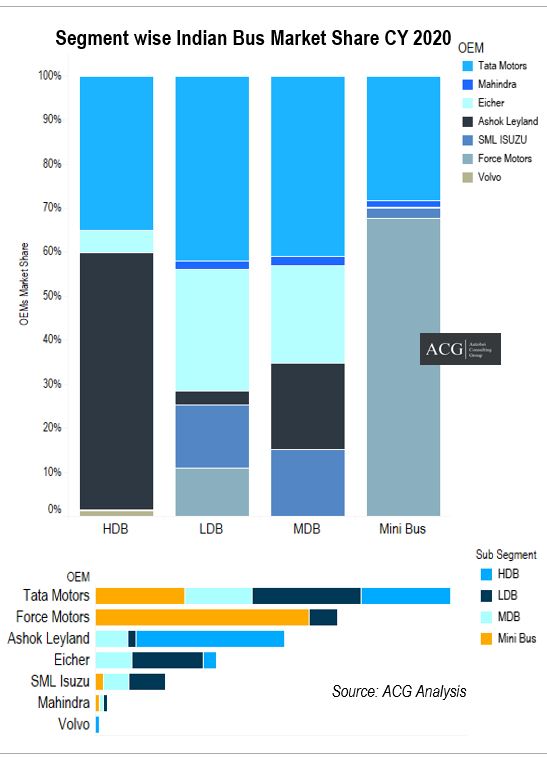
The smaller variant in the Bus sector, the Minibus also saw its market dynamics suffering a sharp change, as their market presence came down drastically and the growth factor stood at null and negative for a major period. The figures say it all, the HDB, LDB, MDB had no buyers in the market and their hold in the market vanished at the rate of 62%, 69%, and 74% respectively.

The relaxations that were given after the decline in COVID cases resulted in bringing some fascinating results for the  Indian Bus market and the same was evident in the 3rd and 4th Quarters, but the LDM sector failed to capitalize during this time.

The HDB sector has different market dynamics and Ashok Leyland is the Market leader of this category by managing an overall hold of 56%, but even they faced the wrath of pandemic and saw their market presence dipping down by 9% in the COVID dominated the year of 2020. Tata and Ashok Leyland continue to be the market leaders of the HDB category, Eicher a dominant player of the same category managed to climb the ranking list by adding up a percentage growth rate to its name.

Get Exclusive Data Electric Bus Product Planning Data

Time and again, the Indian origin manufacturers have reaped fruitful results in the MDB segment, with Tata yet again managing a top podium finish by tightening its Market hold which currently stands at 42%. Despite the fact that Tata’s growth seems no stopping at the moment, but yet the hardcore approach by Ashok Leyland and Eicher to rise to the top has foevedy Tata to be on its toes always.

The year 2020 brought the entire world to a stand-still position and toppled the world economy like never before. Indian Commercial Vehicle Industry Trend and Outlook 2021 report cover all aspects of the Indian CV Industry.

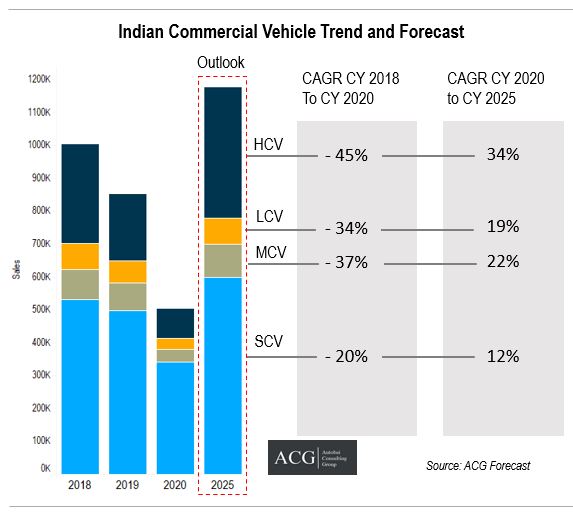
The Indian Commercial vehicle Industry is expected to reach 11,80. 000 units by 2025 with a CAGR of 18% from CY 2020 to CY 2025.Indian Commercial Vehicle Trend and Forecast 2025

It had its adverse effects on the contemporary market scenario too, but yet the indomitable spirit of various Industries and companies have enabled them to rejuvenate and keep up the momentum amidst the global slowdown. The commercial market in India has also faced the wrath of Corona and the same can be deduced by the following statistical explanation.

Read the latest Indian CV Report 2022

Check: Model Indian Truck and Bus Data – Yearly & Quarterly

Indian Commercial Vehicle Trend Analysis

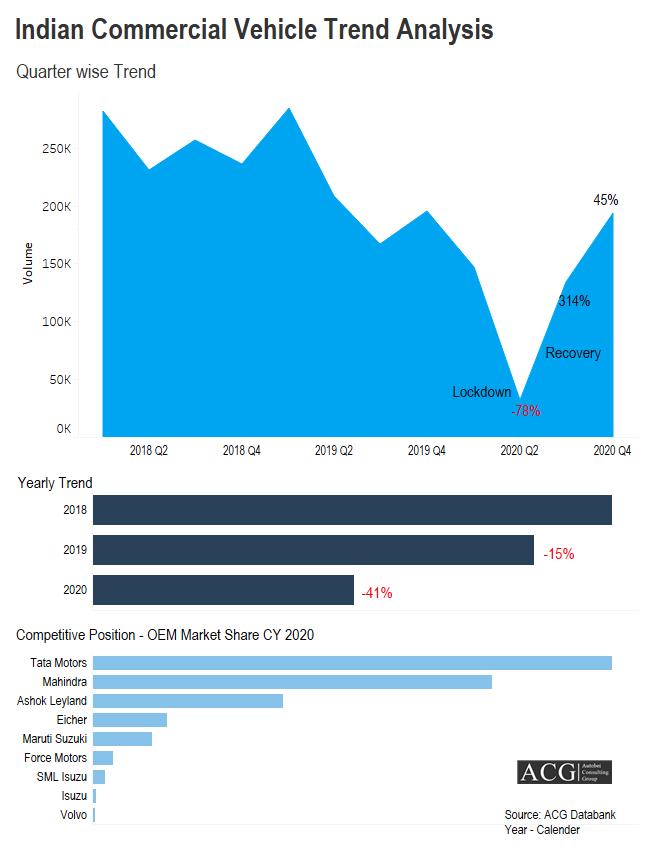
The magnitude of the Commercial Market in India clocked 50k in the year 2020, and this number is significantly 50 percent lower than the overall output that was accomplished in the CY 2018. But the CV segment unraveled a glorious performance by recording a historic recovery in the 3rd and 4th quarter post the lockdown. Nevertheless, the 2nd quarter for the last two consecutive years has turned out to be the worst nightmare for the commercial market. As the degrowth stood at 27% for the Q2 of the year 2019 and this was the lowest ever taking into consideration the last 3 years’ performance. Later in the year 2020, the degrowth further worsened to 78%, proving it to be the worst of all times.Indian Commercial vehicle OEM market Share Trend

Almost all the Industries across the nation were the victims of the year 2020, and the Automobile industry hierarchically ranks first. The Bus segment recorded whooping degrowth of 96% in the 2nd quarter of 2020 and a record high degrowth of 30% was witnessed in the 3rd quarter of 2019. Whereas, the statistics recorded by the Truck segment are no different. As the degrowth stood at 75% for the period between April-June (Q2) 2020, and the degrowth for the year 2019 was resonating at 29% during the same time as in 2020.

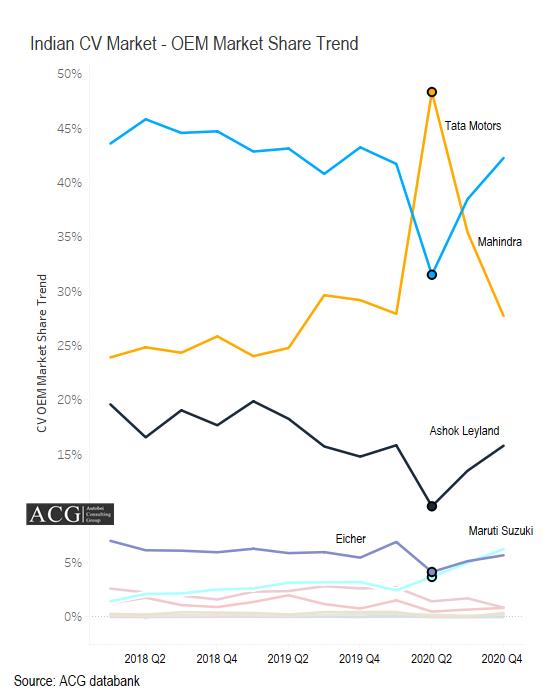
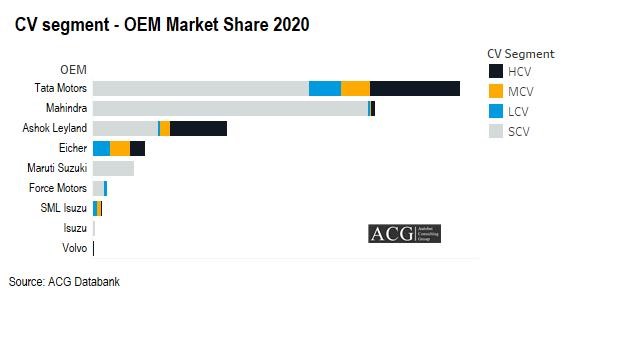
Tata Motors is marveling at the First spot in the CV segment by garnering a market hold of about 40% and the 2nd, 3rd positions are held by Mahindra and Ashok Leyland by taking a market share of 31% and 15% respectively for the year 2020. Though Eicher and Maruti failed to live up to the expectations of the masses but yet were able to get a mediocre turnover of 6% and 5% for CY 2020.Indian Commercial vehicle OEM Market Share 2020

The statistical formulations also depict that the Original Equipment Manufacturer (OEM) Unit of Ashok Leyland suffered 50% degrowth in the year 2020 when compared to 2019.

Maruti Suzuki which had proven its mettle in the Indian automobile arena achieved a growth of 2% as compared to last year. Despite the year 2020 turned out to be a show spoiler for most of the Automobile manufacturers, but Maruti Suzuki seemed to have been the least affected as the statistics tells its degrowth was at 8% when compared to 2019 and the Original Equipment Manufacturer (OEM) unit of Maruti enhanced its market hold in the Quarter 4 of 2020 as compared to the previous year 2019.

Mahindra on the other suffered the most during the last 2 quarters of 2020, as it conceded a loss of 8% market share after the lockdown was lifted.

After taking all the above-mentioned statistical data into consideration, we can outline that the overall degrowth stood at 41% in CY 2020 as compared to last year. The performance of Truck and Bus sales to say have been hit drastically as it faced a backlash and rounded of the degrowth at 38% and 67% respectively in CY 2020 as compared to the CY 2019. If we further ponder light on the crisis-hit scenario then we can clearly see that the degrowth of the 2nd quarter was the worst ever recorded nationally as the degrowth scaled up to the all-time high of 78%

The sales of Bus have been mostly nullified, and its contribution to the overall market share is tending to zero as it has become a herculean task to ensure even the sale of half of the units as compared to last 5 years. All we can summarize is that Covid had the last laugh and it was more than successful indenting the entire market.

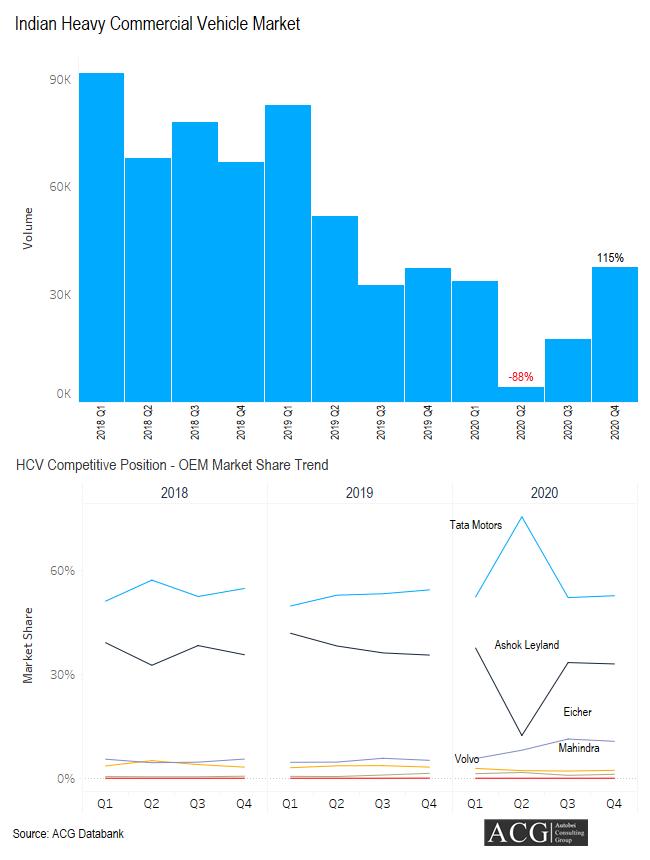
Over the CY 2020, even the HCV segment faced a 55% degrowth as compared to CY 2019, and while we go further deep into the analysis we can note that Quarter 4 was the tedious of all, as it saw a degrowth of 115%.

Indian Heavy Commercial Vehicle Market

While the lockdown was prevalent, the same segment had a degrowth rate of 88% in 2nd Quarter and its overall contribution lasted only for 13% in this quarter, and now this period is quite infamous as it is the highest low that has been observed over the last 4 decades.

Undoubtedly, Tata Motors has climbed up to the market leader position by increasing its share to 53%. The year 2020 was very fruitful for Tata, as it fuelled its growth like anything. And the out Even outstanding achievement of Tata is that its overall market share in 2020 and the 4th Quarter of 2020 is higher than that of the market share that it had in 2019. Even, Eicher shoots up its market presence by 4% in 2020, though it had a mediocre 2nd half of the year as the growth was stagnant during this time.

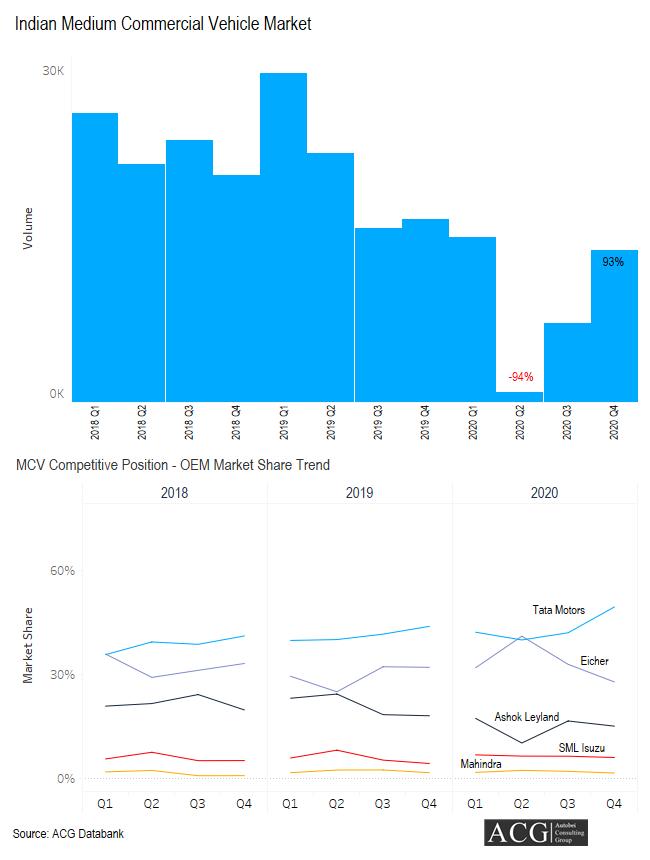
Further, as we move towards the performance of the MCV segment we can see a very nail-biting finish accomplished by Tata Motors and Eicher as they clearly outperformed Ashok Leyland in CY 2020, But Ashok Leyland retaliated and gave a neck to neck competition in the 4th quarter of 2020 and it swept their oppositions of by their feet as it rose to become the Captain of the MCV segment by amassing a clear market share of more than half.

Indian Medium Commercial Vehicle Market

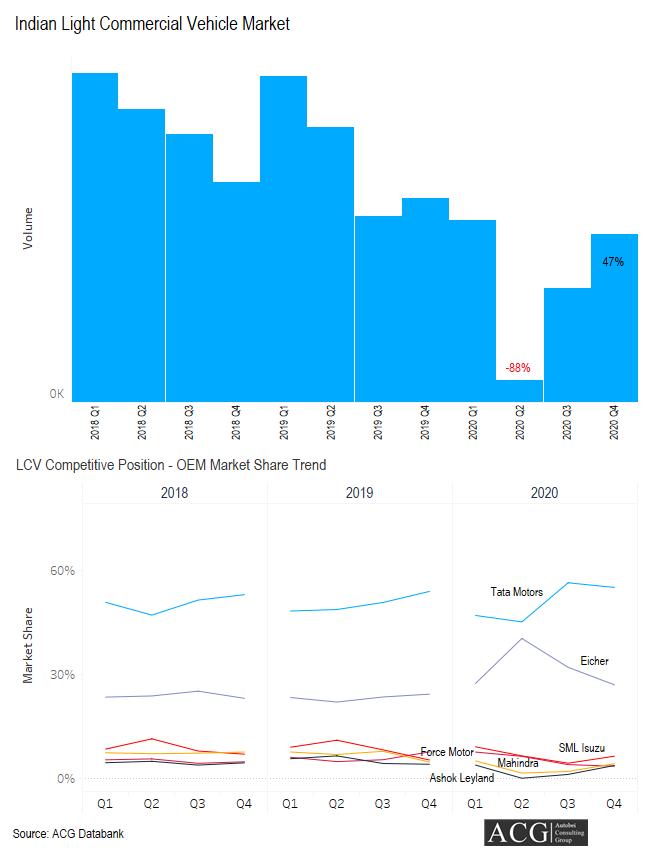
Moving on, we can shift the focus on the LCV segment and even the scenario here is no different than the rest, as it also saw decline degrowth of 51% in 2020 as compared to 2019. It registered a respectful growth of 47% and 412% in Quarter 4 and Quarter 3 respectively in comparison to the performance of Quarter 3 and Quarter 2 in 2019. And the key observation into the data tells us that the 2nd quarter registered a very sharp decline of 94% as compared to the 1st quarter of 2020.

As we have seen the rise of Tata in various segments and its performance has continued to stun even the LCV segment too. As it has taken a podium finish and even the Eicher has put up an appreciating performance by elaborating its share to 6% in 2020 as compared to 2019, but due to various factors it suffered a loss of 5% in 4th Quarter compared to 3rd Quarter in 2020.

Indian Light Commercial Vehicle Market

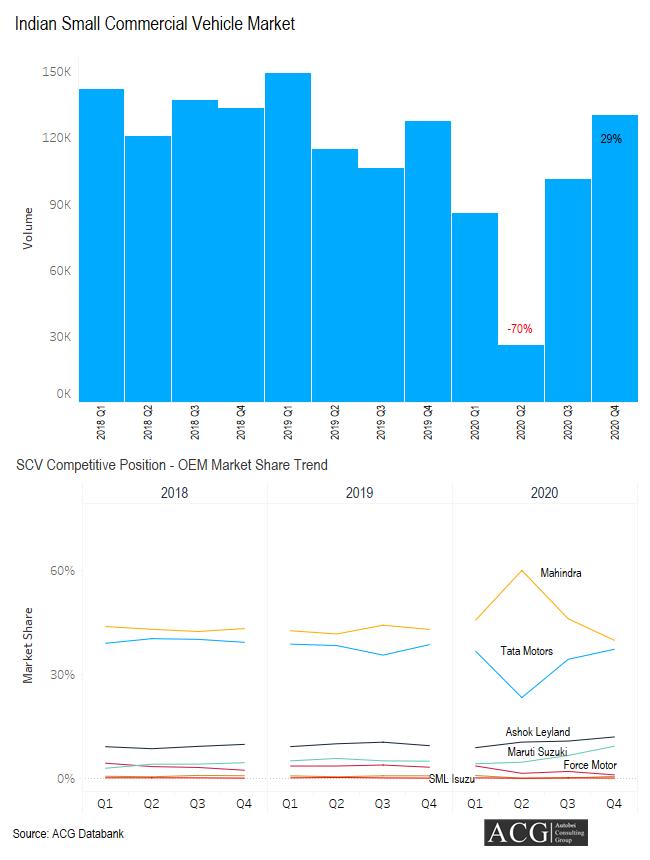
Now, Let’s try to emphasize the performance of the SCV segment, which amounts to the largest market presence of 67% in the 4th Quarter of 2020. Previously, the degrowth stood at 31% for the entire year 2020 in comparison to the year 2019. Way back in 2018, the market share was around 50% and to everyone’s surprise, the SCV segment is the one that pulled out the best ever performance after the lockdown restrictions were relaxed.

Indian Small Commercial Vehicle Market Analysis

The data further speaks that Tata, despite its magnificent and stronghold on the existing market, lost 3% of its share and its close competitor Mahindra added up 2% of the market share when compared with the statistics of 2019.

While, if we get into the minutest details of the analysis we can note that from the 1st Quarter to 4th Quarter of 2020, the Mahindra and Ashok Leyland’s growth is contradictory in nature. As Mahindra loosened its market existence by 6% and the later beefed up it by 3%

The Indian Automotive Industry suffered immensely owing to the pandemic hit 2020. Our reports provide key insight into the Impact of COVID 19 on the Customer’s Car and SUV owning preference.

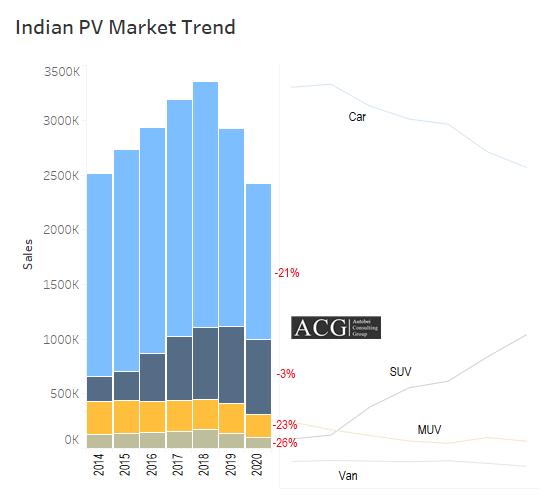
The effect further gets amplified when it comes to the Indian passenger vehicle industry, as the degrowth seemed to be at 17% in CY 2020 when compared to CY 2019.

Categorically, the car segment witnessed a 21% degrowth, whereas the SUV’s stood at 3%, MUV at 23%, Van at 26% in the CY 2020 when compared to CY 2019.

The SUV segment offered a wide pool of choices to the customers to choose from as it put forward 34 models. Even the Cars segment was a cut above as it had a stack of 43 options in its segment. Overall share as occupied by SUV and Car segment stood at 28% and 59% respectively.

Indian Car SUV and VAN Market Trend and Outlook 2020

Maruti led the Market with its commanding hold of 50% in 2020. The indigenous brand Tata too enhanced its market share to 7% from 5%. The market wasn’t favorable to the likes of Mahendra and Honda as they faced a lag of 2% market share in the Indian PV segment.

Sedan’s saga of its below-par performance continued to haunt itself, as it loosened its grip in the Indian PV segment. It has lost its 14% segment share from 2014. The worst happened in 2020, as the degrowth took the exponential rise to 46% when compared to 2019.

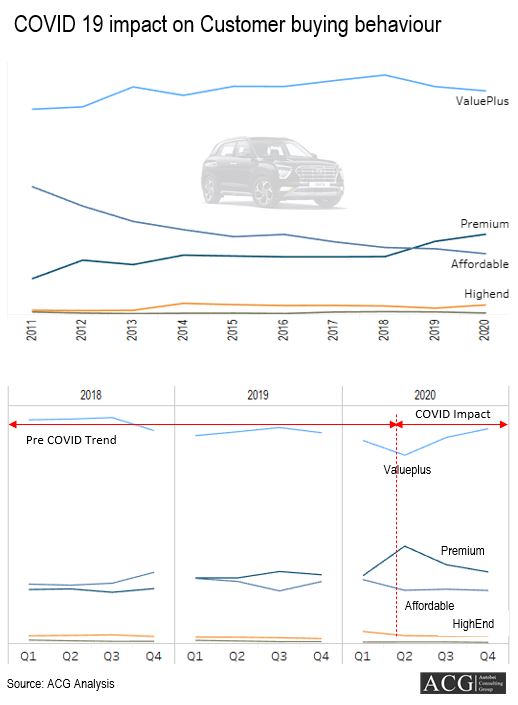
As per the existing market bifurcation, the Indian PV industry has been differentiated as Affordable, Valueplus, Premium, Luxury, and High-end.

COVID 19 impact on Customer buying behaviour

The Premium segment has evolved as an eye-catcher for the Indian customer base. The luxury segment on the other hand faced one of its worst low due to the COVID 19.
The value segment stands tall as the largest segment in India. As the new customers have more craving to pay for the design, Comfortability and cutting edge technologies.

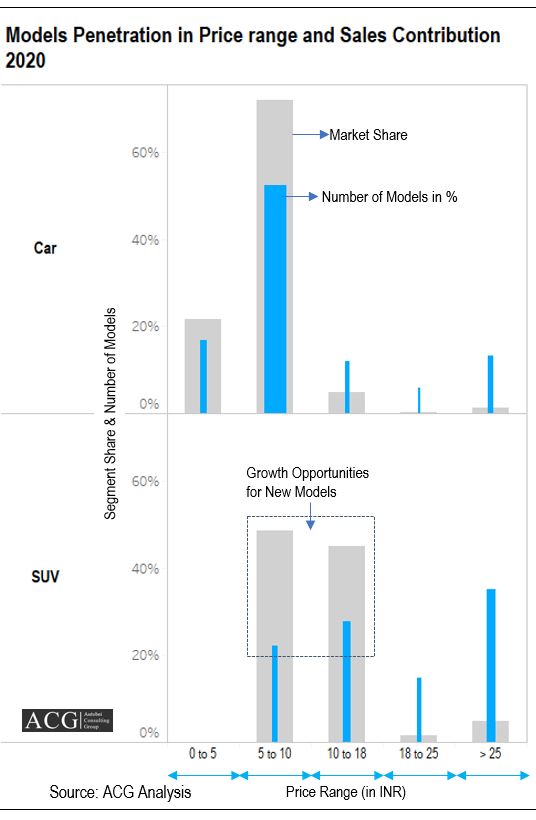
The SUV segment has gathered much more attention than Cars in the Value plus segment, and the key reason for the same is the wide availability of models and the price it is offered at. Despite the pandemic, SUVs faced a marginal 12% degrowth in 2020.

Car Models Penetration:

Indian SUV and Car Models Penetration in Price range and Sales Contribution Analysis 2020

The affordable Segment sales shot up by 2% in 2020 compared to the previous year.

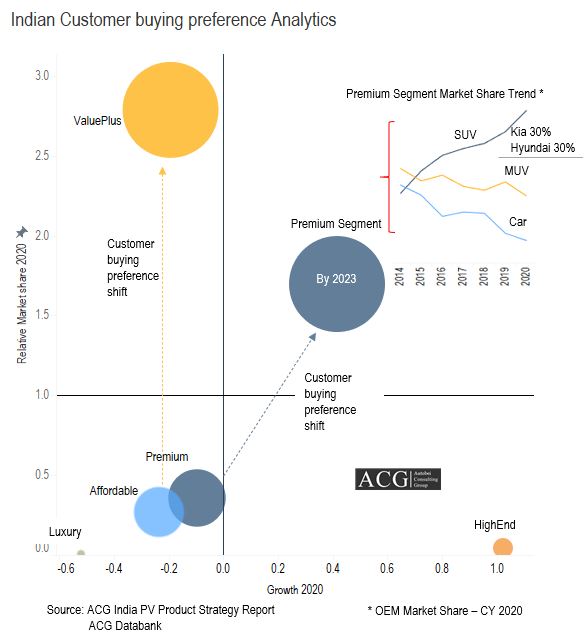
The Premium SUV segment proved to be the most attractive, as its segment share almost tripled in the previous 6 years by going up to 76% from 29%, but yet the 12% degrowth troubled this segment too in 2020.

Indian Customer Buying preference and Segment Analysis Forecast

The luxury segment continues to have a firm hold and is dominating the SUV models by amassing 87% share and it even faced very minimum degrowth by 36% in 2020 compared to 2019.

The most preferred Indian brand Maruti elevated as the market leader in the Value Plus car segment with a 65% market share. Even the TATA motors eyed on this segment and eventually took up their market share by 4% in 2020.

Hyundai and Kia held 25% and 11.5 market share in the SUV Value plus segment. The Premium car segment offered a fair chance to all the manufacturers as Maruti held 73% in MUV, Honda 45%, Hyundai at 60% and Mahendra managed to get a 22% market share in 2020.

Presently, Customers are offered a decent number of options to own an SUV in an affordable Segment. And Maruti continues to dominate this segment by a whopping 75%

Toyota’s indomitable hold in the High-end SUV segment seems no stopping as it has occupied almost half of the total market share. And Hyundai is also now less in this segment and is leading the segment from the front.

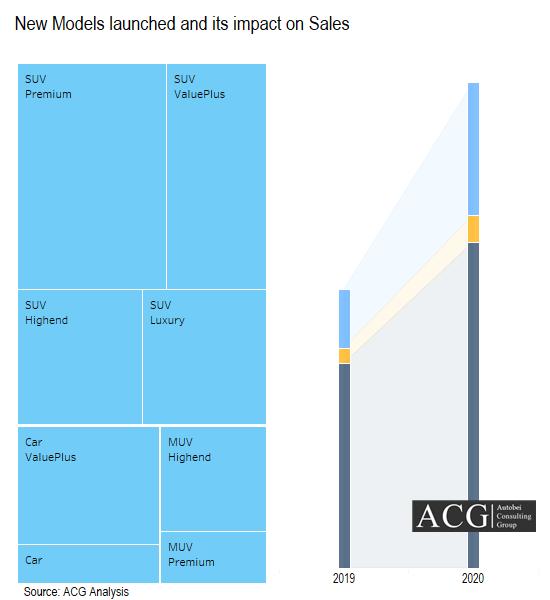
The contribution from the New models stood at 16% Market share in 2019 and it doubled its numbers in the year 2020.

New Car SUV and MUV Models launched and its impact on Sales

Maruti Suzuki’s new product has contributed 17% market share in the Affordable car segment. Kia Carnival absolutely had no rival to compete in the High-end MUV Segment. Recently, the SUV premium segment has gained pace in the Indian PV industry. Kia, though a new entrant into the Indian market has stunned its rivals by getting the tag of a Market Leader with a 19% market share in 2020, and this almost is double the value of what it accomplished in 2019.

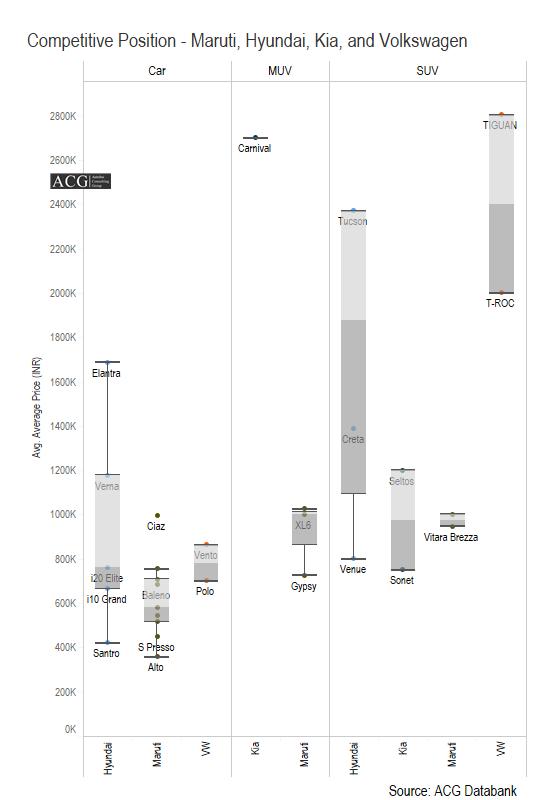
Competitive Position - Maruti, Hyundai, Kia, and Volkswagen

Tata Altroz, which amazed the Indians with its extremely good build quality took up its market share by 3% in 2020 in the value plus segment in 2020.

The value plus SUV segment was not fortunate enough to have major growth in 2020, as Hyundai and Kia models noted a 29% market share in 2019 but this went down by 27% in 2020.

Kia has created a formidable position for itself in the Indian Automobile arena as it shoots up its market share from 19% to 35% in just a year from 2019 to 2020, and this truly is an astounding achievement.

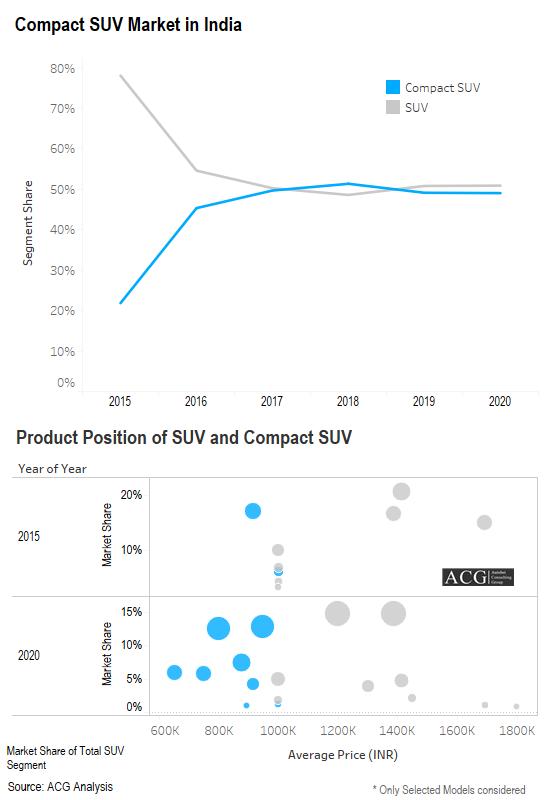
Compact SUV Sales Trend:Compact SUV Segment in India

The degrowth has been a common phenomenon that shook the entire world in the year 2020. A Turnaround of the Indian Truck Market 2021 after the New reforms and Economic booster became one of the key growth drivers.

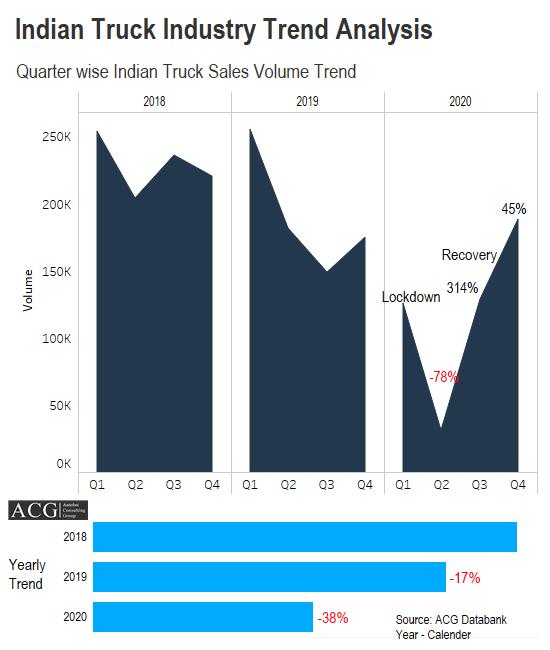
The Indian Truck Market size diminished in the year 2020, as its degrowth stood at 42% compared to the year 2019. The revival rate that was showcased by the Truck segment is really commendable as the market was able to rejuvenate itself at a rapid pace. The same can be concluded while we take a look at the data of the Q4 CY 2020 to Q4 CY 2019, as the degrowth was brought down to 8%.

Indian Truck Industry Trend Analysis

The contribution made by the Indian Truck segment for the year 2020 was at 94% as compared to the 90% that was seen in 2018 for the total CV market in India.

Indian government played a pivotal role in empowering the transport infrastructure of the nation, which eventually is the need of the hour. The government has launched Infra projects worth Rs.103 Lakh crore, apart from this they have also contributed a whopping amount of about Rs.1.70 Lakh crore for improvising the transport infrastructure as well as the focus has been laid on accelerating the construction of Highways. The Infrastructure development is on Government’s Radar, as they believe it is the much-needed booster for economic growth, and it’s very evident when we see as many as 6,500 Infra Projects flagged up across sectors under the NIP (National Infrastructure Pipeline).

The Union Government has taken a special interest in this cause and will fuel Rs.18,000 Crore to strengthen Public transport in Indian cities and they have procured 20,000 buses for the same. This move by the government will mark the beginning of good days and render Impetus for the Bus segment, which had traversed a rough path as its sales crashed due to the negative impact of COVID-19.

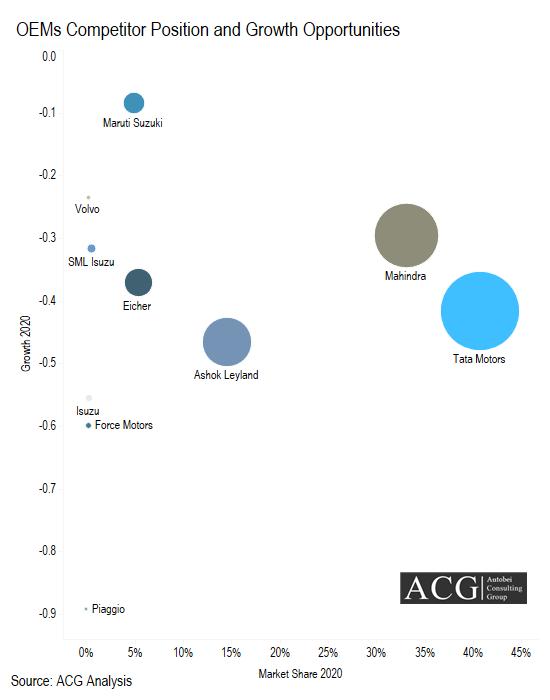
Tata trucks, one of the pioneers in the segment lost 3% of their market share in 2020 compared to CY 2019 and 5% as compared to 2018. Mahendra, on the other hand, amplified its growth by 3%, Ashok Leyland conceded a 3% loss, Maruthi grew its share by 2%. The sales of Volvo trucks were also ill plunged, but if only the Premium Truck segment is taken into consideration then we can note that its performance was Satisfactory compared to Scania.Indian Truck OEMs Competitor Position and Growth Opportunities

Surprisingly, After the lockdown, Mahendra lost its market share by 8%, Ashok Leyland gained 2% Market share in Q4 of 2020 compared to the Q3 of 2020. The Q4 proved to be an improvement period for Maruthi and Eicher as both enhanced their Market share by 1% in 2020.

OEM’S continued to run an uninterrupted show, as all the major OEMs except Mahendra showed better growth rate and this was higher than the Industry growth for the 2nd and 3rd quarter.

Operating costs have gone up as they have a proportionality with the price hike. The increase rate is at 30% for a daily commuting truck that commutes 300 km per day. For the TCO chart, this contributes to almost 50% of the cost. However, this relationship keeps varying for the truck segment and other models as the demand is on the lower end.

The Infrastructure development has attracted a huge amount of investment in Budget 2021. The existing scrappage policy will revolutionize the growth saga of India. The above steps taken by the government have embarked on the demand of Tipper in West Bengal, Tamilnadu, and Kerala.

Even the rural sector has also created a healthy demand, but the fleet utilization hasn’t quite picked up yet, as many trucks are stagnant in the parking because of the demand drop.

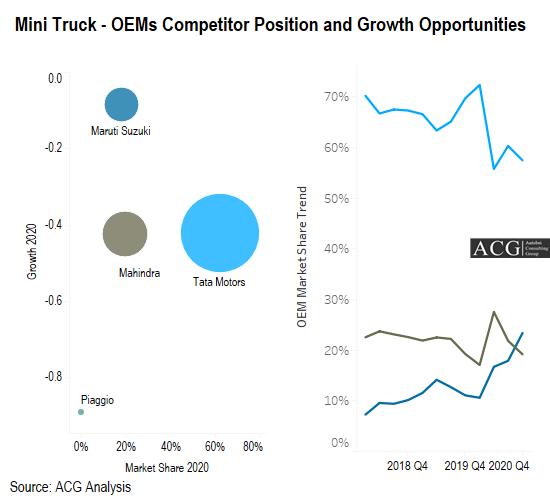
Mini Truck:Indian Mini Truck - OEMs Competitor Position and Growth Opportunities

The losing streak has continued to haunt Mahendra and Tata motors since 2018. But in 2020, Maruthi was able to expand its Market share from 9% to 18% in just 3 years. A similar trend has been noticed after the lockdown and in the Q4 of 2020, Maruthi is dominant as it’s commanding 23% Market share. This segment witnessed 38% degrowth in 2020 compared to 2019.

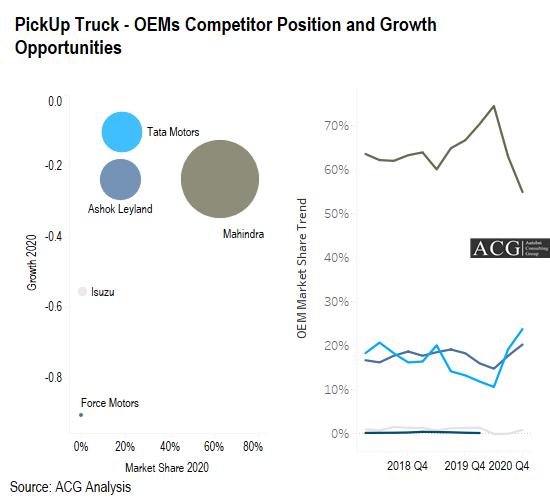
Pickup Truck:Indian PickUp Truck - OEMs Competitor Position and Growth Opportunities
This segment has seen degrowth at 22% in 2020. The year-end quarter turned fruitful for the segment as it managed to achieve double-digit growth in the segment. Mahendra continues to be the top-notch performer in the segment. The new product launch by Tata motors aided them to enhance their market share by 2% in 2020.

In the Q4 of 2020, the likes of Ashok Leyland and Tata Motors were successful in snatching a share of 2% and 4% from the segment giant Mahendra.

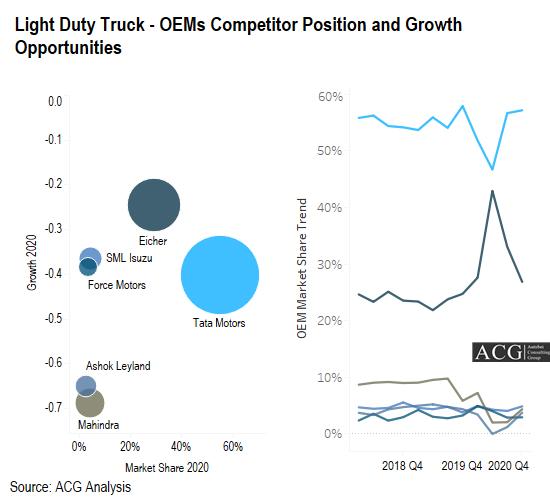
LDT segment:Light Duty Truck - OEMs Competitor Position and Growth Opportunities

Tata motors have held a dominant position and are the market leaders in this segment by amassing more than 55% market share in 2020. Eicher is slowly climbing up the ladder by launching its new trucks to cater to the E-commerce segment. This performance has pulled the Market traction of Mahindra, Ashok Leyland and has redirected the same to Eicher.
In Q4 of 2020, Tata Motors, Ashok Leyland, SML, Isuzu, and Mahendra enhanced their Market share post lockdown.

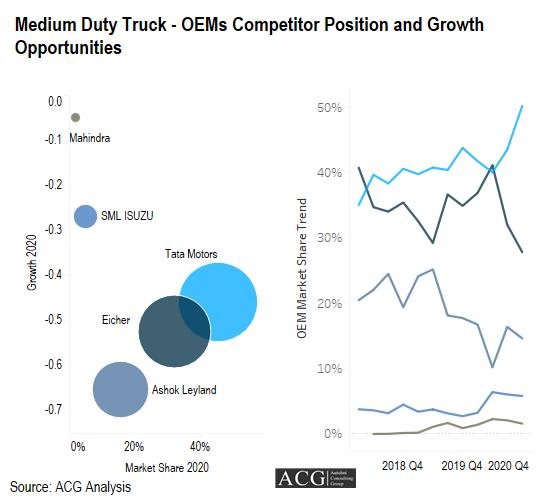
MDT segment:Indian Medium Duty Truck - OEMs Competitor Position and Growth Opportunities

The MDT saw the worst of 2020, as its market size shrank to half of what it had in 2019. Tata on the other hand rose to a respectable position by adding 5% Market share in 2020. Ashok Leyland and Eicher didn’t have the best of 2020, as they lost market share in CY 2020.
The period after lockdown rendered a red carpet welcome to TATA as it became even more invincible by garnering an additional 10% market share.

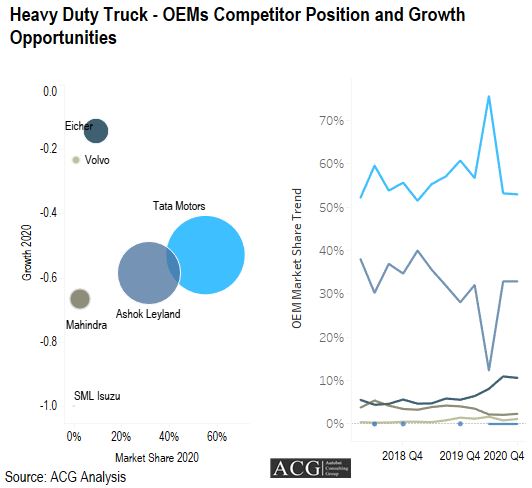
HDT segment:Indian Heavy Duty Truck - OEMs Competitor Position and Growth Opportunities 2021

The HDT segment has 3 subsegments viz. Rigid, Tipper, Special Application, and a tractor-trailer. Though the HDT segment saw degrowth of 50% in 2020, it had the last laugh in the Q4 of 2020 by seeing a spike of growth. The highest growth in the segment was seen by Eicher, as its newer model catalyzed the company to enhance its sales by more than 2 folds in Q4 2020.

The market share that was grabbed by Eicher was at 9%, which is 4% higher compared to last year. In the Q4 of 2020, Eicher went past the double-digit growth. Ashok Leyland and Mahendra lost a 4% share at the same time.

The pandemic brought the Tractor trailer to a standstill position with absolutely no growth. The Market size scaled down from 80k to 12k in 3 years.

Ashok Leyland loosened its hold by a little more than 20%, and Tata tightened its grip by adding 20% market share in 2020. The momentum of Ashok Leyland continued to dip further and worsened as it lost 9% in Q4 compared to Q3 2020. Tata Motors continued to stun its rivals by elevating itself to the leadership position by taking 70% market share in Q4 2020.

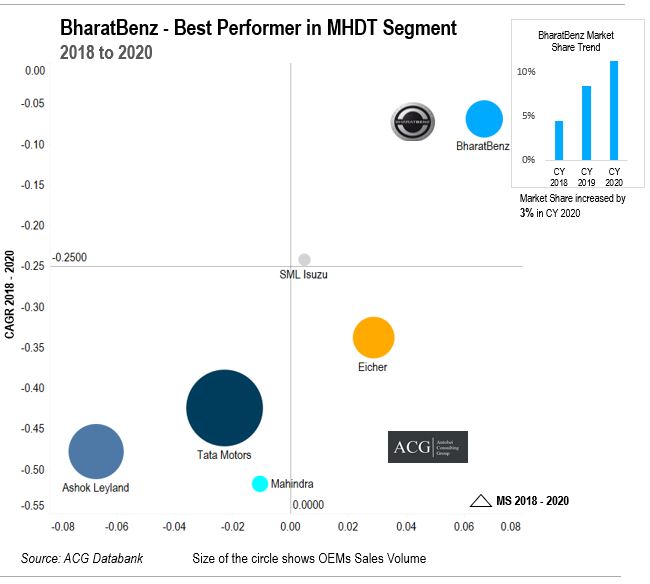
BharatBenz Case Study:

BharatBenz registered 36% regrowth in the MHDT segment but its market share increased by 3 percent in CY 2020 compared to CY 2019.

BharatBenz Strategy and Market Analysis 2021

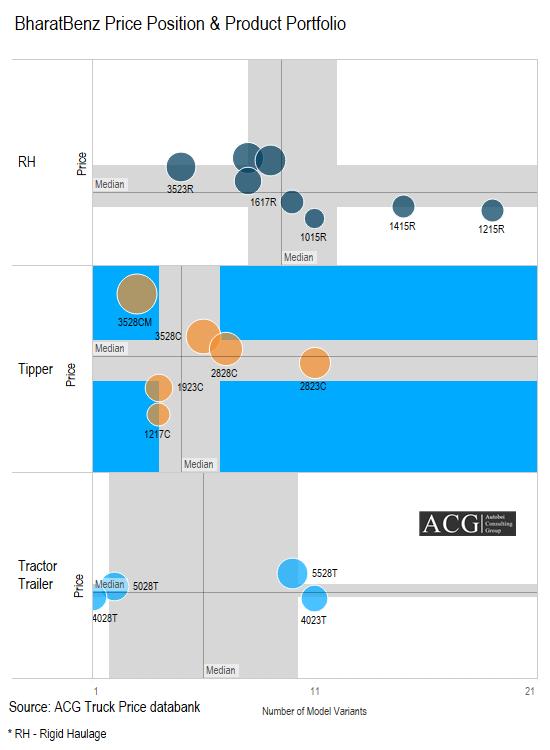
BharatBenz product portfolio and Pricing Strategy play a key role in the growth story.

BharatBenz Price Position & Product Portfolio