In 2025, electric truck registrations in Europe grew 67% compared to 2024. In the first half of 2026, sales increased by another 50.45% compared to H1 2025. Electric truck penetration has moved from 2.3% in 2023 to 4.8% in H1 2026. Diesel lost around 1% market share every year for the past three and a half years.
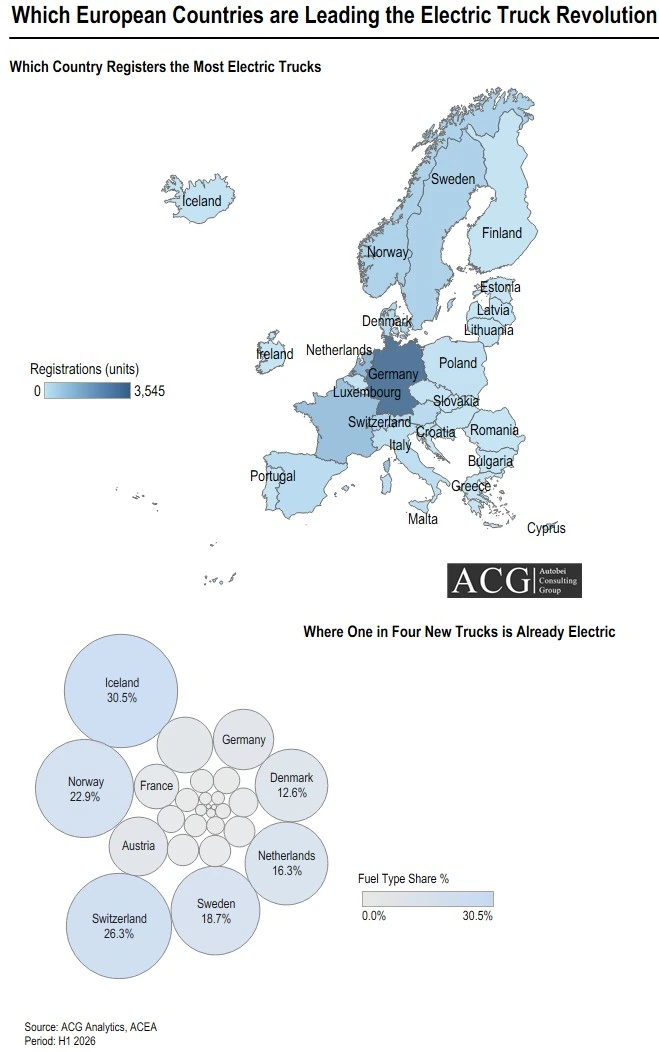
Germany is Europe’s largest Truck market for electric and diesel trucks. The penetration rate of electric trucks in Switzerland is 26.3%, Iceland 30.5%, Norway 22.9%, Sweden 18.7%, and the Netherlands 16.3% in H1 2026.
Monthly Subscription Deep Analytics, along with Forecast Option, is available.
The market that took longer than expected — and then moved fast
For years, the standard response to electric trucks was that they worked only for short urban routes. Supermarkets and e-commerce operators adopted them first, and for good reason. Fixed routes. Known distances. Depot charging overnight. These applications suited early electric truck technology perfectly.
But the story has changed.
In 2023, medium-duty electric trucks held 67.4% of the electric truck market in Europe. Heavy-duty held 32.6%. By H1 2026, that ratio had shifted to 57% and 42.7%, respectively. Heavy-duty electric truck sales grew 83.3% in H1 2026. Medium-duty grew 29%. The heavier end of the market is now growing faster than the lighter end.
Three things drove this shift. New heavy-duty models arrived from Volvo, Mercedes-Benz, and MAN Truck. Regulation tightened. Charging infrastructure improved. Legacy OEMs also brought something newer entrants like Volta Trucks could not — they already knew their customers and understood the applications those customers needed to electrify.
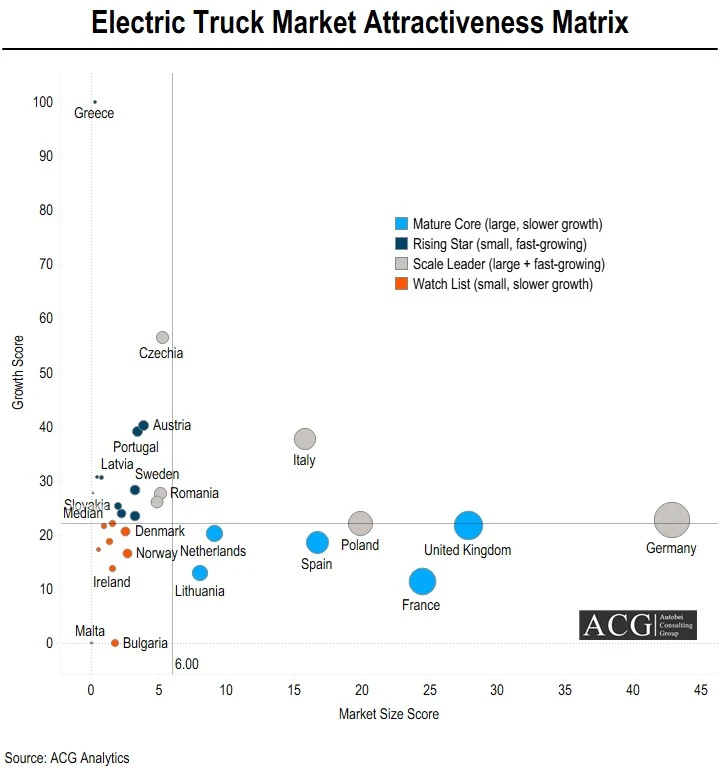
France, Germany, and Poland are large markets but grow slowly, so they’re competitive. Greece, Austria, and Czechia are attractive markets for e-truck brands.
What the duty cycle actually looks like on the ground
The truck transport industry in Europe operates in two broad patterns. Fixed routes with defined loading and unloading points. Multi-stop delivery runs, where the duty cycle is less predictable.
In both cases, drivers typically wait 1.5 to 2 hours at loading and unloading points. Add reporting time and document collection, and you have a genuine window to charge—without adding any extra time to the schedule.
This works very well when loading and unloading points are fixed. Spare parts distribution, for example, typically operates within a 300 to 350 kilometer radius — well within the range of current electric trucks. Beer bottle distribution works the same way: same point of origin, same destination, predictable cycle.
The challenge is when multiple unloading points create an unpredictable duty cycle. That is where careful route planning still matters.
Urban construction tipper applications are another interesting case. Loading and unloading take 15 to 20 minutes. Waiting time is 10 to 15 minutes. The duty cycle is short. And critically, electric tippers can enter city areas where diesel trucks are already restricted. The eArocs 400 from Mercedes-Benz is expected to fit this segment well. The one consideration that always comes up in construction is payload. Comparing payload against an equivalent diesel truck is essential before committing to an electric tipper.
Companies like DB Schenker, DHL, REWE, and Lidl are already using zero-emission trucks in day-to-day operations in Germany. The movement from pilot to operational fleet is underway. Lidl has more than 100 electric trucks across Europe, especially in the Ntherlands, Sweden, Germany and Austria.
The trucks themselves
The Mercedes-Benz eActros 600 can cover 500 kilometers on a single charge. It is particularly well suited to low-density material transport where volume rather than weight defines the load. The eActros 400 uses a 414 kWh LFP battery, an 800V architecture, and SiC semiconductor technology — a combination that enables fast charging at megawatt-level infrastructure.
The average truck replacement cycle in Europe is five to six years. For electric trucks, that cycle may need to extend. The economics improve significantly when the vehicle life is longer — something that benefits logistics companies if they plan for it from the start rather than applying the old diesel replacement schedule to a fundamentally different asset.
How policy is shaping the economics
Three policy mechanisms are doing the most work in making electric truck economics competitive with diesel.
The German Maut toll exemption saves operators up to €100,000 over a seven-year cycle compared to a diesel truck paying full road toll rates. The exemption is being extended to June 2031 following a European Parliament vote in October 2025 — though Council endorsement is still required before it becomes binding across member states.
ETS2 — the EU’s new carbon pricing system for road transport fuel — becomes fully operational in 2028. Diesel operators will absorb approximately €22,640 per truck over the four years from 2028 to the end of a typical lease cycle. Battery electric trucks pay nothing.
France has Suramortissement — a 40% enhanced depreciation allowance specifically optimised for electric trucks. Country-level incentives vary, but the direction across Europe is consistent.
Battery prices have also fallen significantly. From €140 per kWh in 2022 to €75 to 95 per kWh in 2025. The trend continues downward.
Germany is Europe’s largest truck market. The Netherlands and France are other key markets. But for electrification penetration, Iceland, Switzerland, Norway, and Sweden lead — with between 18% and 30% of their truck fleets already electric.
The Chinese Entry
The hot topic in European electric trucks is whether Chinese OEMs will replicate the disruption they caused in the passenger car segment.
Currently, Chinese electric truck brands are targeting approximately 78% of the European market. Companies like Windrose are conducting demonstrations in Finland and Sweden. Sany, Sinotruk, and SuperPanther are among the names entering or evaluating the market.
But buying a truck is not the same as buying a car. The decision-making process is different. The relationship between fleet operators and OEMs runs deeper. Geopolitics plays a role alongside product and price. Chinese OEM decision-making is fast — that is a genuine competitive advantage — but the full picture is more complex than a simple price comparison suggests.
Future Trend
Europe’s electric truck market grew at a 29.8% CAGR between 2023 and 2025. Between 2026 and 2030, it is expected to grow at a 37.7% CAGR. The acceleration is already built into the established trajectory.
Fleet operators that moved early—fixing charging infrastructure at their depots, signing framework agreements with OEMs, and integrating electric trucks into fixed-route operations—are building operational data and driver familiarity that later movers will need years to replicate.
The trucks work. The economics are closing. Regulation is pushing from behind, and infrastructure is building from ahead. The European policymakers need to align with OEMs, Logistics companies, and charging infrastructure companies.
Contact us to get the full report with the Deep Analytics Interactive dashboard