The Market Overview
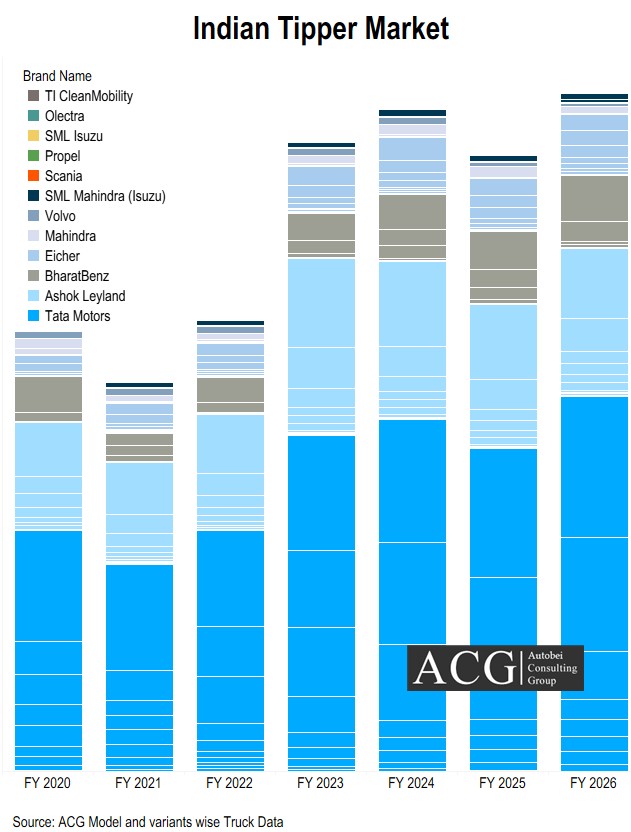
- The Indian tipper market has doubled in five years, driven by demand for construction aggregates and mining. Growth was 39.4% in FY 2023 and 10.1% in FY 2026 over FY 2025.
- Regulation redrew the segment map. The 25T–40T band now holds an 85% market share, up from 33% in FY 2019, after new axle load norms pushed buyers from 25T to 28T.
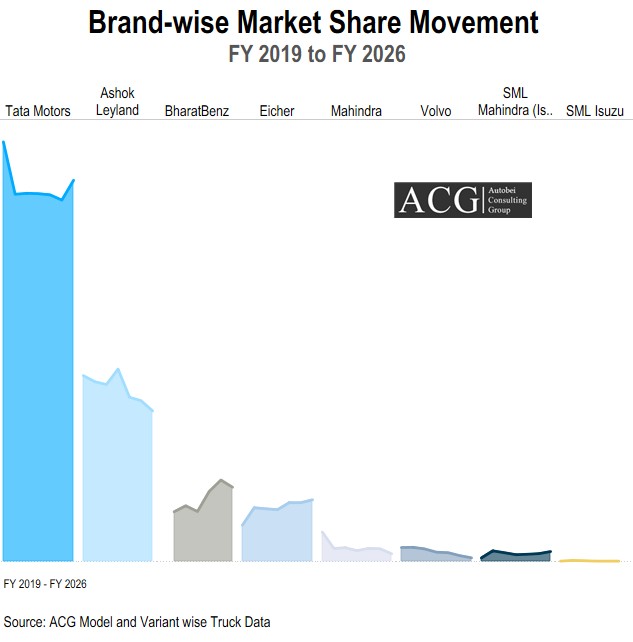
- Tata Motors leads with a 55% share. Yet the sharper stories sit below the headline: BharatBenz is the only OEM with positive growth from FY 2022 to FY 2026, and Eicher has tripled its MDT share.
- Electric tippers have moved from concept to demo economics: roughly ₹8-10/km against ₹35–40/km for diesel — a 60–70% fuel saving.
A market that doubled in five years
Construction and mining have rewritten demand for tippers in India. Market size has doubled over the last five years. The pace has been uneven but persistent: 39% growth in FY 2023, and a further 10% in FY 2026 compared to FY 2025.
Heavy Duty Tippers form the largest segment, suited to the widest range of applications. Medium Duty ranks second. Light Duty remains the smallest slice of the market.
Chinese OEMs have taken notice. High market value attracts them; so does the limited duty cycle, which favors after-sales service economics — a game they are structured to play.
Regulation redrew the segment map
The most consequential shift in this market came from a rulebook, not a product launch. New axle load norms moved the center of gravity from the 25T segment to 28T in July 2018. The result is stark. The 25T–40T band now commands an 85% market share, up from 33% in FY 2019.
Within that band, the 28T 6X4 configuration is the single largest segment. Its advantage is practical: it fits narrow terrain and city loading points. This segment grew 4X from FY 2019 to FY 2026, while the 35T segment grew 5X over the same period.
Watch the top end. The above-45T category is the fastest-growing segment, propelled by sand and other construction applications where volume wins.
Electric tippers: from pilot to P&L
Five players — Tata, Olectra, SANY, Propel, and IPL Tech — have established a meaningful presence in the electric tipper segment. Propel leads the heavy electric segment in battery size, performance, and after-sales support.
New entrants are arriving at the top of the weight range. Liugong recently entered the HDT electric segment with the LET 600, a 62T GVW, 8X4 machine for mining, powered by a 400.61 kWh CATL lithium iron phosphate battery. In demos, it completes about 12-14 trips per day.
The economics explain the momentum. The Montra Rhino, a 28-ton electric tipper, claims operating costs of approximately ₹10/km, compared with ₹35–40/km for diesel — fuel savings of 60–70%. At the smaller end, Euler sold a tipper-body version of its small electric truck last financial year.
One structural adjustment is worth noting. Electric trucks carry less payload than their ICE equivalents, so OEMs have raised electric tipper GVWs to close the payload gap. A related assumption also deserves retirement: the belief that tippers always run overloaded. Overloading now depends on the application and the specific route — it is no longer a market-wide default.
Competitive landscape: one leader, three challengers
Tata Motors leads across tipper segments, with a 55% market share and the highest growth in FY 2026. Its strength rests on proven performance across applications.
The challengers tell three distinct stories:
- BharatBenz is the only OEM to post positive growth every year from FY 2022 to FY 2026. Sharper pricing against Tata Motors did the work.
- Ashok Leyland illustrates the cost of standing still. Its share has been stagnant at 24% since FY 2019. In the 48T segment, Daimler India Commercial Vehicles displaced it as the second-largest player in FY 2025 — before Ashok Leyland reclaimed second place in FY 2026.
- Eicher quietly executed the sharpest share gains in the market. Between FY 2019 and FY 2026, its MDT share rose from 9.4% to 25%, and its LDT share from 1.4% to 14%.
The unit economics of a tipper
Tipper profitability is best understood on a trip-by-trip basis. The two workhorse categories — 35T and 48T — run on different math.
The 35T GVW workhorse
The 35-ton GVW category (Tata Signa 3525, BharatBenz 3528, Ashok Leyland 3525) is the most common configuration for sand and general mining.
The cost stack per trip and per month:
- On-road price: ₹45 lakh to ₹60 lakh; monthly EMI of ₹1 lakh to ₹1.3 lakh
- Fuel: 2 to 3 km/l under load; a 350 km round trip burns roughly ₹20,000 of diesel
- Royalty and loading in sand mining: ₹45,000 to ₹50,000 per trip — often the single largest trip expense
- Tires: ₹50,000 to ₹60,000 per pair, lasting only 3 to 6 months in harsh mining environments
- Major service at 2,000-hour intervals: ₹50,000 to ₹70,000
The revenue side: a single sand trip generates ₹90,000 to ₹1,00,000, leaving a net profit of ₹10,000 to ₹25,000 per trip after all expenses. Owners who prefer stability instead attach the vehicle to a construction or railway site, earning a fixed ₹1.5 lakh to ₹2.5 lakh per month.
The 48T GVW volume play
The 48-ton category (Tata Signa 4825/4830) trades maneuverability for volume. It struggles in narrow city streets but carries up to 1,200–1,300 cubic feet of sand.
- Purchase price: approximately ₹80 lakh, with EMIs often exceeding ₹1.1 lakh per month
- Royalties scale with axles: ₹35,600 for a 16-wheeler versus ₹27,200 for a 12-wheeler
- Total single-trip cost on a long-distance sand run — fuel, royalty, RTO, and tolls — reaches ₹60,000 to ₹70,000
The volume premium pays. In underload regimes, 16-wheelers are reported to be more profitable than 12-wheelers. Daily profits range from ₹20,000 to ₹25,000, and some trips clear over ₹60,000 in net profit.
The costs owners don’t advertise
Three expense lines rarely appear in brochures but decide real returns:
- Crew: sand-business drivers are paid per trip (₹1,500–₹3,500), not monthly — and can earn ₹60,000 to ₹1,00,000 a month
- Road expenses: RTO entries run ₹3,000 per trip; overload toll charges add ₹300–₹700 per toll
- Downtime: a breakdown or even a minor accident costs ₹20,000–₹30,000 in lost revenue for the day, before repair bills
Where the money actually is: three applications
River sand mining is the high-stakes end — highly profitable, but seasonal and risky. Profits peak in June before the NGT closure, when single-trip revenues reach ₹1.23 lakh.
Construction and site work is the “no-tension” income. Tippers attached to sites on 5-year agreements earn consistently; some owners clear ₹2 lakh per month after diesel and driver costs.
Coal transport runs on specialized equipment — purpose-built coal bodies such as the Eicher Pro 8035, designed for coal’s specific density.
What this means
Three implications stand out. For OEMs, the regulatory shift to 28T and the growth above the 45T mark are where product investment should concentrate. For fleet owners, the trip-level math argues for matching the vehicle to the application — volume plays for long sand runs, site attachment for stable income. And for the electric transition, the tipper segment’s short, predictable duty cycles plus a ₹25–30/km operating cost gap make it a more natural early EV market than most of the industry assumes.
Contact us to get the full report along with the forecast for 2035
RECOMMENDED REPORTS
India’s E-Trucks: 5 km from New Corridors
July, 2026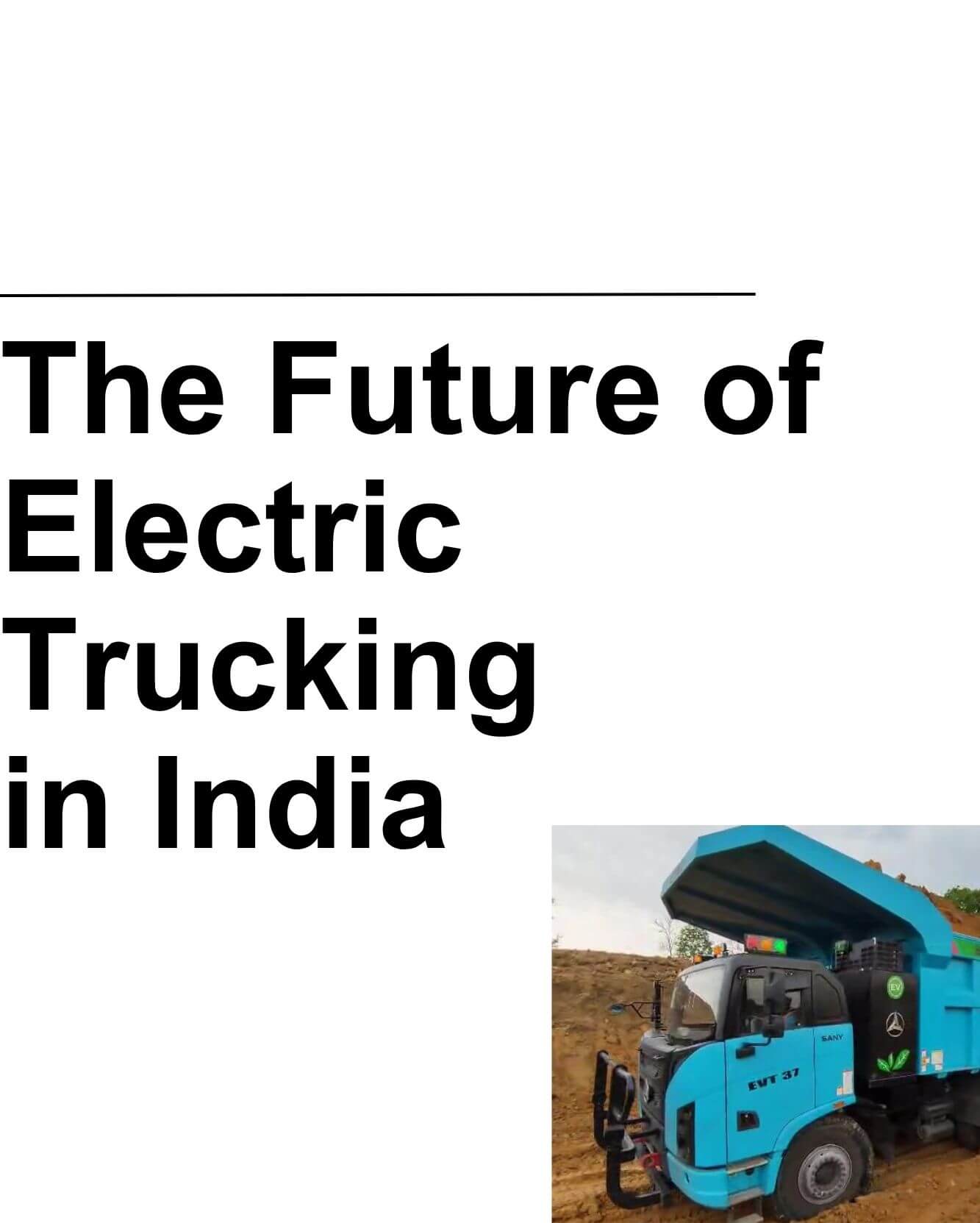
The Future of Electric Trucking
June, 2026
Winning in the Indian Truck Market
June, 2026