The new innovation in Global Truck Industry is going to change complete concept of the truck Industry. Autonomous truck, Driverless truck, Electric truck and other key innovation are ready to make the impact on this Industry. All stakeholders will be beneficial of technology trend.OEMs like Daimler, MAN, DAF and Scania are the front runner in this race.On the other hand, some key challenges are emission norms find the new market for tough competition in emerging markets by local players.

Global OEMs Truck Product and Market Strategy:

Truck OEM Product and Market Strategy

Product and Market Strategy Analysis:

Global Truck Product and Market Strategy Analysis Outlook

The Truck business has been a flagship for the financial cycle and long haul monetary and modern development in distinctive areas of the world. That makes it a key measure of the change in the worldwide economy, reflecting a large portion of the noteworthy movements that have occurred in the relative positioning and development of distinctive economies and locales. As the BRIC and other creating economies developed and their ways wander from those of the customarily predominant locales of North America and Europe, changes will proceed in the structure and adjust of assembling and gathering right the world over.

“…a clear summary of the major and minor truck builders throughout the world.”

“The World Truck Manufacturing Industry” maps the effect of the difficulties and opportunities made by the change of the worldwide economy on the truck producing sector. To investigate the present position of the worldwide truck industry and recognize the key patterns the report takes a gander at basic monetary, demographic and activity information for every locale and significant nations. The report presents information on truck deals and creation and portrays truck assembling and get together operations in each delivering nation.

This is Exclusive Global Truck Market Intelligence Report covered following key points:

Key Highlights of Global Medium and Heavy Duty Truck Market

Regional chapters:

Inside of each local part, all truck makers with base camp or real backups in the area are profiled with a brief history of mergers and acquisitions, corporate structure, shareholders, market technique, model extent, deals execution.

In the real truck fabricating locales, all litter volume, specialist truck producers are likewise recorded. Inside of locales, for example, Africa and Southeast Asia, where there are for the most part just get together operations that are supplied with CKD units from assembling offices somewhere else, these are recorded by OEM with models delivered and other key data.

Manufacturer Profiles

Investigation of each of the seven driving “world” truck producers that have real assembling offices in no less than two noteworthy areas [Europe, North America, Asia and South America is exhibited in a different suite of reports inside of the parts of the significant districts. In each of these reports, the majority of the OEM’s backups are incorporated alongside the data incorporated into the applicable territorial parts. These “world” OEMs include Daimler Trucks (Mercedes-Benz, Freightliner, Western Star, Mitsubishi Fuso); Volvo Trucks (Volvo, Renault Trucks, Mack, UD Trucks), Scania, Volkswagen, CNHTC, Foton, Dongfeng, MAN; Paccar (Kenworth, Peterbilt, DAF Trucks); Iveco and Isuzu.

Truck and Bus Builder is broadly perceived be the main universal industry pamphlet for medium and heavy truck fabricating with more than 30 years of the scope of the worldwide truck industry. The report expands on Truck and Bus Builder’s profound industry learning and wide article connections to display a report that is as complete and solid as would be prudent. The exploration for the report was driven by Mike Murphy, who has composed and examined various reports on diverse truck industry subjects in the course of the most recent quite a long while.

The report is beneficial for:

This report is a vital apparatus for top administrators in the truck business: truck producers, part makers, suppliers; administration advisors, venture investigators, research foundations & instructive foundations, government bodies and trade associations.

Key highlights of the Report:

  • Global region wise truck Volume
  • Product plant and capacity
  • Regional Market dynamics
  • Forecast
  • Product and Brand position
  • Detail Competitor analysis
  • Driveline Analysis
  • Technology Analysis
  • SWOT analysis
  • Company Analysis
  • Opportunities and Challenges
  • CAGR
  • Industry and OEMs fact book
  • Case Study

Bosch currently stands as the leader as one of the largest global suppliers of technology and services, showcasing a spectacular revenue of almost 70.6 billion Euros in 2015. Almost 5 billion Euro of the revenue was spent on its R & D department in 2014 and 6.4 billion Euro, which accounted for nearly 10.1% and 9% of the total revenue.

Bosch Revenue Forecast

R&D Expenditure analysis:

Bosch R and D expenditure 2015

It’s main business operations have been characterized into 4 sectors :

  • Mobility solutions,
  • Industrial technology,
  • Consumer goods and Energy and
  • Building technology.

Recent developments have also begun to show improvements in the non-automotive business sector too, resulting in the formation of an independent group and consequently shift the focus to retail sales of home appliances. Last year saw a 100% stake from Bosch BSH JV, responsible for new innovations and development. The company plays a significant role in launching hybrid vehicles. Their success was only multiplied manifold by their innovative engine technology which led to fuel consumption being 15% lower in commercial vehicles.

There has been a considerable increase in the profit figures of the year 2014 as compared to the previous year, 2013. However, one trend that is observed is that capital expenditure has stayed in homeostasis from the year 2020.

On the other hand, R & D has undergone a major increase and being the backbone of this industry, it has exhibited excellent results with an increase from 4.2 to 6.4 billion Euro. Innovation is the key for the company.

Cost cutting solutions tailored towards attaining financial independence seems to Bosch’s strong suit. Some Business practices undertaken in the Bosch Head office in Germany are listed as follows :

1. Employees are not permitted to make personal phone calls from the office phone, If so, the cost of the call will be deducted from the salary.

2. Employees are not allowed to print in high-quality papers unless the need necessitates the use of the same. The Economic paper is also widely available for use.

3. Many employees are students or work students, contributed as permanent employees result oriented.

4. Very stringent travel and hotel expenses.

5. Limited internet access.

6. Only the middle and top level management employees are provided laptop and other electronics.

The cogs of Indian infrastructure have been moving on rapidly in the last two decades, especially in the field of surface transport. The bus transport has thrived very well in Indian roads owing to their excellently built roads and favourable conditions. Buses have a become an integral part of urban as well as rural life. The following report briefly introduces the bus sales strategy and business planning research which is undergone in doing the same. In this report, we also focus on primary and secondary research analysis, product life cycle, automotive and marketing strategy.

The demand for a number of good quality buses has given the automotive industry something to expect. Also, the fact remains that this industry is one of which still remains to be delved into further and hence, it is a potential gold mine industry we might be sitting on, literally. One day, over the years, to come OEM pioneers like Volvo, Scania and Mercedes are expected to capture the market. The coming of a new dawn will also enable many other new players to enter into the scene. A very promising environment awaits the new players who are yet to enter into the segment.

With the objective of keeping in tune with the global standards, the Indian government has planned to implement a new, improved Bus Safety Code. This improved bus code is expected to be guidelines in view of maintaining safety as well as comfort. Though this will no doubt be of use in the future, new players will have to up their game to keep on par with such a radical system. To keep up with the new system will be one of the biggest challenges the bus industry will face in the future, as the new technology which complies with the bus code needs to use.

 We at ACG have studied the product features based on applications, city and bus code regulations. A few key features of this study are given as follows:

1. State wise market dynamics which stakeholders need to account for.

2. The >5T GVW segment has shown more than a double digit market size growth in the past few years.

3. GVW wise: 5T,7T, 9T, 12T and >12T

4. Bus Application wise

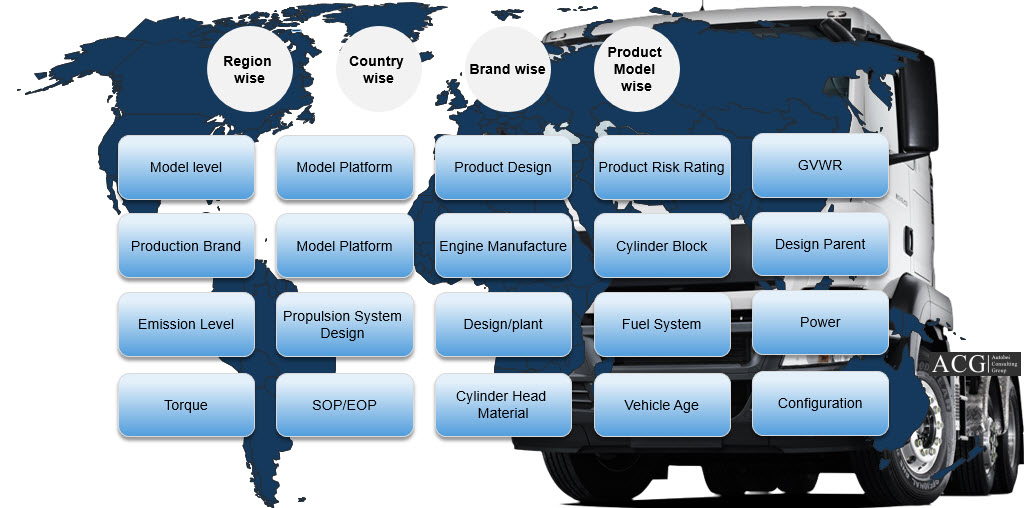
Being a culturally diverse country, our regional geographical factors contribute a major part to the automobile industry. So, in a country as vast as ours, it makes more sense to analyse the data city, state and zone wise analysis to gain a little more clarity and depth. The conical matrix that ACG follows accounts for all the parameters required for a macro level research. Surveys undertaken in various parts of the country have led to the need for color coding safety compliant buses to gain more awareness among the people on the same.

The market size variation from 2009 – 2015 in the >5T department and the zonal wise market share of the parts of India every year from 2009 to 2015. It is evident that South India captures the largest market, followed by North, West and East India. The South Indian market is ruled mostly by new buses. In stark contrast, North Indian roads are fleeced with old buses. The color coded safety indication system could begin on a trial from South India, given that they are the largest segment. The detailed report gives a little more insight on the factors that play an important role in sales in each region of India.

The Premium segment of the bus market has seen a refreshing growth in sales and it may just return more positive investment in the long run, though the initial amount may be high.

Bus Running cost structure:

The major cost factors that goes to Fuel cost and EMI. As it can be clearly observed, most of the expenses are eaten up by fuel costs. Initial investment and other additional costs like tire, crew, and maintenance are incurred.

The growth in each part of India is analysed and compared to the year 2009 and in the year 2015 along with forecast 2025. The South have registered a double digit increase in their sales. The Northern part of India has seen its sales rise by more than 20%.

Trends in the market :

1. The South and North Indi markets have shown an upward curve growth since the year 2009. This can be accounted to better roads, a number of passengers, improved lifestyle, and willingness to pay. TamilNadu and Rajasthan are one among the best performers.

2. A significant drop is seen however during the same period in the East and West zones, with Uttarakhand being the least performing state.

3. The southern travellers are open to paying higher fares for receiving more improved versions of transport. However, the North Indian passengers are reluctant to pay that high.

4. When analysed brand wise, we see that Ashok Leyland and Tata Motors have shown a major drop in market share.

Top Bus States in India:

States in the south like Tamilnadu and Andhra Pradesh are recording an upward curve. Uttar Pradesh, however, recorded a major  decrease in its market share.

  • Region wise fleet life is different in all states
  • Region wise fleet wise, APSRTC is the largest.
  • Market size, Major Models, Market leader, and Applications of Buses:

Tata Motors has successfully imprinted its hold on the 5T to 9T segments and the higher tonnage segments are dictated by Ashok Leyland.

With respect to market size, luxury buses seem to have the most impact. However, budget buses seem to the safe and comfortable option for most passengers. Though the initial investment is high with these luxury buses, the ROI they give is considerably more. Companies like Scania have managed to break the monotony by creating an impact, challenging the monopoly of brands like Volvo. However, few European companies still find it hard to plunge into the luxury bus segment. Technical breakdowns have reduced to a large extent due to the introduction of Dashboard diagnostic tools.

TCO and ROI are different for Luxury,premium, budget and low-cost buses.Though may characteristics are similar like the revenue collected and the seating layout, the output seems to vary with the two. The total cost is exceedingly higher with luxury buses and total profit incurred with luxury buses are almost three times as compared to luxury buses.

The following entails a detailed description based on primary and desk research and arrives at the most fruitful model that was analysed here at ACG. It provides the most important parameters that one may easily overlook while buying a bus.

ACG has undertaken an in-depth analysis to understand what are the most important aspects of has to look into while buying a bus and has understood that a brand name is one of the least important aspects whereas fuel efficiency is given top notch priority as that decides profits incurred in the long run.

This classification is done by categorising the population into strands which cater to a particular budget. For example, the more lavish route run buses are mostly taken the foreigners who visit India to travel to tourist spots like Agra, Jaipur, etc. On the other hand, this market also caters to the low-income specifications of students in routes that run from Indore to Mumbai or from Bangalore to Pune.

This analysis also takes into view the businessmen who travel frequently and mostly all-night, round trips. It also accounts for Indian tourists who are the economy travellers frequently traversing the Delhi-Agra, Bangalore-Goa routes.

Strategising market intelligence state wise helps to provide additional information about the Indian bus industry. This can be utilised by OEMs and new entries to sketch their own strategies based on the already available data. The report has helped to cater to their weds and enable them to come up with their individual strategies to penetrate the market.

We at ACG also met with many fleet owners in India to further gather a deeper of the understanding of the system we work with, and this is what they had to say.

Bus operator Survey

As per our Global Commercial Vehicle Market Intelligence Report 2005-2025, Global CV market expected to grow at a CAGR of around 4% and to reach around $7 billion by 2025. This CV report analyzes the global markets for Commercial Vehicles across all the given segments on global as well as regional levels presented in the research scope. It presents historical market data of sales and revenue since 2005 to 2015 and outlook till 2025.

Global Commercial Vehicle Industry Report 2005 to 2025

The study covered Historical market trends, Forecast, Market Dynamics, Production plant location, Product portfolio, Key players, supply chain trends, technology upgradations, Emission norms, Connected vehicle, key developments, and strategy analysis of coming trend. The report covered comprehensive market analysis across the key geographies such as Asia, Europe, North America, Middle East, Latin America and Rest of the world. The is most detailed global CV market intelligence report.

Top Commercial Vehicle Market Analysis 2015

More than 140 countries included in our report like India, Turkey,Spain,France,Italy, Thailand, South Korea, South Africa, Africa, U.S., Canada, Mexico, U.K., Germany, Spain, France, Italy, China, Brazil, Saudi Arabia etc. We also included Business review and strategy analysis of OEMs such as Daimler,Navistar, DAF, IVECO, Tata Motors, MAN,Volvo, Ashok Leyland, Scania, Eicher, Foton etc.

Top 10 Global CV Market:

Top 10 Global Commercial Vehicle Market 2015

Highlights of the report:

1. Introduction

2. Abstract

3. Market Overview

3.1 Current & Future Trends

3.1.1 Growth & Investment Opportunities

3.1.2 Policied

3.1.3 Electric Vehicle Outlook

3.2 SWOT Analysis

3.3 Key Challenges

3.4 Industry Attractiveness

4. Product portfolio

5. Brand Analysis

6. Heavy Commercial Vehicles Market, By Axles type

6.1 Two Axles

6.2 Multi-Axle, 3-4 Axles

6.3 Five and above Axles

8. Commercial Vehicles Market, By regions

9. Leading Companies – Ashok Leyland Limited – Daimler – Eicher – Ford Motor – Hyundai Motor – King Long United Automotive Industry Co., Ltd – MAN Truck and Bus – Mitsubishi Fuso Truck and Bus Corporation – Peugeot Citroen – Renault – SML Isuzu – Tata Motors – Toyota Motors – Volvo Trucks Corporation and Volvo Bus

Axle is the part of Driveline of vehicle which play important role of complete product life cycle. Manufacturers of axles and propellers worldwide are trying to offer latest technology, longer product life cycle, light weight, suitable to complete vehicle infrastructure, cost advantages, comfort levels, and safety to the end consumers and OEMs to through their product range. Axle manufacturers are focusing on advance axle with minimum power losses through mechanical actions. Axle manufacturer work closely with OEM to fulfill to produce axle for their specific product architecture and for after market for fleet owners.

Scope of Study:

– Axle Market Overview

– Axle Market size in terms of Value and Size

– Geography wise: Asia, Middle East, Europe, NAFTA and Rest of the world, (Country wise Axle market report is available on request)

Axle Market, By Position

  • Front
  • Rear
  • Intermediate

Axle Market, By Type

  • Live
  • Dead
  • Tandem

Axle Market, By Geography – Country wise report available on request

  • Asia
  • Europe
  • NAFTA
  • Middle East
  • RoW

Drive Shaft

  • By Position
  • By Material

For India region, states wise Axle Analysis is also available based on Type and After market volume

Auto Dealer Strategy Analysis Report is a exclusive report. Today Dealer network play key role in OEMs performance. Their success depends on right approach of the dealer network to consumer trend and dynamics. Optimizing network Human Resources,Promotion, Market track, competitive intelligence, Brand and Product USP, location and product/service mix—is critical. ACG provide complete Dealer solution including IT services, CRM, Digital marketing, Sales Analysis, Regional market dynamics, Economics changes,performance measurement, Outlook, local business sentiments etc. We have a key expertise in Global Automotive Industry.

  • In Depth knowledge of regional market
  • Sales and customer interaction practice
  • Competitor Analysis
  • Branding and Promotion strategy
  • Assess historical, current and future network opportunities
  • Local Challenges and risk
  • Find prospect customers and locate opportunities
  • Optimize dealer and Sub Dealer networks
  • Check implementation result and taking corrective actions
  • Ready for market changes
  • Increase market share, Sales units, market coverage, revenue, cost analysis and profitability
  • Revenue and Profit analysis
  • SWOT Analysis

This report is available for Passenger vehicle, Commercial vehicle (Truck & Bus), Two Wheeler and Three Wheeler segment

Study Frame: Our Approache:

  • Identify Dealer network’s strengths and weaknesses through comprehensive vehicle Sales data
  • Sales performance against Industry volume, bench-marking and competitive analysis
  • Regional sales volume and potential of Dealer Sales Outlook
  • Define current sales practice and steps need to be taken to improve the team performance
  • Training requirement and GAP analysis between employees and skills
  • Ideal Dealer location and after sales
  • After sales potential and how to tab the market to increase customer satisfaction and revenue
  • Used vehicle Strategy
  • Financial issues

India Commercial Market volume size rank 2025

The commercial vehicle segment is dictated by a compilation of many sub – segments which form the foundation for the economy of the CV segment. One of the main lead indicators of the economy of this segment is the Medium and Heavy commercial vehicle segments. They form a cyclic progression across the globe. This sub-segment also contributes to a major part of the business, mainly due to the long distance travelers and tippers. The past seven to eight quarters has seen mainly the HCV segment growing.

Indian Commercial vehicle Industry Analysis and Forecast report

One of the major reasons for the elongated periods of recession can be owed to fluctuation of diesel prices. The freight rates have failed to keep at par with the hike in diesel prices causing demand to not be translated onto increase in sales due to this price hike.

Being one of the industries with most investment by the government has seen various actions taking place here, leading to positive sentiments being created due to their infrastructure investments. Land acquisition conflicts have been solved, which has resulted in many projects being stopped midway. This also led to the coal mining sector being re-opened and this will result in many opportunities opening up by 2015 as the economy is improving  The government is expected to take a lot of steps in order to increase the productivity of the country and an optimistic mindset currently prevails the CV segment. With interest rates falling, an improving economy, low inflation and falling oil prices, the industries indeed have very high hopes in terms of productivity.

The Future is here, and with it, has brought unprecedented change and disruption. The Global Automotive industry  has sped up the cogs of change by introducing Autonomous driving, connected vehicles, the rise of e-commerce and the sharing economy, surely changing the way that consumers view mobility and logistics. OEMs and suppliers need to learn to bear with the highly volatile market coupled with the huge competition and increased regulations of safety emissions. This list of competencies seem to only be growing every day.

Commercial Industry Overview:

BRICs Commercial vehicle Market Analysis 2015

There is a clear drop in the cargo sales of M & HCV segment in the last quarter of 11-12 whose cyclic nature took another 18 months to impact a full scale blow on the LCV and HCV segments too. This cyclic recession took almost two and a half years and it hit the SCV segment hard on the financial front. Though the situation is not as stark as before, it has still made a complete recovery from the recession. The years 2011- 2014 was the period the M & HCV segments were worst hit, the worst time of all being the January of 2012. During the year 2008-09, the global liquidity crisis created an exponential slump in sales, but however the effect on the M & HCV segments did not last long, and was able to revert back to normality in 8 to 9 months. Though the CV segment fell through by 25 – 30%, the Passenger vehicle segment remained unaffected. The problem, more than being the problem of the segment can be due to the failure to plan, as a country. The unstructured industry fell through due to lack of better planning strategies. Consequently, as the economy decline so do the industries that have not thought emergencies properly through. The country’s planning is as bad as to give only an 80-85% utilization of trucks’ capacity utilization. In the slump of 2012 – 2014, these utilization figures went down to an all-time low of 20 – 25%. Buses, being a minority of the segment fell by a small 10 – 15%.The cargo section of this segment suffered the wrath of fundamentally weak economics during the period from FY12 to FY2014. This breakdown was exceptionally bleak as it occurred from a height of 299000 units in FY12 and plummeted down to 162000 units in FY14.

The CV sales in terms of value in US$ million figures for the commercial vehicle segment in the years 2011 and 2016 and also analyses the predictions for the year 2025. From the year 2011 to 2016, there has been a dip in sales of about 10%. However, these figures are predicted to multiply manifold by the year 2025. There can be seen more than 3 times the growth by this time. By 2025 the market size will be touched to 2,156 US$ million.

The influence of technological and business model distractions have had a profound impact on Indian OEMs which have been under pressure for several years now. Domestic overall CV segment sales saw a drastic drop from 12, 59,785 units to 12,41,699 units(including Truck,Bus, Three Wheeler and Taxis) in FY16 owing to a 0.3% drop in CAGR. This environment which has seen such a vast change in the little time can be due to both domestic as well as the negative global environment.

The success in sales varies across the different segments. The SCV passenger segment increased from 19% segment share in FY 2011 to 21% in FY16. There is a tough competition to SCV three wheeler passenger segment to four wheeler SCV segment, the Three Wheeler products are cheaper, less heavy, cost of ownership and operating cost. Sales was limited in the SCV segment also due to lack of finance. Parallel, the cargo section of the SCV segment also saw a major crunch in their sales from 0.27 million units in FY11 to 0.3 million units in FY16. It lost around 4% market share in 2016. In this segment, the 2 – 3.5T increased its segment share from 14% in 2011 to 31% in 2016. Sub – 2T mini trucks have lost in the market from a mere 32% in 2011 to an astounding 20% by FY16. This shift in the market scenario arose as a result of combining aggressive pricing and higher utility value of the larger vehicles. Mahindra dictates 68% of the market share, the remaining balanced out by Tata Motors and Ashok Leyland.

In stark contrast however, the last two years have led to an overall growth in sales owing to the optimistic economic impetus. This has led to the growth of more than 6% in GDP from FY2015 to FY2016. Boasting the highest growth rate among emerging nations, India has seen fluctuation in inflation and strong FDI inflows sum up to the optimistic business and consumer confidence. However, they still face the dire challenge of inflation in oil prices and elevated pressure on freight rates. “Make in India”, a pro-investment initiative ensures 100% investment on defence and has also helped increase FDI limits in insurance and business sectors. These have help transition to a positive environment from a slow economy. This positive growth prevails in Q1FY2016 with a 12%YoY growth in domestic sales.

In terms of the LCV passenger segment, market size is stable at around 20,000 units since FY 2011. This segment’s volumes can be reasoned due to urbanization and the increasing need for inter-city and semi-urban transport. Their cargo segment, in contrast went down by 45,000 units to 35,000 units from FY11 to FY16. CAGR in FY 2016 was -8% between 2011 to 2016 of 3.5T to 6T segment and expected to reach at 14% by 2025. Other sub segment of 6 to 7.5T CAGR 4.8% between FY 2011 to FY 2016 and expedted to reach 11% by 2025. The submerged sales could be owed to their overloading and restricted financial situation.

The MHCV Bus segment however underwent an 8.3% reduction in volume with only 43,000 units being sold between FY16. The 7.5 – 12T bus in this segment owed to 20% of total volume, showcasing a gradual increase from their 14% figure in FY11. The pioneers of this market are Ashok Leyland, with a market share of 45% and Tata motors with a market share of 34%, followed by Volvo Eicher.

The cargo section of this segment suffered the wrath of fundamentally weak economics during the period from FY 2012 to FY 2014. This breakdown was exceptionally bleak as it occurred from a height of 0.29 million units in FY 2011 and plummeted down to 0.16 million units in FY 2014. The situation has been improving since then, economically, owing to the growth in both GDP as well as infrastructure.

In a nutshell, it is clearly visible that there exists an inclination towards higher tonnage vehicles and tractor-trailers. On the other hand, the CAGR of Heavy segment 0.7% and expected to reach 9% by 2025. Tractor Trailer segment showed 11.27% CAGR from 2011 to 2016.

MCV cargo segment showed a -4.4% CAGR whereas LCV cargo segment’s de growth was only a meagre 4.8%. The continued period of recession have led to the reduction of robustness of the segment. The LCV segment had seen continuous periods of growth since 2005 till in 2008-09 for a brief period of time. The M & HCV segments however began to affect the performance of LCV from 2014. This can be attributed to lower job opportunities and refusal of banks to provide more than 80% of the vehicle’s value as loan. Though the scenario is a lot better for the M & HCV segment, the LCV segment still suffers and is slowly recovering from the slump. Inspite of all the downfalls, the segment did see significant changes in their market share. Ashok Leyland showed a 11% growth from FY12 to FY16 and is the current holder of 31% of the entire volume. Ashok Leyland’s strong foothold in the market can be owed to a delicate balance struck between strong economic activities in South India and a major increase in the dealer network in North India. The 35.2 – 40T and > 49T segment vehicles also added to strong market share gains. In contrast, Tata Motors saw a stark dip in market share from 62% to 55% in this period. These figures however do not strengthen the fact that their strength of the duopoly rose from 82% to 86% between FY 2012 and FY 2016.

Overall, the CV segment volume is predicted to shoot by 2.7 million units by the year 2025 included Truck, Bus, Three Wheeler and Taxi segment. This is expected to be brought about by various significant factors determining the segment’s growth. Most of this above mentioned growth is expected to be the contribution of the SCV segment which will grow by 10% CAGR by 2025. LCVs however will only grow moderately to about 13% CAGR by 2025 and buses are expected to show an even lesser rate of growth reaching only 0.26 million units by 2025. The HCV segment on the other hand is predicted to grow by 10% in CAGR by 2025. The end result is the inevitable placement of India as the world’s third largest MHCV market.

Growth Drivers:

Some of the main drivers for the CV market include economy, availability of load , low cost finance and freight rate – diesel price equilibrium. Currently, fuel prices are low, freight rates are at comfortable levels and customers are seeing profits. This leads to an improvement of the general economy consequently leading to the betterment of the industry. Increased road construction and mining activities have also contributed to the economy development. Now, customers are looking for a way to make the situation even better with modernization of operations that require better equipped trucks for the purpose. The huge that occurred is the replacement of the fleet that hadn’t happened in the last three years. As economy keeps growing, the size of the fleet also increases linearly. With new e-commerce companies entering the field, this process has been escalated. The National Green Tribunal is also one of the factors that caused growth in the segment.

The Heavy duty segment is also showing refreshing sales figures with earlier peak touching 215,000 units in FY 2016. If this growth prevails, we will cross the peak in the year 2017, however we have noticed some de growth in this segment sales in July & August month. The Tipper and Rigid segments have shown a 90% growth compared to their peak values with 175,000 units in 2011 and 165,000 units in 2016. The replacement demand has been struck to give rise to large fleet operations. With the GST being approved by the Parliament, makes logistics and tax processing very easy. The present distribution process in inefficient, however the advent of GST will change all that and reduce the number of barriers one has to go through to reach the depots, leading to a very efficient distribution system. The GST will also lead to escalation of revenue as this involves taking credit and paying tax only on the value of portion added. Short term effects may be infinitesimal, but long term effects may be a profitable solution.

Apart from road construction and mining activities, we also see other infrastructure based projects kicking into place such as transportation of cement, steel, etc. The tippers that were used for construction and mining saw a major decline in the market in 2014. In 2011, 66,000 units accounted for the peak which is likely to plummet to 45,000 trucks in 2015. Though there has been a refreshing growth in the coal – mining industry, the demand for iron ore mining and construction tippers are at a standstill. Though there is an expectation for new projects to be launched, the future was bleak and unsure but we have seen attarctive growth in Tipper segment in 2016 due to latest development in Infra and mining sectors..

Truck Segment:

Indian Truck Segment Analysis

The above graph shows the growth or decline of sales of the vehicles from the 2T – 15T segments in 2011, 2014 and 2016. The less than 2T segment has seen a steady downfall from the year 2011 and the situation has still not stabilized with this segment. One can see a drop by almost 40% in this segment.

On the other hand, the 2T to 3.5T segment has seen more than doubling of sales from 2011 to 2016. The other components of the segment have seen either very little or no growth in their sales during this time and also account for a very tiny share of the overall market share.

The 5 – 15 tonne segment which has shown the least growth is still resuming its downward growth though the crisis has been averted. This segment which peaked at 100,000 units per annum has dropped to less than 70,000 units in 2014 and managed to reach 80,000 units in FY 2016. August however saw a 20% hike in sales of the LMD segment, but these were mostly due to small operators who still find it hard to receive funding. The recovery process of the LMD truck segment is taking longer than expected, with normal recovery lag period oscillating between 6 to 9 months.

Passenger Vehicle Segment:

Indian Bus Market Analysis

A similar pattern is followed with the bus segment as the commercial vehicle segment. A major difference however is that it does not follow a cyclic pattern as it does with trucks. The recovery process is faster and the fall is much less drastic and cyclic. As trucks are recovering, there is an exemplar growth in the revenue generated by trucks. During a five year period, the cost incurred by the operator is merely 20% whereas fuel accounts for 50-55% of the cost. Bus requirements vary as per the state they run in. This market however, is very significant, especially in rural areas to impact development. State transport undertakings take the biggest push as they form the largest number of big buses catering to intercity transport for passengers. Though last year, lack of funds prevented them from replacing their fleet, this year they have been doing the same diligently. So, state transport undertaking has already seen many orders being placed for the course of this year. Another attractive option is the school bus segment. Tata Motors and Ashok Leyland sold only chassis to both truck as well as bus segment in the year 2001-02. But, the scenario has changed multi fold in the past couple of years. Buses now have switched to BSIV from BSIII due to their extensive use, along with their use of radial tires. With passenger transportation in mind, OEMs need to build an even more specialized network to cater to the metropolitan cities it services. The southern part of India, particularly Tamil Nadu is one of the most advanced bus markets in the country. The concept of 5-7 hour long bus journey started here and then spread. North India, on the other hand limited itself to this thought. Hence, Tamilnadu has been a major trendsetter in terms of bus travel and service.

With great power comes great responsibility, a great man once said. Hence, bus codes and regulations need to be charted in the interest of customers. It covers not only the driver and the conductor but also the 55 odd people who travel in the vestibule every day. The code made the Anti-lock braking system mandatory, and directs bus drivers to follow uniformity in seating arrangements to ensure a comfortable journey for the passengers. Luxury buses have a very minimal level of visibility, and even lower, in the case of foreign players. The Indian OEMs have captured the budget segment, and these OEMs concentrate more on inter-city transport and are interested only in lower price brands. These have much less powerful engines than the luxury buses.

The bus market is driven by the IT and the BPO markets, which have enabled more fleet operators and stage carriers.

Investment by OEMs:

VECV plans to invest Rs.400 crores for capital investments added to the Rs.2700 crore already invested in the past four years. This proves that OEMs are interested in further investment on technology, product capacity and business. With the launch of new products, this has also allocated new emission norms. From 2020, Euro VI norms are expected to be allocated to increase the capacity of this segment further.

Competitor Analysis and Product Strategy:

The strategy of OEMs need to be varied to include concept of engineering in order to decrease weight, save fuel, increase payload and reach top speed better. The space for the driver needs to be made comfortable with an air conditioned cabin and bunk beds for the co-driver to rest. This is to increase efficiency by having two or three drivers to take turns during a 20 hour bus journey. Other key features like ABS and telemetry are added to increase the safety of the vehicle. BharatBenz’s entry into the mid segment truck portfolio with already existing VECV, Tata, Ashok Leyland are others plan to give an equivalent range of products to the customers.

With VECV’s new range of PRO series, the cabin and the exterior are attractive but electronic malfunctions have led to after sales issues.

The current strategy focuses on the heavy duty segment and questions how to gain maximum growth from the segment. Parallel, the SCV segment is also placed in the loop, although the market share is more pronounced in the Light and Medium duty CV segment. VECV has emerged as a strong power in all segments and has added 2 percent to its market share this year. Buses have increased their share every year and is expected to hike beyond 14.9%. With exports, the bus segment looks to increase its value by 2%. The heavy duty industry, governed by the CV segment has the highest opportunity for growth and has planned to launch five new models in the 25 – 49 T range.

The company expects new products launched as a part of Eicher’s portfolio, namely Eicher Pro 1000, Eicher Pro 3000, Eicher Pro 6000 series, Eicher Pro 8000 series and Eicher skyline Pro buses. The launch of these products will help to increase the volume as well as the market of the bus segment in the next 5 years. A new generation of heavy duty trucks, tippers with high power and torque and a great deal of requirement fulfilment and sophistication are going to be released from 25T to 49T GVW. The segment promises to take care of all customers’ concerns during the entire life cycle of the vehicle, regarding anything from productivity to efficiency. The LCV segment, not being the spotlight, its focus is shifted to the M & HCV segment.

The medium and Heavy Commercial vehicle segment of Tata Motors grew by 14.9% and its domestic market share showcases a spectacular 54.4% This exceptional figures rise from the export of Prima and Ultra trucks in the year 2015. These vehicles were seen to outshine in developed markets as well. It has been working wonders in the Middle East, ASEAN and the South African markets. Due to this, the exports market share has increased from 10% to 20%.

Ashok Leyland, on the other hand has raced past the growth og the industry. This budget brand has Boss, which is the market leader and Captain, also a budget vehicle. It has a huge advantage over its competitors.

Customers Portfolio:

The varied customer description of the Passenger vehicle and commercial vehicle segments pushes for a proper understanding of what each customer wants from either market and cater to that specific need. For example, the customers of the Passenger vehicle segment will be attracted by a jazzy exterior, and will not mind increased costs due to the same. However, the Commercial vehicle customer will worry about cost, load, carrying capacity, fuel, durability, service, upfront acquisition costs, uptime, productivity, turnaround time, overload capacity and overall return on their investment. Unless the product is able to fulfill all these requirements, the commercial vehicle customer will not think twice to say No and walk out.

Challenges:

Much better infrastructure is required and needs a lot of tweaking and improvements.

– Emission standard: Euro 4 ‘s implementation needs to be changed to Euro 6 to get a better performance

– Sulphur concentration – The present concentration of sulphur in fuels is alarming. Euro – 6 will bring a change to this too.

– CV industry capacity utilization is greater than 50 – 55% as a lot of new capacity has been introduced in the past years. Due to this, many new companies have not been able to reach their projected figures.

– Other challenges include discount, Product mix, cost, competition, etc.

Key Highlights of the report: Full customize option is also available

– Historical & Outlook volume in terms of units and Value

– State and Region wise – (North, South, West and East)

– Segment Analysis

– Bus Application dynamics analysis

– Replacement Demand cycle, Buying criterea segment wise

– Technology updates and its impact on future of CV Industry

– Pricing & Discount Analysis

– After Sales

– Network Analysis

– Export Strategy and Market

– Vehicle Tracking & Fleet Management

– Company Result update:

 Tata Motors

– Ashok Leyland

– Eicher

– SMl Isuzu

Target right segment and audience are two major challenges for automobile firms. Our special service ” Target your Market” will give you best ROI along with top performance within short duration. We use more than 30 parameters to identify most effective way of mapping product and users. Historical data, Social Life, Social Media, Household income, Brand position, Segment, Style, loyalty, competitors, forecast and technology are few of parameters. Our advance analytics tools provide in depth insight of market dynamics for Car, truck, Bus, Two Wheeler, Three Wheeler, Construction equipment, Component manufacturer or suppliers. Next 10 years will give new shape to Global Automotive Industry and it will impact end user/customers. Precise target, Utilize budget, Innovative idea and memorable campaign will give immediate impact on company performance.

Key highlights of the report:

– How to allocate budget for marketing

– DO differently

– Multiple activities under one roof

– Check list of campaign

– Life style

– Social status

– Competitors Strategy

– Brand appeal

– Brand role to influence buyer decision

– Entry and Re entry of brand

– Check the impact of campaign

– Outlook digital media and its role to target audience

– How to keep your loyal customers for next launching

– Target by Events: Mass market, Niche market, Defense and Special vehicle

– By category: Sales numbers, Profit making and awareness creating marketing strategy

– Prospective and former buyers

– What and how to highlight product key highlights to customers

– Best Marketing practice

– Case study

“The replacement of TCO by GPV calculator foreseen”

“Sit back and let me take you forward into the future, to see what the year 2030 holds in store.

but trucks lightyears ahead in technology from what we see on the road today.’

By the year 2030, our transportation system will have reached a whole new level: intricately connected; and above all, significantly more efficient and effective”.

The future of Commercial vehicles lies in digitized, electrified, safe, efficient, automated and well-connected Trucks and Buses.

The Global CV Industry is geared up to witness some major changes in the next ten years. The industry is very interested to see the impact of these changes, mainly on Transport system, OEMs Strategy, Vehicle Configuration, Suppliers technology, Customers, Productivity, Profit etc. This industry’s dynamic market will change in correspondence with the new approaches it takes in order to realise this.

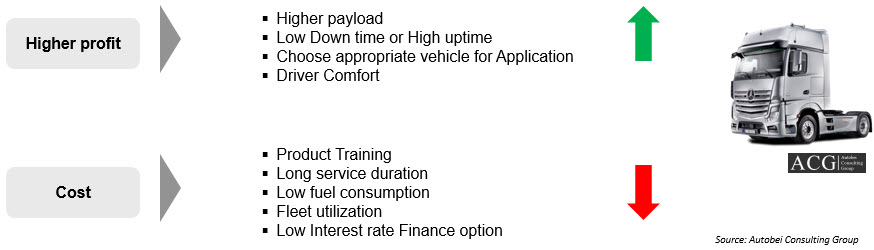
Every Tom, Dick and Harry’s current focus is on cost cutting solutions. Using that as the major criteria, Global TCO has managed to stretch it’s dictatorial webs all over the scenario reaching even the farthest corners and nooks of the world. This was one of the most important buying factors in Traditional approaches. With the advent of technological advancements and innovated logistics, the stakeholders are now shifting their focus on to the GPV (Gross profit of vehicle).

Gross profit of vehicle concept analysis

The latest research carried out at ACG to analyze and inform about new trends aims to change buying opinions as its focus does not lie on cost, but profit. By choosing to do so, ACG offers better solutions to converge on increased profit and revenue. Reducing cost has always been the more tedious job when compared to increasing profit, and it adds to why we need to be concentrating on the latter than the former.

Now let us shift our focus to the working and components of the GPV.

If more transporters started following the profit making strategy, it could be a game changer for the logistics Industry, OEMs and other stake holders of this Industry. In order to increase profit, the first step is to ensure that transporters use minimum full capacity of their Trucks. This will enable them to carry more load compared to current practices. Another practice that will help in increasing revenue is making sure that return freight will also be carrying the full capacity load. This can be done by attaching more trailers or providing provisions of double loading platform. The attachment of trailers depends on rated payload of the truck and density of the material. Additionally, a recent technological innovation contributes to increasing GPV like those in the Long haulage sides that automatically open and close with the simple push of a button – delivering safety and time-saving benefits. Online freight booking also helps transporters maintain their attractive profit and increase revenue too.

Gross profit of vehicle component analysis

The Truck Industry needs to adapt itself to the dynamic, technologically advanced scenario. Connected vehicles help all stake holders of the transporter industry to maximum utilisation of the vehicle. As communications increase, productivity will also improve and ultimately profit will be jumped ahead of the truck industry.  A very new phenomenon in the current scenario is the penetration of ‘technological innovation’ in almost all areas of logistics and Commercial Vehicle Industry.

Coming to our next phase in the transportation sector, this phase loops in even the customer, who can check status of their vehicle even while it is in the production and assembly line. It’s transparent market makes sure to invest all of its stakeholders.

This smart system will also work like a bridge between Demand and supply load transport in addition to helping prevent accidents. On every transport hub there will be server that will be connected to other servers in the regional transport hub. If one vehicle has a total load of weight A, it will unload weights of A/8, A/7 and A/6 to locations L1, L2 and L3. The system will now inform the next nearest server immediately to book the unload space in advance.This will facilitate an increase in GPV and better utilization of vehicle capacity. This system is very helpful for quick and economical transport of the goods also.

People will be ready to invest more if they see that the inside temperature of the vehicle is maintained and consequently, be assured that their goods will be delivered in good condition. Such systems will entrust the customer to believe in transport of the goods. The system also provides after sales support in case of any break downs in remote areas, it will immediately send help to find the vehicle and rescue the same.

It helps connect the Driveline (engine and Transmission), making them intelligent and more powerful. It allows for sensors to cleverly detect the status of parts, and share this with the workshops/ Advance garage to enable them to be better informed in advance. It also connects your vehicle to Trucks’ services centre, all in an effort to help your truck and your operation become smarter, safer and more efficient which give you better GPV.

Additionally, this system increases the GPV indirectly also by detecting drivers’ drinking habits. Studies have shown that Driver’s driving habits can influence mileage between 5 to 10% less or more. It also detects if drivers need training and on what. Are they idling too much, speeding, hard braking, rough driving? This becomes an additional option, till we proceed onto the driverless vehicle future.

Digital technology also supports GPV by providing many key features. Some of the main features include Internet Digital Tachograph, the first of its kind wirelessly, combined with hands-free communication, voice guidance, and text messages displayed from the dispatch office. The system also has a password enabled vehicle theft prevention feature that will not let the vehicle start without the driver having entered a password.

Since the Tipper area of operation is limited, Tipper segment is the best segment to start integrating such technology to see how it profits the fleet owner and utilize all other advantages of this technology. After many successful testing carried out in this segment, it is now ready to be implemented on other vertical segments like Long Haulage and Buses.

Daimler, Volvo and Scania are ahead of other OEMs to integrate and have already started to use such features in their vehicles.

However, the Global CV Industry faces many more challenges like Economic Trends, Technology Trends, Society Drivers, Society regulators, Environmental trends, Suppliers trend etc.

Key Questions this Study will Answer:

– What are the key updates in the connected commercial vehicle market ? OEMs competiveness in this technology?

– Key drivers of connected vehicle Industry and trend? How trend will change market dynamics?

– Market size of Connected Cv market and outlook

– Rules and Rugulation role and its impact analysis

– How After market will adopt and use this technology?

– Customer behavior and challanges for accptance

– Opportunities and Challanges

Q1 Truck Market Report provide Key insight of Indian Truck Market. We also provide monthly Analysis on Indian Automobile Industry with Qualitative analysis along with data.

This is Study Frame of the report:

1. GVW wise: Sales| Production | Export

  • Small Truck
  • Light Duty Truck
  • Medium Duty Truck
  • Heavy Duty Truck

2. Type wise

  • Rigid Haulage
  • Tipper
  • Tractor
  • Others

3. Make Wise Analysis

4. Key Drivers of the Industry and Segment

5. Trend Analysis

6. Competitor Analysis

7. Product Analysis

8. Quarterly Outlook


Q1 FY 2017 or Q2 2016 is a detail report on Indian Commercial vehicle Industry.

Report Highlights:

  • Commercial Market Overview
  • Macro Economy
  • Latest Development
  • Sales|Production|Export
  • OEMs Performance report
  • Segment Analysis
  • Competitor Analysis
  • Product Portfolio
  • Quarter wise analysis
  • New Product Entry Analysis


The report covered following points:

  1. Overview and key points of Q1 FY 2016
  2. Segment Analysis
  • Passenger vehicle
  • Commercial Vehicle
  • Truck
  • Bus
  • Two Wheeler
  • Three Wheeler
  1. Statistics Analysis
  • Sales Analysis
  • Product
  • Export
  • Market Share
  • Growth Analysis
  1. Segment and Sub Segment Analysis
  2. New Products launch and Position
  3. Market Dynamics of Q1
  4. Market Drivers

Customize option is also available.

To Subscribe Yearly Report please click here