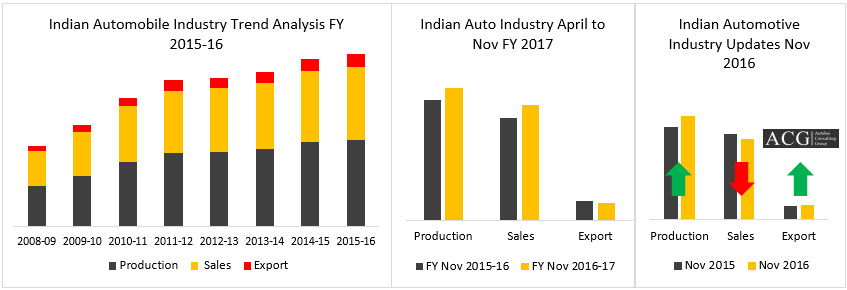
The highlights of Indian Automotive Industry Analysis after Demonetization

  • Economic growth rate forecast that has been revised downwards to 7.1 percent from 7.6 percent due to effect of demonetization
  • Since repo rate unchanged at 6.25, there is no impact on EMI
  • Indian OEMs are trying to adopt new technology and discuss with their suppliers
  • On ground level, Inflation came down in several sectors especially in Real state and Commodity
  • Some key models has been launched in last quarter
  • On Dec 16, manufacturers are planning to reduce the production to fill the gap between demand and supply
  • Suppliers will be also affected and need to change their business plan accordingly

Indian Automotive Industry Market Analysis Report Nov 2016

Detail report is available in PDF version

We are updating our Market forecast for Indian Automotive Industry on Impact of Demonetization on Indian Auto Industry. There will be short,Medium, and long-term impact on Demonetization on New and Used vehicle.

On the 8th of November 2016, Indian Govt disclosed that the 500 and 1000 notes to be demonetised. Automotive shares were also hurt by this move the BSE Auto index closing with a loss of 2.5% on next day of the announcement.The disclosure of PAN while buying vehicles had already been made compulsory except for two-wheelers. The entry level car segment would have an impact on this move but the rural area would face some slowdown in Two-Wheeler segment.

The passenger vehicle price more than 25 to 30 lakh may see a slowdown in this segment. Here we also analyzed the relationship between Customer types like real state or Contractor, Builder, Farmers, Jewellers, Professionals and another segment.

The next few quarters would see some low number sales and production figure. Unorganized Industry vertical like used car segment will feel the heat of demonization. OEM are now started to offer some attractive discount, Zero down payment and tie up with some banks and online payment firms like to get the buying sentiment up. ACG expects that the challenges are only for short time and there be reviving of consumer demand.

Every segment is effected in a different manner. We have covered following Segment

Vehicle type (Sales & Production), Customer (Retail/Strategic), Dealers, Financiers, Used car Market, Suppliers, Transporters, Logistic Companies (Small to large) and others

Area: Rural, Urban, Tier 1, Tier 2 and others

Macro Economy- IIP, Inflation, GDP, and others

1. Indian Passenger Vehicle

  • Car
  • UV
  • SUV
  • Van
  • Taxi
  • Premium Vehicle
  • Luxury Car
  • Entry level
  • Small Car Segment
  • Mid-Segment
  • Others

2. Commercial Vehicle

  • Small Commercial Vehicle
  • Light Commercial Vehicle
  • Medium Commercial Vehicle
  • Heavy Commercial Vehicle

3. Truck | Small, LDT, MDT and HDT segment – Industry & Application wise

  • Haulage
  • Tipper
  • Tractor
  • Puller
  • Special application

4. Bus Segment – GVW & Application wise

  • Intercity
  • Intracity
  • School
  • Staff
  • STU
  • Others

5. Two Wheeler Segment

  • Entry Level vehicle
  • Premium
  • Luxury
  • Economic segment
  • Bike
  • Scooter

6. Three Wheeler Segment

  • Passenger
  • Goods

7. Tractor & Other Agriculture equipment

The market size of Bus in India is around 86,000 Units including premium Bus segment. The CAGR from FY 2008 to FY 2016 is 4%.Around 24,000 new buses have been added in FY 2016 since FY 2008.

This Report is free available for ACG Premium subscribers.

Indian Bus Sales Trend Analysis Report FY 2016Light Duty and Heavy Duty Bus segments are two largest Bus segment in India.

Indian Bus Sales Trend Analysis Segment wiseSmall Bus segment has shown around 11% CAGR from FY 2008 to FY 2016.

Segment wise CAGR Analysis of Bus Segment FY 2016

Indian Bus Product and Market Analysis is most detail report which covers all segment, Brand, Market Dynamics, Trend, After sales, Buying behavior, Production forecast, Export analysis, Sales, Marketing Strategy, Sales Strategy, Dealer Network,  Model wise critical analysis and its mapping with customers etc.

Section 1: Macro Economy

  • Key Economic Indicators
  • Industry overview
  • Economy forecast
  • Market Drivers
  • Challenges

Section 2: Brand wise

  • Sales
  • Production
  • Export

Section 3: Segment wise

  • Small Bus
  • Light Duty Bus
  • Medium Duty Bus
  • Heavy Duty Bus

Section 4: Category wise

  • School/Staff
  • Coaches
  • Luxury
  • Intercity/Intra-city, and Others

Section 5: Pricing Analysis

  • Historical Trend
  • Price wise segment analysis and Brand wise
  • Forecast

Section 6: Competitor Analysis

  • Product Analysis
  • Pricing strategy
  • Brand perception

Section 7: Customers behavior

  • Purchase behavior
  • Psychology
  • Behavior parameter forecast

Section 8: Sales Forecast

  • 3 years forecast
  • New market development
  • Technology up gradation

Indian Truck Market Intelligence Report FY 2016 report is our latest study on Indian Truck Industry. Indian Truck Market size is around 0.59 million units in FY 2016. The market parameters are divided into GVW, Axle Configuration, Horsepower Engine, Application, Fleet size, TCO, Transmission, Price, After Sales, Product Age, and some other factors.

Price, Segment, Application, Sales Volume, Model and Customer Segment Analysis:

Price, Segment and Model Analysis of Indian Truck Market

Small Truck and Heavy Duty Truck segment registered highest CAGR from FY 2008 to FY 2016.

Indian Truck CAGR Analysis

Industry showed 7% CAGR period of FY 2008 to FY in the period of 2016.

Indian Truck Market Analysis Report FY 2016

Our latest Research report on Truck Market Analysis give complete detail of Sales, Production, Export, Price, Discount, Customer behavior, Brand perception, Spare parts price, Competitive Analysis, Product Analysis, Retail Finance, Network Analysis, OEMs strategy, Dealers issue, Volume in terms of Value (US$ & INR), Volume in units, Transporters issue, Market Dynamics, Challenges, Low cost, Budget Truck, Premium Truck categories, Key Drivers, Policies, Regulations, Technology and Transporters issue.

Indian Truck Segment Analysis and Trend

We have covered Small Truck, Light Truck, Medium Duty Truck and Heavy Duty Truck. Haulage, Tipper and Tractor Trailer (Prime Mover)

Tata Motors, Ashok Leyland, BharatBenz, AMW, Eicher, Volvo, Scania, Piaggio, Force Motors, SML Isuzu, Isuzu, MAN, Mercedes OEMs are included in our report.

Autobei Consulting Group introduced fleet management Solution for Truck, Bus, and Taxi

fleet management solution

Please contact to Info@autobei.com for Demo

Table of Content:

Section 1 : Macro Economy

  • Key Economic Indicators & Forecast
  • Executive Summary
  • Key Developments

Section 2: Brand Analysis and Segment wise

  • Sales Analysis
  • Production Analysis
  • Export Analysis

Section 3: Segment Analysis – Sales, Market Share & Key products

               Driveline Analysis – Engine, Axle Configuration, and Transmission

  • Small Truck
  • Light Duty Truck
  • Medium Duty Truck
  • Heavy Duty Truck

Section 4: Category wise

  • Rigid Haulage
  • Tractor
  • Tipper
  • Others

Section 4: Pricing Trend Analysis – Model and Brand wise

  • Rigid Haulage
  • Tractor
  • Tipper
  • Others
  • Tata Motors, Ashok Leyland, BharatBenz, AMW, Eicher, Volvo, Scania, Piaggio, Force Motors, SML Isuzu, Isuzu, MAN, Mercedes

Section 6: Competitor Analysis

  • Product Analysis
  • Pricing strategy
  • Brand Analysis

Section 7: Customers behavior

  • Purchase behavior
  • Psychology
  • Behavior parameter forecast
  • Fleet Utilization

Section 8: Industry Analysis

  • Construction
  • Mining
  • Ports
  • Logistic Industry
  • Others

Section 9: Sales Forecast

  • 3 years forecast
  • New market development
  • Impact of GST, AC Cabin, Demonetization
  • Technology up gradation

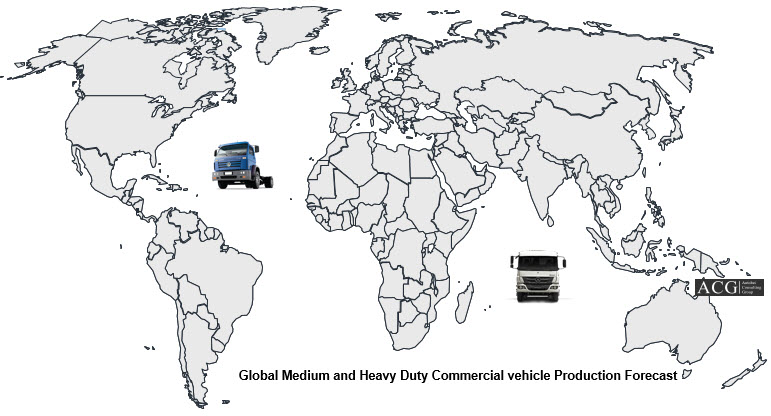
OEMs and Suppliers are working closely to take the Medium and Heavy Duty Truck to next level by providing latest technology. Automated Manual Transmissions (AMTs) and Automatic Transmissions (ATs) is one of the key issues for the Global Automotive Industry. AMT will helpful to increase productivity, efficiency of the vehicle and drivers. Globally it is expected that by 2030, 60% of new trucks will be featured with AMT or AT transmission.

This analysis report presented an outlook of the global medium- and heavy-duty commercial truck transmissions market Intelligence for the period 2016–2030. This report also forecasts the trend, regulation, and other market information.

Study Frame:

Report Summary

  • Key Findings
  • Technology Concept
  • Global Medium and Heavy Duty Truck outlook

Research Methodology, Scope, Background and Objectives

  • Methodology
  • Scope
  • Objective
  • Background
  • OEMs Strategy

Global Medium and Heavy Duty Truck Overview

  • Market Forecast
  • Segment Analysis & Outlook
  • Global Transmission Market Analysis
  • Segment wise Outlook – MD & HD segment

Impact on Industry 

Market & Product Segment

  • Commercial vehicle segment analysis
  • Product Analysis

Technology and Trend Analysis

  • Next Gen Truck Concept and its components
  • Regional Market Dynamics
  • Regional trend of Transmission
  • Fuel Technology and Vehicle Configuration
  • Technology requirement and cost analysis
  • Supplier Strategy
  • OEMs Strategy

Latest Transmission Technology Analysis

  • Transmission Technology overview, Concept, and Type
  • Dual Clutch Transmission
  • Different Technologies
  • Infinitely Variable Transmission (IVT)
  • Other Technology analysis

Market Drivers & Restraints

  • Industry Stake Holders Analysis
  • Automatic Manual Transmission, AutomaticTransmission, and Manual Transmission

– Key Drivers

– Key Restraints

Regional Market Analysis & Outlook

  • Europe
  • North America
  • South America
  • Russia
  • China
  • India
  • Rest of the world

Transmission Suppliers Analysis

  • Allison Transmission
  • ZF Friedrichshafen AG
  • Eaton Corporation
  • OEM Transmission

Conclusion


In the current scenario, the product does not mean the mechanical vehicle only. Customers are expecting complete transport solution by OEMs. Some  recent developments in the country would have a positive impact on CV sales in a long-term scenario. Indian Commercial  Vehicle Industry expected to grow between 14 to 16% CAGR by assuming certain parameters in next 4 to 5 years. Demonetisation would have the positive impact on loan EMI, Fuel price, Availability of loans and inflation.

– Fleet utilization is the key issue for fleet owners which reflect in TCO.

– New Infrastructure and Mining projects need to boost heavy Truck sales

– Safety norms, low level of NVH and banned on overloading will drive new product portfolio for OEMs and Fleet owners.

– The industry is facing Trained driver issue from a long time not in India but in Europeana and other emerging markets.

– Bus Application like School and Intercity become most popular in its category. Features like onboard entertainment system, pushback reclining seats, individual AC louvers, reading lamps, mobile charging points, cup holders, Print literature holding mesh, wide windows, spacious interiors,and Bus Body code are going to be part of executive class Bus in India. BharatBenz is also coming with the full range of buses with some new features and technology. SML Isuzu, Ashok Leyland, Tata, Volvo, and Scania are also working on new product portfolio to get the pulse of Industry.

– New Regulations are impacting in Indian, European and other markets. GST is another tax game changer for Indian CV Industry.

– Fast Urbanization is one of the key drivers for Goods and passenger transportation

– Even small cities are going through changes in their daily life of transportation mode. South and West India’s Tier 1 and Metro cities will be a major region for Bus Industry.

– From Hybrid Technology Buses, OEM started to work on Electric Bus technology.

– STU buying trend is shifting towards low floor and premium bus segment

Zone wise Commercial Vehicle Sales FY 2016:

M&HCV Zone wise Sales:

– Passenger Vehicle- South Zone contributed 39%, West Zone 30%, North Zone 20% and East Zone 11%

– Goods Vehicle- South Zone contributed 22%, West Zone 36%, North Zone 26% and East Zone 16%

LCV Zone wise Sales:

– Passenger Vehicle- South Zone contributed 38%, West Zone 26%, North Zone 26% and East Zone 10%

– Goods Vehicle- South Zone contributed 27%, West Zone 35%, North Zone 23% and East Zone 15%

OEM Strategy:

– Foreign brand needs to customize their product as per local requirement and create effective supply chain of spare parts

– Few OEMs created local corporate and product brand to penetrate mass market in India to compete with local players like BharatBenz

– Full product range and cover all segment would improve OEMs performance

– Improvement in Quality process and overall product quality will extend product age and product life cycle

– With introduction of new norms and technology, OEMs are closely working with supplier to fulfill current and future trend

Unfortunately transporters business have not seen some effective technological changes which could help them to grow their business. We are expecting some improvement in supply chain and distribution channel by an introduction of new Technology platform developed for Indian Commercial vehicle Industry by Autobei  Consulting Group.

Contact us for Customised Study of Indian Commercial vehicle Market Report

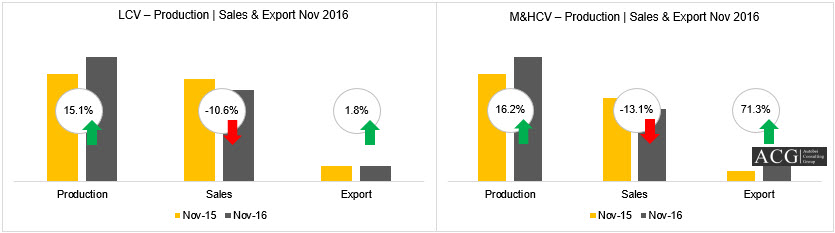
Indian Commercial Vehicle Report October 2016 is detail report of Indian CV Industry. CV market showed the positive momentum in Oct 2016. Ashok Leyland, Tata Motors and Eicher increased their sales in Oct 2016.

Indian Commercial Vehicle Report Oct 2016

Indian CV Production, Sales and Export Analysis Oct 2016:

Commercial Vehicle Sales Production and export October 2016

  • Positive impact on Eicher, Ashok Leyland, and Tata Motors performance due to demand increased, New Model launch and actual purchase started by Transporters.
  • Some sluggish demand for freight movements also impact on CV Industry
  • Exact GST format on CVs of tax structure and its implementation time frame is still undisclosed
  • ACG expect CV sales to pick-up in Q3 FY 2017 and outlook for the M&HCV (Truck) segment at 6-8% for FY 2017
  • Due to fluctuation in fuel price, there is some minor impact on TCO of CV vehicle

To buy Report please contact to Nidhi.Singh@autobei.com

Indian Automotive Business Review Subscription is our special services for Automotive Industry Stake holders. We provide complete Automobile Market Intelligence Services on Monthly, Quarterly, Half Yearly, Yearly, and Outlook. There is two option of subscription, one is Standard format and scope of study and second is customized report as per requirement.

– Qualitative and Quantitative Analysis

– Industry Updates

– Market Sentiments

– New Product Launch

– Competitive Analysis: Segment wise

– Advertising and Branding updates

– Trend Analysis

– Passenger vehicle

– Commercial vehicle

– Truck Segment

– Bus segment

Advantages:

– Precise and timely information

– Proper Explanation of each key information

– Cost effective solution

– Complete Market and Product insight

Contact us for more detail at Nidhi.Singh@autobei.com


Geographically Vietnam is situated in the South East Asia with the total area of 329,314 sqm. km. It is touched by China on the north, by the Gulf on the south. Its maximum Surface is covered by rich agriculture land and chain of mountains. The climate is uneven due to the difference in latitude and the average temperature lies between 26 to 33 degrees. Hanoi is the capital of the Vietnam.

With the introduction of Doi Moi reforms, Vietnam has become one of the fastest growing economies in the world. In 2015, the economy grew by 6.68 percent, better performance the government’s 6.2 percent estimates and per capita GDP is 6,000 US$.The GDP growth forecast is expected to between 6 to 6.25 in 2016 and 6.2 to 6.5% in 2017.  In the first half of the year 2016 Manufacturing, construction, and services expanded robustly in the country.

Vietnamese culture is heterogeneous from North to South. Differences in historical background and financial condition from the North to the South of Vietnam led to some cultural and political differences. The culture of Vietnam is very close to Chinese culture because of its long association with China.

Vietnam is committed to global economic integration through the participations in APEC, the ASEAN Free Trade area and being 150th member of WTO. Bureaucracy, corruption, and red-tape characterize every aspect of social and business life.

Political power lies with a single communist party CPV (Communist Party of Vietnam) which is headed by the party general secretary. It is the most important force in every part of the society followed by government institutions and then private sector and the media.

Having successfully kept the big powers (China, France, and the US) away from controlling the country; patriotism is a strong component of country’s psyche. Till today 5 million people are affected by the after-effects of the Vietnam War.

Vietnamese culture is multi-layered and heterogeneous throughout the country. In general, the Vietnamese culture can be described as a high power distance, high collectivism, moderate high certainty avoidance and high context. Vietnam is a Buddhist or Confucian country. Religion plays a vital role in the country’s social life

The organizational culture of Vietnam Electricity (SOE) is the monopolistic corporation which reflects the national culture to a large extent at different levels.

The study reveals that Vietnam faces several social and economic challenges. Transforming rural economy, human capacity, human rights, improving environmental quality and civil society participation in decision-making processes are some of the main areas which need attention.

Report Highlights:

  • Country Overview and Analysis
  • Economy Analysis and Economy Outlook
  • Key facts
  • Political Analysis including PESTLE analysis
  • Legal Analysis
  • Technology Analysis
  • Financial Analysis
  • Analysis of Vietnam National Culture: Hofstede, Trompenaars, Communication style and Religion
  • Critical Assessment of Vietnam
  • Vietnam Industry Analysis: Auto, manufacturing, IT, Agriculture, Defence, Mining, Insurance, Transportation, Consumer, Electronics, Power, Labour, Construction, Food 7 Drinks, Health, Crime, Trade and other sectors
  • Case study

Global Hybrid and Electric Commercial Vehicle Analysis is exclusive in-depth analysis and forecast 2025. Alternative energy vehicle technology is quite well known in passenger car industry. But  truck and bus manufacturers started working on hybrid too and there are the first models in the market.

Hybrid electric vehicles (HEVs) decrease fuel consumption as well as emissions significantly compared to conventional and CNG vehicles used today. The benefits result mainly from recuperation, reducing losses during idling, operating point optimization and start-stop. With pure electric driving, which is possible with HEVs and battery electric vehicles, noise emissions can be reduced significantly.

Europe, Japan, and North America are the key markets for hybrid trucks. While East Asian manufacturers are more focused on light and medium duty hybrid trucks, European and North American producers strengthen their presence in the heavy duty segment.

Minimum payload reduction, reasonable costs and significant reductions in fuel consumption are the top requirements from a customer’s point of view.

The big European and Japanese manufacturers are highly active in the field of hybridization. In the United States and China, the OEM are setting at the moment a new focus on gas fuelled trucks with CNG and LNG.

Hybrid & Electric Bus market

Hybrid city buses are seen as mature technology, as they operate successfully all over the world. Fuel savings depend on the conditions (topography, start-stop cycle, heating in winter, cooling in summer etc.). Hybrid and electric buses are manufactured for the city use. All competitors claim fuel savings between 20 – 40% (depending on operating profile) through hybridization.

Due to falling battery prices, quiet and local emission-free operation electric buses are getting more attention.

Induction, plug -in, charging from the top via pantograph and battery swap are possible charging solutions.

Costs, capacity, and weight of batteries are the main challenges for electric buses. With mass production, batteries have big potential to become cheaper.

Leading e-mobility bus markets are China and North America. Europe hybrid bus market is behind  but growing. Emerging countries are also beginning to manufacture hybrid and electric buses (e.g. Brazil, India, and Russia).

Report Highlights:

– Key Insight

– Regulation and Policies

– Key Markets and Market leader

– Electric Vehicle Market Size and Trend

– Hybrid Vehicle Market size and Trend

– Technology cost analysis

– Product Strategy, Product Position, Applications, and Technology

– Growth Analysis

– OEMs Strategy

– Forecast 2035

– Challenges and Opportunities

Brazilian Automotive Industry is facing critical time since 2014. The political situation, Strict Regulation of safety measure like Air Bags which increased the cost of production, and Macroeconomy are also affecting the Automotive Production. After acquiring VW Latin America by MAN SE, there are some new dimensions created in the market and new product position in Commercial vehicle Segment. Country’s export figure of a vehicle is not as per expectation.

Brazilian Auto Industry Will take some time to fully recover. In H1 2016, the vehicle Sales showed 25 percent degrowth. Production figure also registered 21.2percent degrowth in Q2 2016.Commercial vehicle sales showed 27 percent degrowth in Half year of 2016. Car Segment is also on the negative site, it showed 25 percent degrowth. The Country GDP is facing degrowth since 2011.

Honda, Fiat, Ford and Chevrolet added some new product in their portfolio but still the market is waiting for some positive sentiments.

Report Highlights:

– Brazil Automotive Market Overview

– Macro Economy Analysis

– Latest Updates

– Key Automotive Notes of the country

– Key Challenges of the market and for OEMs

– Product Analysis and Product portfolio

– Sales| Production and Export

– Market Drivers

– Industry Segment Analysis

– Customer Segment Analysis

– Car | Truck | Bus| and Commercial Vehicle Industry critical Analysis

Indian Commercial Vehicle Industry Business Review H1 FY 2017 providing in-depth analysis of Indian CV Industry.  During First half year of FY 2017,  Commercial Vehicles segment registered a growth of 6%  as compared to the same period last year. The M&HCVs segment showed a de-growth at 1.19% and LCVs segment grew by 11.70%  during April-September 2016 over the same period last year. The GST is going to a paly key role of buying practices of fleet owners. We have covered key insight of Industry In our latest reports of Commercial Vehicle Industry Analysis.

Report Highlight:

– H1FY 2017 Commercial Vehicle market Overview

– Small Commercial vehicle | Light Commercial vehicle |MediumCommercial vehicle | Heavy Duty Commercial vehicle

– Goods and Passenger vehicle including Taxi

– Latest Development and Interpretation

– OEMs product. sales and Market Strategy Strategy

– Application Analysis | uses Type Analysis

– Segment wise Market Drivers and Market size

– Market Size by Sales volume and Value in US$, INR

– New Model launches

– Product Analysis – technical and Commercial

– After sales Analysis

– Promotional Strategy Analysis

– Product Position

– Customer buying habits

– Sales ,Production and Export Analysis

– Industry Trend and Outlook