Overview of Indian Automotive Market in February 2019 and Cumulative

The sale of automobiles is facing a bit slow down in Feb 2019 which is temporary in nature and is due to an election which is about to take place in the next month. Apart from the phase of pre-election, there are several other factors such as tight liquidity condition which plays a major role in impacting the behavior of the consumers.

The market of automobiles is continuing to exhibit the subdued demand sentiments because of the fact of high-interest rates, slowing economic activity, the lagging effect of implementation of new norms for axle load, decreasing index of IIP growth and the slowing industrial output. In addition to this, the base effect is also a major factor that plays an important role in the very slow growth of the CV industry with respect to H2 of the financial year 2018.

After the implementation of the new norms for axle load, the freight carrying capacity of MHCV parc has gone up by twenty percent, but on the other hand, the freight growth has not been able to take this enhanced capacity. This, in turn, has resulted in decreasing demand for the new trucks. Now, talking about the segment of tipper has kept on showing a very good growth of about 22 percent on the back of road construction, irrigation as well as affordable housing projects.

This is one of the segments which has not been affected very much by the changing of the axle load norms. The introduction of the new products in the very quick growing segment of 15 T – 16 T is seen to have been accepted by the customers very well. The demand in a segment of M & LCV has been readily propelled by the e-commerce sector as well as increased rural consumption both of which is very well supported by the introduction of the new products.

Coming to SCV Cargo and the segment of the pickup was back in form in the previous month that is February 2019. With the evolution of the hub-spoke model, the increasing want for the last mile connectivity across the rural as well as the urban markets, along with the initiatives of Swachh Bharat have led to the rise in demand in this segment.

The launch of New Product & Market updates

Honda Cars India has finally launched the All New 10th Generation Honda Civic in the Indian market which is its iconic and much-awaited model This new launch Honda Civic promises to deliver the users with an all driving experience. The car with its fantastic sporty design, great driving performance, an advanced set of key technologies as well as innovations along with premium quality and an upscale interior is all set to give the users complete satisfaction. The model Civic from Honda is the longest – running automotive nameplate and its largest selling model throughout the world.

The model Harrier which is an SUV from Tata Motors has received a very good response in the Indian market. Tata Motors is expecting to increase its production volumes in the months to come. Tata Motors grabbed the order of a total of 1045 buses from Gujarat State Roadways Transport Corporation which included 695 fully-built Midi-buses and 350 12m chassis. Another order which was more than about a thousand Winger Ambulances that are AIS 125 standard complaint from the governments of Uttar Pradesh, Gujarat, Himachal Pradesh, and Haryana. In addition to this, about 812 was received in the last quarter from the government of Uttar Pradesh and 400 CNG BRTS buses from Pune Mahanagar Parivahan Mahamandal Ltd. (PMPML).
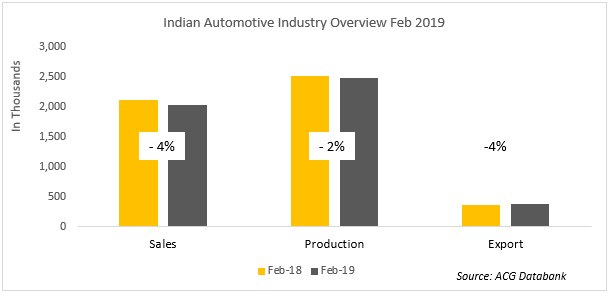
Indian Automotive Feb 2019 Analysis report

Passenger Car, SUV, MUV, and Van Industry Overview

In the month of February 2019, the Indian automotive market showed very low degrowth of about four percent in sales and about two percent declination in production. On the other hand, the export showed a growth of about four percent. However cumulative, the Indian automotive production market showed nine percent growth, sales showed a rise of seven percent and the export registered a total growth of 16. In the last month, a total of 1,71,372 cars were sold which was four percent decline whereas the segment of SUV/MUV registered a growth of four percent where there was a sale of 83,245 units. Cumulative, the segment of car sales showed growth of three when compared to the same time period in the previous year. The segment of SUV and MUV rose by two percent and the segment of van rose by thirteen percent when compared with the same time period in the previous year.

The segment mini Car showed a sharp declination of 33 percent in February 2019 as compared to February 2018. However, the share of the two major OEMs that is Maruti & Renault rose from 76 percent to 83 percent and from 14 percent to 17 percent respectively in this sub-segment.

The segment of the compact car increased by 2 percent, where the vital players are Maruti, Hyundai, and Tata Motors. The market share of Hyundai in this segment is stagnant but the share of Marui share increased by 2 percent and the share of Tata Motors decreased by 2 percent whereas in this segment the share of Honda just simply doubled in February 2019. The segment of super compact fell thirteen percent as compared to the same month of the previous year. The mid-size segment is another of the major one which in February 2019 showed a declination of 21 percent when compared with February 2018. But the shares of Honda, Hyundai, and Skoda rose by two, one and three percent respectively in the month of February. But the struggling player Volkswagen showed a massive growth of more than doubling its market share in the last month.

The segment of affordable SUV that is Maruti, Mahindra and Hyundai ended with an increased market share in the last month. Tata Motors gained two percent market share and this segment showed growth of one percent in the previous month as compared to February 2018 which is the key highlight. A growth of 25 percent was shown by the budget segment but on the other hand, the premium segment of SUV/MUV showed negative growth. Jeep which is one of the most successful models also started losing its grip incurring a loss of ten percent market share. The market share of Fortuner is almost the same without any movement.

Commercial Vehicle Industry Feb 2019

The market of Indian commercial vehicle also remained the same in the month of February 2019. The segment mini truck showed a growth of 18 percent as compared to February 2018. In this segment, Maruti Suzuki Supercarrier attracted a lot of customers from its competitors. Market share lost by Tata Motors & Mahindra was three and one percent respectively Suzuki gained four percent market share. Overall, the segment showed growth by 18 percent in February 2019 as compared to February 2018.

The segment of pickup truck rose by one percent in February 2019 as compared to February 2018. In this segment, Mahindra and Tata Motors both lost one percent market share.

The light duty truck also fell by one percent. In the segment of 3.5T to 6T, Eicher lost two percent and in the category of 6 to 7.5T Eicher lost seven percent market share in February 2019. In the same sub-segment, the gain of market share was two percent by Ashok Leyland.

The segment of the medium-duty truck rose by seven percent in February 2019. Eicher showed a loss in its grip in the segment of MDT. In the same segment, the other majors such as Ashok Leyland, Tata Motors showed a better performance.

The segment of the heavy-duty truck fell by fourteen percent in February 2019 as compared to February 2018. In HDT, the rigid truck segment showed a negative growth of three percent in February 2019. The segment of 31T and above 31T GVW recorded the highest negative growth of 21 percent in this subcategory but in another segment showed good growth.

The performance of Ashok Leyland is quite a good one which has increased its market share in each of the sub-segments. On the other hand, Tata Motors which is its closest competitor lost market share in each of the sub-segment of Rigid HD segment.

Negative growth of 35 percent was noticed in the tractor-trailer segment in February 2019.

The segment of the bus is the same and no changes are noticed in terms of the volume of buses. In the segment of 5T, Tata Motors ranked first which registered an increase in market share of 20 percent from 16percent to 36 percent. 17 percent market share was lost by Force Motors which came down to 52 percent from 69 percent.

Another of the sub-segment of 5T and seating capacity of more than 13 saw negative growth of 15 percent but Force Motors is a gainer in this segment.

The segment of the medium-duty bus of 5 to 7.5T registered a growth of seven percent whereas Eicher, Tata Motors and Force Motor lost market share of 2 percent, 3 percent & 1 percent respectively. The segment of the medium-duty bus of 7.5T to 12T showed a negative growth of three percent. At the same time, Tata Motors and SML Isuzu lost market share in February 2019 as compared to February 2018. The segment of heavy-duty bus showed a growth of 8 percent where Ashok Leyland gained 12% market share from 55 to 67% and Tata Motors lost 11% market share.
Indian Automotive Annual Subscription Package

Indian Two Wheeler Industry Feb 2019

The industry of Indian Two-Wheeler showed a negative growth of five percent in the month of February 2019. The segment of scooter increased by one percent but the segment of the motorcycle segment came down by 12%. In the category of 75 to 125cc, the market share lost by Honda was four percent and Suzuki gained a market share of five percent February 2019. The market share of TVS remained constant at 15 percent. In the category of 75 to 110cc, the segment of motorcycle rose up grew by eight percent in February 2019 as compared to the same month of the last year.

In the category of 110 to 125cc, the negative growth was of 17percent. In this category, the market share lost by Hero MotoCorp was six percent whereas the market share of Honda increased by 12 percent in February 2019.

In the category of 125 to 150cc, there was a growth twelve percent in which Bajaj increased market share from 42% to 59% but the loss of market of Honda was 16 percent. In the category of 150 to 200cc, there was a negative growth of 13 percent in February 2019 as compared to February 2018. Here the gain in market share by TVS was 9 percent but Suzuki and Honda lost market share by 8 percent and 5 percent respectively.

In the higher segment of 200 to 250cc, there was degrowth of 61 percent where Yamaha gained 3 percent market share and Bajaj lost 5 percent market share. In the category of 250 to 350cc, there was again a negative growth of 15 percent where Royal Enfield was the supreme dominator the segment with 99% market share. In the category of 300 to 500cc, the degrowth was 67 percent where Royal Enfield showed an improvement in its performance by gaining 11% market share. In the category of 500 to 800cc, there was a growth of 415 percent in February 2019.

In the three-wheeler segment, a negative growth of four percent was registered. The segment of passenger three-wheeler showed degrowth of four percent and the goods three-wheeler segment showed growth of six percent.

Please contact us to get Monthly Automotive Detail Analysis
Autobei Consulting Group has done various strategic projects on Indian Truck Transport sector or Truck Fleet owners/ Drivers since 2011. ACG always check the pulse of the Indian Truck Industry through various stakeholders of the Industry like Driver survey, Fleet owner survey, Truck ownership pattern, Future trend and other keys issues.

  • Fleet Owner Operation practice
  • Revenue Model
  • Purchase pattern of Vehicle, Spare parts, and other services & products
  • Driver detail database
  • Planning to buy a new vehicle
  • Repairing vehicle – Workshop
  • Vehicle leasing and rental concept
  • Transporters expectation
  • Transporters Challenges
  • Adaptation of Digital solution
  • Mapping Truck Best Application
  • Used Truck Sales
  • Load and unloading issues

Another part of the database:

  • OEM and Model name
  • Year of Manufacturing
  • Year of registration
  • GVW
  • Payload
  • Truck Type – Tipper, ODC, Tractor, Special Application etc
  • Axle configuration
  • Engine Make
  • Engine Power
  • VIN
  • Steering Type
  • Country of manufacturing
  • Chassis detail
  • Body Type
  • Owner name
  • Truck Application
  • Address and Contact number

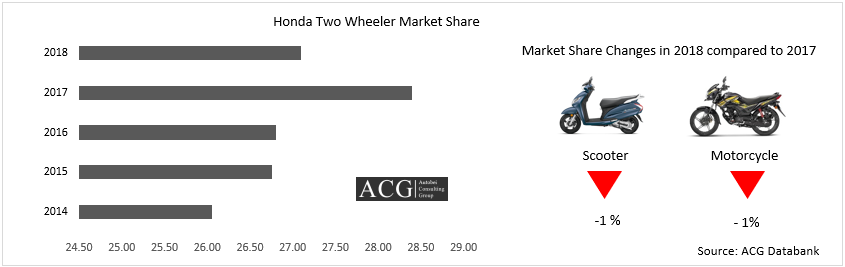
Honda takes pride in being the second largest two-wheelers’ manufacturers in our country. The company has an extremely good brand image in the Indian two-wheelers’ market and hold of Honda in the country is quite strong. This is evident from the fact of the huge preference of Honda products by the Indians. Activa which is the First model Honda has gained a lot of popularity in the Indian two-wheelers’ market. Something that is even better for the company is that Activa has become the household name in almost all the Indian cities as well as the villages. In the scooter segment, Activa is basically the largest selling model. Activa is very well known for its simplicity in design, trouble-free performance, great mileage and lastly a service friendly vehicle. These are the ultimate reasons as to why it is ruling the Indian market. “Unicorn” is Honda’s first motorcycle in the country after its break up with “Hero”. This is the first commuter bike with “Mono Suspension” in India was very well received by the consumers in India. Most importantly, “Unicorn” was the best-preferred bike in the 150cc category in the Indian market.

Honda Two Wheeler Market Share 2018

It is true that Honda is known for a few “First”, wherein the introduction of several new features in the models which are as follows:

  • Mechanism of bonnet lifting in the Activa models making the serviceability much easier
  • Unique braking system referred to as “Combi Brake” where both brakes are initiated at the same time once the rear brake is applied. This eliminates the risk of skidding and certainly makes the brake more efficient in nature.
  • The introduction of “Tuff up” tube in the OE scooter models helps in the sustaining of the adverse road conditions. It helps in keeping the tire inflated in case of a puncture.

Honda in its later stage has lost the strong grip on the motorcycle market of India and the only model that still lies within the top ten selling motorcycles in the country is “CB Shine”. This model which ranked fourth in the largest selling bike in the Jan 2017 came down to the eighth position in the Dec 2018. This drop in the ranking was due to the volume of sales by about 17,543 units. However, CB shine sold more than 7 million vehicles by end of 2018. Honda has still not been able to re-grip its motorcycle business despite launching a number of other different models because of the fierce competition from Bajaj, Yamaha, and Royal Enfield. The new models Hornet and X-Blade was not able to fulfill all the expectations of the customers did not live up to the expectations of the customers. But on the other hand, other similar models with the same capacity by the other manufacturers such as Bajaj and Yamaha were able to increase their share in the market in this category. The customers had a clear idea in their mind that the Honda products are fuel efficient in nature and the ones who are in search of power, their choice would certainly be Bajaj or Yamaha. However, the ones who are looking forward to a Cruiser bike will be inclined to go for Royal Enfield.

The dealers of Honda are very well equipped in terms of infrastructure as well as manpower. Almost all the dealers are permitted to open their own outlet within the allotted territory for the purpose of extending the reach and each of the branches is running as a separate profit center. Adequately trained and vastly experienced manpower is available throughout the branches along with a centralized customer support team who are in the main office taking full control of all the grievances of the customers. This makes it quite clear that the Customer Satisfaction Index or the CSI process is implemented at its best and working in its full swing. Most importantly, the overall process under constant monitoring from the head office. Despite this, there still exists some unsatisfied customers of Honda. One of the main reasons behind this might be due to the fact of huge volumes where the reach is still not a hundred percent.

The relation between the company and dealership is completely in the business terms where everything is simply cash and carry. Honda expects all its dealers to completely adhere to the policies and guidelines of the company. However, in case of any kinds of deviation will result in the termination of the dealership. Now, due to a very high volume of sales, the dealers are at the receiving end thereby making themselves self-aligned with the policy which in turn gives highly successful results.

Dumping of the vehicles is a very common practice which is followed by almost all the manufacturers in this field and it simply cannot be avoided where mixing up the models are existing largely. After the initial craze for the models like CLIQUE and NAVI, it drastically came down. At present, there are a very few buyers and the inventory are slowly getting liquidated with the help of the dealers. Honda might be taking a call on the further manufacturing of these models. One more similar example is the CBR 150 model of Honda. This is one of the premium models of Honda which find a lot of difficulties in getting the desired numbers. Though the product is a great one and all of the customers give good feedback about the product, the numbers seen on the road is quite less. The dealers of Honda are of the viewpoint that this segment is not running behind the volumes. With the “CBR 300” being launched, we need to wait for seeing the segment into which Honda is looking.

Now, if we have a look at the spare parts from Honda, they set a very good example by keeping its prices on the lower side as compared to the price of the local market. This is to make sure that the customers necessarily visit their nearby service center for the requirement of spare parts or for servicing their vehicles after the free service is over. Due to volume limitations, a number of customers still visit the local garages but make sure that the spare parts are genuinely from Honda itself.

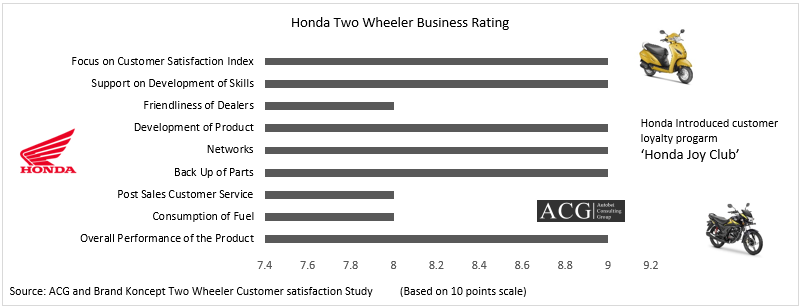
ACG has done customer and Dealer study with leading firm Brand Koncept to know the rating of Honda Two Wheeler business

Honda Two Wheeler Business Rating

Every year there is a tremendous development in the bus sector with modernization and with the innovation of new techniques and features. The innovation of highly developed bus vehicles led to its introduction into different sectors.

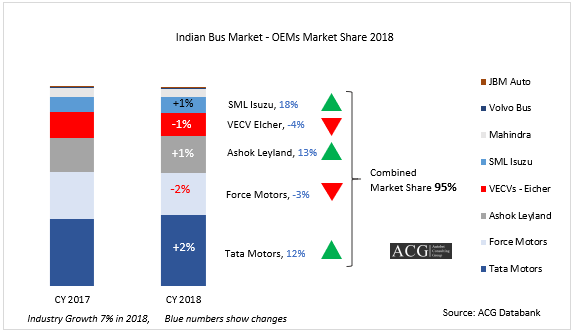
In the year 2018, the bus industry witnessed a record growth rate of 7 percent when compared to the growth rate in the year 2017. Tata Motors increased 2 percent market share whereas Ashok Leyland market share increased by 1 percent, Luxury Bus manufacturers like Volvo have had a stagnant market share rate of 0.4 percent with a minor increase in volume.

Indian Bus market Analysis and OEM wise market share 2018

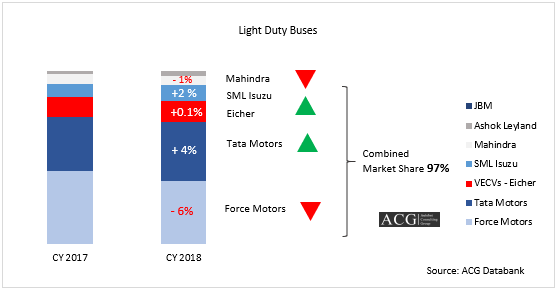
A market leader like the Force Motors was on the decline losing 6 percent of the market share in the Light Duty bus segment. The performance of Tata Motors improved in almost every segment. Its market share increased to 4 percent whereas in the case of Ashok Leyland the leading market holders of the bus Industry improved their market brand value and gained a 1 percent market share. The bus segment grew by 13 percent in the year 2018.

Light Duty bus Market Analysis and OEM wise market share 2018

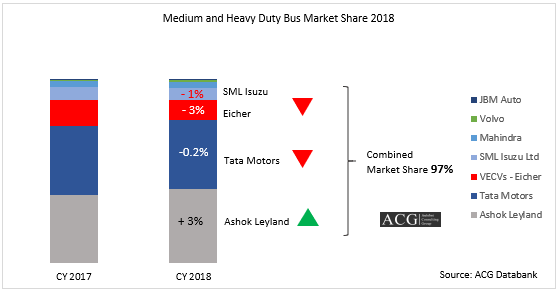
The Medium and Heavy-Duty Bus segment is stagnant due to the decreased demand for Medium and Heavy-Duty Busses. In the Medium and Heavy-Duty Bus sector, Ashok Leyland gained 3 percent market share whereas Tata Motors market share remained stagnant, VECV and SML Isuzu also had a decline in the market share rate in the year 2018.

Indian Medium and Heavy Duty Bus market Analysis 2018

The introduction of new norms marked the enforcement of the bus body code (AIS 052), and the school bus code (AIS 063). The initiation of bus codes provided a base for good growth in the bus sector, the industry also witnessed the initiation of the sleeper bus code (AIS 119), which is claimed to be a world first. The Progress in the sector was also achieved in tarmac and double-decker bus code draft. The initiatives from government run State Transport Undertakings (STUs) and City Bus Undertakings (CBUs) as well as private bus fleet operators to provide high rate orders improved the growth rate of the segment. Factors like the bus code, demonetization and GST impacted STU orders in the year 2018. After Bus code relaxation and GST is stabilizing the market is expected to improve hence the demand is expected to rise again.

The bus industry is one of the most important and highly developed segments of the Indian automobile industry. It is the most commonly used and widespread public transport in India as well as in other countries. The industry comprises of buses that are categorized into school buses, mini buses, tourist buses, deluxe buses, commuter buses and others depending on the purpose of the use of the vehicle. Owing to the development in the infrastructure and roads, connecting to remote places has become easier due to which more and more people are availing bus services in a day to day basis. This has greatly contributed to the growth of the bus industry. The growth in this market has stimulated the manufacturers towards more innovations and development in the technology used in the bus. New buses have been introduced that are well equipped with advanced facilities and services such as passenger information system, air-conditioners, high-quality engines, air suspension, and transmission systems and much other safety as well entertainment features. With the increase in the use of such buses over the next few years, the customer base is also expected to ascend at a high rate.

With respect to increase in the commuter base, even foreign companies such as Daimler, Mercedes, and Volvo are making heavy investments in this segment of the automobile industry in India. New standards of luxury and comfort have been set by these companies in the tourist bus segment by providing high class and advanced air-conditioned buses.

There is an invention in every segment on a day to day basis; the bus sector is also expected to grow at an alarming rate with the increased rate of consumers. As the rate of growth increases the company will have to develop new methods and plans to keep the consumers at their bay. This, in turn, will also improve the economic and financial status of the country. We can always hope for success in the segment in the coming years.

Report Highlights:

  • Bus Market Overview Trend and Forecast 2024 – Volume and Value
  • CAGR Analysis
  • Bus Seating wise Volume
  • OEM Application wise Market share
  • Qualitative Analysis of the Industry
  • Key Drivers of the Industry
  • SWOT Analysis
  • Application wise Competitor Analysis
  • Top Selling Models and their Specs
  • Price and Discount analysis
  • Margin Analysis
  • Product Support and Customer expectation
  • Product Analysis – Portfolio, Mapping with Customers and Application, the Life cycle of the vehicle, Product Position, Model wise Best and Worst features
  • Brand Analysis and Perception
  • Route Analysis
  • Premium Bus segment Analysis
  • How OEMs planning to introduce or upgrade the vehicle
  • Electric Bus Market Forecast
  • Bus TCO analysis

Please send your requirement for a customized study to info@autobei.com

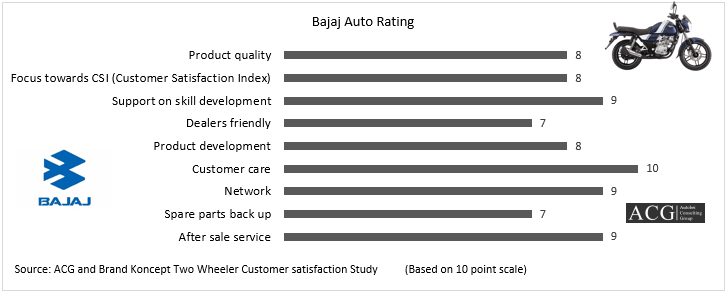
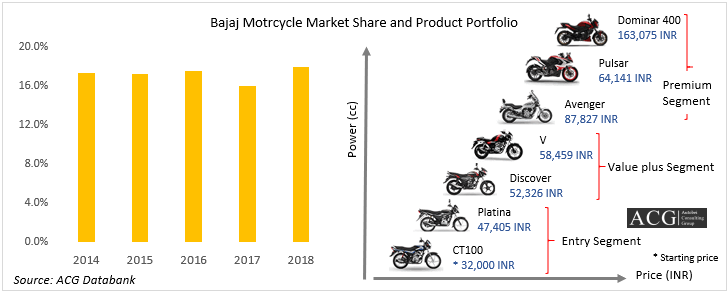
Bajaj Auto is one of the oldest automobile manufacturers of India which is more popularly known as “Hamara Bajaj”. Bajaj Auto has been ruling the scooter market of India for some decades with its household product “Bajaj Chetak”. The brand was particularly known for its trust, value as well as reliability. Basically ‘Hamara Bajaj’ summed up what Bajaj meant at that point of time.But, in the year 2001, the launch of Pulsar created a new category of common sports bikes which brought up the opportunity to deal with motorcycles. Now, the focus of the company is on motorcycle business and its well-known products that are CT, and Pulsar lies within the top 10 motorcycles which are being sold in India. The company worked in several areas for the transformation of brand perception from a scooter company to a motorcycle company and built some of the very powerful brands like Pulsar, Avenger, Dominar, V and Platina, each of them occupying its own space in the market.

Bajaj Auto Rating

The company is presently targeting to create a strong presence in the market of electric scooters or motorcycles which would certainly be an attractive space to be in. Bajaj automobile is now looking forward to entering the segment of an electric vehicle with new motorcycles and scooters in India. All these electric vehicle offerings by Bajaj Auto are expected to be launched in India by the year 2020.

The company is aiming at about 20 to 25 percent market share as it has shown an improvement from the 15 to 18 percent market share in the year 2018. Bajaj is aiming for increasing its market share in the next 12 months to come. The 10 percent gain in the market share in the next two years would be something outstanding for Bajaj Auto.

Bajaj Motorcycle Market Share and Product Portfolio

Over the last few years of time, the brand has shown tremendous growth and most importantly the growth is not limited to the Indian boundaries. At present, Bajaj is available in about 70 countries all over the world. But the markets keep on fluctuating thereby continuing to be uncertain at all the times. In spite of this, the company by the end of the year would have exceeded in exporting more than about 2 million units in a calendar year across to 70 countries over the world as per the export plan of the company. The exports which are talked about here would basically represent about 40 percent of the overall sales of the company.

The relationship of Bajaj Auto and the dealers have been quite encouraging. The business relationship manager Mr. Rahul Bajaj played a vital role to make this bonding strong during his days made the bonding very strong. Almost all the dealers are having more than 30 years of business relationship and are continuing even after the post is taken over by Mr. Rajeev Bajaj has. The present volume of the dealership is 4,450 and it is continuously growing. This is because of the frequent launch of new models, simply over the KTM products which are adding numbers to the dealerships. The upgradation of technology is a continuous process and here Bajaj is having an advantage of KTM technology which they can very easily adopt in its range of products. This makes the Bajaj products technologically quite strong which makes the competition stronger for its competitors.

It is clearly observed that in some of the instances that Bajaj Auto was not supplying the required models to the dealers when the orders were placed. In an addition to this, the models which are readily available in the inventory are getting dumped. The company began focusing on CSI (Customer Satisfaction Index) which is presently at the infant stage of implementation at the dealership. There is no dedicated team for CSI available in most of the dealership. The existing team of the dealership is sharing the responsibilities. As a result of this, the overall process is getting neglected. Also, the company has begun to tighten the dealerships regarding the small amount which the dealerships make by selling performance enhancement additives.

Most of the dealerships are bound to the fixed labor charges of the company and as a result of this, the small amount charged by the dealerships might not affect CSI significantly. Now, if the question arises as to why the dealerships run after these small amounts if the company is taking care of the income of the workshop. Yes, it is true that the labor charges of Bajaj are too low for the purpose of making their customers happy but the first customer of the company that is the dealers who are feeling the pinch.

This new positioning will necessarily be reflecting in the retail showrooms as well. Bajaj has a network of around 4,500 dealers and sub-dealers who sell the brands exclusively. Both the exterior signage and the interior look, as well as the feel of the showrooms, are being upgraded. Bajaj aims at completing this rapid and frontloaded transformation of the entire brand within this quarter.

Why Pulsar 150 is leading Motorcycle

Bajaj Pulsar 150 is among the most popular range of Bikes from the Two-wheeler manufacturer which is still going strong in terms of sales and Pulsar 150 is one of the models in the series which is the prominent choice in the 150cc segment. The main factors which attribute to the success of Pulsar 150 are its ample power, sporty design, impressive fuel economy, and lucrative pricing. The engine wheeler was designed by the Product Engineering division of Bajaj Auto in association with Tokyo R&D and later with motorcycle designer Glynn Kerr. The engine and the Vehicle got a perfect match and you can feel the excellent biking experience. By increasing the cubic capacity of the engine in order to give more powerful engine (180 and 220cc) keeping the geometry of the motorcycle same may not able to bet the required match what we get in 150cc could be one of the reasons why this
particular model (Pulsar 150) is popular among the most of the buyers apart from the four parameters mentioned above.

Products & Brand image

The products of Bajaj have state-of-the-art styling, technology as well as performance. Bajaj’s product is being sold throughout the world with a strong dominance. But they have not spoken about this position of dominance. This was a big reason as to why Bajaj chose to move the brand from being a heritage to a brand that involves modern technology and design. The entire product range and the fact that Bajaj has built each product into individual brands has been the strength. Finally, the way Bajaj has built a distribution network, nurtured its partners and serviced customers has made it into the trusted brand that they are today.

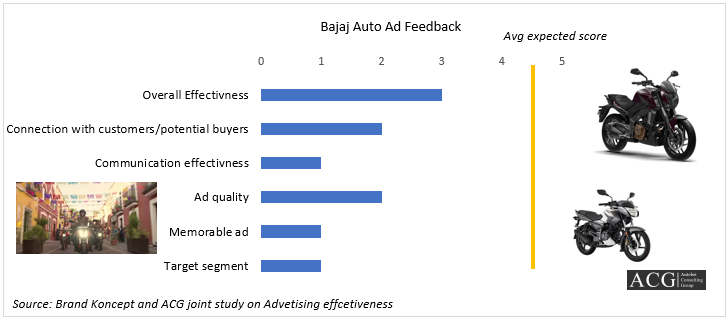
Advertise only unrelevant facts does not make any sense. As per the survey was done by Brand Koncept, the consumer does not influence by saying that Bajaj is selling in 70 countries. Other OEMs also do not follow the same pitch while they run an ad campaign in India. As per Brand Koncept, by creating proper concept ad, the company can drastically improve ROI.

Bajaj Auto Ad feedback by Brand Koncept

The wide range of Bajaj products, be it Economy (CT100, Platina) or Premium range (Pulsar, Dominor) are doing very good in the market. CT100 is the entry-level commuter bike whose price starts from Rs 32,000. This is one of the most preferred choices of the customers who wish to upgrade from moped to motorcycle mainly because of its great mileage. The cost of maintenance as well as the service charges are on the lowers side. Moreover, the availability of spare parts is available at every spare parts shop, make these economy models quite service friendly.

Customer Preference

Twenty years ago, if anyone bought a Bajaj Chetak, he was of the viewpoint that he was buying something that can be relied upon reliable, designed in one’s own country and available at a pocket-friendly price. ‘Hamara Bajaj’ was moving the whole country at that point in time. A huge number of customers are still of the viewpoint that Bajaj M80, the 80cc step through from Bajaj should have been continued with new 4 stroke engine for the purpose of meeting all the norms of emission. The ultimate reason for preference of M80 was due to its ruggedness and a very simple design. When M80 came up, one model from Hero Honda that is “Street” it was not quite comfortable in making a space in the market of the country. Both Street and M80 are quite like look at, but Street came with a 100cc engine and its price is more than M80. Now, if the customers wanted to buy a step through, there were two options in front of them that are M80 and Street, where M80 is slightly ahead of Street. If Bajaj looked at continuing with M80 by a modification of the engine with 4 strokes, then at this point of time, it would certainly have been one of the best sellers in the Indian market. If we look at the reviews of Bajaj M80, it would be clear that all the customers own these bikes for around 15 to 20 years and all are very happy about its performance including several aspects like pick up, mileage and ease of handling.

The strategy of Bajaj is very clear. Ignore scooters and Step through, focus only on motorcycles to become the number one motorcycle manufacturing company in India. Having a look at the trend and the activities of Bajaj till now, it can be ascertained that Bajaj is not very far from the achievement of the goal. This goal gets great support from its powerful marketing campaign. For an efficient and effective marketing campaign, Bajaj uses a powerful communication on TV, digital media, a lot of outdoor accompanied by several engaging stories. The products from Bajaj are certainly very good, their network is vast, manpower is dedicated and with a little more focus on CSI will certainly push Bajaj towards their aim.

Every year there will be growth and decline in any industry. The automobile industry is one such industry where there is a significant development as well as new technology being implemented. Owing to the new initiatives and norms there has been an improvement in the sector and on the other hand there have been few hiccups also. The following section will detail the key factors affecting the industry.

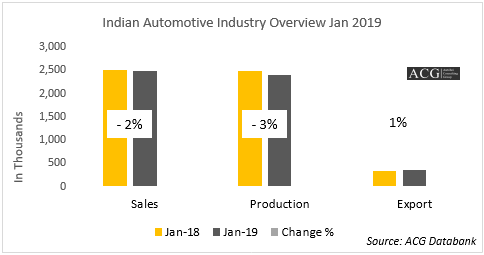
Jan 2019 Major Influencing Factors of Indian Automotive Industry:

The Indian Automotive segment showed a 5 percent decline in the growth rate in the sales sector and a 3 percent decline in the production sector. The export segment could register only one percent growth.

Indian Automotive Jan 2019 Analysis report

There are indications for improvement in the industry and many populists’ believe that the budget for the year 2019 will strengthen consumer sentiments in the country, thus enabling a significant development of the Automobile Industry. The increased focus on the initiation and implementation of rural Industrialization and infrastructure development will further drive the development of rural markets across the country. We can expect enhanced customer demand with this initiative which will uplift the market share value for the products. The increased tax exemptions norms will generate more disposable income; this will further uplift the buying sentiments in the upcoming months. A key focus on the improvement in the highway developments and railways sector will be an additional impetus for the commercial vehicle industry. This change will prove to be a significant factor of hope for a positive sales momentum with these growth-oriented schemes.

The highly influencing factors like subdued market sentiments from the consumers, high-interest rates, lag in the implementation of revised axle load norms have impacted the industry development and growth.

Passenger Vehicle segment:

The passenger vehicle segment, car, and SUV/MUV segment registered a decline in the growth in the sales segment and export with an exception of the van segment. Van segment showed 17 percent growth in Jan 2018 compare to the same duration of the previous year.

The executive segment showed the highest decline in growth with 44 percent. The mid-size, mini, super compact and the executive segment also registered a double-digit decline in growth.

The compact segment and the premium segment showed signs of improvement with 4 and 28 percent growth respectively.

The declined customer sentiment towards the segment is caused due to the non-availability of retail finance schemes and liquidity crunch of the product in the market have also impacted the Passenger Vehicle (PV) Business in the market. The Car sector is and always will be about the consumer sentiments. The consumer will always have a lot of emotions, dreams and sensitive sentimental factor regarding their vehicle. The client will have to satisfy their needs to be successful in the market.

There is buoyancy in the rural growth, commodity costs are leveling and fuel prices are coming down which in turn will improve customer sentiment towards the Passenger vehicle segment.

Skoda launched their upgraded models like the Skoda Rapid Monte Carlo and in luxury segment, Lamborghini launched Huracan Evo in the market.

Honda and Ford showcased excellent performance in the market and these models were able to register 73 percent and 54 percent growth in the compact car segment.

In this segment, Nissan had a declined growth rate of 58 percent in the month in Jan 2018. Maruti too had a declined growth rate of 4 percent market share when compared to the 3 percent decline in growth against 4 percent segment growth in the month of January 2018.

Maruti Suzuki showcased 42 percent decline in the growth in the mid-size segment which comprises of the CIAZ model also. Maruti Suzuki also lost 10 percent of their total market share. On the other hand, Honda had an incline in its growth rate with a 12 percent market share with an improved growth rate of 38 percent in the mid-size segment market share.

Creta continued to show good performance in the market. Now Market is shifting from sedan to compact SUV with more consumer opting for SUV due to its technical and luxury features.

Indian Automotive Yearly Market report subscription

The SUV and MUV Segment:

The successful establishment of the Marazzo and Alturas brands and with the launch of the new compact SUV models which were based on the SsangYong Tivoli’s X100 platform, the XUV300 was developed. This SUV launched in this segment is made with less than 4m length.

The difference in the price range between the diesel and the petrol version is just around 50k, normally it will range from 80K to 1 lakhs due to low demand for a diesel vehicle in the market. This manual comes only in the manual transmission. The company launched this SUV to regain market share in this segment.  The company has already lost five percent market share in the last year in their various product bases. Maruti snatched this opportunity to grasp the market share from Mahindra and increased their market share 5 percent to go with the 8 percent total growth rate. The company faced a five percent decline of growth in the SUV segment.

The company is mainly targeting the middle-class segment by introducing this SUV.

The Tata Harrier has received a good response in the market and the company is expecting to witness a good sale rate in the coming months as the production ramps up.

Two Wheeler Industry Analysis:

The supporting factors which have improved the trend for two-wheelers are factors like more women joining workforce, faster expanding road network in rural areas and increasing demand for a unisex two-wheeler that fulfills the need of every family member. Lower maintenance cost as well lower fuel cost has also acted as a catalyst for improvement of the sector.

In the entry-level segment from 75 to 110cc the market share of Bajaj has increased from 13 to 18 percent but in the case of Hero Moto Corp, their marker share value declined 1 percent. In the 110 to 125cc segment, Hero Moto Corp lost 11 percent of the market share, but Honda gained 14 percent of the market share only in this segment. In the premium segment of 150 to 200cc, the Honda gained 5 percent market share in the month Jan 2018.

Bajaj also had an improved growth rate of 16 percent in 125 to the 150cc segment. In the upper segment of 150 to 200cc, the company had a decline of 6 percent market share. In the export segment the company registered 24 percent growth in the entry segment but in the 125 to 150cc segment, the brand registered an 18 percent decline in the sale rate in the market.

Suzuki Motorcycle lost market share in every segment with a decline in the market value in the year Jan 2019. Yamaha also had a loss in the market share in every segment except for the 110 to 125cc segment.

TVS is currently doing well specially the Apache Motorcycle and TVS gained 10 percent market share. In the entry-level segment, they were able to show improvement with 2 percent incline in the market share.

In Premium Motorcycle segment, Royal Enfield is continuously showing consistent as well as improved performance without any heavy and expensive advertising. The company has shown increased market share in every segment. In the 250 to 800 cc, the company had an increased market share of more than 80 percent sale rate. However, in the 250 to 500cc, the brand failed to showcase the growth and in turn, the company registered negative growth in sales.

Harley Davidson could not increase its market share in the month Jan 2019 when compared to the month of Jan 2018.

Triumph launched two new bikes in the premium segment. The company lost a chunk of its market share in its present segment. Triumph is expecting to gain some market share by launching new products in the market with improvised features.

In the 75 to 90cc scooter segment, Hero has done an aggressive campaign, but they still lost 3 percent of their market share. Honda also lost 3 percent market share. Suzuki gained 6 percent market share and registered 60 percent growth in the market share. TVS also showed signs of improvement with an increase in market share value to 15 percent from 14 percent.

Commercial Vehicle Segment:

The introduction of the axle load norms has led to the freight carrying capacity of MHCV parc to be increased by 20 percent. However, the freight growth has not been able to absorb this capacity resulting in lower demand for new trucks. The tipper segment, on the other hand, has continued to witness a strong growth on the stable and steady implementation of new development strategies like road construction projects, irrigation, and affordable housing projects. The increased demand in the MHCV segment has been led by the e-commerce sector, increased rural consumption, supported by new product introductions to the fleet.

The Bus segment has been hugely impacted by the slowdown in the procurement of buses by STUs and the limited permits for private hiring.

Heavy Duty truck registered 6 percent de decline in growth rate, tractor-trailer segment which was one of the fastest growing segments also faced few setbacks. The Introduction of 37 and 42T GVW trucks has led to the tractor-trailer segment to move towards rigid haulage. The segment registered a 32 percent decline in growth. Mini Truck continued to exhibit an 11 percent growth rate and the pickup segment remained stagnant. Due to the increasing number of logistic park and e-commerce business, MDT segment showed 21 percent growth in sales.

In the mini truck segment, Tata Motors lost 6 percent market share, whereas Maruti Suzuki and Mahindra gained 5 and 4 percent market share in the month Jan 2019.

In Pick up segment, Mahindra and Ashok Leyland gained 2 percent market share. This 4 percent market share moved to its competitors. The Pickup segment showed 5 percent growth.

In some sub-segment of LDT Tata Motors lost market share and they were able to gain improvement in some other segment. Ashok Leyland had an increase of 3 percent market share. The segment showed on whole showcased 8 percent decline.

In 7.5 to 10 T, Tata Motors showed excellent performance and gained 12 percent market share with 68 percent growth. One of the major competitors like Eicher lost 10 percent market share. In 10 to 12T segment Eicher lost 8 percent market share.

In the HDT segment of 16.2T, Tata Motors lost 9 percent market share. On the other hand, Ashok Leyland was able to deliver 8 percent increase in the market share. The 25T segment is always the most popular segment which grew by 36 percent in Jan 2019 when compared to the month of Jan 2018. Major competitors of this segment like Tata Motors had a 4 percent increase in their market share. In the case of Ashok Leyland, they lost 2 percent of their market share.

31T and above segments were able to overtake the sale of the 25T segment but showed a 10 percent decline in growth. Ashok Leyland increased 10 percent market share in this segment. Tata Motors and Eicher lost 11 and 2 percent market share respectively.

In most of the tractor-trailer sub-segment, Tata Motors had a decline in market share and in case of Ashok Leyland, they were able to improve their market share.

Bus Segment:

Bus Industry registered a 49 percent decline in market share value. Small Bus segment indicated a 15 percent decline in its market share value.

Tata Motors did a good performance and increased market share value. Traditional strong player Force Motors too lost a good value of their market share value.

Light Duty bus segment also showed a decline in their growth rate with a 3 percent market share value. Ashok Leyland, Mahindra, and SML Isuzu increased market share but Eicher, and Tata Motors lost 1 and 4 percent of the market share respectively. In the medium-duty bus segment, all the OEMs had to face loss in the market share. This segment registered a 2 percent decline in growth rate.

Only the heavy-duty bus segment registered 33 percent growth in the month Jan 2018. Tata Motors lost 10 percent of their market share whereas Eicher gained 2 percent market share respectively.

Tata Motors also started to supply 40 electric buses for city transportation in Lucknow. Olectra BYD also supplied 25 Electric Buses in the city of Pune.

Promotion and Advertising:

Honda started to promote its CRV SUV through a TV commercial. Bajaj also started to promote their products heavily through advertisements. Advertisements through social media, hoardings and another innovative method will improve the brand value among the consumers. The promotions through road display and another display method will allow the consumers to have a look of the product.

Every brand and their products will require improvement in its technology and features. The consumers will look at the advancement in the product. The market share improvement totally depends on the consumer. The brands will have to be smart and innovative to be in the consumer’s mind. By attracting the consumer and by keeping the brands attached the emotional sentiments the brands can achieve a higher market share in the market. The consumer wish list and product features will have to be proportionate and these factors will have to be like hand and glove for the industry to grow and develop.

ACG is having key expertise in Automotive Business Consulting. We provide end to end consulting service. Key highlights of our customized consulting services:

Promotion strategy:

  • The media planning process, Media mix strategy, and tools to measure the effectiveness, Calculation of ROI, Factors & Parameters which affects the decide media mix, Business Models

Dealership Management

  • Dealership management – Model and OEMs wise margin and incentive, Market intelligence about the deciding parameters? T&C to provide incentive. – Internal regulation to assign a new dealer, Dealership customer interaction experience

Pricing strategy

  • How to decide pricing policy e.g. the same mark-up based on production cost, set strategic model with high margin

OEM wise After sales and Support and Strategy Analysis:

  • After the Sales Business model and margin analysis of service and Spare parts
  • Customer expectation

Product Mix and Portfolio Analysis – Motorcycle & Scooter

  • Top Models Trend and Forecast
  • Market share and product mapping to customers
  • Price and mapping with specs, features, and customers
  • Product Life cycle
  • Pre and post-buy brand experience

Marketing Mix Strategy

  • Sales and Aftersales Marketing strategy
  • Digital Marketing Analysis
  • Nature of spending

Brand Management and customer

  • How to create a brand perception, Pre and Postpurchase brand experience
  • Road map to create a brand image
  • How to make customer and product segmentation
  • How to use digital platform for dealers, Customers, and Financiers
  • Create customer loyalty and brand advocacy

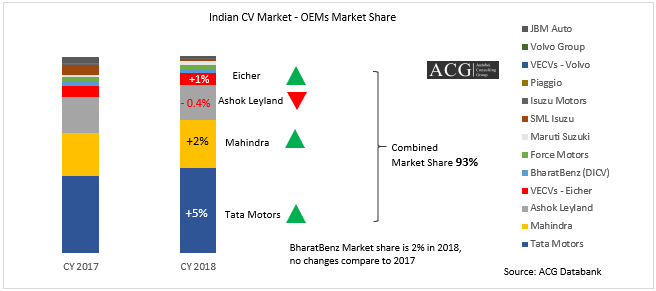
Indian Commercial Vehicle registered 27 percent growth in CY 2018 compared to CY 2017. Market sentiments indicate that Industry maintains at least double-digit growth in the next 2 years.

Tata Motors, Mahindra, and Eicher gained market share in CY 2018 but Ashok Leyland lost market share in most of the segments of CV.

Indian Commercial Vehicle Market Share 2018

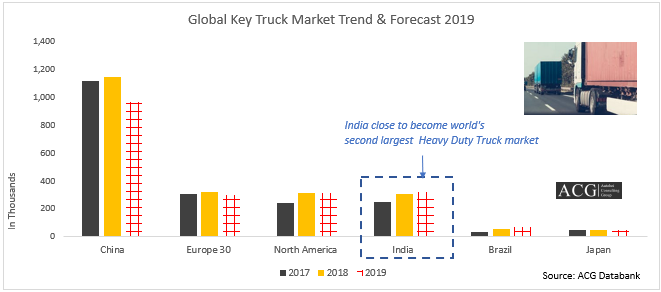
The heavy-duty truck market of India is rapidly developing on a regular basis. This can be very well proved from the robust growth of the Mini/Pick up and heavy-duty trucks market in India in recent times and further growth is expected in the time to come. It is expected that the market will keep up the positive momentum. In India, the truck market touched a high level in 2018, but demand weakened due to the crash crunch to vehicle finance. 

Global key Truck Markets and Forecast 2019

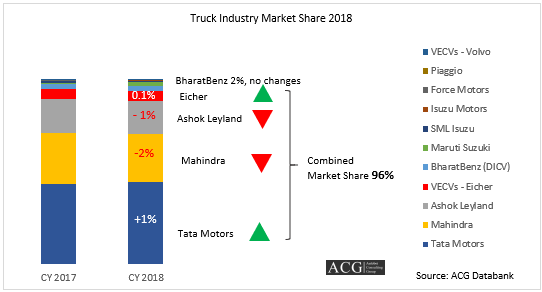
As shown in Graph, Tata Motors gained a 1 percent market share, Mahindra lost 2 percent market share, Ashok Leyland also lost 1 percent market share, and Eicher market share is almost stagnant.

Indian Truck Industry Market Share 2018

A noticeable price increase of 7 to 10 percent at the time of migration from BS III to BS-IV. On the other hand, at the time of changing BS IV to BS VI will have a minimum 10 to 15% price increase which will necessarily have a significant impact on the sales growth and OEMs margin.

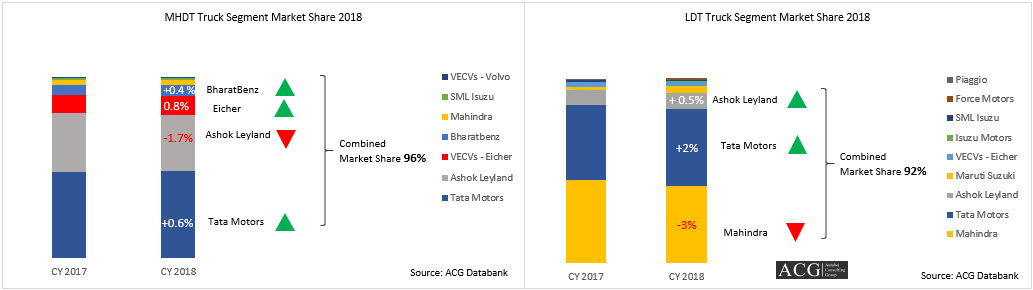
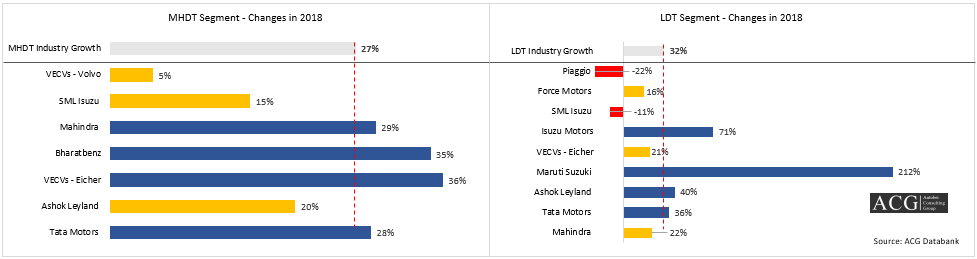
MHDT and LDT Truck Segment: LDT segment registered 32 percent and MHDT segment registered 30 percent growth in 2018 compared to CY 2017. BharatBenz registered second the highest growth of 35% after VECV.

Indian Medium and Heavy Duty and Light Duty Truck Market Share 2018

In both MHDT and LDT, Tata Motors regain its market share. In LDT segment Mahindra lost 3 percent market share even after doing aggressive promotion. We will discuss later on how Tata Motors regain market share in every segment.

In the MHDT segment, all OEMs registered double-digit growth except Volvo (It is also not relevant to compare due to its premium segment presence). In LDT segment, Piaggio and SML Isuzu registered de-growth in 2018.

Indian Medium and Heavy Duty and Light Duty Truck growth analysis 2018

One issue that pops up at the present time is axle load norms but it does not impact light & medium-duty truck and premium truck category. The impact is on higher tonnage trucks such as 37T and tractor-trailer. Now, the vehicle would be able to carry an extra load of up to 25% which is of great benefit to the customers. Most importantly, it plays a vital role in the help in the modernization process of the industry. Two axle truck which is currently 16.2T GVW is raised to 18.5T GVW. The popular category of 25T is increased to 28.5T GVW, and the 5 axle truck of 37T is increased to 43.5T GVW. The tractor-trailer GVW is increased by up to 36% GVW. OEMs necessarily need to make a lot of changes in the overall truck architecture such as tires, brakes, steering systems, etc. accompanied by an increase in the cost as well.  As the overloading comes down significantly, this new norm will certainly have a positive impact on Industry.

A discussion with the transporters made it even clearer that the impact of such norms is limited to only 30 to 40 percent volume at the time of carrying goods that have a high density such as copper, marble, cement, copper coil, sand, etc. About 60 to 70 percent of the volume will be not be impacted as a result of the low density of carrying material. Thus, it would be a good step if the norms are implemented at the time of the introduction of BS-VI since all the required changes in the architecture of the vehicle will be done at one time.

As a result of improvement in infrastructure, mining, the growth of GDP, and pre-buying of implementation of BS-VI, the industry is all set to see a growth of about 30 percent in the year 2019. The infrastructural activities will enable the tipper to have double-digit growth in the year 2019 from the previous 6 percent in the year 2018.

The heavy-duty truck market of India shows constant signs of healthy growth, particularly among the medium and the larger fleets which are on the verge of expansion. Throughout the market segments, it has been observed that about one in every four fleet managers and owners were planning to upgrade to value trucks thereby resulting in the creation of a significant upmarket sales potential.

Overall, this movement will certainly have a positive impact on the sales of trucks. The greater is the load-carrying capacity, more will be the generation of revenue and transporters will go for reinvestment in buying new trucks.

A scrape policy is all set to be introduced for commercial vehicles that are more than 20 years old. This is will have a maximum impact on the heavy-duty trucks. About 80,000 new vehicles are expected to replace the old vehicles. Now, if we combine the impact of BS-VI norms (Downturn impact) and the scrape policy, the result will certainly be positive for the volume.

The two giants in this field Tata Motors and Ashok Leyland will have the maximum impact on the norms and VECV Eicher will have a minimum impact of these norms due to its insignificant presence in this segment.

Almost all Indian fleet owners want to buy reliable vehicles in the future. Mining, construction truck and, the logistics companies who work in the long-distance transport segment will be the drivers of growth in the time to come.

The transportation industry of India is on the verge of taking a new shape. There are several logistic parks which are built near the major towns and cities. This new transportation design will result in the boosting up of the small and heavy-duty truck volume.

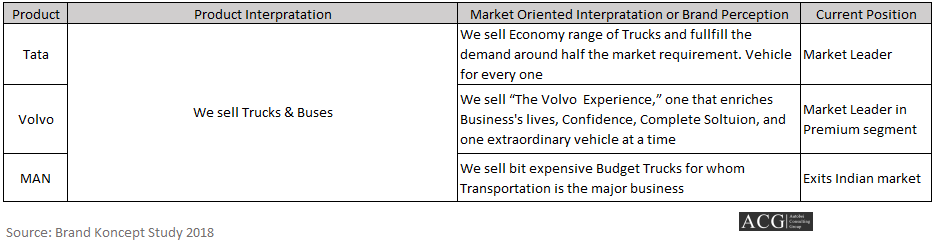
Tata Motors was struggling for appropriate gains in the market share and margin improvements on their home turf in the Indian markets. MAN decided to shut down its operation in India and another major player AMW also stopped its operation in India. Several other players are facing a similar issue and hence the opportunity is quite open to Tata, Ashok Leyland, Eicher, and BharatBenz.

Indian truck manufacturers can excel in their home markets and create a competitive advantage by focusing on the needs of the customers in the domestic market. ACG has interviewed more than 3,000 customers over a period of 30 years to get a detailed idea about factors that the customers find most important at the time of deciding on which truck supplier to use.  This report, which focuses on the opportunity in India, reports on our third and most recent survey of 550 buyers of Mini, Pick up, LDT, MDT, and HDT trucks in six key states of India.

Product and Brand Perception:

Market Oriented Interpretation or Brand Perception

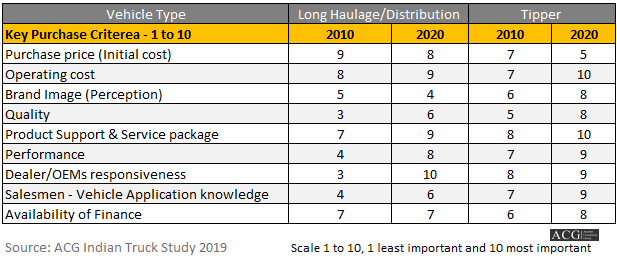
Key Purchase Criteria Trend: 

After leaving MAN and rumors about Scania give strong reasons to buy in the Indian makes. Among our findings, we have learned that the buyers are increasingly making purchasing decisions as per the best value they get for their money, which necessarily includes the purchase price, operating costs, maintenance cost, and the performance of the truck. Very few buyers are of the viewpoint that the brand image plays a role in purchasing decisions, but they necessarily value good relationships with the dealers, service points as well as the manufacturers. The brand image and experience play an important role in mining and ODC application.

Truck Purchase Criteria Study 2019

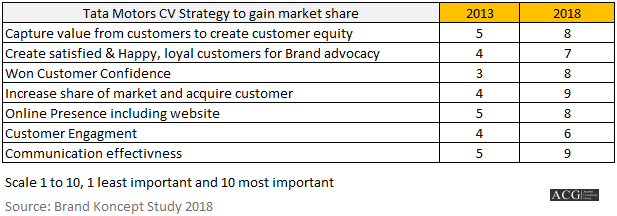
Tata Motors is an extremely good example in this regard. After losing significant market shares in several segments of CV, the company started increasing its engagement with the customers, dealers and other stakeholders. The company also made its product portfolio rich in order to gain market shares and focused on repeat purchases as well as referral sales. The reduction of cost to keep the margin high and launching new products also helped a great deal for regaining the market share. Tata Motors launched about 70 new products in the financial year 2018.

Tata Motors CV Strategy to gain market share

Brand differentiation Strategy:

At this point in time, it is getting much harder to differentiate trucks of the same segment. Several different brands have reached a minimum level of performance, beyond which it is difficult to get paid for superior performance. But now the meaning of “truck performance” is shifting a lot from the driveline (engine and gearbox) performance to several other factors such as fuel efficiency, cost, dealer relationships and quality of service. OEMs need to shift from Product to service provider concept. We certainly believe that these factors will necessarily become the main differentiators for truck manufacturers in the years to come.

OEMs can make differentiation with the help of the strategies mentioned below:

  • Availability of service and parts network
  • New product launches keep the primary focus on the customers
  • Development of end to end customer support system
  • Uptime guaranty
  • Extended Warranty

In CY 2018, the passenger vehicle registered minor growth compared to CY 2017. New players like KIA and MG Motor are launching the new product range in 2019. The budget will have a positive impact on PV sales in selected segments.

Tata Motor is giving excellent performance in the SUV segment, Company increased its market share almost double. The company-new launches are playing a key role to increase its market share.

Key highlights of the report:

  • Small car, Sedan, Hatchback, SUV, MUV, Premium, Sport, and Luxury
  • Low cost, Budget, and High-end vehicle
  • Macroeconomy impact
  • Middle-class buying power
  • New Regulation
  • OEMs Sales and Product Strategy
  • Availability of finance
  • New launches impact
  • Car buying process
  • Customer mapping
  • Customer segment analysis
  • Advertising and Brand Strategy Analysis
  • Product life cycle
  • Electric car forecast
  • Case study: Skoda, Toyota, Volkswagen, and Tata

ACG Research released the latest version of Indian Automobile Industry Outlook 2019. Now India became the 4th largest Automotive market in the world. Indian Automotive Industry contributed 7% in Indian GDP, providing employment of 19mn people, 40% share in Global GDP, and contributed 4.3% share in export.

The Auto industry is expected to reach 125 bn by 2020 and 280 bn by 2025 at a CAGR of 18%.

Indian Auto component Industry also plays an important role by contributing 2.3% in Indian GDP, expected to reach its turn over USD 200bn by 2025. The Auto component Industry growth rate is almost 20%.

In the Commercial Vehicle market, India is the second largest bus manufacturer, third largest Truck manufacturer,  largest Tractor manufacturer. The country is producing around 25mn vehicle with 3.5mn exported. Key export markets are Africa, the Middle East, and South East Asia.

Electric and Hybrid Vehicle volume is now more than 1mn volume.

Key Highlights of the report:

  • Last 5 years Trend of Volume
  • Budget 2019 Impact on Indian Automotive Industry
  • Forecast
  • OEMs Sales, Export, and Production volume
  • Electric Vehicle Sales Forecast
  • Market share, Growth, and Degrowth analysis
  • Price, Cost, and Margin forecast
  • Business Strategy Analysis
  • New Product launch planning
  • Segment and sub-segment forecast
  • Model level Sales and Production forecast
  • Competitor Analysis
  • Market Dynamics Analysis
  • Regulation impact

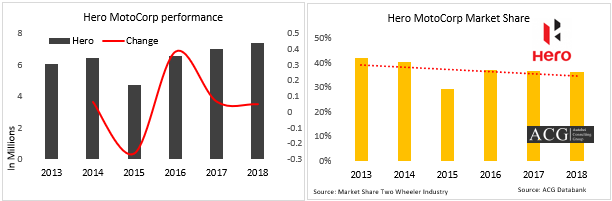
Hero MotoCorp continued to be one of the leaders of the two-wheeler market in India for almost 20 years even after the breakup with Honda. After the breakup, the existing Honda products were kept but a few new products were included so as to enhance their overall product portfolio. But somehow the dealership across the country was not comfortable and started leaving the dealerships. One of the main reasons behind it was the issue of viability. It is quite surprising to know that in spite of being at the top of the sales volume, the dealers are finding the difficulty to keep service revenue at a high rate.

Hero registered 5 percent growth in CY 2018 compared to CY 2017 with 37 percent market share.

Hero performance Analysis in Two Wheeler segment

It is true that after the breakup with Honda, the company has tightened the supply of materials directly to the dealerships from the vendors. The engine oil is a very good example in this regard. The dealers are not allowed to procure oils from any of the local sources but they should get it only from the company. This results in the rapid downfall of the profits. In an addition to this, the workshop labor charges have also been directly monitored by solely company which eliminated the chances of any dealer to do any malpractices. This might be a very good step towards enhanced customer satisfaction but too much tightening on all petty issues brings about dissatisfaction among a number of dealerships. All of the manufacturing companies are aware of the fact that the dealerships are their first customer and Hero is well aware of the same.

After the detailed research, it is revealed that viability is not the exact issue but it is necessarily the drop in the service revenue. The dealers are actually habituated to make some money from the services offered but the sudden drop in this particular income due to the strict monitoring by the company, the dealers have started comparing themselves with other brand dealerships which made them come to a conclusion that they are being ill-treated. Hero also announced awards for the best-performing dealers based on the customer satisfaction survey, but the dealers are basically looking for a regular income by offering paid services rather than the one time award.

If we have a detailed look at the service centers or the sub dealerships, they perform much better as compared to most of the main dealerships since they need not block the money on new vehicles. They take vehicles from the main dealerships and settle the payment once the vehicle sold. Even if the margin of sales is on the lower side which is ranging somewhere between 1,000 INR to 1,500 INR per vehicle sold, no risks are involved here. Similarly, the revenue on the spare parts, the service volume considerably increases at the service centers and the sub dealerships at the time when the main dealerships nearby quit. Now, these sub-dealers are en-cashing the situations at their best.

As far as products are concerned, Splendour, Passion, HF Deluxe and Glamour still lie within the top product range which is being sold across the country. As long as the consumers are getting the same quality product, it is just immaterial for consumers, whether the product is from “Hero” or from “Hero Honda”. At the time of interaction with a number of customers, it can be clearly understood that they are still buying Hero products because of good mileage and service network. Even a very few of the customers feel that their Scooter (Pleasure, Maestro) is giving more mileage as compared to nearest competitors. But some of the high-end product like Extreme-200 have disappointed the customers a bit because of the quality of the product. Excessive vibration of the engine is another of the issue which the customers have noted and thus by doing necessary corrections.

Hero segment wise market share

Hero MotoCorp needs to make its effective presence in the Premium segment.

Please contact us for full report.

ACG analytics expects domestic commercial vehicle (CV) sales to rise ~22% in fiscal 2019.

The forecast is divided into Sales and Production (Goods & Passenger carrier) segment. The segment further divided into OEMs and Model level along with key technical specs and product features.

Indian commercial Vehicle Industry and outlook 2019

Major Industry Drivers are:

  • National road development
  • Pradhan Mantri Awas Yojna
  • GDP growth
  • Some new pre-election announcement
  • The new product range of higher GVW/payload
  • E-commerce sector growth
  • Regulation

BS VI Norms impact on CV Industry:

  • BS VI impact on demand
  • The cost impact on vehicle
  • The function of SCR/DOC and DPF
  • Emission Control through Engine Design
  • Technology impact of BS VI
  • Other aggregate and cost impact
  • Global Strategy of using SCR and EGR for various Norms
  • Subsidiaries and tie-ups for after treatment
  • Supplier Market share
  • BS VI regulation and history of emission norms

Key highlights of the report:

  • Short-term demand
  • Medium Term Demand
  • Long-term demand
  • Competition Analysis & players Strategy Analysis
  • HCV demand Analysis
  • MCV demand Analysis
  • LCV demand Analysis
  • SCV demand Analysis
  • Bus demand Analysis – Application wise
  • Cost variables
  • Margin Analysis
  • Regulations Impact Analysis
  • Brand Position
  • Brand engagement
  • The relationship between Brand perception, and Application
  • Changing buyers behavior
  • Top purchase criteria
  • After sales – Maintenance cost Analysis
  • Forecast Value and Volumes
  • Vehicle type
  • Engine type
  • GVW wise
  • Transmission type
  • Fuel injection type
  • Vehicle Financing Type and issues
  • Import and Export Trend and Forecast
  • Model-wise Price and Discount Analysis
  • Product benchmarking and Product Portfolio
  • Customer Experience
  • Driver feedback on vehicle usage, USP and its best-suited application

Please contact us for more detail and Table of content