The Indian Automotive Industry suffered immensely owing to the pandemic hit 2020. Our reports provide key insight into the Impact of COVID 19 on the Customer’s Car and SUV owning preference.

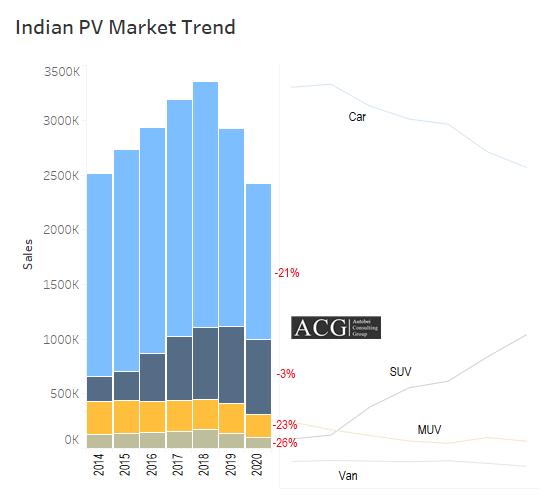
The effect further gets amplified when it comes to the Indian passenger vehicle industry, as the degrowth seemed to be at 17% in CY 2020 when compared to CY 2019.

Categorically, the car segment witnessed a 21% degrowth, whereas the SUV’s stood at 3%, MUV at 23%, Van at 26% in the CY 2020 when compared to CY 2019.

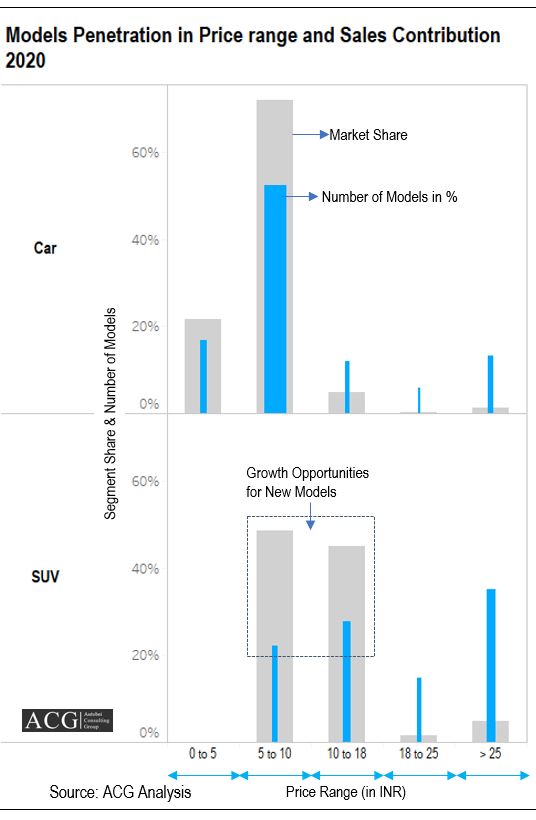
The SUV segment offered a wide pool of choices to the customers to choose from as it put forward 34 models. Even the Cars segment was a cut above as it had a stack of 43 options in its segment. Overall share as occupied by SUV and Car segment stood at 28% and 59% respectively.

Indian Car SUV and VAN Market Trend and Outlook 2020

Maruti led the Market with its commanding hold of 50% in 2020. The indigenous brand Tata too enhanced its market share to 7% from 5%. The market wasn’t favorable to the likes of Mahendra and Honda as they faced a lag of 2% market share in the Indian PV segment.

Sedan’s saga of its below-par performance continued to haunt itself, as it loosened its grip in the Indian PV segment. It has lost its 14% segment share from 2014. The worst happened in 2020, as the degrowth took the exponential rise to 46% when compared to 2019.

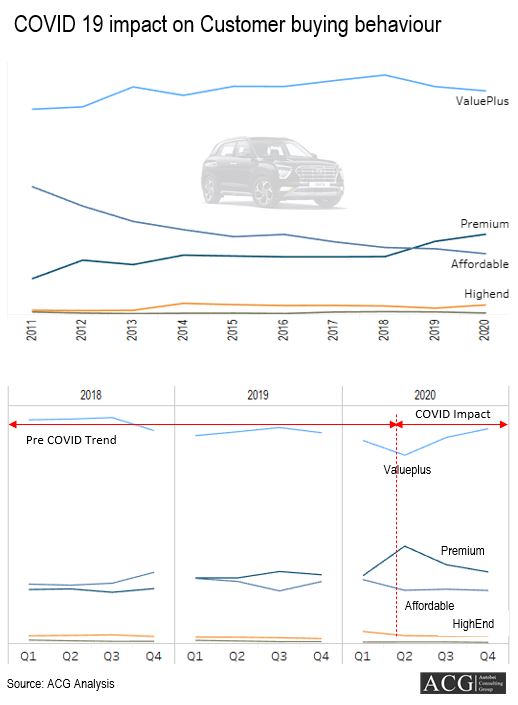
As per the existing market bifurcation, the Indian PV industry has been differentiated as Affordable, Valueplus, Premium, Luxury, and High-end.

COVID 19 impact on Customer buying behaviour

The Premium segment has evolved as an eye-catcher for the Indian customer base. The luxury segment on the other hand faced one of its worst low due to the COVID 19.
The value segment stands tall as the largest segment in India. As the new customers have more craving to pay for the design, Comfortability and cutting edge technologies.

The SUV segment has gathered much more attention than Cars in the Value plus segment, and the key reason for the same is the wide availability of models and the price it is offered at. Despite the pandemic, SUVs faced a marginal 12% degrowth in 2020.

Car Models Penetration:

Indian SUV and Car Models Penetration in Price range and Sales Contribution Analysis 2020

The affordable Segment sales shot up by 2% in 2020 compared to the previous year.

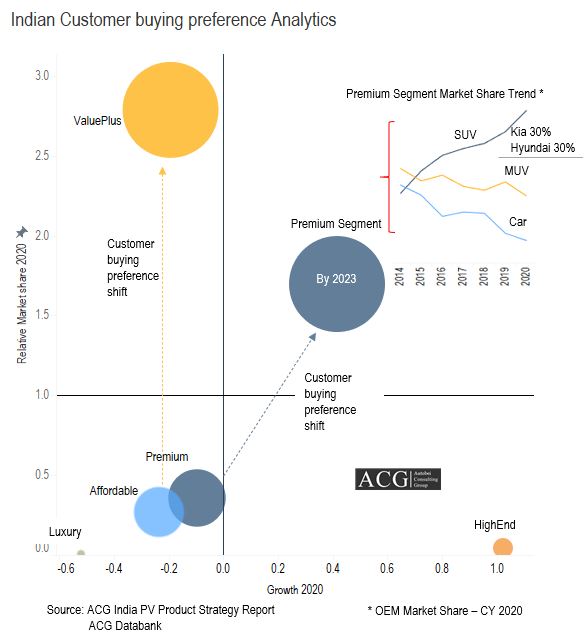
The Premium SUV segment proved to be the most attractive, as its segment share almost tripled in the previous 6 years by going up to 76% from 29%, but yet the 12% degrowth troubled this segment too in 2020.

Indian Customer Buying preference and Segment Analysis Forecast

The luxury segment continues to have a firm hold and is dominating the SUV models by amassing 87% share and it even faced very minimum degrowth by 36% in 2020 compared to 2019.

The most preferred Indian brand Maruti elevated as the market leader in the Value Plus car segment with a 65% market share. Even the TATA motors eyed on this segment and eventually took up their market share by 4% in 2020.

Hyundai and Kia held 25% and 11.5 market share in the SUV Value plus segment. The Premium car segment offered a fair chance to all the manufacturers as Maruti held 73% in MUV, Honda 45%, Hyundai at 60% and Mahendra managed to get a 22% market share in 2020.

Presently, Customers are offered a decent number of options to own an SUV in an affordable Segment. And Maruti continues to dominate this segment by a whopping 75%

Toyota’s indomitable hold in the High-end SUV segment seems no stopping as it has occupied almost half of the total market share. And Hyundai is also now less in this segment and is leading the segment from the front.

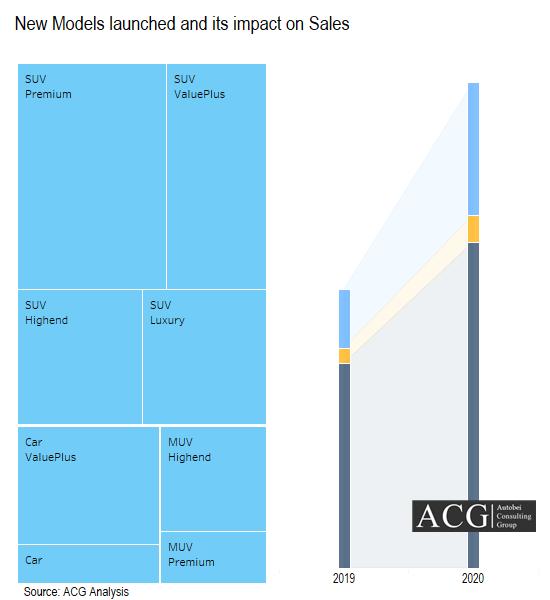
The contribution from the New models stood at 16% Market share in 2019 and it doubled its numbers in the year 2020.

New Car SUV and MUV Models launched and its impact on Sales

Maruti Suzuki’s new product has contributed 17% market share in the Affordable car segment. Kia Carnival absolutely had no rival to compete in the High-end MUV Segment. Recently, the SUV premium segment has gained pace in the Indian PV industry. Kia, though a new entrant into the Indian market has stunned its rivals by getting the tag of a Market Leader with a 19% market share in 2020, and this almost is double the value of what it accomplished in 2019.

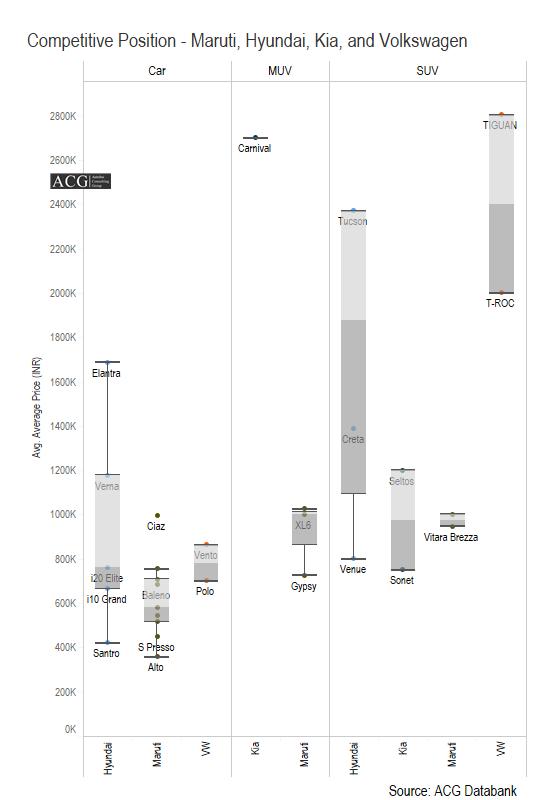
Competitive Position - Maruti, Hyundai, Kia, and Volkswagen

Tata Altroz, which amazed the Indians with its extremely good build quality took up its market share by 3% in 2020 in the value plus segment in 2020.

The value plus SUV segment was not fortunate enough to have major growth in 2020, as Hyundai and Kia models noted a 29% market share in 2019 but this went down by 27% in 2020.

Kia has created a formidable position for itself in the Indian Automobile arena as it shoots up its market share from 19% to 35% in just a year from 2019 to 2020, and this truly is an astounding achievement.

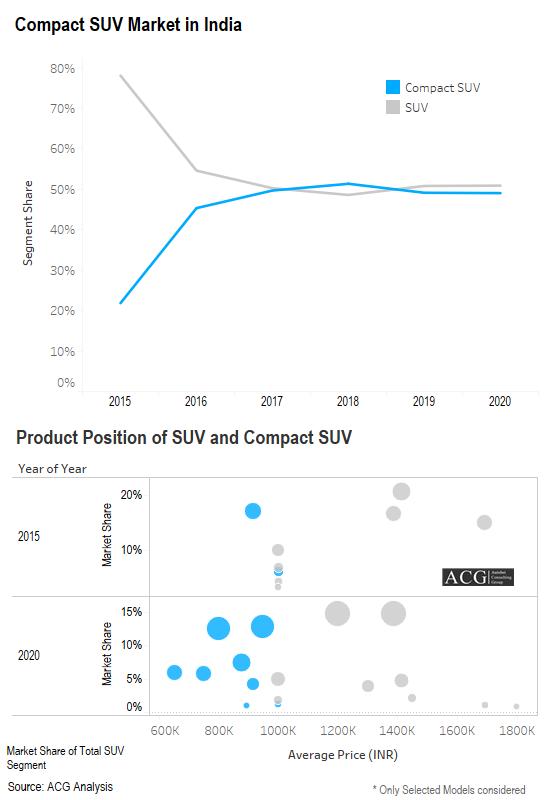
Compact SUV Sales Trend:Compact SUV Segment in India

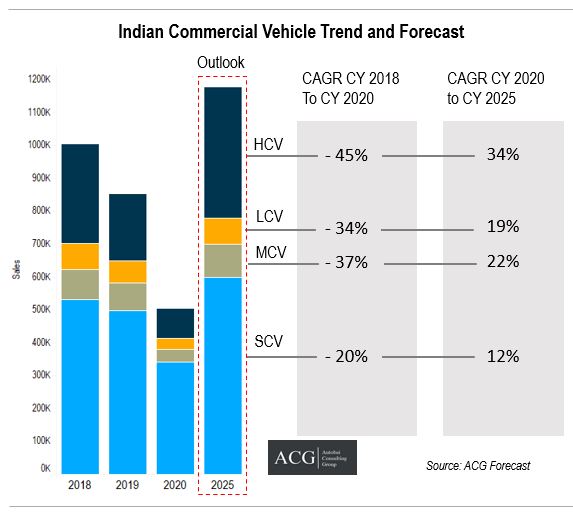
The degrowth has been a common phenomenon that shook the entire world in the year 2020. A Turnaround of the Indian Truck Market 2021 after the New reforms and Economic booster became one of the key growth drivers.

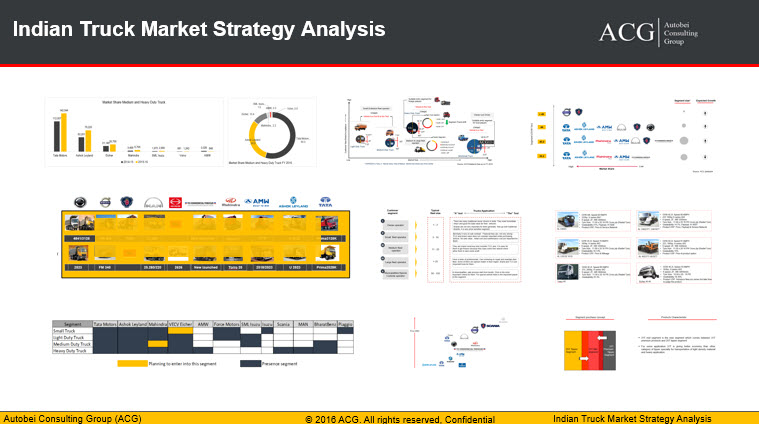
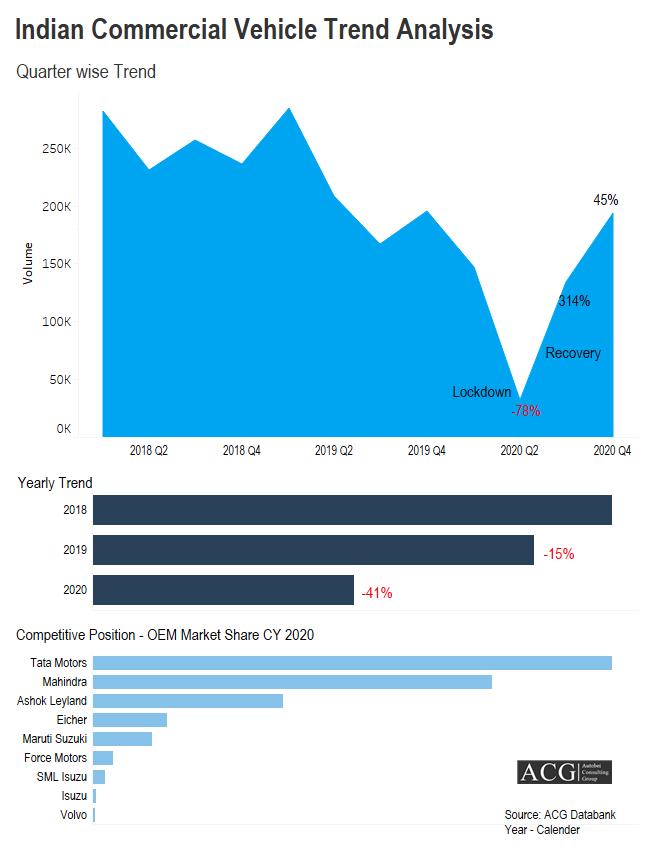
The Indian Truck Market size diminished in the year 2020, as its degrowth stood at 42% compared to the year 2019. The revival rate that was showcased by the Truck segment is really commendable as the market was able to rejuvenate itself at a rapid pace. The same can be concluded while we take a look at the data of the Q4 CY 2020 to Q4 CY 2019, as the degrowth was brought down to 8%.

Indian Truck Industry Trend Analysis

The contribution made by the Indian Truck segment for the year 2020 was at 94% as compared to the 90% that was seen in 2018 for the total CV market in India.

Indian government played a pivotal role in empowering the transport infrastructure of the nation, which eventually is the need of the hour. The government has launched Infra projects worth Rs.103 Lakh crore, apart from this they have also contributed a whopping amount of about Rs.1.70 Lakh crore for improvising the transport infrastructure as well as the focus has been laid on accelerating the construction of Highways. The Infrastructure development is on Government’s Radar, as they believe it is the much-needed booster for economic growth, and it’s very evident when we see as many as 6,500 Infra Projects flagged up across sectors under the NIP (National Infrastructure Pipeline).

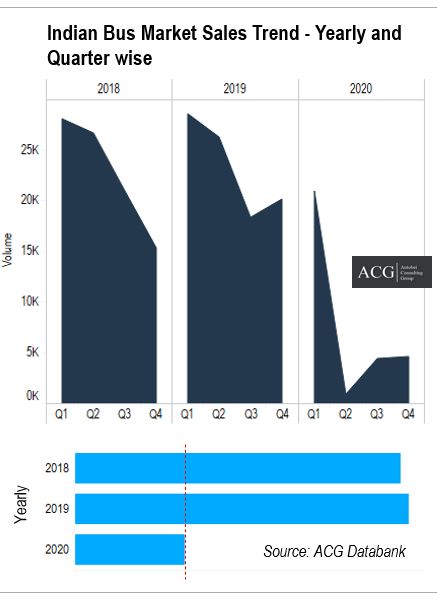
The Union Government has taken a special interest in this cause and will fuel Rs.18,000 Crore to strengthen Public transport in Indian cities and they have procured 20,000 buses for the same. This move by the government will mark the beginning of good days and render Impetus for the Bus segment, which had traversed a rough path as its sales crashed due to the negative impact of COVID-19.

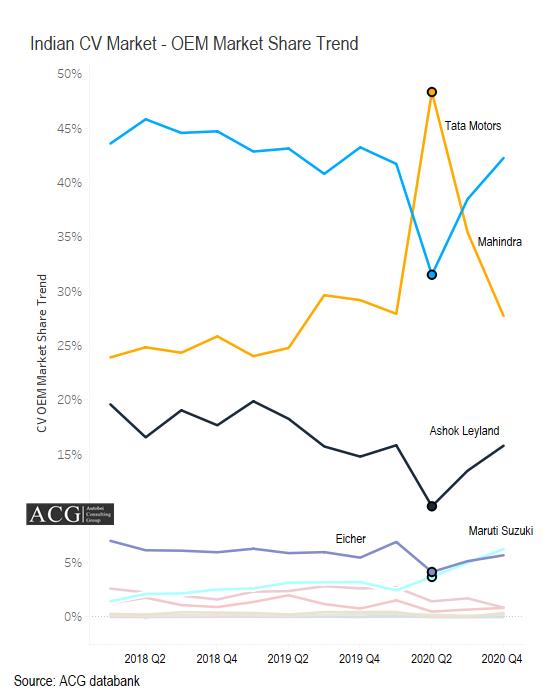
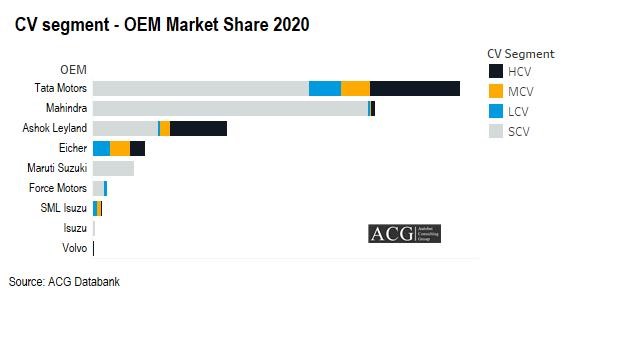
Tata trucks, one of the pioneers in the segment lost 3% of their market share in 2020 compared to CY 2019 and 5% as compared to 2018. Mahendra, on the other hand, amplified its growth by 3%, Ashok Leyland conceded a 3% loss, Maruthi grew its share by 2%. The sales of Volvo trucks were also ill plunged, but if only the Premium Truck segment is taken into consideration then we can note that its performance was Satisfactory compared to Scania.Indian Truck OEMs Competitor Position and Growth Opportunities

Surprisingly, After the lockdown, Mahendra lost its market share by 8%, Ashok Leyland gained 2% Market share in Q4 of 2020 compared to the Q3 of 2020. The Q4 proved to be an improvement period for Maruthi and Eicher as both enhanced their Market share by 1% in 2020.

OEM’S continued to run an uninterrupted show, as all the major OEMs except Mahendra showed better growth rate and this was higher than the Industry growth for the 2nd and 3rd quarter.

Operating costs have gone up as they have a proportionality with the price hike. The increase rate is at 30% for a daily commuting truck that commutes 300 km per day. For the TCO chart, this contributes to almost 50% of the cost. However, this relationship keeps varying for the truck segment and other models as the demand is on the lower end.

The Infrastructure development has attracted a huge amount of investment in Budget 2021. The existing scrappage policy will revolutionize the growth saga of India. The above steps taken by the government have embarked on the demand of Tipper in West Bengal, Tamilnadu, and Kerala.

Even the rural sector has also created a healthy demand, but the fleet utilization hasn’t quite picked up yet, as many trucks are stagnant in the parking because of the demand drop.

Mini Truck:Indian Mini Truck - OEMs Competitor Position and Growth Opportunities

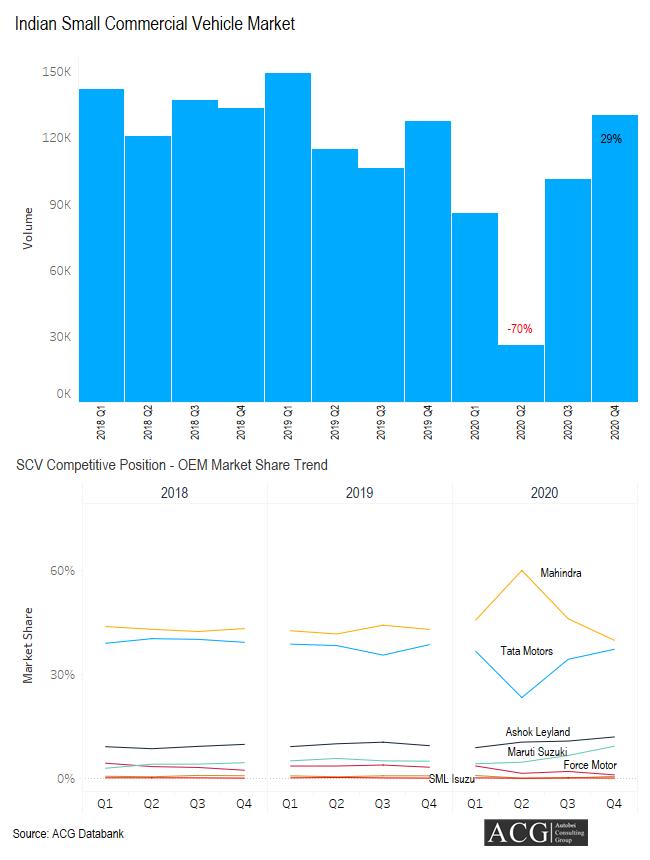
The losing streak has continued to haunt Mahendra and Tata motors since 2018. But in 2020, Maruthi was able to expand its Market share from 9% to 18% in just 3 years. A similar trend has been noticed after the lockdown and in the Q4 of 2020, Maruthi is dominant as it’s commanding 23% Market share. This segment witnessed 38% degrowth in 2020 compared to 2019.

Pickup Truck:Indian PickUp Truck - OEMs Competitor Position and Growth Opportunities
This segment has seen degrowth at 22% in 2020. The year-end quarter turned fruitful for the segment as it managed to achieve double-digit growth in the segment. Mahendra continues to be the top-notch performer in the segment. The new product launch by Tata motors aided them to enhance their market share by 2% in 2020.

In the Q4 of 2020, the likes of Ashok Leyland and Tata Motors were successful in snatching a share of 2% and 4% from the segment giant Mahendra.

LDT segment:Light Duty Truck - OEMs Competitor Position and Growth Opportunities

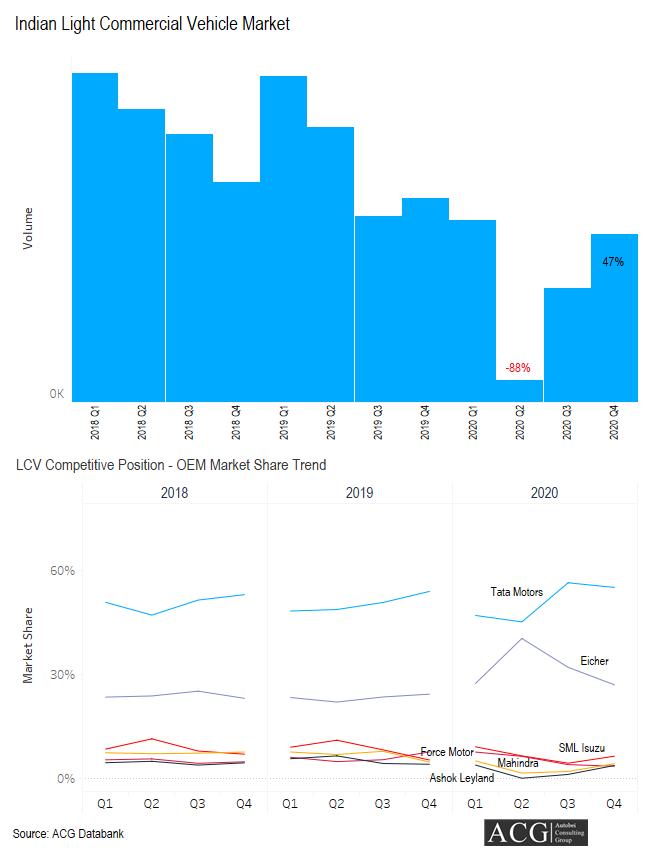
Tata motors have held a dominant position and are the market leaders in this segment by amassing more than 55% market share in 2020. Eicher is slowly climbing up the ladder by launching its new trucks to cater to the E-commerce segment. This performance has pulled the Market traction of Mahindra, Ashok Leyland and has redirected the same to Eicher.
In Q4 of 2020, Tata Motors, Ashok Leyland, SML, Isuzu, and Mahendra enhanced their Market share post lockdown.

MDT segment:Indian Medium Duty Truck - OEMs Competitor Position and Growth Opportunities

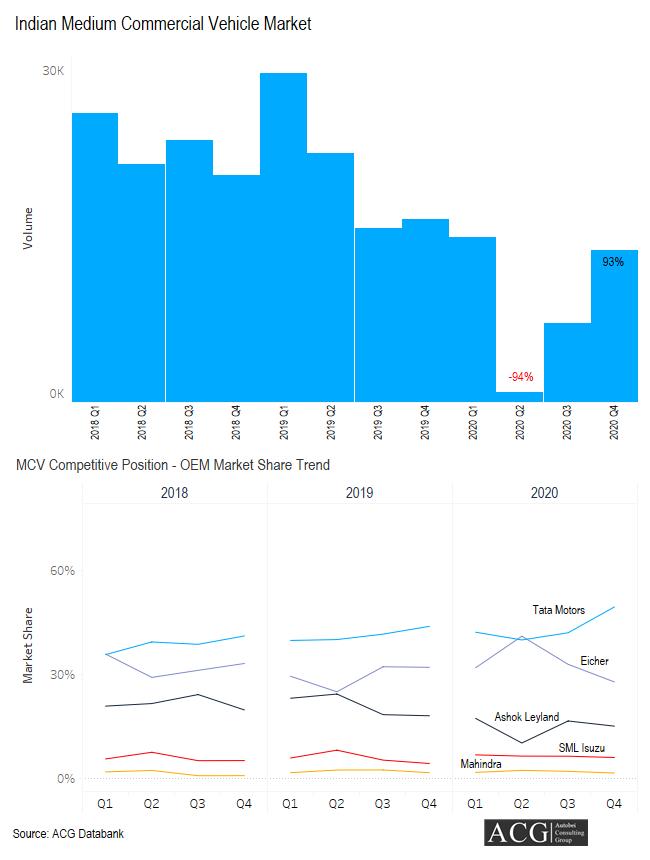
The MDT saw the worst of 2020, as its market size shrank to half of what it had in 2019. Tata on the other hand rose to a respectable position by adding 5% Market share in 2020. Ashok Leyland and Eicher didn’t have the best of 2020, as they lost market share in CY 2020.
The period after lockdown rendered a red carpet welcome to TATA as it became even more invincible by garnering an additional 10% market share.

HDT segment:Indian Heavy Duty Truck - OEMs Competitor Position and Growth Opportunities 2021

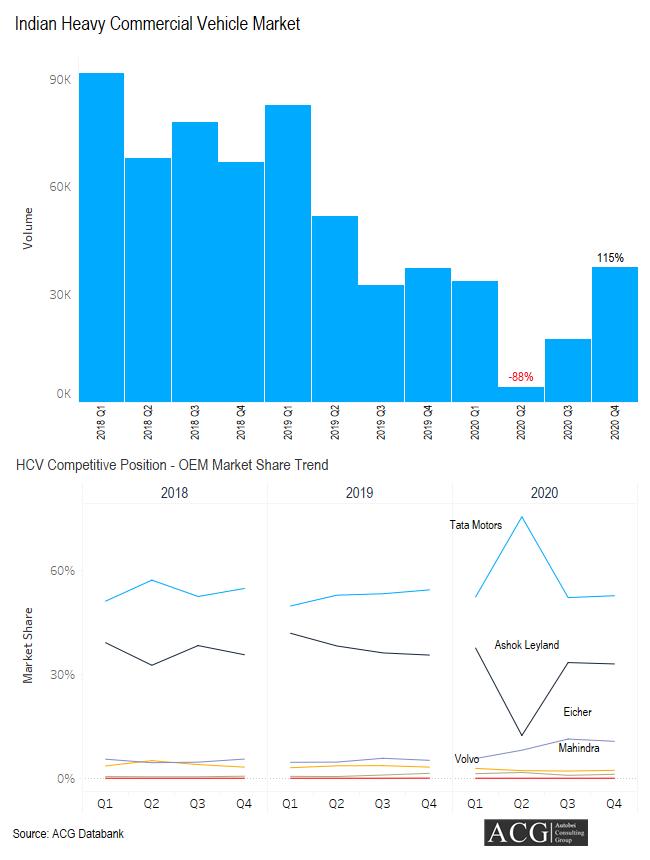
The HDT segment has 3 subsegments viz. Rigid, Tipper, Special Application, and a tractor-trailer. Though the HDT segment saw degrowth of 50% in 2020, it had the last laugh in the Q4 of 2020 by seeing a spike of growth. The highest growth in the segment was seen by Eicher, as its newer model catalyzed the company to enhance its sales by more than 2 folds in Q4 2020.

The market share that was grabbed by Eicher was at 9%, which is 4% higher compared to last year. In the Q4 of 2020, Eicher went past the double-digit growth. Ashok Leyland and Mahendra lost a 4% share at the same time.

The pandemic brought the Tractor trailer to a standstill position with absolutely no growth. The Market size scaled down from 80k to 12k in 3 years.

Ashok Leyland loosened its hold by a little more than 20%, and Tata tightened its grip by adding 20% market share in 2020. The momentum of Ashok Leyland continued to dip further and worsened as it lost 9% in Q4 compared to Q3 2020. Tata Motors continued to stun its rivals by elevating itself to the leadership position by taking 70% market share in Q4 2020.

BharatBenz Case Study:

BharatBenz registered 36% regrowth in the MHDT segment but its market share increased by 3 percent in CY 2020 compared to CY 2019.

BharatBenz Strategy and Market Analysis 2021

BharatBenz product portfolio and Pricing Strategy play a key role in the growth story.

BharatBenz Price Position & Product Portfolio

ACG released the latest report on Customer preference towards Electric Cars. The fast-paced world of today is the end result of many successful ideas that have been implemented with the right business strategy. If we consider any business model that has rendered fruitful results to the owner, then such a business will be governed by various factors, pivotal of them would be the consumer base and the specification in which it is offered viz. pricing, efficiency, uniqueness, etc. But the market dynamics slightly change in regards to the booming EV industry, and we need to bring in a completely different approach to ascertain its growth strategy. Any newness in the market will never be welcomed with an open arm, and the same goes with the EV industry as well. Similarly, even the EV segment faced a lot of problems in the initial phase, as the customers cited a lot of apprehension in regards to its efficiency, build, and other aspects.

Whenever a product is presented into the market, then the buyers look for the uniqueness coupled with affordability to own it, and the EV sector is still not able to present their product in the market with a cheaper tag nor an exorbitant mileage on offer, or vast reach of charging places. The research analysis that would be carried out as we deep dive into the core, will further unravel various factors that will influence the locomotion concerns. The following factors have proven to be the quintessential for deciding the success of EV: Option to get a feasible Charging point, an alternate mode of transport, especially cars to facilitate commuting, the cutting edge systems in place to boost the mileage efficiency.

We have been able to ascertain that an ample kilometer coverage for an EV to be considered as good or worthy can stand starting from as low as 95km to a maximum reach of up to 260km.

The transition to the field of Electric Mobility has challenges of its own viz. inadequate charging infrastructure, shorter range, and time-consuming charging.

In the current market scenario Tata Nexon, MG EV Hector, Tata Tigor EV, Hyundai Kona are the Top products in the Market.

Electric Vehicle Product Strategy and Segment wise Electric Car product position

Electric Cars Product Performance:

Indian EV Model wise Specs

After a keen inspection of the Locomotion structure, We can deduce the need of strengthening the fundamentals and the observation is as listed below:

Option to get a feasible charging point:

In the domain of EV, the energy fuelling stations have attained utmost importance and are indeed very integral for its operation. When we take a glance at Germany, France, the United Kingdom, and China market, which flaunts the topmost active users of the eco-friendly vehicle, it can be seen that the major amount of EV sales belongs to the region that has a vast amount of energy refueling stations.

An alternate mode of transport, especially cars to facilitate commuting:

The presence of commuting alternatives always reduces the risk associated with moving from one place to the other, and the inception of EVs has paved a way for the customers to prioritize EV’s as their next priority choice of vehicle or even as the primary. Luckily, this factor has turned out to be a blessing in disguise for the EV industry.

The end users anticipate a comprehensive system in place so that it can render practical solutions to all their locomotion needs. This aspect also seems to be the need of the hour, as many users may need to take up travel across the city or states owing to relatives function, various events, sightseeing, etc. As per the observations made from the recent analysis amassing a handful of commuters from various metropolitan cities concluded that there are instances where the drivers are supposed to drive greater than 1000 Kilometres and this sought of situation arises on a maximum of 30 to 40 days per year, as per the report. Since the EV has not yet been empowered to carry out trips on a stretch, this would continue to haunt the sprawling growth of EV and would be a major hurdle in the path of its adoption as the primary car of the users.

This structured article aims at exploring the three vital things influencing the commuting concerns on adoption to EV i.e Kind of energy refueling facility or point availability, the need of owning a second commuting option, lastly the mileage extent influencer system.

The EV’s available in the market is one of the commuting facilities that are available to access with certain characteristics, and these characteristics at times may not be feasible to meet one’s own needs or usage. What matters most to the drivers is the mileage efficiency, higher energy refueling times, and sparingly available charging points and these concerns need an efficient and immediate addressal so as to facilitate all their travel requirements.

The EV’s on the other hand find their space in the locomotion option, if in case an alternate car is available at any given point of time. Studies have also revealed certain points that the mobility issues seem to be very negligible with the users with an option of an additional car, and this can be any car that runs with conventional fuel.

The kind of trends that are seen amidst the community of owners who own multiple cars and then shift towards EV is: Initially, they try to fit in EV in the place of the user for shorter commuting needs, as the range that needs to be traversed falls under the purview of actual EV range, and the EV’s when harnessed for this need will perform to the expectation and nullify all the negative concerns. Apart from this, EV also tries to take it well past the user in the area of flexibility and thus boost the figures of EV in the arena of Universal travel distance. So, all these positives sum up to conclude the essentialness of EV and the need for it to evolve as a prime alternate commuting system though it does not find its use for everyday travel.

The cutting edge technologies in place to boost the mileage efficiency:

The topmost governing authority highlights that at times the Shorter mileage offered by EV’s acts as a thoughtful psychological barrier. When we analyze and comprehend the desirability of EV’s range then the user community is polarised to overestimate the total distance they need to cover, and underlines this more than their travel needs. Usually, these concerns are the end result of anticipating the risk of being prone to breakdown, running out of fuel or energy on the highways and in the vulnerable areas viz. forest, village roads, nomans place, etc. Also in case of an unplanned trip, these concerns will haunt even more as the driver needs to take up the commute without the knowledge of the kilometers to be covered, as they will not be aware of it beforehand. This will put them into a situation where they will not be able to furnish their travel needs owing to the miscalculation of the total distance to be covered and other factors. The study conducted taking into consideration 100 EV users of silicon city of India, revealed the stressful situations they face owing to the lesser mileage of EVs is arising in a recurrent fashion and poses a threat to the end-users at least 12 times a year.

Technology is the boon to the field of EV, and it is the need of the hour for the manufacturers to come up with an application that serves the purpose of giving end to end information about the EV car to the user, like What is the vehicle condition, Total mileage that can be achieved, Next service duration and lot more.

When it comes to the performance and capabilities of EV, we can say that it has undergone a swift change and its significance as well. But the evolving customer mindset has posed a great threat to it, and the failure of EV manufacturers in building a system to identify end users’ aspirations has blown the issue out of proportion.

The Manufacturing company-related aspects like the Value of the manufacturer and his position in the market, impeccable consumer facilitation, ability to retain the users play a very vital role in influencing customer’s mindsets and prove to be quintessential in their decision-making process of owning an EV.

Strategy for Building the product and the segment it can fall in:

The influential factors like Brand perception or social status tend to occupy the foremost importance when customers have the option of owning a Luxurious vehicle at the same cost as buying an entry-level trim of EV.

The EV buyers of the present world are in search of getting the best in class cutting edge features, they are versatile, passionate to own a car and they consider this owning affair to be a vibrant period. But ironically, the customers who value all the aforesaid points are not existing everywhere and their presence in the contemporary market almost tends to zero.

The prominent area of performance in the automotive sector is the lookout for superior vehicle acceleration by the customers. The best luxurious vehicles of today keenly encash on this aspect by advertising the time elapsed in seconds by their car to accelerate from 0 to a certain km range.

To conclude, we can clearly highlight the enormous amount of importance that is being rendered to the concept of Speed and Throttle maximize level. Categorically we can say that Cars that take the mentioned points into consideration will have a presence in the market of the following types: Affordable, Value Plus, Premium, Luxury, and Highend Cars.

Indian Electric Car Segment wise market size forecast and Key Challenges

To conclude, we can say the need for attention to detail cited by the customers is very much instrumental in amassing the sales figures and thereby contributing to the growth of the Product.

The world today is driven by technology, and technology has had an impeccable impact on our lifestyle too. These days owning a car is not only for commuting means but also reflects one’s own societal status. Despite the root cause of procuring a car is travel needs but it all boils down to the user’s perspective. There might be other influential factors for the owner to buy a car, such as updating the car to the one with larger capacity so as to accommodate additional members, passionate to get the taste of the advancement in the market that may, in turn, contribute for the higher efficiency and best in class feel. The above-listed features are pivotal in making the choice of the car.

So, Which according to you is the instrumental thing that will have its effect on the procurer to get a car for himself/herself? The Response for this will be ‘Procuring amount’.

Many of the customers have a restricted budget for procuring the vehicle. Cars are considered to be one of the fundamental purchases and the price one can afford to own is very restricted owing to a fixed cash flow. The EV’s are yet to get a level playing field and at times find it difficult to compete with the existing market, as the cost to own an EV is extremely high for a middle-class family and the high cost is due to the battery and its build architecture. The overall Amount that needs to be spent for buying an EV car is a very costly affair compared to owning a 4 wheeler with an ICE.

The scientific point that needs to be observed here is the slightly costlier investment in Electric vehicles, which can be largely reimbursed by saving considerable amounts in energy dissipation, service, and a lot more aspects. But it is very saddening, that the potential car procurer will pay the least attention to this broader concept. They consider that the savings they will be able to make is very inferior and assume to count it as fairly minimal than the product investment they make. As a product architect, one can perceive to get a thought of luring the customers by gradually scaling down the product cost by rendering govt aided funds or freeing them from tax, else the manufacturer can carry out impeccable research on the battery architecture, and thereby present an economical battery solution so as to address the high manufacturing cost and scale it down in the near future.

There also exists an idea proposed by Better Place, which seems to be practically feasible if efficiently implemented, like letting the customers purchase an electric-powered car with no battery. The customer in this case can be given an option of taking the electric fuel endowment or renting them on the basis of trips. This can be achieved by charging the customer only for distance covered, or a 7 day,30 days plan. This implementation can largely address the High-cost product issue.

Indeed, Better Place came up with a Superior sequel of this feature, which included a specific energy interchangeable infrastructure and also a closed-loop charging infrastructure. They claimed that the battery Interchanging process of replacing the charged battery with an already drained battery in the car can be done within a quarter of an hour, and this innovation is superior compared to the already existing fast charging services of today’s world. But, the hurdle in the path of achieving this mode of operation is that the concept of battery packet changing needs global acceptance and the same has not yet been acquired to date.

Things that are also equally impactful in owning a car are the specifications and the characteristics inculcated in the car, like the orientation of the structural part and vehicle trim. The vehicle trim choice is completely dependent on one’s own requirements and needs. For instance, a group of 7 people will aspire to strike a deal of owning an SUV or MPV kind of car than a 4 seater hatchback. As we take a glance at the existing electric models, interestingly we find a notable amount of impeccably enriched sedans and large SUVs.

Though many people were of the opinion that electric vehicles would storm the market as a hatchback, Tesla’s advent into the market presented a Sports racer and a Luxurious sedan. This was the precedent set by Tesla, and the other manufacturers in the lineup seemingly embraced the market with the same approach. This move of them is to be well appreciated. The strength of an electric sports car has always been its speed or the ability to needle up beyond the normal speed. The car savvy’s have time and again proved that they are all ready to procure the Investment for attaining higher speed. Yet another factor that is plaguing the slow-paced adoption of electric vehicles is its operationality.

The psychological thought which is prevalent in the world today is that the influence of the people around and their choices on an individual is immense: If your classmate, co-worker, people in the vicinity and acquaintance procure a number of EVs’s and in case they share a good review with you, then eventually your thought process bends towards making a similar choice.

A detailed walkthrough of the Electric Car Business Model for India.

In the contemporary situation, the question which is demanding the answer of the highest priority is “what’s the way ahead for unraveling a future that is completely Electrified and free of Emissions?”

The journey ahead may seem herculean and impossible at the start, but when approached with the right strategy it can yield us the right outcome. In fact, the two crucial things that are integral ingredients for success are:

  • The positioning of EV product on varied parameters
  • Enhancing the Market acceptability

Undoubtedly, The era of Electric vehicles and their technology will give an immense booster to the Transport industry and the entire mankind at large.

Whereas the Management Sutra and proven Business strategies imply that, at the end of the day what really counts is not the greatness of the technology, but its ability to sell itself in the market by meeting the client’s requirements.

The Fundamentals of the EV Business:

Initially, weightage needs to be given for scaling the uniqueness and its distinguished value for the customer. Emphasis needs to be laid on portraying the standout features viz. Design, Ergonomics, Features, and availability of various models.

Further, the technicalities of the project need to be brought to the table, and this innovation needs to be experienced by the customers through boundary objects like flowcharts, Graphical representation, maps, etc.

Monetary-related things take the driver’s seat in evolving the leads to the final Customers. So structuring the right price is of utmost importance. The pricing should address all the questions like do the customers have to pay the entire price at once to get the subscription? Will they get any aid in the form of a subsidy? And this financial aid if rendered acts as a launchpad for shooting the Market.

Last and foremost, the quintessential thing is to loop in the right partner network for catering to the customers and other sectors by establishing hassle-free connectivity between the production base and the users.

‌Once the above said things of the Electric Vehicles are channelized in the right direction, then we can realize that business model is not only about the cost incurred for the battery, but rather involves lot many things. Today’s cutting-edge technology offers us to choose from a wide range of choices, but one should know the art of picking the right product and try to exploit it commercially for the benefit of customers and ensure its feasibility to the user base. We should also take into consideration that all the possibilities that can be tapped by the technology cannot be passed on to the end-users due to various constraints like Cost, the paucity of time, the vastness of the network.

‌The bottom line is that even though the battery technology has proven to be cost-effective, eco-friendly, affordable, and mature. But it cannot be directly implemented by swapping electricity with a fuel-driven vehicle.

‌The right care is to be taken for choosing the accurate business model which takes into account cost, Value, and the offer so that customers can have access to choose the product that meets their expectations and pricing.

The overall value of Electric Vehicles depends mainly on their distribution across Pan India, and also on an associated electromobility system. This sort of distribution needs external activation of levers apart from the car manufacturers. So that the growth strategy can be tapped by reaching out to cities, highways, companies, and a lot more places. The next important thing is to spearhead a mission to popularise the best in class Electric experience to the customers and this is the core element for the success of distribution methodology.

The government and the other major OEMs are on a mission to revolutionalize the Automobile sector by swapping the ICE vehicle with pure Electric Vehicle. But this approach initially seems to be like Marching to war without adequate practice and skillset. There are certain key areas that need to be well equipped before evolving the Indian Automobile sector to the BEV.

Vital points in regards to Product development:

  • It needs to be within the monetary reach of the customer and it should fall in the affordable range.
  • The choice range should be myriad in nature, so as to let the option to the customer to choose from various models and variants.
  • The product needs to comprehensively address the issue of Charging duration, availability of Infrastructure for charging, and the maximum range offered.

Things to be kept in mind to Appease the Customer base:

  • Ensuring the database of the target audience who will choose electric Vehicles.
  • Bring about best market practices to take the confidence of the customers, and also boost their trustability in the product.
  • Structuring the product under a nominal pricing scale and making it the best product for the money being paid.
  • Standing firmly by the line, “Customer is the king”, and try in all sorts to satisfy their particular needs and wants.
  • Building up the epitome of Brand value and create an impeccable social status.

The proposed Business model for EV:

The uniqueness or the Value proposition of the product can be structured in 4 part:
The term environmental friendly garners much interest from the crowd but not many intend to invest in it and own one.

Electric Vehicles are premium priced, despite the fact that their maintenance and usability in a long run is economical. In the present scenario, the pricing of the Electric car is in the reach of only High-income group customers, and the question arises whether its running cost-effectiveness can be grouped under the canopy of the value proposition? The response for this may hold true or false depending on usage like personal or commercial and also on the Value addition to the product offered by OEMs, tax incentives, and subsidy from the govt.Electric Car Running Cost Analysis in India

Further, the value proposition gets bolstered by the addition of the following factors:
Free to drive the vehicle across villages, city, district, and State without having to worry about the infrastructure for charging nor the charging timelines.

Making the product available to the customers for a nominal upfront amount.
Inculcating the Internet of things in the product Encashing the special key point that the electrical vehicles are super economical and a class apart from its competitors.

Cost to procure Infrastructure: This factor should also be considered, as there are different charging methodologies and the costing differs and they are a need for different partnership approaches.

An analysis and comparison of the Electric car:

ACG has come up with the cost analysis module by carrying out the testing of EVs in various real-life scenarios. Below are the enlisted considerations:

  • Electric car for the general usage of one’s own self
  • Harnessing Electric car for commercial purpose
  • Stage a comparison of Electric cars with diesel and petrol cars of a similar price segment.

The observations made from the above-mentioned considerations have been gauged under the Ideal as well as the actual factors. The commercial usage of an electric car as a Taxi has scientifically proven to be more rewarding than its personal usage. Nevertheless, the tests will have different outcomes basis on the models and variants.

Hence the need for a Business strategy will intend to make necessary changes in the revenue model. And to showcase that the electric vehicle is more affordable, we have priced the EV in line with the thermal vehicle which has the same price segment, and have varied the operational cost or the energy usage by renting a battery.

The Economics of Electric Cars in India

Three keen observations were witnessed:

There was clear visibility of savings when they were not. The battery rental and pricing can be varied depending on the customer’s usage and needs. Lastly, the customer can be free of risk, as the battery-related issues are transferred to the seller end in this case.

EV Dealer Survey:

Electric Vehicle Dealer Survey India Sales Skills

ACG is the leading Market Research and Consulting firm in the domain of Global Electric Vehicle.

The Feasibility Study of Electric Vehicle Charging Station report contains Market Size, Growth, Customer expectation, OEM Challenges, Infra Companies risk and Opportunities, Feasible Study, EV charger Demand Analysis, Types of Charging Station, Investment required, and Key players.

Region: Asia, China, Europe, and NAFTA, Country-wise Separate report is also available

Key Highlights of the report:

  • Overview of the Indian Electric Vehicle Market
  • Electric Vehicle Sales Forecast
  • COVID 19 impact on Electric vehicle and Charging Stations
  • Current and Expected Demand for Electric Vehicle (Bus, Two Wheeler, and Three Wheeler) Charging Station
  • Design of Charging Infrastructure
  • The requirement to build Charging Infrastructure and Cost Analysis
  • EV Charging Station –  Private and Public
  • Govt Policies to support – Charging Station
  • Types of Charging stations and Key players – Basics and Standard
  • Battery and Charging time
  • Strategic Position, and Roadmap
  • Different Component of Charging Station
  • The bay design
  • Tax Structure and Other key insight
  • Expected Revenue
  • ROI Analysis
  • Detailed Expense Analysis
  • Business Case
  • Key Players like Bosch, Siemens, Tesla, ABB, Mitsubishi, and others
  • Customer Survey – Existing Customer or user of Electric Vehicle and Forecast

The COVID-19 crisis has forced one of the most interesting and attractive Passenger car markets to drive in reverse gear. The year 2020 could perhaps be one of the most difficult for the South African Automotive Industry to traverse through. With a whopping 6.9% of GDP, the automotive industry makes a significant contribution to the country’s economy. However, South Africa’s grandiose plans for its automotive industry were brought to ruin by the pandemic and the five-week lockdown imposed in the country. ACG predicts the country’s automotive market to face a decline of 30% to a mere 40% share in 2020 as compared to that in CY 2019.

According to the NAAMSA, the manufacturing industry employs 110,000 people both directly and indirectly and the automotive sector provides nearly 457,000 jobs. Aided by the government’s proactive industrial policies, this sector is the only manufacturing sector that has shown significant growth.

Owing to the country-wide lockdowns, ACG predicts that the demand for passenger vehicles (Car, SUV, and MPV) will shrink by 25% yielding only a 35% demand in 2020. However, this situation is subject to change, depending on consumer choices in spending after restrictions are relaxed for restarting industries. This would also be a good time to kickstart the demand for second-hand cars.

In order to fuel the fight against COVID-19, the government has introduced a number of packages such as the Debt Relief Fund, SMME Finance Scheme, and the Temporary Employee/Employer Relief Scheme (TERS). The Reserve Bank has announced a 100 basis point cut to the repo rate, incentivizing employers to hire young and temporary employees. These schemes are expected to boost the demand for the industry and fast-track the economy’s revival.

The South African Passenger Car Market is divided into 3 broad categories: Cars, SUVs, and MPVs. More than 400 models of these main categories are available in the country.

Between 2011 and 2019, the Passenger Vehicle (PV) industry showed a -2% Compound Annual Growth Rate (CAGR) which is expected to jump to 12% between 2020 and 2022. On the other hand, between 2011 and 2019, the car industry had a -5% CAGR, the MPV segment with 1%, and the SUV segment with 6% CAGR. In the next 3 years, these figures are expected to leap to 4%, 18%, and 22% growth is CAGR in the car, MPV, and SUV segments, respectively.

In 2019, Volkswagen enjoyed the lead in the car segment with a 30% market share followed by Toyota with a market share of 16%. Other players in the market included Hyundai, Renault, and Suzuki with market shares of 10%, 8%, and 6% respectively.

In the SUV segment, however, in 2019, Toyota captured the market with a 22% share, with Ford and Renault following behind with 11% and 9% market shares respectively.

Similar to the situation in other markets, the South African automotive industry is also seeing a shifting trend from the car to the SUV segment, owing to the latter’s space, aesthetics, and comfort aspects. Toyota’s Fortuner, RAV4, Tiguan, Sandero, and Ford’s EcoSport are the Top 10 models in this segment.

South Africa also enjoys the title of the highest cars per capita in the continent. It has the largest vehicle market in the continent. It is not surprising to note that one out of every five people in South Africa owns a vehicle. Among the top car models in South Africa are the Volkswagen Polo and Polo Vivo; Toyota’s Corolla and Etios; Renault’s Kwid; Hyundai’s Grandi10 and i20 and Ford’s Figo.

With aggressive Chinese investments, Chinese OEMs have seen their market share increasing especially fast in the country. Their strategy targets the SUV segment, pricing this segment lower than what their Toyota, Volkswagen of Ford counterparts do.

Indian OEMs too have the opportunity to penetrate the African market with Tata Motors and Mahindra. This creates an attractive opportunity with favorable market dynamics for them.

Consumer Groups :

The South African Society is divided into 8 categories based on certain facets, like income bracket and owning a car. High inflation rates and slow growth in wages wrought by the pandemic offer serious challenges to the industry, keeping consumer sentiments at an all-time low. Most South Africans, like all consumers in the world, are treading cautiously with their financial decisions. They want to study the market and get the best deal and value for their money. Our surveys indicate that certain vehicle models are preferred by certain specific groups, for instance, in the case of Volkswagen and Toyota.

Brand Loyalty :

Our customer behavior studies indicate that South African people prefer buying their favorite brands only at a lower price. This is the reason why growth is predicted in the used car industry in the next 3 years, leading to OEMs advertising discounts to attract new customers. This could be an opportune time for Chinese OEMs, which have registered only a 2% CAGR in the last 9 years, to think seriously about increasing their market share.

Key Highlights of the Report:

  • South Africa Passenger car Market Trend
  • Segment-wise market movement
  • Short, and Medium-term Forecast
  • Challenges and Opportunities after COVID 19
  • Pricing Strategy – Model and variant wise
  • Key Export Market
  • Sedan, Hatchback, Premium, Luxury, Budget, Small Car, Sports, Category wise Analysis
  • Model and OEM wise Competitor Analysis
  • Product Position and Product Gap Analysis
  • New Product Launches and its impact on the market
  • Customer income Group and mapping with Models
  • Customer Buying Journey after COVID 19
  • OEMs offer a comparison for customers to create demand
  • How Supply chain affected after lockdown
  • How to offer Digital solution to the customers
  • How to connect with customer emotionally
  • Advertising impact and choose the right channel

The coronavirus pandemic has wrought an unprecedented downfall in the entire Indian Automotive industry. This industry, which accounts for more than 7% of the nation’s Gross Domestic Product (GDP), was already grappling with a drawn-out decline when the nation-wide lockdown brought the industry to a standstill. Production of vehicles, the supply chain of parts, dealers’ channels, advertising, customer sentiments, and after-sales services were adversely affected.

Impact-of-COVID-19-on-the-Indian-Automotive-Market

Our Monthly subscription gives a key insight into the market movement.

In March month of this year, domestic automotive sales fell by 45% compared to the previous year of the same month, Two Wheeler sales declined by 40%, and Three Wheeler sales declined by 58%. Commercial vehicle’s year-over-year (YoY) sales dropped at a steep 88%.  The month of April was a complete washout for the industry.

According to official data released by the government, in June 2020, the Index of Industrial Production shrunk by 15.7% from last year’s figures. In July, the index had fallen by a 15.7%, ever so slight progress from the previous month.  India’s industrial output suffered a major contraction for the fifth consecutive month in July, impacting the production of consumer durables and capital goods.

However, as the country brought relaxations of restrictions on industries, sales revived in the subsequent months. August, the month of Onam and Ganesh Chaturthi, has been the most productive since 2018.

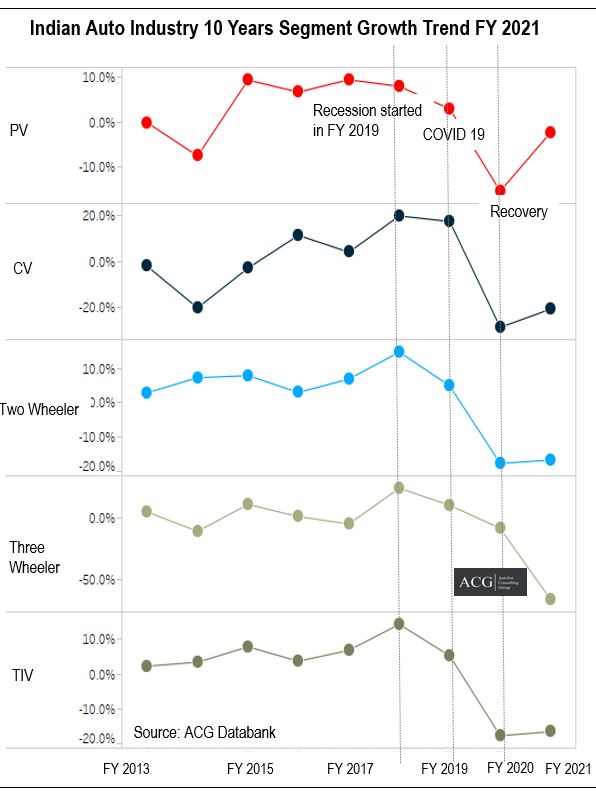
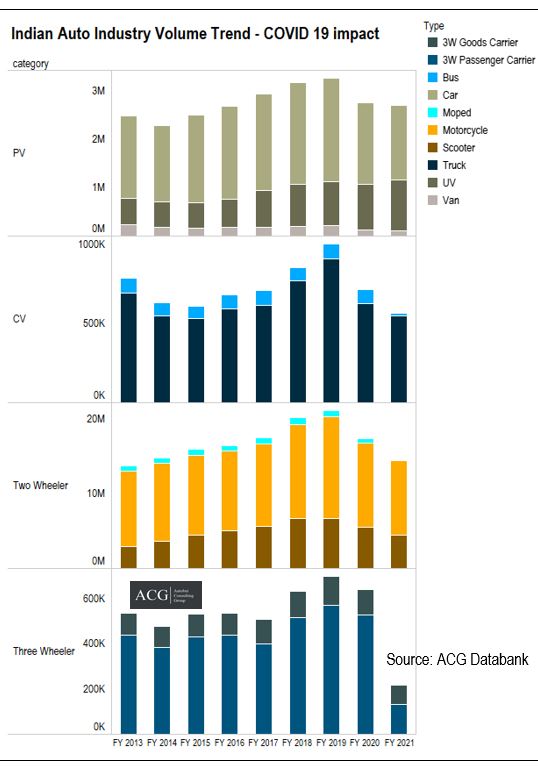
The industry was already wrangling since the third quarter of FY 2018 due to liquidity crunch, higher acquisition cost, and weaker customer sentiment. Sale of Passenger vehicles and Two-wheelers contracted by 18% in 2020 from the previous year, while Commercial vehicle sales fell by an even greater 29%.

Judging from the trend in the industry so far, automotive sales for the fiscal year 2021 could decline by 20-25% from the previous year across all segments – Passenger Vehicles (PVs), Commercial Vehicles (CVs), Two-wheelers (2Ws), and Three-wheelers (3Ws).

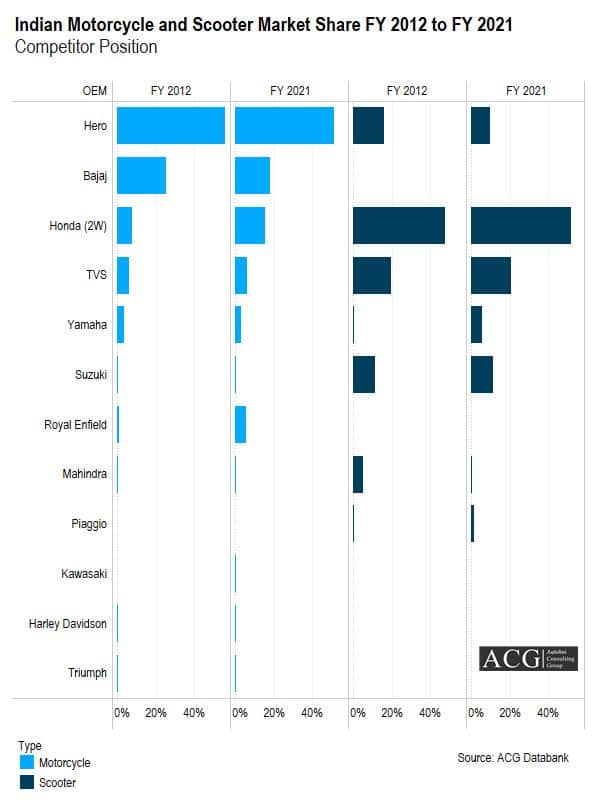
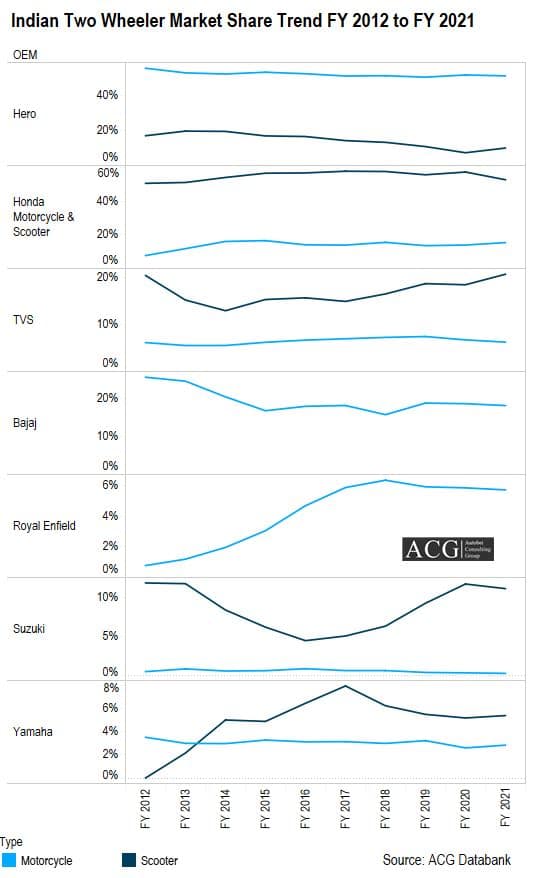
The 2W and 3W industries, however, have seen some exciting developments in May and August 2020 with a bounce-back of entry-level scooters and motorcycle sales. The increase in sales could be accounted to the small-format mobility and higher levels of comfort that 2Ws and 3Ws have. Furthermore, 2W manufacturers reported a fourfold increase in this time. 2Ws and 3Ws are the best alternatives for those who do not wish to or are not able to use Public Transport. 3Ws are a safer option as they provide affordable mobility. The demand for this segment also comes from migrants who fled the cities to move back to their hometowns in the countryside. On the other hand, 2W production surged due to the rising demand in last-mile delivery.

The CV industry however has been the worst impacted with almost 1% to negative GDP growth. Hard times await this industry which is considered the backbone of the country’s economy. Demand for this segment could be increased by accelerating infrastructure expenditure in rural and urban areas and supporting the real estate sector.

OEMs have managed to handle the situation owing to their affluence. Hyundai, Maruti, and Kia have invested a lot to promote new products like Venue, Sonet, and S Cross. Mercedes, BMW, MG Motor, Honda, Hyundai, Maruti Suzuki, Toyota have transitioned into the digital arena and have started selling their vehicles online. With the hesitation to go to physical stores and avoid contact, online demonstrations, door-step test drives, digital launches, and online financing options have provided a unified seamless virtual experience to customers. However, the dealers face viability issues and expect support and liquidity from OEMs to run the business.

The Auto components manufacturers have also faced a serious setback due to the pandemic-effected lockdown, affecting thousands of component suppliers and tens of thousands of employers in central Europe. The negative sentiments against China have to lead to the unveiling of ‘vocal for local’ initiative by the government. This will open some more opportunities in the market.

With an increase in the number of loan defaulters, financial institutions are hesitant to give out new loan applications.

Customer Sentiments:

Though basic models are still in demand, customer buying has reduced for the luxury vehicle segment. This sector will be seeing a significant drop in sales in the coming months. The confidence index of the Logistics Industry is at an all-time low. Transporters face capacity utilization issues and demand for vehicles for goods transportation.

Outlook:

The effects of the pandemic and consequent lockdown are seen across all industries. The impact on the economy and the automotive industry, depending on the intensity, duration, and spread of the outbreak. Customer spending has reduced a lot due to the psychological and financial situation. Gauging by the current scenario, the market will take another 1 to 2 years to revive from the setback. Reduction in GST will protect the industry against the economic ramifications of the pandemic. A scrapping policy should be introduced to boost the CV segment.

Many organizations are increasingly making use of the term “Market size” and developing product strategies based on the market size. Our novel study revealed that the meaning of “Market Size” is significant only if has been defined in a specific dimension of product, market, and Customer attribute. Fortunately, the strategy works unquestionably if evaluated, used, and employed in relevance to the Market Size.

We have conducted our experiments on more than 100 Car that including SUV and MUV models which have been launched in the last 10 years. In addition, we have also built a sub-segment based on Features, Customer income, Technical specs, Brand Position, Market Share, Product Portfolio, Product Gap, Product Price, Sub segment Market competition/competitors, and other 20 more parameters.

Analysis of the Different car Segments: The study is divided into 3 components on the basis of vehicle Type i.e. – SUV, MUV, Car, and VAN.

Indian Car SUV and MUV Model discontinue analysis

Most of the Cars in the segment SUVs (sports-utility-vehicle) and MUVs (multi-utility-vehicles) has been launched in India owing to – Product gap Analysis and Customer purchase power. That is to say: Because of not standing superlative on the aforementioned parameters, a good number of Low-Cost Car Segment models have been discontinued in these segments over the past 3 years. These cars include models from big brands like Tata, Hyundai, Maruti like Nano, Eon, Alto 800, etc. In recent times, only one car model has been introduced by Maruti in this segment. This segment lost its charm even before COVID-19 but could only cash in minor growth post the lockdown period due to weaker consumer sentiments and declined income.

City wise Innova Sales Analysis: Major Market for MUV Segment

Budget Segment has become all the more popular in the lockdown period and so far most of the Top-selling models belong to this segment.

Hyundai’s Venue is currently positioned strategically to get maximum benefits. Our Product Analysis gives a clear picture of how this segment looks and where is the opportunity to launch a new model.

For New launches, the SUB B segment is emerging to be an attractive segment in India. The chances of increasing market share are more than 3 times as compared to the fiscal year 2019.

Under the Budget & Premium segment, SUV dominates the domain. Maximum new models of SUV have been launched in these two segments like Tata Harrier, MG Motor Hector, Kia Seltos, Renault Captur etc. All Models are strategically positioned in a different portfolio canvas, thus enjoying the monopoly somewhat. Even after launching multiple models in this segment, there is still a lucrative space to accommodate new models at the appropriate position.

In the Luxury segment, many models have been discontinued, just one model launched in this segment. This segment is gradually losing its shine among the upper-middle and rich class for the past 2 years. We if analyze the second level of sub-segment, there is possibly a good chance to launch new models.

In the High-End segment, only selected models are available for the high-income customer groups.

Case Study: Volkswagen India, Maruti, and HyundaiVW Maruti and Hyundai Product Strategy Analysis of Indian car market

Report Highlights:

  • Indian Car Market Size, Market Share, and Growth Analysis
  • Indian Car Market Entry Strategy
  • Detail Product Analysis
  • Map Models to Customer segments
  • Car, SUV, MUV, and Van Pricing and Specs Analysis
  • COVID 19 impact Analysis
  • Variant Level Product Analysis
  • Customer buying Journey Analysis
  • OEM, Type, and Segment wise Market share analysis
  • Statewise Market share and Sales Analysis
  • Brand Analysis and perception Analysis
  • Outlook for the next 5 years
  • Segment-wise Product Portfolio
  • Product Strategy and Product Gap Analysis
  • Competitor Analysis of Indian Passenger Vehicle Market Analysis

ACG Provide end to end customizes service to establish the business in 40 European countries.

Following services are included:

  • Market Entry Strategy
  • Business Development & Business Expansion
  • Register office in European countries
  • Business Culture & Etiquettes
  • Government Policies
  • Local tax consulting
  • Market Survey
  • Country Profile
  • Business Tie-up with local companies
  • Find JV or Alliance company in the respective country
  • Find strategical location
  • Local market intelligence
  • Supply Chain Management
  • Customer insight
  • Brand perception and loyalty
  • Customer buying nature
  • Position Product and brand
  • Price decision
  • Prepare Detail promotion plan (Print, Digital, Hoardings, Exhibition, etc) along with budget
  • Countries included – Germany, France, Switzerland, Spain, UK, Denmark, Netherland, Belgium, Sweden, Austria, Finland, Norway, Ireland, etc

ACG released the latest Indian Electric Two-Wheeler Product, Sales, and Production data. Following  data fields are included:

  • Brand/Make Name
  • Model Name
  • Charging Range
  • Top speed
  • Full charge in HRS
  • Torque
  • BLDC Hub Motor
  • Battery Type
  • Battery Capacity
  • Charger Rating
  • Battery Life
  • Gradeability
  • Front Suspension
  • Rear Suspension Brake
  • FR / RR Tyre
  • Kerb Weight
  • Wheel size
  • Ground Clearance
  • Warranty
  • Licence & Registration
  • Price
  • Customer Segment
  • Vehicle Application
  • Product USP
  • Top Cities and States for Electric Vehicle

Indian Automotive sees the worst demand decline in history due to the worldwide outbreak of the novel COVID 19 and month’s long lockdown. The Automobile Industry saw a steep sinking of 78% in Q1 FY 2021 compared to FY 2020. The massive slump of 78% resulted in the Indian automotive market has sold only 153,734 units compared to 712,684 in the previous fiscal.

On the other hand, the pandemic also disrupted production in Indian Automotive. The production declined by 80%, Sales 76%, and Export 64% in Q1 FY 2021 compared to Q1 FY 2020.

Indian Automotive Industry Put ON A Soft Pedal:

While the Indian Two-Wheeler market slumped by 74%, Commercial Vehicle Industry 85%, MHCV 94%, and LCV 80%, Passenger Vehicle 79%, the Three-Wheeler registered a plunge of 92% in Q1 FY 2021 compared to Q2 FY 2020.

Segment-wise Sales Forecast:

Passenger Vehicle Segment:

In the Car segment, Tata Motors increased its market share by 9%, Volkswagen by 2%, whereas Honda Cars dropped 5%, Hyundai 3%, and Maruti lost 3% market share. In the SUV/MUV segment, Hyundai and Renault gained 4% market share, while Mahindra lost its market share by 8 % and Maruti 6%, in Q1 FY 2021 compared Q1 FY 2020.

Commercial Vehicle Segment:

Mahindra had a market share of 25% in Q1 FY 2020 and could see around 50% market share in the fiscal Q1 FY 2021. Tata Motors and Ashok Leyland lost 14% and 8% market share respectively in Q1 FY 2021.

Coming in the grip of ongoing Covid19, the MHCV truck segment moved to negative by 93%, and the Light Duty Truck segment dropped by 78 percentage in Q1 FY 2021. MHCV and LCV Bus segments witnessed a degrowth of 98% and 95% in Q1 FY 2021 as compared to the same period last year.

Two- Wheeler Segment:

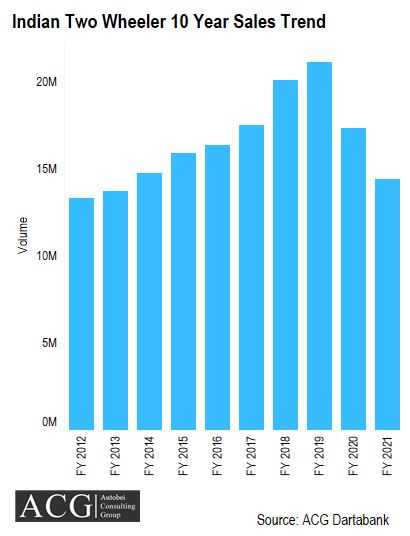
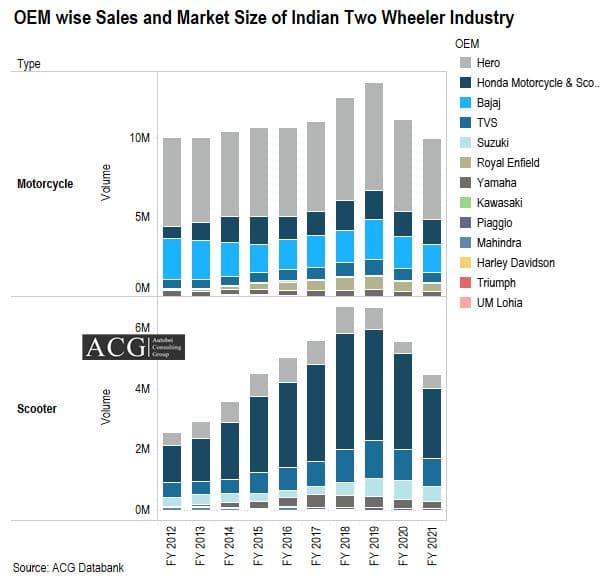
Indian Two-Wheeler Market reported a decline of 78% and the Bike segment registered degrowth of 73% in Q1 FY 2021.

Three-Wheeler Segment:

Indian Three-Wheeler Goods segment declined by 81% and Passenger vehicles declined by 94% in Q1 FY 2021.

Coincided with arguably the world’s stern and most stringent lockdown to prevent the covid19 from spreading in extension to low consumer sentiments, the wholesale dispatches, and retail sales of Indian automobiles contracted drastically in the quarter FY2020. Moreover, increasing fuel price, Inflation, slow demand slackened production, unemployment, lesser spending power appeared to be some major challenges since and post COVID 19 and lockdown.

The industry though is hoping for improved business and operations in June with sales limping back to 35% of pre-COVID levels.

Key Highlights of the report:

  • Indian Automotive Market latest updates on Investment, New Product launches, COVID 19 and lockdown impact,  and other updates
  • Sales, Production and Export Analysis
  • Next 3 Quarters Forecast
  • Customer Survey
  • Logistic and Transporters challenges
  • Dealership Crisis Analysis
  • Use Digital Technology acceptance
  • Passenger Vehicle Market Analysis
  • Commercial Vehicle Market Analysis
  • Two Wheeler Market Analysis
  • Three-Wheeler Market Analysis
  • Top Models, Pricing, and USP

Recently, the Indian Govt has started an auction for 42 coal blocks for commercial blocks. This will play an important role to create tipper demand.

Report Highlights:

  • Mining Tipper and Articulated Trucks Market size
  • OEMs – Volvo, Scania, Mercedes, Tata, BharatBenz, Eicher, and Mahindra
  • Model and location wise Tipper sales Trend and Forecast 2023
  • Market Share and Growth Analysis
  • Model-level Yearly cost Analysis for the different location
  • Model-level Product USP and pain areas
  • Pricing Analysis
  • The major reasons for product failure
  • Mining tipper customer database with their contact detail and fleet size
  • Key mining tipper locations, vehicle population, AMC, Labour cost, Running hrs of tippers, Mineral type of mines, the location of the lease, Working status
  • Major Aggregates
  • Product mapping
  • Location wise working hrs
  • Customer to Customer dealing market intelligence information
  • Fleet Required (Type and number of equipment)
  • Product Feedback
  • Engine Failure Analysis – Brand & Model wise
  • Oil Change Interval
  • Transmission Analysis
  • Axle Type and Axle Warranty
  • Axles shaft failure in hours/Kms
  • Differential failure in hours/Kms
  • Differential oil change intervals
  • Tipper Body volume & Type of Body
  • Spare parts pricing
  • A service contract, warranty
  • Soft offering e.g. driver training, telematics,
  • Free spare parts
  • Duties and taxes benefits
  • Service contracts, fleet management systems, financing, network density
  • Second-hand equipment
  • Average age
  • Average utilization
  • Key Tender
  • Key Tender milestones and Dates
  • Upcoming Tenders
  • Current Status (L1, L2 , H1)
  • Contractor Details
  • Expected Competition
  • Possible Challenges
  • Case study  – Sino Truck Business Model

Segments

  • Coal mining segment – overburden and coal transportation
  • Limestone
  • Quarry
  • Granite mining

Approach:

  • Qualitative and quantitative research
  • Primary and Secondary research