Indian Two Wheeler Market Analysis 2015

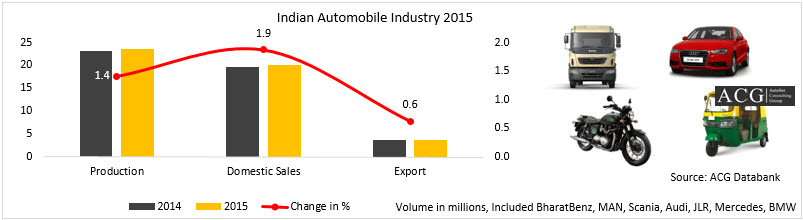
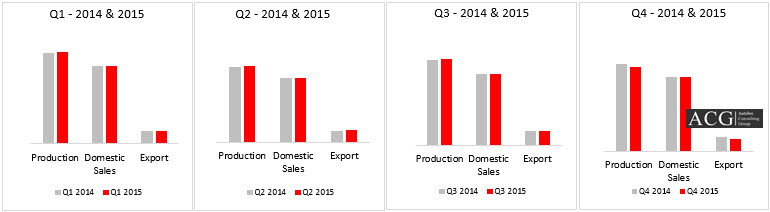
The year 2015 saw a slight decline in terms of production from 2014 to 2015, whereas sales dipped by a minimal 0.25%. In contrast, export saw a minor 0.16% in its numbers from 2014 to 2015.

When the two wheeler industry is analysed segment wise, we narrow it down and compare individual segment shares of scooters, bikes and mopeds. The segment share of scooters shot up from 2014 to 2015 by 3%. In the case of bikes, they saw a negative fall of 4% in the same period, and a stunning 7% decrease in segment share of mopeds from 2014 to 2015 was seen. Overall, production increased by less than 1%.

To get a more comprehensive view of the current scenario, a quarter wise analysis of the industry was done. Quarter 1 of the corresponding years of 2014 and 2015 saw a 0.23% fall. Quarter 2 saw a minimized escalation of less than 1%. Quarter 3 on the other hand saw almost a 1%decrease in sales over the corresponding years. Quarter 4 has managed an almost constant sales figures in 2014 as well as 2015.

The domestic sales curve of scooters sees an erratic behaviour when the different players of this industry were analysed with a comparison of sales in 2014 and 2015 placed side by side. Honda is definitely the dictator of this segment and it saw a stunning 16%increase in domestic sales through the previous year. Hero and TVS on the other hand saw mild increase in sales. Yamaha witnessed a timid increase in sales whereas suzuki portrayed a 16% reduction in sales which was alarming to note. Though Mahindra role in the big picture of sales was a very minor one, it still displayed more than 100% increase in sales over the year.

The market share and domestic sales curves go hand in hand as the graphs are just a linear relationship translated into one another. As expected, honda dominates the market bagging more than 50% of the scenario. Hero and TVS with nearly similar statistics, and yamaha, Suzuki and Mahindra playing minor roles too.

In terms of the export market share, Hero and Honda were at par and were the superpowers both with a stunning 41% each in the year 2014. However in the successive year, Hero saw a stunning decrease to 28% and Honda saw a slight decline to 38%. Yamaha on the other hand saw its export share multiplied five times to reach a 10% from 2% in the year 2015. Suzuki and TVS also noted similar increases in their export market share.

To obtain a more well-rounded view of the market scenario, we have also analysed the segment engine-wise. The 75cc and below segment saw a mind-boggling descent of 99% leaving it to practically be of no value in the year 2015, its key player being TVS. The 75cc to 90cc segment on the other hand saw a still hige 23% decline in sales owing to almost 4%of the market, its key player also being TVS. Bagging almost 99% of the market stands the 90cc to 125cc segment which showed only a 14%increase in sales, still managing to dictate the whole scenario with its key player, Honda.  The 125 to 150cc segment in stark contrast to the rest displayed an enormous exorbitant increase, though their market share still remained an insignificant 0, its key player being Vespa.

Motorcycle Market Analysis:

The motorcycle segment is now being analysed with respect to market share and comparison is carried out between the market share in 2014 and that in 2015. Hero owns more than half the industry and has seen almost constant numbers over the past year. Bajaj and Honda are the runner ups with slightly increase in share over the same period too. Companies like TVS, Royal Enfield and Yamaha own an insignificant percentage of market share, while on the other hand companies like Harley Davidsson and Suzuki barely manage to surface their sales above water.

Export Market Share %:

The export market share is almost entirely dictated by Bajaj with their 66%share of the market. Companies like TVS, Yamaha, Hero and Honda revolve a little above the 5% market share level. Companies like Royal Enfield and Harley Davidsson however barely touch even half percent of the export market share.

Engine Wise Analysis:

The engine wise analysis of motorcycles was also carried out and yielded the following results. The majority of the market is owned by the 75 to 110 cc segment with almost 65% of the market share with a 5% decrease in sales over the past year. It owes its market to its pioneers, Hero and Bajaj. On the other hand, the runner ups by an exorbitant amount are the 111 to 125 cc segment with a minor yet significant 16% share. As the engine capacity increases down the line, the sales as well as market share dwindles down to practically nothing after a point. This clearly states that in india, the two wheeler industry has thrived to a large extent due to lower cc motorcycles as compared to high octane powered brands like Harley Davidsson, Kawasaki and Triumph.

BharatBenz-Truck-sales-analysis-2015

BharatBenz Truck Strategy Analysis report is exclusive detail report. This is the newest product and corporate addition among the Daimler group. It has noted a excellent growth in sale of Medium and Heavy duty trucks after it’s launch. Daimler has introduced this brand especially for the truck segment for Indian and other emerging countries. This analysis gives a detailed descriptive intelligence analysis on the Truck Model wise sales, State wise sales analysis, Truck Segment wise sales, Product position, Pricing strategy analysis & Trend, Production & branding Strategy, Network analysis, Market share of BharatBenz.

It was assumed that Daimler only wanted to target the niche segment when they introduced their premium model, Actros into the Indian Truck market. Another major player in this department was Scania, a global player created by MAN for the new budget segment. India’s vast market is dictated by the budget segment and Daimler has rightly realised this potential for incredible growth. Indian market could very well be the biggest market for this group if they pool in their resources wisely, and their main challenge would be to balance the scales of their brand image with indian prices and position. It is very important to have the right product position with balance and market dynamics at BharatBenz.

The company has seen tremendous growth over the years. 2013 registered a whopping 73% increase in sales as compared to the last year, and 2014 saw a 172% incredible increase in sales from the previous year. The sales figure every year prove beyond doubt the giant lies that BharatBenz has thrust forward to achieve more number of sales in India, with their impressive product portfolio.

The Rigid Haulage truck segment of DICV has seen a steady growth in the transition from 2013 to 2014. The Tipper on the other hand has noted a considerable de growth of 40% in sales and has dipped extensively over the same year. Tractor or loang Haulage sales on the other hand have seen a impressive 96% increase leaving everyone mouth-gaping.

The two most targeted and significant regions for truck sales in India have been the southern and western regions. Bharat Benz has targeted the South region and have managed to capture 48% sales in this region. It’s incredible success in this region could be attributed to the major fleet owners and decision makers who inhabit this region. This region is also characterized by its flexibility, both in the South and West. People in the North and East regions have been observed to have an open mind towards new brands. The company gained 2% sales in the south and the East, lost another 2% in the West and north.

The 16T truck was not launched initially by the company. Only the 12T was available powered by its 70hp engine and it’s payload and application suitability. After the 16T was introduced due to market, dealer and customer demand, sales saw a hike. Kerala and Goa are two major regions of development for this segment.

State wise sales trend showed that BharatBenz has made a strong foothold in Maharashtra. TamilNadu, Karnataka. Regions of South India, Punjab – Haulage market have also shown a positive, impressive growth due to the attractive multi axle tipper market.

Initially, the company targeted it’s truck sales only in certain states and regions to ensure proper sales-service. The plan to capture market share has been a goal for the company who have reached there though division of regions zone wise and step wise. Jharkhand, a potential market could be next to capture the market with it’s off road tipper. After networking the Dealers in India, the company has also launched its Tractor. Products like the Tipper and LCV were introduced during the beginning of sales as the run in a limited span. The company approached sales wisely with the goal of efficient, quick service.

Daimler has used effective entry strategy into the the Indian Market segment and Product segment. The Company has been seen with such enthusiasm that the BharatBenz truck segment is extending onto the Bus project for budget segment. It’s product positioning and value proposition made it popular and welcoming entry into the Indian commercial vehicle market. Also,DICV started export in a short period of time to neighbouring countries.

Its target customers are the medium & large fleet owners in South India which then extended into West India, North and West India region. South and East India are largest markets for truck Industry.

The heavy duty segment is characterized by it’s flagship products, 3123 and 2523. LCV has it’s flagship products as 1214 and 1217. Sales of Tipper have dipped by 16% whereas the 12T segment sales have shooted by 1%. Recently launched products like the 4023 and 4928 have also registered impressive growth.

Pricing Strategy:

BharatBenz has launched it’s products at a very competitive price. They are a bit higher than those of traditional players like Tata, Ashok Leyland. Their strategy is to give products with additional features at the market price. Discounts are not offered by the company, which has been bombarded by complaints and unhappy customers in the Indian market.

The Company has increased the prices of all it’s products launched between 2012 to 2015 by 1 to 2 Lakhs (2.000 to 4.000 Euro).

The most sellable trucks like 2523 (Tipper), 1214B and 1217 have seen  a 2 lakh increase in price(4.000 Euro) and sales of other products which needed to take some time to establish  were increased by 1 lakh(2.000 Euro).

Dealer Strategy:

The BharatBenz dealer showcases their impressive infrastructure and cleverly planned campus with all facilities made available including driver space just like any other car showroom. There was a time when such a rich dealer network was provided by Mahindra Truck and Bus.

Media Strategy:

At BharatBenz, they strategized by giving proper awareness of it’s product through Industry Magazines, newspapers, blogs, Digital plate form etc before launching the vehicle into the market. They did not focus too much on popularity through advertisements, and this decision had a positive impact on potential buyers.

Brand Strategy:

Daimler has launched a new brand in India. It gives a clear message to the market that this is an Indian brand but characterized by Benz quality and standard. It’s new logo successfully differs from the Mercedez Benz one.  Their campaign and indirect marketing were successful in creating an effective brand image. However some of the Western media criticize this concept to introduce budget truck.

It give preference to public relations rather than paid advertising & promotion. The vendors follow a very unique strategy where DICV signs an agreement with them vendors which is very helpful for its dealers.

Bharatbenz Truck Strategy Analysis report

AMW Truck Sales Analysis

The AMW Business Review aims to understand the role as well as the impact of after sales in the Commercial vehicle Industry. According to latest statistics reports, AMW products have showcased excellent growth figures. However, their growth has not yet reached its bar due to the lack of appropriate after sales strategies. There used to be a time when AMW was considered a key competitor by Indian and European OEMs, especially in the heavy-duty truck and tipper segment. However, the situation is not so in the present day.

It can be clearly seen that apart from a linear growth of AMW along with the industry, it has failed to be at par with the industry, specifically in the period 2014-15.

After an extensive analysis of the sales figures, the following updates were listed as those that majorly affect the situation. It was observed that dealer margins were affected. Also, it was seen that the dealers go through very strenuous ordeals currently. There also exists the issues of the waiting period for delivery and also the price of spare parts. There was also noted a need to improve after sales service and provide dealer and financial support. Another major hurdle that was noted was that the transportation cost of the vehicle was passed on to the dealer and also, the dealer margin amounted to around Rs. 40,000.

AMW Truck price variants 2015

The price of AMW vehicles is highly competitive and lies in the budget truck segment. The price of a Tipper (16T,25T&31T) starts from 19 lakhs and goes until 29 lakhs. On the other hand, the price of a Haulage ranges from 16 to 21 lakhs. Tractors’ price extends from 17 to 24 lakhs. Additionally, special application vehicles’ price ranges from 19 to 28 lakhs.

AMW Sales and Market trend:

AMW Truck sales and market share analysis

The above graph compares the sales and market share of AMW from the year 2009-10 to the year 2014-15. Evidently, 2011-12 was the year that saw maximum yield for the company touching a whopping 10,000 units sold. However, in the subsequent years, this figure kept depreciating year by year.

Segment Analysis:

AMW Truck Rigid haulage and Tractor sales analysis

The above graph now analysis each segment’s sales and market share of the different segments of this company. Starting at a comfortable point both Rigid Haulage tipper and Tractors have only shown a degrade in their sales and market share with more than a 90% dip in sales from 2011-12 to 2014-15 in the tractor segment.

AMW Multiaxle truck and Tractor Analysis


To buy full report, click on request Quote tab

Bajaj Auto is a name that’s widely known all over the country and is one of the key dictators of the bike as well as three wheeler passenger vehicle segment. There was once a time when Bajaj reigned the scooter segment. Their two wheeler segment was dictated by two very famous products in their portfolio, Bajaj Pulsar and Discover. In the commercial segment however, there was not much impact as it was not able to penetrate the range. Still, Piaggio dominates the segment owing to a multitude of reasons.

Bajaj Auto Business Analysis Report

In the year 2015, there was a dip seen in the Bajaji Auto two wheeler market share from 14% to 11%. Market share on the hand in the three wheeler segment rose from 30% to 44%. Presently, the company is experimenting by trying a permutation and combination of their old brands, Pulsar and Discover brands.

These are some of the permutations with good results:

1. After launching the 135cc Discover, competitors started promoting the same at the cost of a 125cc bike. Hence, financial stability is one of the main obstacles.

2. Pulsar launched the 125cc bike after the launch of the 150cc bike, and hence customers were not satisfied with the same. As the Pulsar was initially launched as 150cc, it was contradictory to downgrade to a lower version.

Hence, maintaining the brand position requires the introduction and establishment of the bike segment. Proper segmenting can also be done as definitions per product specifications and target buyers. Similar problems were faced by Porsche and Hero bond in Europe and India.

This report is the series of our yearly Bus Market Intelligence Report. There is a detail analysis of Indian Bus Industry. Small Bus segment, Light Bus segment, Medium Bus segment and Heavy Segment Analysis covered in this report.

Model wise Pricing analysis and product position is also included in this report. Technology Trend, Sales, Export and Production of Ashok Leyland, Tata Motors, Force Motors, Mahindra, SML Isuzu, Volvo and Eicher OEMs.

Macro Economy analysis and forecast, Bus Sales forecast, Customer buying habits exclusively are also part of this study.

This is part of our yearly series of Truck Analysis report. We have covered Current market size of each segment by GVW. Category wise included Small Truck, Light Truck, Medium duty truck and heavy duty truck. This report also gives snapshot of Key macroeconomy and its relation with truck sales. Key points of Indian Truck Industry overview. Production, Sales and Import analysis of Brand wise and sub-segment wise. Variant wise pricing analysis also part of the study. The segment, brand position and Brand perception with customers mapping. Detail purchase habits analysis and forecast along with technology up gradation trend.

In the SCV segment, which is the largest in the industry sales have seen a minor drop in the period. The HCV segment, on the other hand, has seen a slight increase in the sales. LCVs and MCVs are two segments which are characterized by very low sales figures and they have remained fairly constant in the two years.

In the M&HCV segment, we have compared the sales of individual companies in the transition between 2013 and 2014. Tata Motors being a pioneer of this area has seen a flourishing sales figure which has increased during this period. Ashok Leyland, being a close runner up has also witnessed a slight increase in the same over the year. VECVs-Eicher though having meager sales still has seen a fairly constant trend with respect to sales.

M&HCV Segment:

Production:

Production wise, Tata motors stand out again as the dictators of this department. Their production figures have almost remained the same in the transition between 2013 and 2014 as is clearly visible from the graph above. Ashok Leyland, the runner-up of the segment has seen a microscopic increase from 2013 to 2014. Other companies like mahindra& Mahindra, SML Isuzu barely have any production figures to make a mark.

Export: 

The exports are mainly dictated by three companies, namely Tata motors, Ashok Leyland and VECVs-Eicher. Among the three companies, Tata Motors has shown the biggest growth in terms of a number of units exported, with almost a stunning 40% growth. Ashok Leyland and VECVs-Eicher have also seen an escalation in their exports by meager amounts.

LCV Segment:

The LCV segment in the truck industry was being ruled by Tata in the year 2013. In the subsequent year, this, however, was not the case as sales in the company went down by almost 50% keeping this company at par with Mahindra &mahindra, who are the pioneers of this segment. Ashok Leyland also owns a small share of sales, while going down by a depressing 30% of sales. Companies like Force and SML Isuzu on another hand, barely make their mark on the radar.

Production:

Production wise also saw Tata at the crown in the year 2013. However, at the onset of 2014, these figures dropped by a staggering 40%. Mahindra & Mahindra have a constant sales graph with 2013 and 2014 and are now at par with a production of Tata in the year 2014. Isuzu and Ashok are also minutely visible in the industry. Though Piaggio and Force, Motors are barely even there.

Export:

Export-wise, however, did not see much of a decline in Tata Motors which plummeted down by a very minute amount. Hence the difference must have been seen in domestic sales. Mahindra has also seen a small decrease in export figures. VECVs-Eicher has managed to maintain a constant export figure throughout. Piaggio also falls under the same category.

Small Truck: 

Sales of small trucks have upped by 6 % in the 2 tons segment and by around 14% in the 3.5-ton segment.

Light Duty Truck:

These light duty trucks have been further categorized into : 3.5 to 6tons and 6.1 to 7.5 tons. The 3.5 to 6 to the segment has reduced to a mere 64% in 2014 from a brilliant 70% just the previous year. On the other hand, the 6.1 to 7-ton segment increased its market share by 6%.

Medium Duty Truck:

The medium duty truck segment has been divided into two, namely the 7.5 to 10 ten segments and the 10 to 14-ton segment. The 7.5 segment took a hike from 29 to 31% over the period from 2013 to 2014. Parallelly, 10 to 14-ton segment has taken a hit from 71% to 69% over the same time.

Rigid Haulage and Tractor segment:

One very alarming finding that we stumbled on is the stark difference between the 2013 and 2014 sales of rigid haulage and tractor. Both rigid haulage and the tractor segment have dropped by an exorbitant 90%.

Rigid haulage:

The market share is divided over 3 categories in the rigid haulage segment. The 16.2 ton, the 25 ton and the 31-ton segments. The 16.2-ton segment saw a 4% reduction in market share from 2013 to 2014. The 25-ton segment has maintained a constant 25% over the sale period. Finally, the 31-ton segment has seen a 4% hike to reach 33% of the market in 2014.

Tractor Segment:

The tractor segment is also categorized into three for ease of analysis of market share. The 35-ton category has dropped its market share from 33% to 27% from 2013 to 2014. The 40 to 49-ton category has seen a 5% increase to reach 69% in the sale time. Last but not the least, the >49 tons seem to be constant in their market share at 4.7%.

Indian premium truck market is our exclusive research Report. It covers various important parameters of Premium Truck segment.

– Premium truck Industry Overview

– Industry Volume and Forecast

– Industry Dynamics

– Macro Economy

– Volvo, Mercedes, and Scania Truck Sales

– Competitor Landscape

– Tractor Trailer Segment

– Sub-Segment Analysis

– Product position of Mercedes, Scania, Tata Prima, MAN (TGX… range), and Volvo

– Customer Study

– Product life cycle

– TCO Analysis

– Spare parts analysis

– Application Industry (Mining, Construction, Logistic etc) and End-user analysis

– Key Financiers

– Purchase Concept

– Brand Perception

– Branding

In the Commercial vehicle Industry, MAN Truck and Bus is one of the brands with an international reputation and is well known all over the world. Owing to it’s global popularity, this company sought to make it’s stand in Indian soil too. MAN Truck India is increasingly becoming one of the most sought after and studied case studies with respect to this company. Being the pioneers or the creation of a new mid modern segment in India, the numbers are predicted to portray a double-digit growth, hoping to surpass the other mass market segments in the Indian truck industry. MAN India’s operation combines a plethora of parameters- MAN trucks & Buses, India operation. Force Motors, old leadership style, MAN representatives in India, Munich Office, Languages, Culture, working style etc. The scope of this case study is so vast and highly intensive that more than 100 articles could be written on this topic.

One of the main constituents of the above mentioned case study involves Dachauer Straße 667, 80995 München Germany, MAN in their Pune office. One of the main issues faced by operations in India was that of Proper coordination, especially with respect to working hours. MAN office was closed on weekends and stays open during weekdays, but MAN Force Motors was closed on Thursdays. Technically, for three days in a week there is no communication between MAN Munich and MAN Force Pune office in India. In the intermediary four days, there was also the existing problem of the time difference of 3-4 hours that exist between India and Germany. The production unit is housed in Pithampur whereas the head office is placed in Pune, making the current scenario an entangled map of business.

When the year of 2000 dawned, MAN was known globally and shortly after this the management decided to collaborate and work towards creating a solid vision and planning towards achieving it. The 9 year tenure initiated with three new ventures whose business models were extended to emerging markets. First, CNHTC China was started. Then Volkswagen’s Brazil Commercial Vehicle Business was purchased. Also, JV was established with Force Motors in India. They established that BRIC would be their first priority. Though MAN was able to create a global impact as a brand, they were incapable of creating a similar impact in India too. One of the significant questions asked was why MAN was not able to make it’s presence matter in India.

Once, Force Motors tried fitting one of its most notable products, the Tempo Traveler with a Mercedes Engine and this yielded surprisingly good results. Looking at the scenario as an opportunity, Force Motors sought to MAN Munich and strike a deal which questions the possibility of combining their products with MAN’s engines and parallely, MAN was seeking an Indian partner to secure its entrance into India. An understanding was reached and the duo successfully established MAN FORCE Motors Ltd in 2006 with Mr. Schumacker appointed as the first executive in India. Mr. Schumacker had worked on developing the military vehicle named   “SHAKTIMAN”

MAN FORCE JV Signed India_ACG

This joint venture aimed to combine the technological expertise and MAN ‘s reputation as a global brand with the local market knowledge of Force Motors and their network to secure a place in the Indian market for MAN and provide a means of expanding business for Force Motors.

However, this understanding was shortlived when there arose conflicts between the two with MAN drifting off to open a separate office in Mumbai in the MAN Diesel facility. This office in Mumbai was established with help of Mr. Atul Chandel and Mr. Xavier Polster from MAN Munich and later on, they were joined by Mr. Neundlinger from China. They planned to separately commence operations to carry on with the sale of premium TGX/TGA-WW products. However after a period of time due to various reasons, the office in Mumbai was shut down.

MAN JV India news in German newspaper_ACG

MAN Trucks India Pvt Ltd saw the commencement of their operation under the name, “MAN FORCE TRUCKS Pvt Ltd” having collaborated with Force Motors as a part of a joint venture, India in the year 2006.

But, in the year 2011 in the event of failure of this joint venture, MAN Trucks India Pvt. Ltd. This was fully owned as a subsidiary of MAN Truck & Bus AG, Germany.  The headquarters was placed this time in Pune while the production plant was housed all the way in a small town in the state of Madhya Pradesh, Pithampur with over 1000 employees.

MAN Force become MAN Trucks

MAN Trucks milestone India_ACG

In the course of five years when MAN Force, the joint venture was riding high, the customers were engulfed in its web of promises and slogans. Some of them are mentioned below:

  • India’s Future is Riding the New Expressways
  • Harnessing the world’s Best Technology
  • Introducing India’s New Benchmark of Reliability, Performance, Efficiency, Safety and Endurance
  • Tomorrow’s vehicles manufactured right here, in India today!

Product Launch:

Initial stages of this product saw a collaboration with Force, but the company realized that in the long run, this would turn out to be more harmful than helpful and would question it’s authenticity in the eyes of customers. It would lose its stature as a premium product. Following its transition from Force to MAN, the company launched a tractor head in the top tractor segment. Shortly after this, the company saw entry into the tipper segment.

Another major issue that plagued the company on account of it’s joint venture was the intercultural aspect.

Germany and India Intercultural dimensions_ACG

MAN also introduced its AIROBUS shortly after making its entry into the tractor and tipper segment. The company launched a 45 seater Luxury AC Coach.

MAN was still working with an amateur mindset and had not quite figured out what their stand and place in the market was. They had trouble figuring out their approach in the market. What made it all the more appalling was that BharatBenz entered the Indian market only after MAN but managed to sell more vehicles than MAN itself. They had failed to connect the line between MAN and Bharat Benz and analyse what they were doing right and MAN was doing wrong. While Bharat Benz focused only on Heavy duty vehicles, Bharat Benz had a plethora of segments ranging from light to heavy duty. One of the other major differences that was identified in both their approaches to the Indian market was that MAN targeted only the niche segments of the Indian society while Bharat Benz focused on mass market. It can be seen there were both financially strong and had very similar reputation and both being German companies. However BharatBenz could place a stronger foothold in India in a fraction of the time that MAN had already established in Indian markets.

Product Support

In terms of product support, the company introduced a plethora of schemes. Some include the following, with the promise of free service under the following conditions.

Haulage: This ensured that the customer got his 6 free services which could be availed at an interval or the earlier of either 15,000kms or 60 days.

Haulage with 2VCR & VP44: This supported the customer by providing the promise of 6 free service with an interval of the earlier of either 20,000 km or 75 days.

Tipper & Special Applications: This type of support could be availed on tippers and special application vehicles which entailed 6 free services intervallic at 450 hours or 30 days, whichever is earlier.

Along with product support in terms of specialized and customized service options, the company also had a flawless Warranty Policy.

Haulage: This warranted the product for 24 months or unlimited number of kilometers.

Tippers: on Tippers which gave a warranty for 18 months or 3000 hours, the earlier of the two.

Bus: The warranty on bus held good for a period of the earlier of 24 months and 200,000kms.

Apart from warranty on vehicles, there is also a warranty on separate parts which was introduced to ensure customer satisfaction, which MAN regards as their highest priority. All parts came with a warranty of 6 months or 1000 hours or 40,000 kms from the date of purchase from their respective dealers.

Additionally, the company is equipped with a network to deal with after sales need and support for its customers. This network ensured that after-sales service was on time and efficient, supervised by a global network of equipped dealers. These dealers are located ideally along the Golden Quadrilateral. Equipped individually with a mobile service van, these dealers are able to provide round the clock service to customers. In the case of large operations, “On Site Support” is provided customized to the individual needs of the customer. Apart from this, Sales and service of spares and vehicles are available.

Reasons for MAN’s downfall in the Indian Market:

There are a multitude of reasons for the downfall of MAN’s products in the Indian market. Some of them include considerations of Product and Pricing, Positioning, and Promotion techniques.

  1. Product & Price :

Launched initially in the year 2006, the company sat down with the objective of creating a vision for tractor heads being 65% and tippers being 35% of the sales plan. They were priced at 24 lakhs. Though the customers swallowed a bitter pill with the exorbitant price, they accepted it in view of MAN being a globally reputed brand. Also, MAN had promised to reduce the prices after products became localized within a stipulated amount of time.

On the other hand, another problem existed. Though they were no longer associated with Force motors, product support and after sales support was taken up using pre-existing Force dealers in Mumbai, Belgaum, Bangalore, Chennai, Coimbatore, Jaipur and Gurgaon.

Additionally, the service network was low and this caused the huge collapse of the Haulage market’s initial plan resulting in customer rejection.

MAN ‘s focus transitioned to tippers with capacity of 280HP and 25Tons thus contributing to the mining sector. But this requires them to compete with Actros and Volvo which provide the same specifications at a much lesser price.

As time went by, the market saw the entry of new, dangerous, more attractive and efficient competitors in the form of Bharat Benz and Tata with similar products and prices as well. Ultimately, it set in customers’ minds that their expectations were not being fulfilled by MAN India. The concept of MAN was turned into one of unsatisfying services and they withdrew their interest in the company.

  1. Position :

In terms of position, MAN’s failure can be owed to agreements that Indian customers have with commercial vehicles for undertaking mining projects, road constructions, irrigation work, soil transportation and metal transportation for Haulage and Tractor head models.

Initially, customers accepted MAN’s high prices and its value for money but in segments like Mining and rig applications, they required higher horse power than that provided by those than MAN launched.

They were very hasty with production. Clear proof of this manifested itself when around 16,200 tipper vehicles with 6 speed gear box was launched, when a chronic problem of gearbox failure existed in the Kerala market.

A similar problem existed when they launched the MAN AIRO bus in India. They had initial failures and without prior validation trials and servicing, the product was introduced to its customers.

MAN was evidently incapable of performing in the Indian market.

  1. Promotion:

Initially prior to transitioning from MAN FORCE to MAN, the company conducted many road shows and awareness campaigns were conducted throughout the country. Special emphasis was given to advertising to promote and create a huge awareness for the company and all this succeeded in selling more than 8,500 in India. However after becoming an independent company, JV MAN failed to create a brand image or any sort of awareness in the minds of it’s customers through the media. Many dealers have quit from MAN as confidence that the company would be able to stand tall was dwindling down to nothing. MAN’s vision that they built out of confidence, faith and sheer determination was crumbling down to smithereens.

MAN Trucks India New Strategy, Markets and Products_ACG


The Indian Bus market is one of the most thriving sectors that is predicted to show tremendous change over the coming years. It is estimated that this market size is likely to double it’s current size by the year 2020, owing to more than 80,000 units only in the >8t segment. Translating this fact into statistics shows that the category of buses above 8 tonnes will result in every fifth bus being sold worldwide will be geographically located in India. Though the future forecast seems promising, the year from 2012 to 2013 saw a negative 5 % growth which was quoted as the “first time that overall market is shrinking”. That being said, the consumer has to battle the causes and effects of inflation. Though it has been difficult to put a finger on exactly how this inflation will pan out, it is agreed upon that a slower annual gain has indeed, in the long run helped to lift the load off the consumer.

A government report released here on Thursday showed an all-time low in the last three months amounting to an 8.28% in May in contrast to the 8.59% in the previous month. It predicted a couple other findings. According to the above said report, fuel prices would increase and the Budget deficit of GDP would decrease. Modi plans to construct more ports, roads and bridges in order to secure investment and it has been predicted that this move of his will definitely increase the GDP to an all-time high seen in the last four years of 6.5% in the duration of a year ending with the March of 2016. Additionally, the report also predicted that the IIP rate would increase and many steps were taken in order to increase the rate of manufacturing.

The following report details the recent out comings and trend analysis of the market. The new government has introduced a great deal of projects and broadcasted improved infrastructure plans. This plan has been extended to 100 developed cities. The growth rate is further calculated by plotting graphs to witness how change in the rate of emissions is affecting the sales. With the coming of new projects, what becomes mandatory is the need to increase demand and this arises out of expanding the borders of cities. One of the major standing causes for the flourishing of the Indian bus industry is the fact that the sky rocketing price of fuels is pushing consumers to shift to public transport means instead of private, which turns out to be a highly wallet-burning option. Additionally, schools, BPOs and corporates need buses to provide a comfortable transport option to t’s dwellers which makes up for another reason for increased popularity of buses in India. Beyond all this, many people are moving into the Middle class who prefer public means of travel and not to mention, India’s rising population, ensuring that an industry thrives it’s maximum here.

Production:

The production figures see a two-company dictated process where Ashok Leyland and Tata Motors owe for more than three-fourths of total number of buses produced. The clear pioneers are Ashok Leyland and Tata Motors. However, one thing that’s notable is the decrease in sales from 2012-13 to 2013-14. Companies like VECV-Eicher and SML Isuzu also add to a minor percentage of the production numbers, though not much. Companies like Volvo uses, M&M and Scania on the other hand are virtually non-existent in terms of production figures.

Sales:

Linear to the production graphs, the sales figures paint a similar picture. Tata Motors and Ashok Leyland dictate the sales scenario also with VECV-Eicher, SML Isuzu and MTB accounting for a very minute percentage of the sales figures. Companies like Volvo buses, Scania and Mahindra & Mahindra are invisible in terms of sales numbers. Though Tata and Ashok Leyland have seen such a flourishing growth they have both seen an equally big downfall of about 10% in sales from 2012-13 to 2013-14.

Export:

The export kingdom has also been ruled by the two big superpowers: Ashok Leyland and Tata Motors. The other companies in the race are like tiny dots on an ocean: virtually invisible. Export has purely been dictated by these two companies.

Not surprisingly, Ashok Leyland stands at the top of the market flow chart with almost half the market share. This number has only slightly reduced in the subsequent year. Tata Motors on the other hand, being equally a superpower has seen a 1% increase in market share. VECVs-Eicher and SML Isuzu have managed to stay in the picture with a minority market share, however companies like Volvo, M&M and Scania have not achieved to even start this race.

Sales Market Share:

The domestic sales have also been reported graphically in the following analysis. It comes as no big surprise when Tata Motors and Ashok Leyland arrive at the top in this aspect too. The domestic sales share is shared equally by Tata Motors. Tata Motors’ market share has shot up by 2% while Ashok Leyland’s share has plummeted by the same amount in the period between 2012-13 to 2013-14.

Export Share:

The export market share has however single headedly been dictated by Ashok Leyland with as high as a 70% share in 2012-13. This figure however has reduced by 8% in the subsequent year. Tata Motors has seen a flourishing increase in export market share by 3% over the same period. Other companies however have been dormant in terms of export share.

LCV Sales:

The LCV segment has Tata Motors in the scene, but Ashok Leyland is nowhere to be found. Though Tata motors has seen a slight decrease in sales over the year from 2012-13 to 2013-14, it still stands as the pioneer of this group. Force Motors has also made it’s stand in this sector with an equal share in sales as Tata Motors in the LCV segment. Minor but still existent sales can be seen in VECVs-Eicher, SML Isuzu and MTB.

Market Share:

The sales market shares in the LCV segment as translated by the sales figures has Tata Motors and Force Motors as the dictators of the segment with almost 40% sales share in both the companies. VECV-Eicher has seen a 2% increase to amount to a 10% sales share in 2013-14 from 2012-13. Similar situation is witnessed in the case of SML Isuzu and MTB.

Export: LCV

The LCV exports are not a very high industry, but what exists is dictated by Tata Motors whose figures however has reduced in the year from 2012-13 to 2013-14. The three companies owe to just a few units exported during the same period.

The market share in the exports sector of the LCV segment puts Tata Motors on a pedestal. The other companies as seen in the exports figures owe to insignificant values to export market share.

Medium Duty Bus

The MCV segment comprises of buses in the 7.5t to 12t section. Out of the six companies that dictate this segment, Tata Motors has seen the maximum sales in the time between 2012-13 to 2013-14. Ashok Leyland, SML Isuzu and VECVs-Eicher are close followers all oscillating between the 3000 units sold mark.

Market Share:

As seen in the sales figures graph, the sales market share translates the same analysis. Tata Motors has seen a stagnant market share owing to around 37% of the market in the MCV segment. Ashok Leyland, SML Isuzu and VECVs-Eicher also aid to a considerable market share whose numbers are almost equal. Ashok Leyland has seen a 2% increase in sales in the duration between 2012-13 to 2013-14.

The export figures for the period from 2012-13 to 2013-14 are exhibited thus. Ashok Leyland stands as the first in this aspect with the other companies not even coming close to it. VECVs-Eicher on the other hand saw its export figures multiplied four times in the mentioned period. Tata Motors has been racked by Eicher who currently stand as the runners up after Ashok Leyland.

The market share for Ashok Leyland has come down by almost 10% in the period between 2012-13 to 2013-14. VECVs-Eicher on the other hand has seen an increase in it’s market share from a mere 9% to a stunning 27% in the same period. Tata Motors has also seen a 10% decrease in export market share standing at a 18% export market share presently.

Medium Duty Bus

The medium duty bus sales figures show Ashok Leyland who stand at the top, however suffering from a decrease in sales in the period between 2012-13 and 2013-14. Tata Motors also shares the position of leaders of this segment.

The sales share revolve at almost 50% sales market share each for Ashok Leyland and Tata Motors with VECVs-Eicher with an insignificant 4% market share at the end of 2013-14.

Export:

Export figures again shine a spotlight on two companies, namely, Ashok Leyland and Tata Motors. Ashok Leyland saw a 10% decrease in it’s export figures over the year while Tata motors saw an equal increase to owe to about 1818 units exported.

Market Share:

The export figures are translated onto the export share with Ashok Leyland keeping a stand on nearly three-fourths of this segment and Tata Motors with almost one-fourth combining to be the super powers of this segment


Indian Bus Market Report FY 2013-14

  • Why Chinese Passenger/Commercial Vehicles/Two Wheeler’s OEM’s could not penetrate into Indian Market
  • Effective entry strategy of Chinese OEMs
  • Challenges for Chinese companies- Product/Brand image/ Culture/Price/ After sales/ Reliability/Technology
  • Expected suitable entry segment
  • Detail analysis of Chinese OEMs and their Business practice
  • Chinese Market Overview

– Chinese Automotive OEMs opportunity to enter India

  • Own subsidiary
  • With JV (Along with hurdles for JV)
  • Import
  • Benefits for Chinese OEM’s to put up manufacturing base in India to help them not only to take share of the growing India market as well as Exports to developing countries . (LCV , MCV , HCV, Buses & Passenger vehicles)
  • Foton – Why have they not being able to take off in India
  • Possible partners for a Chinese OEM in India
  • Other opportunities available for them if they enter in India
  • Customer/Dealer survey


Pricing Trend analysis is exclusive research conducted by ACG. We have seen how price d move in last 3 years. It is analysis of Brand wise, Model wise and with all its variant wise.

In Rigid haulage price has increased from AMW Motors 5 to 13% based on 7 variants, Ashok Leyland 1 to 20% based on 29 variants, Eicher Motors 6 to 29% based on 75% variants ,Mahindra Truck 6 to 31% based on 38 variants, MAN  21 to 34%, 9 variants, SML Isuzu 4 to 7% based on 16 variants.

MAN, Tata Motors, Ashok Leyland, SML Isuzu, Mahindra, AMW Motors, Volvo, BharatBenz, Eicher Tipper prices increase from 2 to 17% based on 153 variants of Tipper segment.

MAN, Tata Motors, Mahindra, AMW, Ashok Leyland, Tractor vehicle increased 2 to 11% based on 68 product variants.

Bulker of segment saw price increased from 4 to 8%.

Fuel Tanker saw 5 to 6% price increased.

Transit Mixer price increased 2 to 13%.

Similarly we have done analysis of price trend since 2011 to 2015. We have inlcuded  Tata Truck Price, Ashok Leylamd Truck price, MAN truck price, BharatBenz truck price, Eicher truck price, Scania truck price, Force Motors truck price,Mahindra truck price, AMW truck price

Pricing Trend Analysis of Indian Truck

The following report entails an extensive analysis of the Bus Pricing Trends. It’s an exclusive intelligence report that analyses, weighs and explores trends in Bus Pricing. The trend analysis has shown that the price has been increased every year. The Small bus segment saw an increase in the price of the Tata Motor’s Winger from 30,000 INR to 50,000 INR. The hike in price however, depends majorly on product variants and model. The small bus segment of Tata Motors showed an increase in price ranging from a 3.77% to 13.15% increase translated in various models like the Winger, Magic and Venture with 47 variants in each of these models.

On the other hand, the Light Duty Bus segment of Tata Motors has seen an escalation in price in 2013 from 2011 and 2012, owing to a 2 to 10% increase during this time. However this increase was more pronounced in the years between 2011 and 2012 with a change of 10 to 17% in pricing.

In the case of Medium Duty Bus by Tata Motors, the price hike stood ground at 8 to 15% in the year 2012 and from 3 to15% in the subsequent year. There’s clearly been major price fluctuations in the small gap of a year, owing to the 80 or more variants of the Star bus & Star bus skool, LP Series, LPO Series and Tata City ride.

On the heavier side of things, the Heavy Duty Bus segment has seen a price ascent ranging from 3 to 11% increase on the 67 variants of the Bus models which include TARMAC coach, LP 1618, 1623, City bus and the CNG Buses.

Parallelly, in-depth analysis has been carried out for companies like Eicher, Ashok Leyland, SML Isuzu, Force Motors, Mahindra, Volvo and Mercedes Buses. The said report contains details of MRP Price, End customer price, Discount trends and it’s parameters, Dealer margin, Govt & Institutional sales, Labour charges of dealers, Local garage and Authorised Service centre and Price change of Bus of all the individual variants. The report also encompasses the emission norms. Additionally, it focusses on customer segmentation with variants differing in fitments like Air Brake, PTO, Special color, AC and Non AC. The difference between Euro II and Euro IV is priced at 75,000INR.

Apart from all this, this report includes the spare parts in both the Genuine and Secondary market to give the customer to an overview of the options he/she holds. Options and pricing are also contained in the report with respect to consumable parts like Air filter, Fuel filter, Oil filter, Water separator, Clutch plate, Engine parts, Electrical parts, Pressure plate, Oil seals, Brake cam, King Pin, Lube Filter etc.

This report also shines a spotlight on OEM pricing models, Competitive analyse and it’s forecast. We have included Tata Bus price, Ashok leyland Bus price, Eicher Bus price, SML Isuzu Bus price, Force Motors Price price, Volvo Bus Price, Scania Bus price, Mahindra Bus price.