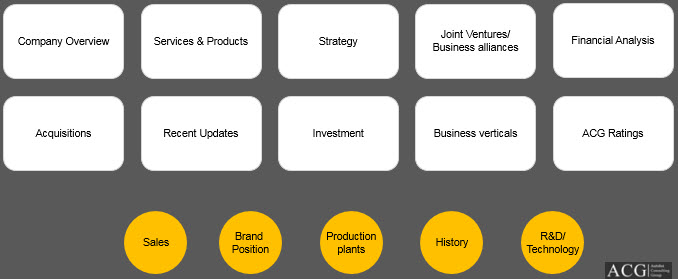
Global Automotive Supplier Study consists of more than 1,200 regularly updated automotive supplier profiles and analysis, making it an perfect reference for quick and precise information on your finger tips.

It is not just text stories about company profiles or data base, products, Finance, Strategy, JV, History and so on. We draw concept to understand quickly about all key information about companies, its stregnth, Product line, portfolio, management, production location, Customers, forecast and so on.

Global Automotive Supplier Profile Database

We update our report in every six months and it avaibale as a standard one and customize version to meet your reqriements.

Adoption new technology is one of the key challenge for Automotive Industry in India. New Emission norms and features like ABS is going to play important role to give new shape to Indian Auto Industry. New Automotive Technology Implementation and impact report describe challenges, implications, advantages, cost and other market dynamics about Auto technology.

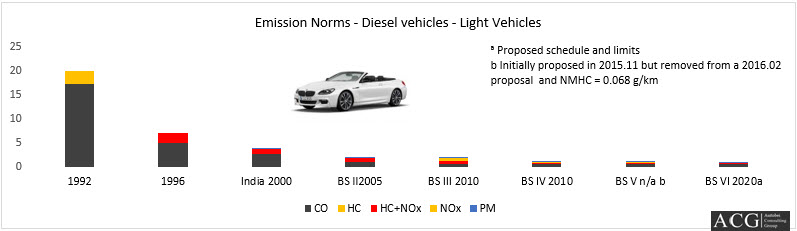
The following graph compares the emission standards for light duty vehicles.

Passenger cars and Light trucks Emission norms for Diesel vehicles

Emission Norms for Heavy Engine:

Emission standards for Heavy-duty engines

Following two years of continuous descent of the Indian Automotive Industry, there is now an established escalation in the same, owing to various factors. However, a multitude of challenges lie in store for the industry as the government plans on enforcing stricter emission standards.

The CO, HC+NOx, NOx and PM emissions have been analysed over the Bharat Stages 1V,V and VI for diesel engines. In the case of Carbon Monoxide emissions, the figures have remained relatively stagnant over the stages. The HC+NOx emissions on the other hand has dwindled down significantly through the stages. It has seen close to a 50% decrease in emissions as observed from the above graph. NOx has also seen a decrease in emissions over Bharat stages IV,V and VI by more than 50%. PM emissions on the other hand have showcased an astounding 80% decrease in emissions through the three stages.

The state of pollution in India:

After the years of 2013 and 2014 that have been particularly difficult for the Automotive sector, 2015 has finally witnessed a huge positive growth. Over the year, production rose by 4.3%, the sales figures skyrocketed to a growth of 6% while exports increased by 2.7% over the same period. This hike in sales especially could be attributed mainly to the sales of passenger cars, particularly popular in the compact car segment. The Indian market is unique in its preference to diesel engines over the others. Consequently, India serves as one of the largest markets of diesel engine share. These diesel subsidies have managed to direct customer preferences allowing the immersion of diesel engines in vehicles from 20% to 50% in the period from 2000 to 2015. This penetration is seen even today with the vast difference in fuel prices (inclusive of taxes) between gasoline and diesel, in favour of diesel.

With the increasing quantity of vehicles on the present day road, quality of the air we breathe is being subsequently plummeted to an all new low. This decrease in air quality due to pollution caused by over congested roads with vehicles is more stark in mega cities like Delhi and Bangalore. Air pollution can be primarily attributed to heavy traffic and un-contained emission levels. Owing to these factors, these days there are inbuilt mechanisms in vehicles to combat the effects of air pollution. Many smog fighting mechanisms have been introduced recently by the sector. The pollution levels in New Delhi have become alarmingly high and the government has been forced to push for new and improved emission norms to keep the pollution levels at bay. The government has ruled that privately owned vehicles in New Delhi will be permitted to operate only every alternate day. As a result of this, there has been a tremendous impact in the pollution figures that are reported by the government to have gone down by more than 50%. Owing to this method’s huge success, the government has decided to enforce strict measures and make usage limitations more stringent. Adding to this and in order to multiply impact, the Supreme court has ordered a ban on registration of diesel cars and SUVs beyond 2000cc all over New Delhi, in effect from the March of 2016. Additionally, the government plans to bring in more stringent norms on emission in highly crowded areas to improve air quality.

Indian Standards:

“Bharat Stages” is India’s emission standard and it runs along with the European standards with a time lapse of five years. These standards were enforced to regulate the emissions of Carbon Monoxide (CO), Hydrocarbons (HC), Oxides of Nitrogen (NOx) and Particulate Matter (PM). These levels are analysed with the help of the New European Driving Cycle (NEDC). The most recent version of the Bharat Stages is the BS III, at par with Euro 3. This version is widely popular world-wide. However, BSIV is being enforced in some of the largest cities of the country. The government is advancing the emission standards forward by huge strides that it is willing to overlook past BS V and implementing BS VI. They have advanced this implementation from April 2024 to April 2020. Though this plan has been thrown down by the supreme court, it is expected to pass through in some time and is expected to be on track as predicted by 2020.

In addition to multiplying design time and considerably increasing investment more than what is already put in, the jump to BS VI has been described by few as being overly ambitious. In order to update technological advancements in accordance with the more stringent emissions, the change in cost will mostly impact the customers. Also, the technical constraints are higher on the more popular diesel engines than ones than run on gasoline. Apart from this, the exhaust has to be treated before being expelled. BSV needs an installation of diesel oxidation catalysts, diesel filters and NOx absorbers for vehicles with more than a 2000cc engine. Additionally, the BS VI aims to equip some vehicles with a selective catalyst reduction (SCR) module. The engines as a result of BS V and VI put in a lot less strain on NOx emissions as they are more stringent and control the emissions by a considerable amount. A huge disadvantage that exists with using these high technologically equipped modules in Indian vehicles is that there is just not enough speed to create that high temperature environment that is required to burn away soot in the particulate filter. These ideas need a lot more time to be available and compatible with the Indian road scenario and several tests are yet to be made to enforce the same over a large amount of time and over a long stretch of kilometers. Though it is a highly ambitious view to enforce BS VI by 2020, tremendous efforts are being put in to make this compatible.

How does the future look like?

A more holistic approach is being taken to battle with the pollution that plague our country’s air. Slowly, everyone has recognized that the entire automotive chain is needed to bring about this change and enforce these measures that will ultimately lead to a cleaner, breathable atmosphere. Apart from the automotive sector, the construction and energy sectors are also needed to bring about the impact that is required.

There are a great many techniques to reduce air pollution apart from enforcing stricter emission standards. Additional exhausts after treatment of the emissions could help in immediately reducing harmful emissions. By altering the prices of diesel and petrol engines, the preference of customers can be swayed towards reducing dieselization, directly resulting in lesser emissions of NOx and PM. Apart from this, the government can stress on the need for more green and clean fuels in vehicles. However, these propulsion need to be imported and customers need to be equipped to handle the increased costs of the same. High import duties and prices plague the imported “green” fuels. In the future, these can be used to encourage the appetite of customers towards these more BS VI compliant options. Another aspect that needs to be changed is the preference to private transportation as opposed to public ones. Wider application of public transportation could change this scenario and also bring about a huge turn around for the pollution levels in the country.

About ABS Sysytem:

  • A very good market potential exist for manufacturers and suppliers for Advanced Safety system like ABS, EBD , LDW system in India after the mandate on safety regulation becoming stringent in India
  • Scenario exist where a project sales volume of ABS to raise significantly to that of equivalent to vehicle produced in India market. This is best in case scenario which triples the in-take rate of safety component. Currently, there are only few significant Tier 1 supplier like Continental, Wabco, Bosch to handle this with significant amount of investment on R&D and mainstream production
  • Technology cost of ABS which is approximately Rs 75,000 in India need currently need to be localised for mass market penetration. As add on technology cost to the vehicle is always a burden on buyer /customer
  • Emission Norm requirement are also mandatory, whereby a technology cost of ~ 52000Rs is required to meet future BS VI requirement
  • No significant overlap on Emission and Safety requirement except in below mentioned instance where author can think of

1. High Speed contribution on ABS being attributed to City driving on Emissions

   2.Engine Braking being trade-off with Brake system thermal failure

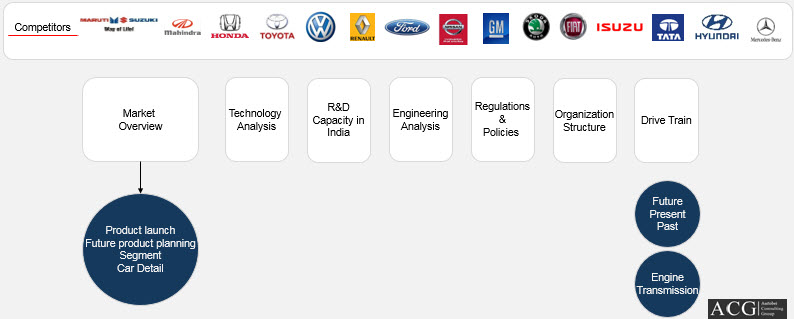
Technology and Market Report of Indian Car Industry is an exclusively Technology Intelligence report. There are several components of Indian car market which analysed closely to develop future Business and Product strategy. Understand the current and future R&D capacity, product planning and portfolio, Sales strategy, Network analysis, Sale Outlet, Service centers, New vehicle launch detail like Drive Train, Segment, Type, Price, Dimensions, Transmission, car name,target segment, Target market share, Estimated volume, Midterm and long-term strategy, Current and future export strategy, organization structure and capacities, Employee policies, Department wise manpower and capacities, 7S model analysis, Training and skills level, Number of exports and their roles, position, Designations, Testing facilities. Engineering support, History of R&D.

Indian Car technology Analysis

Future Technology trend of Engines and Transmissions. Trend analysis from 2010 to 2025. How future technology roadmap would impact on Indian car Industry.

Fuel wise trend analysis and forecast along with fuel economy. What is the scope, development and advance technology for Indian included costing of technology development and impact on production and sales cost?

Expected new Government policies and regulations policies and their impacts on power train and competitive landscape.

Medium & Heavy Commercial Vehicle Industry Outlook report give complete solution to Global CV Industry. Our analyst from every part of the world forecast the Global commercial vehicle 2020. We provide key insights on consumer demand scenario, OEM production outlook, market trends, segment analysis, competitive landscape and so on. An indispensable assessment and strategic planning tool, ACG Automotive Medium & Heavy Commercial Vehicle Industry Forecast empowers all stake holders of Industry like OEMs, suppliers, and financial institutions.

OEMs:

• Market share analysis

• Understand production value and position in the truck cycle

• Find new market opportunities

• Analyze of market, segment, Technology and demographic trends

• Competitive and product analysis

• Competitor product planning strategy

• Evaluate production capacity and utilization strategy of OEMs

• Strategy analysis of  OEMs’ competitive future product portfolio and launch timings

Suppliers:

• Evaluate global OEM production strategy

• Evaluate OEM market growth-segment trends globally

• Future product/production planning

• Target and prioritize future OEMs for sales prospects

• Minimize production and business risk with third-party comparison of OEMs’ stated volume production plans

• Strategy to Develop capacity plans to keep balance between demand and supply

Financial Institutes:

• Assess OEMs’ financial Indicators performance

• Evaluate OEM market share and forecast

• OEM insight to make informed investment decisions

• Analyze OEM brand position and strength

Indian Commercial Vehicle Analysis report provides an insight into the Opportunity in the Indian Commercial Vehicles current market scenario, structure and practices.

In depth market scenario includes:

– Challenges and Opportunities for CV Industry

– Product Analysis

– Product Life cycle

– Driveline Analysis

– Brand position

– Advertising strategy and its impact

– Customer behavior

– Getting Finance and its impact on sales

– Current market size, including domestic market, imports and exports

– Products and Applications

– Market size by product categories (By Vehicle Type) – SCV (Small Commercial Vehicles), LCV (Light Commercial Vehicles), MCV (Medium Commercial Vehicles), HCV (Heavy Commercial Vehicles)
– Market size by product categories (By GVW) – Less than 3.5 T, 3.5 T – 7 T, 7 T – 16 T, 16 T to 25 T,25T, 31T, 35T, 40T, 49T and more than 49T

Vehicle Type: Rigid Haulage, Tipper, Tractor and Special Application

– Market size by end user segments – Construction, Mining, Chemicals, Oil & Gas, FMCG, Vegetables, Special applications etc
– Market size by product applications (Transportation type) – Goods Carriers, Passenger Carriers

For Passenger vehicle: Staff, School, STU, Private Transportation, Tourism, Luxury, Non AC, AC and so on

– Top 10 Commercial Vehicle states

– Market size & Dynamics by regions – North, South, East, West

Market structure details the value chain key players’ presence across products and end user segments. Market practices include understanding the Opportunity in the Indian Commercial Vehicles sets business, market trends, distribution practices and pricing.

This Analysis included a detail of key competition analysis, market movement with forecast over the next 5 years, anticipated growth rates and the principal factors driving and impacting growth of CV market

– Indian CV market performed from FY1972 to FY2015 and Outlook for 2020?
– Key factors which influenced Industry between FY1972 and FY2015?
– Macroeconomic trends that will affect the market during the forecast period?
– Analysis of market drivers and restraints?
– How new product play role to increase market share?

– Indian CV Market-Emission Norms Roadmap
– Estimated Load Carried Per Annum by Road
– Transportation and Logistics Section Indian CV Market-Production, Sales and Exports Forecast
– Multi-axle Vehicles Market-Domestic Sales Snapshot
– Indian CV Market-LCV and M&HCV Domestic Sales Forecast
– Alternate Fuel Forecast
– India CV Market-Technology Road Map
– Key Influencing Factors Impact of Top Mega Trends on the Multi-axle Vehicles Market.

Construction Industry Investment-12th Five Year Plan (2012–2017)
– Road Infrastructure in India
– Major Investments in Rail Infrastructure

Mining Industry – Forecast and Size for mining applications and buying factors

Port: Market size and Forecast, Buying factors

Case Study: MAN Trucks India, Bharatbenz, Mahindra and AMW

Companies included Ashok Leyland, Tata Motors, MAN, BharatBenz, Force Motors, Piaggio, AMW, Volvo, Eicher, Mahindra, SML Isuzu, Isuzu, Scania and HM

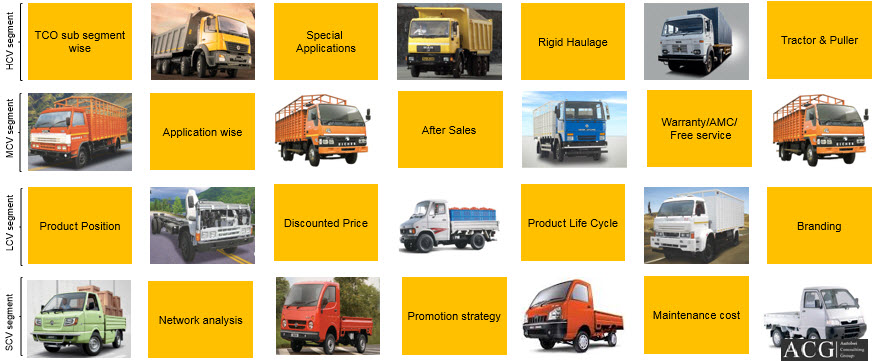
Indian Truck Benchmarking Analysis on Indian Truck Industry is separated into Product Detail – Technical and Features, Technology, TCO, Price, Product position, Product life cycle, Application, Sub segment, After deal Warranty, Spare parts, AMC and so on. ACG had built up its own approach to do this nitty gritty inside and out study considering immensely critical criteria.

Indian Truck Benchmarking Report

We even went ahead to assess the branding methodology of all OEMs and its impact on clients. We have found in our study that for each segment there ought to be a particular include crusade. The points of interest in this study permits OEMs to survey their arrangements on the most proficient method to make enhancements or adjust particular best practices, more often than not with the point of expanding parts of execution.

In our approach we have utilized essential and optional information and make inferences. ACG has considered trucks which are brand new and up to 10 years of age from all segments and gathered genuine documented information for this study. In some classes there are more than 3 sub segments. Furthermore we have included SWOT investigation for every brand and segment/sub segment.

This report will assist OEMs and Suppliers alike to think about associate examination and best business rehearses and forms. Notwithstanding for development of another product or the up gradation of a current product , OEM’s ought to moreover discover this study extremely convenient.

OEMs we considered in our study are Tata, Ashok Leyland, AMW, VECV Eicher, VECV-Volvo, Scania, Piaggio, Force Motors, BharatBenz, SML Isuzu and so on.

Global passenger car production forecast 2020 data is The Exclusive data of passenger car market outlook. It provide insight into the prospects for Global region wise car data forecast of 2016 to 2020 with different business cases.

We also forecast dynamics of Car Industry, Economy forecast, Key regional issues and its impact on production, Key locations for productions, Segment wise and OEM wise outlook.

A region – by – region analysis of the major markets and provides the basis for an outlook for Global vcar Industry.

Wre covered Asia, Europe, Middle East, NAFTA, Latin America,Major countries India, Russia, USA, Brazil, Germany and China are also included.

We also provide customized forecast solution with different business cases.

When a gear is selected, the clutch is employed in such a way as to ensure ongoing transmission without altering the functioning of the engine. The clutch transfers the power to the gearbox in this way. The clutch works to smooth out the transition from a spinning engine to a non-spinning transmission. As the engine needs to be spinning all the time and the wheels do not, the clutch has the job of disconnecting the wheel from the engine. The demand for automotive clutches are increasing steadily, this need arising out of a multitude of factors including high vehicle sales, convenience, sophistication and reliability. However, it is also notable that the same factors of sophistication and reliability have also worked as a restraint for the automotive clutch market.

The demand for automotive clutch markets, in particular have seen a significant growth in the Asia- Oceania and North American regions. This can be attributed to increased production of passenger cars. Additionally OEMs are also expanding production capacity in these regions and introducing new facilities to cater to the increased production requirements.

In terms of volume, the size of the automotive clutch market is estimated to touch 126,000 thousand units by the year 2019, amounting to a monetary value of M $10,700. The greatest impact of automotive clutches however, was felt in the Asia- Oceanic region neck-to-neck with North America, Europe and RoW regions. In the China, India and South America, demand for this market is projected to rise, owing to the need for fully automated transmissions which swap the clutches with torque converters.

A detailed summary of the total volume and value is reported, in addition to a thorough analysis into the insights of the automotive clutch market. This report gives a quantitative and qualitative view of the present scenario and its predictions about the future. The key players in this market are ZF Friedrichshafen AG , BorgWarner Inc. , Valeo S.A. , Eaton Corporation Plc. , FCC Co. Ltd., Clutch Auto Ltd. , Schaeffler AG , Valeo S.A. , EXEDY Corporation,NSK Ltd.  and Aisin Seiki Co. Ltd..

Voice of Customer - Bus

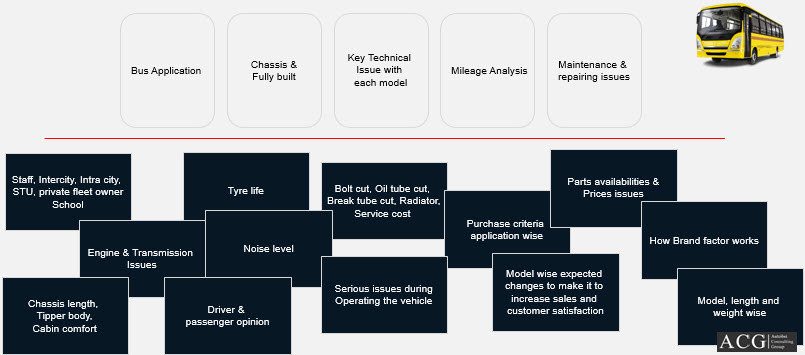
It is Exclusive analysis of customer voice on Bus product. We covered all technical issues, Bus USP, advantages, dis advantages, After sales support, products specifications feedback, customers pain area, Sitting comfort, Maintanance cost, TCO, Distance travel, Mileage, Speed, Safety features, Industry Issues and many other parameters.

Tata Motors, Ashok Leyland, SML Isuzu, Eicher, Volvo, Scania, Force Motors, Mahindra are inlcuded in our study. School Bus, STU, Intra city, Inter city, Staff, Ambulance are part of our study.

This report is beneficial for Product planning, Product position, Product portfolio, Product upgrade, Sales strategy review, Competitor product performace, Changes need to be done in product, Safety issues, Feedback from all stake holder and forecast.

According to Hofstede the main cultural dimensions in organizations include that of power distance (how employees accept hierarchy), uncertainty avoidance (tolerance for uncertainty and ambiguity), individualism versus collectivism (concern to one’s self and to the group, long-term versus short-term orientation (future goals and immediate goals), and masculinity versus femininity (personal goals and friendly atmosphere as opposed to income. On the other hand, Trompenaars have illustrated that culture has different layers: the outer layer captures an individual’s interest at first when he is experiencing a new culture; the middle layer, consists of norms and values or the sense of what is right or wrong; and the core layer which focuses on the fight for survival.

China culture

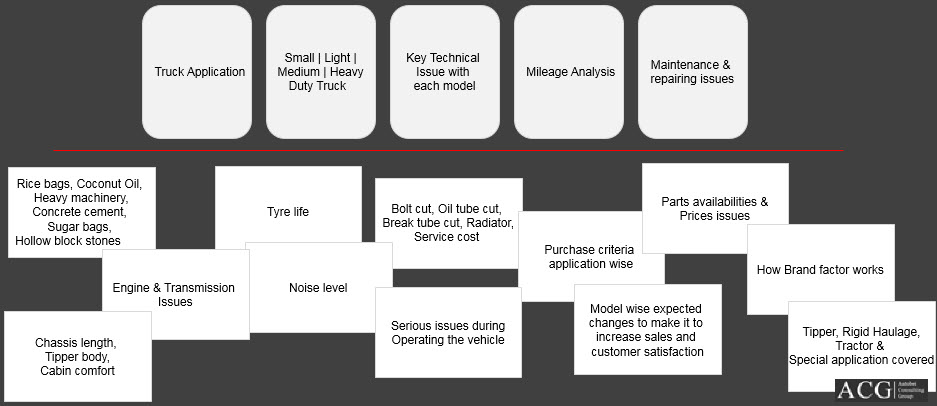
Customer voice of Truck segment is our exclusive study. It gives complete detail insight Indian Truck Industry, issues, market dynamics, customers choice, their pain areas, Product feedback,product current position and its suitability for various applications.

Customer voice Truck Report

Our study give complete solution also along with expected improvement in customer satisfaction and repeate purchase. Make some small and changes in truck make it most suitable for particular applications. Also it is very helpful to create product portfolio and product planning. Companies can save lots of time and their fund to make most suitable product as per market requirements.

Tata Motors, Ashok Leyland, BharatBenz, MAN, Mahindra, AMW, SML Isuzu, Eicher, Scania, Volvo, Piaggio, Hino are included.

Tipper, Rigid Haulage, Tractor, ODC, Special Application are covered.

Some of the applications:

·         Rice bags, Coconut Oil,

·         Vegetables,

·         Mining,

·         Construction,

·         Heavy machinery,

·         Concrete cement,

·         Sugar bags,

·         Hollow block stones,

·         Fire fighters

·         FMCG products

Construction material and many more…

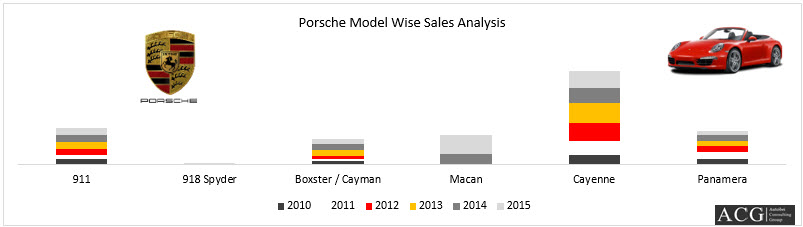
Porsche Business Strategy Analysis 2015

– Business Review and Overview

– Strategy Analysis

– Sales Trend Analysis

– Model wise Analysis

– Global Markets

– Market Dynamics

– Major Markets

– Product Strategy

– Group Performance

– Financial Analysis

– Outlook 2020