Having conquered the title of being the one of the top world’s two-wheeler manufacturer, Yamaha is well on its stairway to glory and fame. But the road to success is not always paved easy and effortless. It comes with its own ups and downs. This road to enlightenment was not devoid of such obstacles when Yamaha established a foothold in India, nevertheless achieving the desired result and landing on the right runway. This was attained largely to an extent with the launch of their product, the RX100 aiding in boosting both the motorcycle and the scooter segment. However, what the company needs to shift its focus to now is on their policy and backup after service.
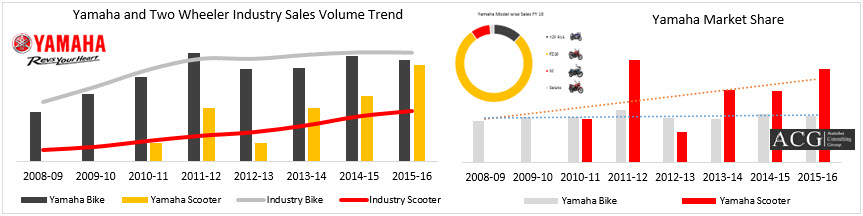
Yamaha India Bike and Scooter Strategy Analysis FY 2016

The company is blessed with an excellently webbed dealer network across the country. However, a major percentage also seem to agree with the idea of shifting the company’s focus into major areas that need to be further developed, namely the policy of the company. This particular area of development has even resulted in the pulling back of some dealerships. The reason for their pulling back could be attributed to improperly demarcated areas and insufficient short-term volume increase for dealers not giving them enough incentive for a long-term deal. In such a dog eat dog world like ours, one needs to put all one’s energy and effort into survival and from the viewpoint of a dealer, that could translate into discounting of products. One solution to the problems that seem to be underlying the situation could be to facilitate dealers to spread their network by means of anointing sub-dealerships of their respective branches following proper demarcation. In specific cases wherein the dealers are unable to further this expansion, the company gets to make the call.

A strong example of a well-connected dealer network which has taken all these aspects into account are the people at Honda, who have an immaculate company policy. Yamaha has only the simple task of piecing the little bits together along with what they already know and add in their tweaks to their areas of development to further strengthen their company policy. With an excellent product base, all they need is to build their foundation and an excellently policies building with the quality ensure meant of their sales and service department. This will make them a superpower alongside companies like Honda and give them a worthy enough opponent.
This is most detail Bus fleet owner database and Analysis Report. The database and report give multiple level information about Bus Industry.

ACG is going to release latest version of  Bus owners and Bus body maker. It is unique data collection including major cities and all states India. This is first kind of database of  Bus fleet owners along with anaysis of BUS body makers. It give key information about these two vertical of Indian Bus Industry. We have included Customer name, Customer profile, Company name, Decision maker, Purchase manager/ contact number, Financiers details, City or location, Number of Buses, Planning to buy new Buses, Bus age, Workshop information, Maintenance practice, Product support strategy,  Prefer language, Media Influence – Newspaper | Magazine | TV, Digital| Off line| Others, education level of staff, Type wise portfolio- Inter city Bus | Intra city |School Bus |Staff Bus| Air port uses| Brand wise| Ambulance| Defence|Bus Age| Major routes|

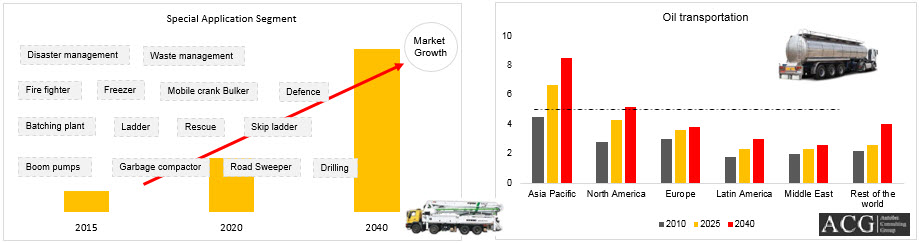
In India, the special application segment is growing gradually yet the right fitment items are unavailable. To be particular, defense and heavy oil transport items are absent. ACG has unraveled in its study that there is an incredible opportunity for development in this segment. We trust that, this period is a perfect time to begin the production of these items for their respective applications.

Special Application Truck Analysis Report

The trails left by Tatra Controversy have now given different OEMs a decent opportunity to penetrate into this segment. The Small trucks segment (up to 3t GVW) could have a considerable measure of regional opportunities. In the special application segment, product positioning is significantly an alternate process that has been clarified and regulated in our report. We have additionally included price components, after deals procedure and so forth. Disaster administration/salvage trucks are likewise drawing incredible interest in the Middle East and Africa, especially all-wheel drive. As indicated by subordinates from ACG’s “Special vehicle Analysis Report”, various buying procedure and arrangements are entirely not quite the same as mass business sector items. Having obviously clarified these aspects, our exploration report will help OEMs, as well as different sellers to tap the massive potential in this immature segment.

In this report we have additionally designed a custom technique to craft strategies for success, to carry out product life analysis and to stay informed regarding utilized truck issues and so on. We have broken down the special application segment and its sub segments in distinctive edges and accumulated a report under some basic parameters viz. brands, product examination and its position, innovation and so on. According to our report, none of the OEMs are presently in possession of such products which could fit in all sub segments.

MAN trucks are standing out in the special application trucks yet at the same time can’t enter as much as they would have got a kick out of the chance because of a few reasons. On the off chance that MAN could restore its system for India, it can set up its brand specially in this segment. All brands of Volkswagen traveler segment in India are working under one rooftop and are having better synergy when contrasted with Scania and MAN. MAN and Scania need to meet up to investigate how their synergy could function to be fruitful in the present business sector. Comprehensively, Volvo had experienced a similar issue amid 2008-09 when their brands were contending with one another in the European and Asian markets. In our report we have additionally done sub segment market analysis and state wise item analysis. A few states are profitable and their industry is generally good for the special application segment. OEMs ought to basically enter those states. It is additionally recommended to note that there exists a fine crevice between every sub segment, development of such a product which could fit and fill this hole would in the end yield decent results.

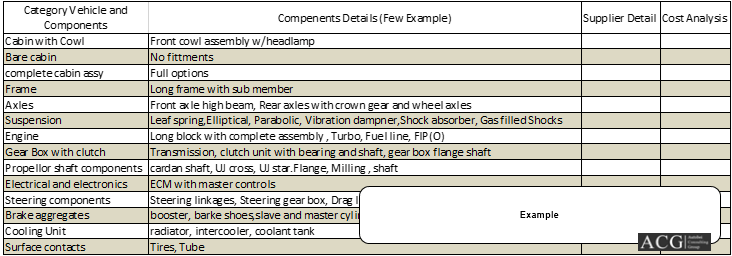
“Who Supplies Whom” Research Report is an in-depth Research Report which gives detail insight of Auto Components Suppliers:

Who Supplies Whom_Automotive

• All major Suppliers in all segment (Car, Truck, Bus, Two Wheeler, Three Wheeler & Construction Equipment) has been covered

  • Market, Sales, and Technology has been considered
  • Price (Different buyers seller points), Margin, life cycle Analysis
  • Competitor Analysis
  • Availability and suitability
  • Primary and Secondary Data
  • OE, Vendor Strategy
  • Material composition and Quality
  • OE, Vendor, local Market and Spurious parts analysis
  • Branding
  • Buying process, Habits, and Trends
  • Supplier Directory

Automotive Supplier Database-Who Supplies Whom

The Automotive engine management system Analysis is Exclusive technical Analysisof Global Automotive Industry. Technology and Emission norms are going to play most important role in Engine managment system. With growing pollution levels and customers’ increased awareness of efficient emission systems, the inclination of automotive industries towards increasing fuel economy and reducing emissions can be explained. This helps to keep the NOx and CO combustion levels in control. The major idea behind the engine management systems is to ensure that precise amounts of fuel is being combusted in accordance with the aerial signals emanating from the ECU (engine control unit) across multitude of sensors fixed on the vehicle. These systems provide an excellent method of reducing fuel emissions and escalating fuel efficiency in vehicular systems.

Like humans, these engine systems too have evolved from a basic need for efficient fuel combustion system and reduced emissions to that of advanced systems, light years ahead of its time. The customers’ inclination towards the use of more environment friendly vehicles is commendable and the industry is working towards making that ‘green’ dream a reality. The government and the institutions governing the same have also worked towards this goal by enforcing more stringent laws and norms to ensure heightened performance, but not at the cost of the world choking on its own fuel emissions. Meeting these stringent norms could not have been easier with the recent electrification of vehicles, attributing to fuel economy and fuel emissions. The engine management system dictates the performance of the vehicle, and hence fuel emissions and hence, these systems play a significant role in the same. The global limits need to be met, and all possible measures are being undertaken by the automotive engine management systems. Where there is extreme good, there sometimes is a minor bad. To balance out fuel emissions and efficiency, industries and customers alike are bombarded with slightly higher costs. Optimizing engine performance to meet the fuel combustion burns a hole in the pocket, but this is a necessity now, more than before. The Automotive engine management systems however have taken massive strides in this area and have emerged successful more than ever.

The Automotive engine management system alone has attained a notable CAGR of 8.09%, which leaves us to base an estimate of $197 billion by the year 2019. As always Asian markets are predicted to see the highest growth, financially and volume-wise. This can be attributed to the more stringent emission norms in these areas as compared to others and increase in per capita income. The Asia region currently holds the largest market share standing at a stunning in the year 2015.  The fastest growth however was recorded by the North America region due to more advanced technological systems in place there, owing to a market share of nearly 22.4%. Saudi Arabia, UAE, Brazil and South Africa also major markets.North America is closely followed by Europe and RoW regions with shares of 21.1% and 7.3% respectively. The Corporate Average Fuel Economy(CAFE) standards dictate the fuel economy will be set at 54 miles per gallon by the year 2025. China V standards are already being implemented on light duty vehicles in Beijing and Shanghai. This is expected to be followed by the entire nation by the Jan of 2018.

In the global market, the CAGR is expected to show figures of 8.09% by 2019.

The pioneers of the automotive engine management system still are the U.S, China, Germany, Japan and Brazil. Developing countries such as India and South Korea are expected to come up in growth rate by 2019. The key players of the global market are Robert Bosch GmbH (Germany), Continental AG (Germany), Denso Corporation (Japan), Delphi Automotive plc (U.K.), and Hitachi Ltd. (Japan). The other key automotive engine management system manufacturers include Sanken Electric Co., Ltd (Japan), Sensata Technologies (The Netherlands), Hella KGaA Hueck & Co. (Germany), Infineon Technologies AG (Germany), and NGK Spark Plug Co., Ltd (Japan).

The above report gives a detailed qualitative and quantitative insight into automotive engine management systems. It highlights potential growth, as well as downfalls. It analyses the landscape of the market and cleverly balances it with the market dynamics and other key challenges and indicators. The key market players in addition to having been identified have also been profiled and thoroughly identified.

ACG is going to release special on Indian Bus Industry “Indian Bus Market Strategy Analysis Report”. This report coversw some special areas of Bus Industry.

This exclusive Bus report give follwoing answers:

  • Buses used by intra-city state transport corporations? GVW and Length wise?
  • What is the volume State, City and  nationally and how many are procured every year State wise volumes and Trend?
  • Average price of these buses?
  • What is the distance travelled by these intra-city, Intercity, School, Staff and other applications buses on a daily basis?
  • What is the running cost of these buses?
  • What is the maintenance cost?
  • What is the life of these buses?
  • What is the market size projection of these buses in terms of VALUE?
  • Luxury Bus market size and trend?
  • Procurment strategy?
  • New technology for Buses and its impact?
  • Market Drivers?
  • Market Segments and its defination?
  • Business Opportunities and Challenges?

Indian Two Wheeler Disc Brakes market Intelligence report give in depth analysis. It covers following key areas:

  • Growth Trend Analysis from Drum  to  Disc brakes in  Two  Wheelers segment (Indian Market)  from inception.
  • Disc  Brakes Potential – OE Manufacturer  wise,  Segment wise (Both  M/C & Scooters separately  ,Model wise Potential.
  • Above  details with  past  minimum  4 years Production & Sales volume &  Next five years Forecast.
  • Disc brake Component  Suppliers  database partnered with OEM’s & Value buy potential.
  • Growth Trend Analysis from Drum  to  Disc brakes in  Two  Wheelers segment (Indian Market)  from inception.
  • Disc  Brakes Potential – OE Manufacturer  wise,  Segment wise (Both  M/C & Scooters separately  ,Model wise Potential.
  • Above  details with  past  minimum  4 years Production & Sales volume &  Next five years Forecast.
  • Disc brake Component  Suppliers  database partnered with OEM’s & Value buy potential.

Spare parts of Car Truck Bus Two Wheeler and Three wheeler vehicles strategy

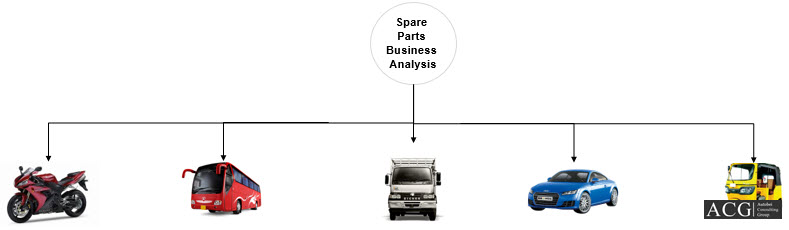
Automotive Spare parts Business Analysis is exclusive Research report. Spare parts Business analysis of Car, Truck, Bus, Commercial vehicle, Two Wheeler, Construction Equipment and Three Wheeler

Spare parts of Car Truck Bus Two Wheeler and Three wheeler vehicles strategy

  • District wise retail market for select spares
  • Retail demand across districts
  • Product flow/movement-feeder market, consumption markets
  • Market share by OME (brands), vendors, Unbranded and other (local)
  • Pricing structure, variables driving sales of unorganized, vendor products
  • Qualitative assessment of end customers and mechanics
  • Dealers/Retailer at clusters levels within districts
  • Assessment of retail demand of spare parts in each cluster, aggregated to district
  • Understanding business relationship with their existing principles and customers
  • Purchase process and sourcing practices – manufacturer vs Channel (other dealers)
  • Geography/territory being catered to (rationale any)
  • Marketing and selling practices
  • Assessing the competition structure, universe and in-depth analysis
  • Profiling select customers on their expectations and expectation
  • Product selection and purchase criteria: brand, price, quality etc
  • Key enablers for purchase products from their current brand, competition products and local brands (if applicable)
  • Perception of OEMs, local made products and fast selling brands in a given cluster-reason for preferences and choices
  • Future demand and qualitative assessment of opportunity
  • Potential analysis, how much of the market is addressed by OEM/ Local/Vendor and others
  • Channel sales analysis – Possibilities

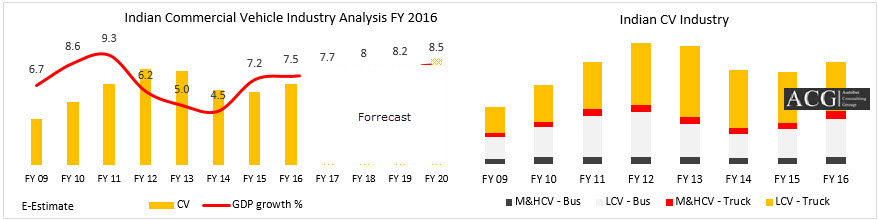
Indian Commercial vehicle Industry Analysis FY 2016

Indian Commercial Vehicle Strategy Analysis FY 2016 is the latest report give in-depth Technical and Market information. M&HCV Industry seeing strong demand conditions powered by constant replacement demand and initial fleet expansion due to positive market sentiments. Growth was driven by volume expansion across all application segment. In FY 2016, CV Industry grew by 12%, M&HCV segment grew in the double-digit of 30%, LCV segment is almost flat by registering 0.30% growth.

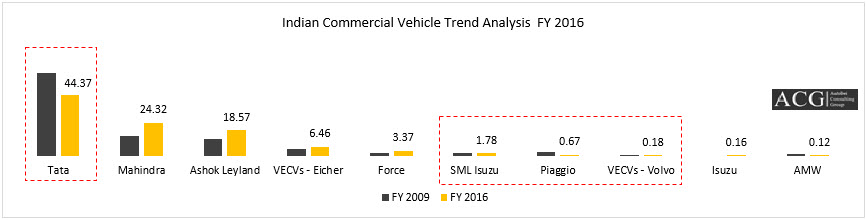
On the other hand, LCV segment continues to weaken. Some segment showed mix response of positive and negative growth. Tata Motors is the market leader in Commercial vehicle segment with more than 44% in FY 2016.

Indian Commercial Vehicle Trend Analysis FY 2016

Report Highlights:

  • Macro, Microeconomic trend and demographic profile of these countries and its impact on
  • Market overview and segmentation based on GVW, Usage segments and geographic distribution of volumes
  • Evolution of Market size and competition market share
  • Brand-wise, model wise  domestic production and numbers for import and export volumes
  • GVW wise competition sales data for last 5 years and forecast for next 10 years along with cabin type (Bonneted, COE sales) bifurcation.
  • Current and future demand drivers and projections for installed production capacities
  • Competition: Players and their product offerings, dealer, after sales service, warranties, financing options, buyback arrangements and any other customer strategies adopted
  • Top selling Competition models SWOT
  • Sales and service footprint for competitors
  • Price positioning and current freebies/discount practices
  • Duty cycle & operation model for similar kind of vehicles, Variant wise competition prices, and Specification
  • Segment wise Altitude/Climatic boundaries, loading/Overloading patterns
  • Segment wise preferred features (Current and future)
  • Typical Applications usage (Tipper, Cargo, Vans etc) by percentage
  • Segment Wise – Understanding of loading patterns, road conditions, service practices , maintainability, durability and reliability expectations
  • Policy, Regulations, and Duties
  • CKD CBU, Duty Structure, Value stream mapping
  • Homologation requirement
  • New technologies/Preferred Features /Expectations to be mapped for the mentioned key markets
  • Network Analysis
  • After Sales and parts analysis

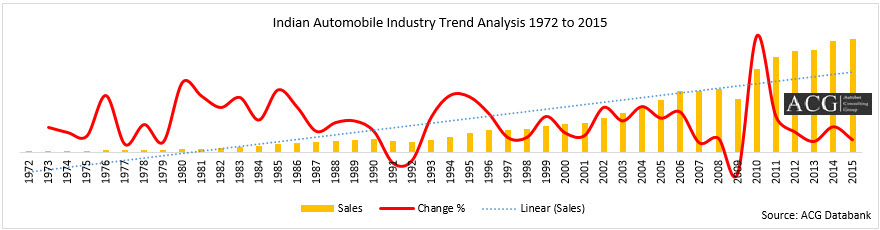
Indian Automobile Industry Trend Analysis 1972 to 2015

Indian Automobile Industry Strategy 1972 to 2020 is exclusive report which covered every corner of the Indian Automotive Industry.

Following points covered in our latest Indian Automobile Industry Analysis:

– Key findings of Indian Automotive Industry

– How “Trust” parameters changes for customers

– Mile stone of Indian Auto Industry

– Dealer Challenges and Opportunities along with Trend

– Digital Media role to shape Auto Industry

– Impact of Global market dynamics in Indian Auto Industry

– Commercial vehicle, Truck, Bus, Car, SUV, MUV, Two Wheeler and Three Wheeler

– Major Changes since 1972 to 2015 and outlook of 2020

– Product position change and New Product launch

– Price Trend Analysis

– Export, Production and Sales

– Technology Trend

– HR policies

– Famour Branding strategy and its impacts

– Advertising Strategy Review and thier impacts

– Buyers profile and habits change

– Game Changer case studies – Renault, BharatBenz, Hero, Honda

– Challenging Study: MAN, Fiat, Tata Motors, Hino,Yamaha, TVS Three Wheeler, Volkswagen, Skoda, GM, Nissan

– Government Policies and regulations

– Vendor strategy analysis

– Market Drivers of Industry

– Mega Trend Analysis


Volkswagen product Strategy Analysis for Indian Market

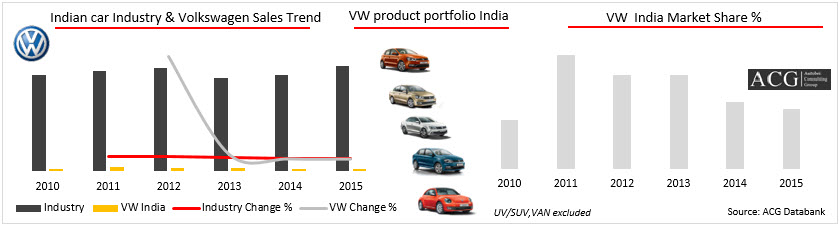
Volkswagen India Future Strategy Analysis is our special report on Volkswagen India. One of the names that ring a clear bell in our minds when we say car manufacturers is Volkswagen. This company has made it’s ultimate goal to stretch it’s web across all expanses of the car manufacturers universe. However, the company with such a huge success in the overall global market struggles to keep it’s head above Indian waters. Having made its appearance into the Indian market in the year 2009, it grew by an exemplar 1,500% by 2010. The company however has plummeted down and is slowly falling into the trenches since 2012-13. It’s share in the market also dwindled from 3.88 to a mere 2.9%. Many questions have been asked that revolve around the reason for such a stark failure of this company in the Indian market. One answer that stands separate from it all is the company’s technique involved in product strategising. The company needs to properly position the various products,ensuring a parallel alignment with other players of the respective segments in question.

Here at ACG, we have studied and analysed the trends and feel that the studies point to the company needing to find a private space in the market and create an attractive USP for all of its recent products. Further, ACG feels that Volkswagen need to show exponential growth and focus on almost every aspect of its business to result maximum sales for the company. When recent trends have been analysed along with product sales figures, they show that most OEMs have at least 1 to 3 products which impact maximum sales for the company. This particular analysis, namely the ABC analysis can be applied on OEMs from over 50 countries. This solidly proves the fact that merely entering a low cost segment will not provide the ticket to increased sales. The following detailed study covers Product strategy or portfolio, Branding, people perception, Brand recall, product USP, Competition, culture, After sales, Re sales value and  Buyers preferences.

Please contact us to see preview of the report

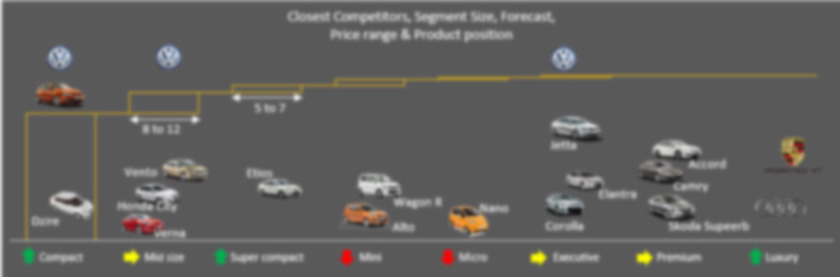
Volkswagen car Product strategy and position analysis

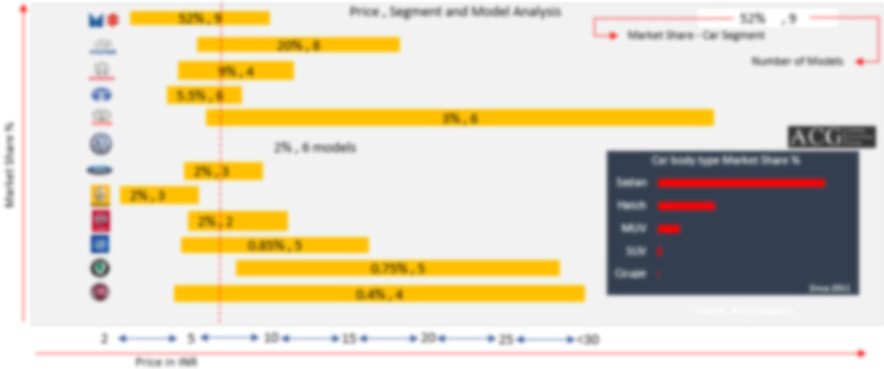
Price , Segment and Model Analysis:

Price , Segment and Model Analysis

Global Automotive Supplier Study consists of more than 1,200 regularly updated automotive supplier profiles and analysis, making it an perfect reference for quick and precise information on your finger tips.

It is not just text stories about company profiles or data base, products, Finance, Strategy, JV, History and so on. We draw concept to understand quickly about all key information about companies, its stregnth, Product line, portfolio, management, production location, Customers, forecast and so on.

Global Automotive Supplier Profile Database

We update our report in every six months and it avaibale as a standard one and customize version to meet your reqriements.