ACG released its latest exclusive data on Global Bus Production Trend and Forecast 2023. The comprehensive data is available since 2000. We covered almost all Global Bus Models and OEMs. We also covered Vehicle Technical Details like the type of fuel, Engine, GVW, Power, and other key parameters. Some of the parameters are listed below

  • By Region
  • By Country
  • By OEM
  • By Fuel type
  • By GVW
  • Architect
  • Design
  • Start and End of Production
  • Production plant
  • Assembly type
  • Platform
  • Program
  • Segment, region wise
  • Emission norms
  • SOP
  • Valves
  • Cylinder
  • Model
  • Power
  • Torque
  • Brand
  • Cylinder Block Material
  • Displacement

Region: Europe, Greater China, Japan, Korea, Middle East, Africa, North America, South America and South Asia.

Countries: Austria, Belarus, Belgium, Czech Republic, Estonia, Finland, France, Germany, Hungary, Ireland, Italy, Kazakhstan, Lithuania, Netherlands, Poland, Portugal, Romania , Russia, Slovakia, Spain, Sweden, Turkey, Ukraine, United Kingdom, Uzbekistan, China, Taiwan, Japan, South Korea, Iran, South Africa, Canada, Mexico, United States, Argentina,  Brazil, Colombia, Ecuador, Peru, Venezuela, Australia, India, Indonesia, Malaysia, Pakistan, Philippines, and Thailand.

Get Exclusive data by taking Subscription package


Currently, India is the fourth largest Passenger car market with 3 million vehicles; by its value is around 24 billion Euro, and is expected to be around 35 billion Euro by 2023. Germany, Japan, USA, and China are bigger markets than India. Last year’s trend showed that GAP between Indian and other bigger market is narrowing every year. India is having positive growth and on the other hand, Germany and Japan markets showed de-growth since these markets are already saturated.

Indian Car sales Forecast Analysis 2030

If we see car density, India comes at number seventh position with 24%. It shows that there is tremendous growth potential in the country. We expect that by 2030, India will be second largest car market. Chasing German and Japanese market does not look difficult.

Indian GDP forecast and Car density

The market is expected to grow by 4 percent CAGR and it will touch around 8 percent CAGR by 2023. The market size of the passenger car segment may touch around 5 million units by 2023. In Indian PV segment, SUV will be the fastest growing segment, with expected registration in double-digit growth. Also, Sedan is expected to grow better than Hatchback segment.GDP size and growth is one of the key parameters to check the health of the country’s  economy. In 2016, India was contributing 7 percent in a global economy and by 2050, it is expected to contribute 15 percent.

Top Global Passenger Car Markets

Globally, compared with Germany, the gap was 2.2 million units in 2005 and was just 0.3 million units in 2016. If we compare with Japanese car market, in 2005 the gap was 3.6 million units which became just 1.1 million units in 2016.  Currently, US Car market is the second largest market but India will expect to overtake by 2030. In 2016, the gap is just 3.9million from 6.5 million in 2005.

GDP size and growth is one of the key parameters to check the health of the country’s  economy. In 2016, India was contributing 7 percent in the global economy and by 2050, it is expected to contribute 15 percent.

Top Car Market Trend Analysis India, Germany, Japan and USA

Even after entering of Top European players in India, Maruti is still increasing market share in PV segment. The company gained around 6 percent market share since 2011. Recently GM stops to sell cars in India due to its poor sales performance. One of the keys of the Maruti is continuously launching the new product in every segment. The company is presence almost 98 percent of the PV segment where Tata Motors just presence in 40 percent PV segment. Tata HEXA is game changer product for the company due to its value for money.

Hyundai, Honda, Renault, and Nissan only four players increased their market share in last 5 years.

Indian Passenger Vehicle Car and Luxury Car Market Share Overview

All major OEMs are the presence in India and trying to position themselves with different product strategy. After tough competition from European players in Technology and Brand image, Maruti is still increasing market share in PV segment. The company gained around 6 percent market share since 2011. Recently GM stopped selling cars in India due to its poor sales performance in India. One of the key aspects of the Maruti is that it is continuously launching new products in every segment. Company’s presence is almost 98 percent in the PV segment whereas Tata Motors’ presence is just 40 percent. Tata HEXA is a game changer product and it will support to increase its market share and sales volume at least for next few years.

Hyundai, Honda, Renault, and Nissan are the only 4 players who have increased their market share in last 5 years.

Tata, Ford, Mahindra, Volkswagen, Skoda, and Fiat lost market share in 2016. With all mentioned OEMs, there are different issues which need to be addressed properly. Tata Motors is aggressive and expected to launch few game changer products like Tata HEXA. The company is focusing on style and design of the products. However, it is a not complete solution for the company. In Switzerland, Alfa Romeo is a famous brand because of customers like design and style of cars; so there is a good fit between product features and customer taste, but it is different in India.

French car maker Peugeot is trying third attempt to enter into Indian car market. Kia is another play coming to competitive Indian Car market.

Car Segment Analysis body type and forecast 2030

The hatchback is the largest segment, Sedan is the second largest segment and SUV/MUV is the third largest and fastest growing segment in India. Hatchback car segment grew by 0.4, Sedan grew by 6, SUV by 25 and MUV by 4 percent CAGR from 2011 to 2016. SUV segment is expected to dominate PV segment due to its product value proposition and customer buyer’s changes.

B-Segment of cars is the largest segment with CAGR of 4 percent, C-Segment is the second largest with the CAGR of 3 percent. A and D segment is losing its grip in the market and showed de-growth if the same period.

B and C Segments are flourishing segments due to product features, price, increased purchase power of people and overall vehicle performance with customer choice. B and D segment registered -4 and -15 percent CAGR from 2011 to 2016.

The luxury segment showed 11 percent CAGR from 2011 t0 2016 and expected to show 43 percent CAGR by 2023.

Car Segment Analysis- Vehicle length and Engine

Less than 4 meters length and up to 1,200cc car segment share shrunk but less than 4 meters and up to 1,500cc increased segment share.

Indian Car Segment Analysis - Volume By Units and Value

Price wise, 11,500 to 21,000 Euro is the biggest car segment in India. This segment is having 22 percent market share.

Car Segment Analysis Price wise Segment Share

Customer buying behavior:

Customer behavior and New Technology

Product Strategy- Product plans forecast and its impact on Industry:

Like other OEMs, Mahindra is also planning to launch the new product in SUV/MUV segment to regain some market share. Since the company is mainly in SUV/MUV segment, the new product shall not overlap with each other. Every segment and the segment share shall not move within the group.

SUV and MUV Product Strategy and Product planning forecast for Indian Market

After launching of XUV500, the market share of Scorpio drastically fall. XUV 500 market share fall in the same manner after launching of Duster.

Mahindra TUV 300 and Bolero Market Share Analysis

Now, Chinese OEM like SAIC is expected to enter into MUV/SUV segment. Brand perception and the relation between India and China will also influence these products.  They are successful in East African market due to local market dynamics, pricing and political relation between China and African countries.

After Sales Analysis:

Indian Car Parts Price Analysis

Now, Chinese OEM like SAIC is expected to enter into MUV/SUV segment. Brand perception and the relation between India and China will also influence sales of these products.  They are successful in East African market due to local market dynamics, pricing and political relation between China and African countries.

Connected car, autonomous car, and driverless cars are ready to enter into Indian market also. Connected cars facilitate connectivity on wheels and provide the best infotainment system, Safety, comfort, convenience, performance, and security combined with a well-connected network are the main features. This enables the driver and passengers to connect with all important authorities, businesses, and people. Changing market dynamics, the need for constant connectivity increased dependency on technology and the growing number of tech-savvy people account for the growth of this market.

Connected Car Dashboard

Connected car market in a joint study with InnoEra Software Technology and Autobei Consulting Group. Digital apps and services will be part of the car industry by 2020. InnoEra already developed connected car software which can be integrated into any car. Other technology companies like Google is providing a directory of businesses of nearest locations. InnoEra not only provides business directory but also provides emergency services in Medical and panic situation. In a case of road accident also, it helps to get medical services on time along with location and description of the incident. If you would like to know about the city where you are going to visit, the famous place with routes, local market information, city representatives, medical facilities, etc. then all will be on your finger tip on a car dashboard.

Even you will get all important message from authorities, best business deal; participate in making a smart city and many other key features.

Connected Car Technology

Digital After-sales Service: This App not only provides the Dealers or workshops location with their details but also describes the issues with vehicles and can send Audio/Video/Image of the vehicle issues. If your car is facing technical issue or breakdown somewhere on the highway or near the mountain, it is difficult to explain the vehicle issue to dealers and workshops.

Connected Car and After Sales Solution

This app gives complete solution and sends a clear communication with service providers. This connected car concept can be implemented in anywhere in the world by this InnoEdge Software.

(ACG Annual Subscribers can download the report by using given link)

Report Highlights:

– Trend and Forecast 2030 of Indian Passenger Vehicle Analysis

– Vehicle Pricing Analysis and Sub-segment Wise Market Analysis

– OEM Strategy Analysis

– Entry Strategy for New players

– Rural and Urban Sales Analysis

– Competitor Analysis

– Product strategy and planning

– Coming up product Analysis and Its Impact

– Connected Car future in India and how it will work

The year 2017, is the most interesting year for Indian Auto Industry in terms of forecasting. The recent macro economy indicators are negative impact except for Agriculture sector but market sentiments are positive.

This report is useful for Business Planning, Product Planning, Sales Strategy and other critical decision.

The industry is going through critical phases like the first demonetization, then Emission norms BS IV now GST and then BS VI implementation.

There are short term, Medium-term and Long-term impact of all these changes. The other industry regulation like The Real Estate Regulation Act, Act on NPA issue, Employment, Inflation, Oil Prices, Electric vehicle, New Product Launch, Smart City, Public transport system, RBI credit policy, Monsoon, Technology, GDP growth, Industries like Cement, Steel, Manufacturing, Mining and other key parameters will shape Auto Industry.

All factors will have the different impact on demand volume of Auto Industry. Demand volume is divided into different phases.

We have released revised forecast data till 2030 of Sales and Production for every segment separately:

  • Passenger Vehicle: Cars, SUV, MUV, Premium, Luxury, and Sports segment.
  • For Commercial Vehicle: Rigid Truck, Tipper, Small Truck, Mini Truck, Light Truck, Medium Truck, and Heavy Truck, Budget and Premium truck category.
  • Two-Wheeler: Economy, Premium, and another category
  • Three-Wheeler: Passenger and Goods Vehicle
  • Agricultural and Construction Equipment demand forecast.

ACG Subscriber can download this report by login their account

ACG Auto Intelligence released World Truck Production forecast with historical data since 2000. Europe, Greater China, Japan, Korea, Middle East, Africa, North America, South America and South Asia region are covered on country wise.

Global Truck Production Trend and Forecast Data 2000 to 2023

Countries included: Austria, Belarus, Belgium, India, Czech Republic, Estonia, Finland, France, Germany, Hungary, Ireland, Italy, Kazakhstan, Lithuania, Netherlands, Poland, Portugal, Romania , Russia, Slovakia, Spain, Sweden, Turkey, Ukraine, United Kingdom, Uzbekistan, China, Taiwan, Japan, South Korea, Iran, South Africa, Canada, Mexico, United States, Argentina,  Brazil, Colombia, Ecuador, Peru, Venezuela, Australia, India, Indonesia, Malaysia, Pakistan, Philippines and Thailand.

In our forecast, we considered all critical factors which could impact on Market.

The forecast is included OEMs past production data with their past trend.Under OEMs we have also exclusively included their model production numbers, production plant detail and other key information like:

  • Sales distribution –countrywise from mother/source plant
  • Vehicle details – Models, GVW, Segment, Gross vehicle weight, Engine max torque, Gearbox, Engine Displacement
  • Vehicle Architect
  • Vehicle design
  • Vehicle Platform
  • Emission norms
  • Start and End of Production
  • Production brand name
  • Parent brand name
  • and other 30 more product and market attributes

ACG Subscriber can download this report by login their account

The Indian Bus Industry volume was around 94,000 units in 2011 and it touched more than 1 lakh units in FY 2017. The Bus penetration in India less compares to other emerging countries.

Indian Bus Market Strategy Analysis 2017

Indian bus market Trend and Forecast analysis Report

There is huge potential in India for the Buses. Smart Cities or Amrut will drive the Premium Bus segment. Customer affordability is increasing because of increasing in the Young population. Moreover, working women mainly prefer to go in the Premium buses for the safety and comfort reasons. The government was also taking very aggressive decisions on the infrastructure & on the regulations such as max speed of 150 Km/hr on the Delhi corridor, Euro 6 of preponement, AC fitment etc. All these are having a motto of aggressive innovation in India, and this will make the advance costly feature which is available with low and affordable cost such as Tyre pressure monitoring, variable temperatures in AC, Automatic braking thru radar, Air suspension and AMT etc.

Bus Buying Parameters Analysis: There are different buying parameters for every Bus Application. The tender works on entirely different buying condition. In a case of luxury buses, recently the ROI changed from 2 years to around 3 years. This factor is having a negative impact on this segment sales.

In the recent times, in commercial vehicle sector, developments of next 10 years will increase with what has taken place in the previous decade. There are 3 types of technologies which are happening here.

1. Autonomous driving

2. Alternative drivelines

3. Connected Bus (Telecommunications, sensors etc.)

In a broader level, the segment is defined in 3 categories, Premium/Luxury, Value Plus and Low cost. The low-cost segment is moving towards value plus segment. The size of a premium bus market currently is around 2% percentage of the total bus market. In past times, the market was really challenging & has been stagnated. In this premium bus market, coaches & the city buses were having the equal amount of market share. But in coming 5 years, Industry will able to see increased numbers, particularly in coach segment.

Presently, Volvo is the market player in the category of luxury buses and having the market share of nearly 60%. Scania is also be playing in the same segment & snatching the market share from the Volvo Buses.

Six years past, this 50 % of city buses was largely from JNuRMM scheme which is now closed. There is no alternate for the 50 % of volumes which were happening & city bus market almost get shut down. Even though the coach market is growing because of the middle-class, their traveling habits & their affordability.

The buses are the main capital item and the customer is buying it to generate the revenue & profits. The whole ecosystem suppliers, OEMs, dealers & customers are to be in a profit zone. If any one of these is not profitable the entire ecosystem will get fail and then sooner or later, the market will get recover & OEMs will struggle.

The demand for the AC buses is growing very rapidly. Rising the disposable income in India was the main reason. The other reason was to be the increasing temperature levels in every city & also towns across the India. Rising of the urbanization & growing of the infrastructure was also creating the market for the buses & AC buses are no longer will be looked upon as costly alternatives to the conventional non-AC buses. Travelers are also getting ready to pay the high amount for their comfort. With STUs & the city bus, they are undertakings the warming up to the outlook of the AC buses, so the brighter future was certainly towards the bus AC manufacturers.

Investment in the additional capacities was also certainly helping the bus AC manufacturers in order to raise their market reach & also offers a deal which promises the ‘best value for money’. Investment in the R&D centers, application engineering & service networks are the main steps to be implemented in a right direction. This type of steps will also ensure that the AC bus industry will grow beyond the estimated rate of the growth of 15 %.

The market for the bus AC manufacturers was appearing good, in the case of School buses. Most of the STUs & city bus undertakings were already have the AC buses as their flagship offerings. The total number of AC buses in India was been estimated as 10-12 % (around 10,000 units) of the total bus market, the number was growing rapidly. But when we look at the rising demand, it was quite natural for the bus AC manufacturers to gear up for their growth. To be a market leader in India for the luxury bus ACs, Eberspaecher Suetrak, the Indian arm of USD 4.4 billion German major Eberspaecher, is known to supply above 2500 units of its AC 353 model to the large buses till now.

Govt is also taking an initiative to improve public transportation quality by taking several steps. The government came up with the bus building code in order to ensure that, the buses are built as per the stipulated standards which are related to the safety, design & comfort.

AIS: 052 this code represents, that every bus manufacturing unit will obtain the accreditation certificate and to demonstrate its capabilities to build the buses as per some of the safety standards. These rules are set by the ARAI, which is the premier testing & certification agency.

This notification will apply to all of the companies & individuals who are engaged in the bus manufacturing or bus body building of the vehicles, which are having the seating capacity of 13 or even more passengers & all bus types will be covered under this code. From Jan 2018, every bus body code is scheduled to implement completely. We believe that this is a great decision & also a high time that it will be implemented completely. Safety is very necessary for the mass transportation solutions. In past, the bus body building industry has been unorganized from so many decades. Currently, India is having around more than 10,000 bus body builders but very few are organized players. By the presence of huge unorganized sector, safety & the knowledge of regulations goes in a wayward & the bus body code will also address various issues.

Mainly Bus Body Code implementation is now diluted & also staggered over 2 phases – with initial obligations implemented purely on the dimensional criteria. OEM already adopted body code not only just these dimensional aspects but the complete scope of the current version of the Body Code. Cutting corners for the safety, these are OK for the small Body Builders, but not consistent with the OEMs ethos & they took first opportunity to comply in full.

Any type of Bus Body which is built in the OEMs factory is completely compliant with the Body Code. There is some extra amount incurred but it is worth for the customers, passengers & brand value. ACG hope that Govt. should not further stagger or even dilute the implementation & same will be strictly implemented & enforced on schedule time.

Legroom step height, require simulation, driver seat, emergency door, sticker & safety, survival space, OEMs are having the facilities. Prototype requires the heavy amount, everywhere cost consultant, design issue, lobby forced are not implement the bus body code.

OEMs keep high quality of bus compare to local body maker, like Paint shop will cost higher, finally product affected, quality of the front to rear, concentricity, no scratches should be there, all buses should look like same, bumper body gaps, door gaps, no compromise in the testing quality process, care need to be taken for small to smallest things, headlamps life, reliable product issue after the 6 months, no noise vibration, durability should be good in Volvo, Scania bus.

In spite of the growing the popularity of the air travel, there is also a growing trend for the travelers to opt for the buses. It makes more sense to consider a coach. While traveling in between 2 cities which lie within some distance of about 250 km & also well-linked with 4 or 6 lane highways or expressways.

Industry is able to view a major transformation in this particular sector over the next coming 3 – 5 years. The transformation regarding improving the road networks, marginal growth in the railways & also increased the requirement for the mobility, long distance of travel by using the inter-city buses is also going to undergo some volume of shift and also with the customers who are expecting more value from Buses.

Presently Ashok Leyland has a 60 percentage of market share in the inter-city travel application particularly with the non-premium buses, which are trending nowadays. Even though, the market moves towards the comfort & longer distance travel.

Some of the new products are going to launch, in coming 12 – 36 months, a slew of the products in this segment. These products are ranging from Luxury Coaches to simple coaches which are reliable & efficient buses. These product design based on some of the current Platforms.

Presently Indian OEMs are able to seamlessly & reliably implement the good solutions for all the customers in the areas of Telematics, web/app/cloud based solutions, materials & processes including the 3D printing.

But, in-order-to stay in the game, the whole industry still has a to go long way while new frontiers such as Big Data, Internet of Things & other tools will move from the cusp to “mature” part of Gartner’s Hype Curve.

We expect that the industry is going by a revolution & lot of challenges such as changing from the front engine to the rear engine & manual transmission to the automatic transmission. Under FAME initiative, there is a lot of action which is happening in terms of the hybrid & electric buses. Likewise, moving from the non-air-conditioned buses to complete air-conditioned buses, entertainment systems and electronics, composites coming into bus sector, there is a lot of things are happening in bus industry more when compared with the car industry in terms of the transformation.

Mumbai-Pune, Ahmedabad-Vadodara, Delhi-Chandigarh, Delhi-Jaipur, Delhi-Agra, and Bangalore-Chennai, demand the buses & also the luxury coaches will be expanded phenomenally in coming years. Already India’s bus transport business is so huge, and India ranks among the top-10 in the whole world in bus segment. But the market for the air-conditioned luxury coaches is so limited, it is estimated that it is less than about 1,000. Even though the luxury bus segment is growing at the compound annual growth rate of nearly 22.7% from 2011 to 2016. Value Bus also registered growth but low-cost segment showed de-growth in the same period.

Currently, the market does not have so many electronic engines, the penetration of the AMT in the commercial vehicles space is also very less. Now with the BS-IV emission norms in the place, it becomes the starting point of the AMT engines. The technology is also expected to penetrate gradually, possibly starting with city bus applications. The comfort of the driving & more fuel efficiency will play an important role to influence the buying behavior. In trucking segment, the intra-city vehicles, where there is a need to have so many gear shifts, would be the first ones to adopt the AMT technology. In Europe, penetration is already 80 percentage. In next five years, this technology will have at least 30% of the Indian commercial vehicles.

ACG estimates that the market electric & hybrid buses in India will reach to 400-500 units in next year.

6 High Power Euro engines, Electric/Hybrid /Bio Gas Buses, AMT and Automatic brakes thru Radar.

16 years back Volvo has been launched & created its own brand when every Indian assumed as the cost sensitive. Now Scania & MB are using this brand new premium bus market created by Volvo. The trend is for the Sleeper buses along with the water closets for the long distance as the train availability will remain constraint in India. Tata Motors has launched 2 electric buses: one is stretching 9 meters & other is 12 meters under the Ultra range, & a 12-metre hybrid with Starbus badge. The prices are in between Rs 1.6 crores to Rs 2 crores. Incentives on the electric buses will be given on the project basis: The buyer is refunded by 75% of the capital cost for an electric bus. The industry requested the Ministry of Heavy Industries to extend incentive to all the orders. We expect the segment is set to the witness a compounded of annual growth rate of 20-25% in coming 3 years, as the state transport was undertakings have shown the sustained increase.

The main motto is to encourage the people to step out of their cars & to start using the public transport. This is badly needed because of the traffic congestion. Even though, the public transport needs an attractive experience in terms of the timeliness, cleanliness etc. Customers are ready to pay more amount of money for their comfort & safety and also for the other features such as AC & sleeper coach are trending very much when compared with the normal rather than the luxury.

Aviation tickets are also decreasing & they will compete in the future with the Premium buses customers. Fast trains & metro train are expected soon for various cities & will impact the market of the Buses. Availability of the spare parts, cost & service network will remain as a challenge. Electronics service will also remain as a challenge because very few experts can able to handle in case of the field issues.

Rapid increasing of the infrastructure development & smart cities regulations will automatically push the Premium bus market.

Euro 6 preponed & Euro 5 totally skipped Aggressive implementation of regulations such as BS4 /Bus code etc. HVAC for the commercial vehicle should plan in 2017 itself, very good focus on the Smart Cities & Tourism, this will attract various passengers for the premium buses. Electric Buse’s policy in the place (FAME) & ambitious aim of replacing all the Buses to the electric by 2030 – 2032 by Cabinet minister Mr. Piyush Goyal.

Excellent Multifold progress in the infrastructure when compared with past decades. Bharatmala is projected, and the main motto of the project is to connect almost all the directions in India. Various Metro/Smart City projects will able to drive the infrastructure growth. Various airports are also planned in the coming years.

Under Make in India, innovations cost significantly will be decreased. GST will also have some positive impact on this industry. Make in India Policy will also promote local supplier. This move will give cost effective products. Battery cost of the electrical vehicles is also expecting to decrease by 50% in last 2 years.

After a decade-long wait, India will finally implement the GST tax system. It is expected that GST can boost GDP growth 1.5 to 2 percentage. This is the biggest tax and economic reform which will change completely business process in the country. GST will help remove tax barriers between states, creating a “one nation one tax” concept. The roll-out will replace of cascading effect of central, state, interstate and local (mostly) taxes with a single, nationwide, value-added tax (GST) on goods and services.

Recently, ACG reviewed the Indian Automobile Industry forecast after implementation of GST model.

ACG Premium subscribers contact us to get this report since this report is part of subscription package or Contact to the become premium subscriber.

The purpose of introducing GST model is one single tax on supply of goods and services, from the manufacturer to the final consumer. This model will replace all indirect taxes and only GST will be applied as an indirect tax. As a result, it avoids the cascading effect which raises the tax burden on the end consumer. The credit of input taxes will be paid at each stage which will be available in the succeeding stage of value addition.

The final consumer of the goods and/or services will only have to bear the GST charged by the final dealer in the end to end supply chain, and avail set-off benefits at all the previous stages. This means all indirect tax will be engaged under GST.

GST will give new shape to Indian Automobile Industry. Our detail study describes the current business practice, Market dynamics and how GST will make an impact on all attributes of Industry.The majority of the Automobile verticals are coming under 28 percent tax slab except for Electric Vehicle and Tractor.

GST Impact on Indian Automotive Industry and Production Forecast

To draw the conclusion of its impact, we have to analyze not only the accounting practice but also see a larger picture of its effects on all Industry after implementation of a new tax system. The change will be beneficial for Industry along with some challenges in an initial stage. The new tax system will have an impact on the complete supply chain of Industry – start with Suppliers, Manufacturer, Distributor, Logistic model, and Dealers.

All components of this chain will have contribution at different stage and level. We have analyzed their impact on Sales, Production, Export, Components business model, their logistic cost, Vehicle logistic practice from plant to warehouse to Dealers.

In simple term, we cannot just see the accounting number change on price, Tax on material cost, and expenses but also need to research on other industry and its impact on Auto Industry.

According to the current tax system, when companies move their goods from one State to another and selling it in the other State, then they are liable to pay 2 Percent CST on Value of goods and Excise duty. To avoid this tax, company transfer the stock to another state to their warehouse since there is no tax on the stock transfer. Since most of the Automobile OEMs sell their 70 to 80 percent product in other state and produce goods in the only specific state. As a result, currently OEMs have warehouses within every State and move their goods as stock transfer and then sales to their dealers. In this practice, there is additional cost come which finally customers have to pay. With GST Business model in, companies will be freed from this problem and they can sell directly to dealers under IGST tax.

Since the logistic cost of any goods transportation is going to reduce by 25 to 35%, the will increase the consumption of goods and increase demand.

Impact on Sale: There is a different scenario and it depends on an Auto segment like a Small Petrol car, Small Diesel Car, Sedan, Sports, Luxury Vehicle, Truck, Bus – Seating capacity, Two-Wheeler – Engine CC, Tractor or Construction Equipment. We have analyzed all these verticals in detail.

Auto Component is also playing important role in Auto Industry. They are the first who start the manufacturing chain. After GST, organized and unorganized will be on the same platform since both would have to follow compliances and will drive competitiveness for the organized segment. The OEM will get input tax credit only if a vendor will be registered under GST regime. This will reduce the end product cost also.

The common business practice of auto component companies has been setting up plant close to the OEM factories. There is two key reason of this strategy: Just-in-time supplies, cost-effective business model, and current tax system.

There are two ways how the supply chain works from Auto ancillary to the end dealer via OEM.

Modified aftermarket distribution models: The GST can have a big impact on the spares aftermarket because of increasing requirements for storage and retail penetration. GST defined how to calculate tax if the service and parts both are providing by dealers to customers. Since the parts are coming under 28% tax slab, there could be some negative impact work on it.

Impact on Import and Export: There is a positive impact on export, now tax will be not exported, only goods will be exported. Under GST model imported tax is going to increase and there will tough competition with local manufacturer products.

Major Challenge: During the transition process, there will be a major impact on working capital. The earlier assessment of working capital requirement is going to be changed. We are having key expertise in working capital management. Since GST process is available via an online tool, all forms need at least basic IT infrastructure and computer skills to deal with GST. This is close to Digital India concept.

Make in India: GST system is designed in such a way that it promote make in India concept.

The Indian commercial vehicle (CV) industry registered volume growth of 4.5 percent in the financial year 2017 over the previous year. CV Industry growth was driven by favorable economic condition and positive business sentiments. The Industry registered double-digit growth in FY 2016.

Buyers are still waiting for clarity on GST that may bring down Vehicle prices to some extent. During FY 13 to FY 15, the CV industry was going thru difficult time due to slow demand by fleet owners, and weak replacement demand.Currently, issues like GST, emission norms, Bus code for safer and comfortable journey, Truck body code is also being considered by Govt., Mandatory Fitment of Speed Governors on Transport Vehicles to avoid over speeding, Model Automated Centers for checking the fitness of the vehicles, AC cabin and other regulations are impacting on Industry.Ministry of Road Transport & Highways also taken the initiative to offer an incentive to replace more than 11 years old vehicles.

Indian Commercial Vehicle Industry Analysis Trend and Forecast FY 2018

In FY 2009, the Commercial Vehicle volume was 383 thousand units and it touched 727 thousand units in FY 17. If we check the market share of Tata Motors in FY 2009 to FY 2017, company lost around 18 percent market share. On the other hand, Ashok Leyland, Mahindra (Overall CV segment), Eicher, Force Motors gained market share.

OEMs Market Share Analysis:

Indian Commercial Vehicle OEMs Market Share

Tata Motors lost around 19 percent market share since FY 2009 to FY 2017. There are several factors are responsible for continues losing the company’s grip on the market.Mahindra gained around 10 percent, Ashok Leyland 6 percent, Eicher 2.3 percent, Force Motors 1.3 percent market share during the same period.

M&HCV and LCV Segment Analysis:

M&HCV and LCV Segment Share and Volume Analysis

European players are more interested in the Medium & Heavy segment due to favorable market dynamics and competitive position. Foreign OEMs are focusing not only just selling the vehicle but selling the complete solution along with Telematics, Digital Technology etc. Since FY 2014, the M&HCV segment is showing positive moments from FY 14 to FY 16. Due to unexpected market dynamics, this segment lost around 2% share.

LCV segment share decline from FY 2014 to FY 2016.There is a minor improvement in FY 2017.

 The Commercial Vehicle Industry outlook for FY 2018:

We expect that commercial vehicle to grow by 5 -6% in FY 18 due to normal  Monsoon and GST bill. The sales growth should be visible after July 2017 after implementation of GST. It could reduce vehicle price by 3 to 4 percent.

(In our detail report, we have covered all market dynamics and their impacts on each OEM and Commercial Vehicle segment (SCV, LCV.MCV, and HCV) along with percentage impact on Commercial Vehicle Industry.)

OEM strategy Analysis: Tata Motors Segment Overview:

Tata Motors Commercial Vehicle Product strategy and planning

Tata Motors Product Strategy:

Tata Motors introduced new product range of Signa and upgrading the products like Pick Up Xenon and Tata ACE by modifying their body.The company is offering 4 years warranty on its heavy truck range and extended warranty.

Tata Motors Commercial Vehicle Product strategy and planningCV segment Analysis:

Indian Commercial Vehicle showed continues growth since FY 15 but Tata Motors market share is declining.

Commercial Vehicle Industry and Tata Motors sales and Market share Analysis

Tata Motors lost its market share in every segment of Commercial vehicle. Overall it lost around 18 percent market share in its CV segment.The LDT segment which contributes around 51 percent of sales lost 22 percent market share in FY 2017.

Indian Medium and Heavy Duty Commercial Vehicle Market share Analysis

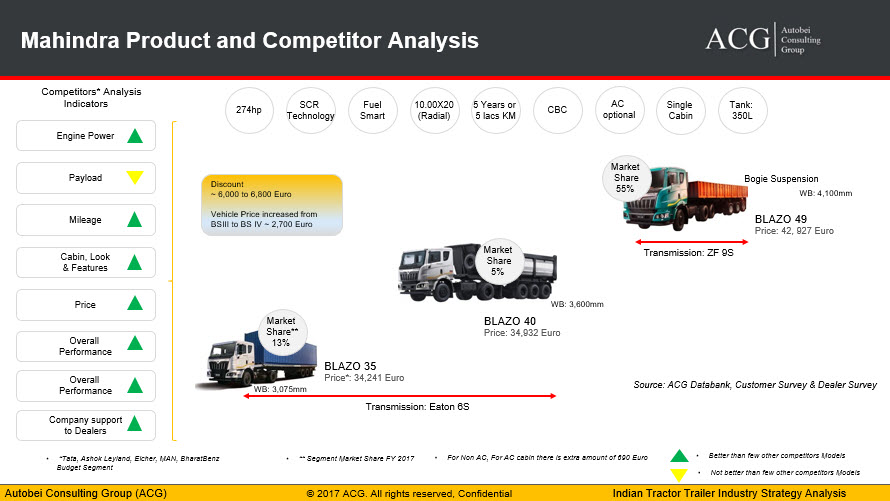
Tata Motors is the biggest loser in this segment which lost around 15% market share. Ashok Leyland increased its market share from 25.7% to 32.4%, Eicher increased from 7.4% to 10.9%, BharatBenz showed excellent performance by achieving 4.1% market within 5 years of its operation.

LCV segment is dominating by local players. European players like Daimler, MAN are not planning to enter into this segment due to price position of vehicles. The LCV product would be more expensive with European technology. It also requires good after-sales network in rural and semi-urban areas. Mahindra Maxximo vehicle equipped with electronics parts. This was the major reason that this vehicle struggling in the market.Vehicle architecture must match the market dynamics, Application and Customer expectations.

Newly launched vehicle JEETO performance is excellent in mileage and Payload capacity.

Indian Light Duty Commercial Vehicle Market share Analysis

Mahindra had just 27.9 percent market share in FY 2009 and Tata Motors had around 60 percent market share in Light Commercial Vehicle Segment. In 9 years, Mahindra became a market leader with 42 percent market share and Tata Motors hold only 38 percent market share in FY 2017. Bolero, Jeeto are flagship products of this segment.

Tata Motors Heavy Commercial Vehicle Market Share Analysis:

Tata Motors Heavy Commercial Vehicle Market Share Analysis FY 2017

In Heavy Commercial Vehicle Segment, Tata Motors lost market share in every segment of HCV. On the other hand, Mahindra, Eicher, Ashok Leyland and other players increased market share from FY 2009 to FY 2017.

Tata Motors, Industry and Competitors performance Analysis:

Truck Industry Industry Volume and Competitors performance analysis

In M&HDT Truck segment, Tata Motors Volume declined by around 8% against Ashok Leyland 6.7 percent and Industry de-growth of 1.25 percent in FY 17.

In LDT segment, Tata Motors, Mahindra and Industry are in the same position by registering around 7 percent growth in FY 17 compared to FY 16.

Bus Segment:

Indian Bus Industry, Tata Motors, Ashok Leyland and Force motors performance analysis

In Bus Tata Motors, given the excellent growth of 22 percent against Ashok Layland de-growth of 9.5 percent and industry growth of 7.6 percent.

In Light Bus segment, Force Motors is dominating the segment for a long time. Tata Motors showed de-growth of 0.95% against Force Motors 2.24 percent and Industry growth of 3.9 percent.

Promotion Strategy:

Tata Motors, recently started TV commercial with Akshay Kumar to promote its CV sales. Mahindra is also running TV commercial with Ajay Devgan for a long time but company registered only 17 percent growth in FY 17 compared to last year.

Tata Motors, Mahindra, Bharatbenz, Eicher, Ashok Laylend advertising strategy analysis for commercial vehicleIt is better to invest in product development, improvement and gain the confidence of the customers by giving world-class product. Ashok Leyland is a good example of this strategy. Company diverts the fund to invest in technology and also improved its balance sheet. We have not seen the exceptional impact of celebrities on Commercial vehicle business in any part of the world. Sometimes, it could only have a minor impact on branding.

(In our detail report, we have covered Ashok Leyland, AMW, Force Motors, Mahindra, Piaggio Vehicle, Tata Motors, Maruti Suzuki, SML Isuzu, Eicher, Volvo, Scania, and MAN)

Report Highlights:

  • Sales, Production and Export Trend and Forecast
  • Segment Analysis: Truck & Bus
  • Heavy Commercial Vehicle
  • Medium-Heavy Commercial Vehicle
  • Light Commercial Vehicle
  • Small Commercial Vehicle
  • Drive Line Analysis
  • GST, Emission norms and other regulation changes
  • Price Strategy
  • Product portfolio and strategy
  • Network Analysis
  • Organization Structure
  • Soft offering by OEMs
  • Customer perception
  • Economy Analysis
  • Infrastructure

For customized Report please contact to Nidhi.Singh@autobei.com

The clutch plate is an important component of the vehicle. ACG released its latest exclusive report on Global Automotive Clutch Market Analysis. It is the key component of power transmission and engine design. Functions of clutches are to disconnect the engine from wheels. We have included Passenger vehicle, Truck, and Bus segment. Asia region is the biggest and growing clutch market in the world. Almost all OEMS are ramping up their production capacity to service this region.The report, global automotive clutch market covers the market by geography into Asia- Pacific, China, Japan, India, North America, South America, Middle East, NAFTA, Europe and Rest of the World. The market is further divided by transmission type ( Automatic Transmission (AT), Automated Manual Transmission (AMT), Manual Transmission (MT), and Continuously Variable Transmission) and by Clutch Dia size (Below 9 inches, 9 inches to 10 inches, 10 inches to 11 inches, and 11 inches and above). On the basis of classification of clutch type, the automotive clutch market is segmented into friction clutch, dog clutch, centrifugal clutch, semi-centrifugal clutch, hydraulic clutch, vacuum clutch and electromagnetic clutch. Market size in terms of volume is provided from 2000 to 2023 in terms of value and units.

Largest Passenger and Commercial Vehicle like India and China focus on increasing production capacity. It is expected that this region will be one of the largest and fastest growing clutch markets in the world. The North American market, on the back of strong demand from the Mexico and USA region, will be the second-fastest growing region after Asia Pacific. The increasing demand in the domestic market will drive the growth of the clutch market in Mexico. Latin America and Russia are facing some difficult market situation.

Global Automotive Market Analysis

  • Region wise
  • Country wise
  • Segment wise
  • Passenger vehicle
  • Commercial Vehicle

Market dynamics:

  • GDP and Commercial Vehicle relation
  • Urbanization vs. Passenger Car Per 1000 People
  • Infrastructure Analysis

Industry Dynamics – Driver and Challenges:

  • New Regulation
  • Vehicle Production
  • Latest technology
  • Dual clutch popularity
  • Fuel efficiency and Automatic transmission imtegreted vehicles
  • Rapid growth of Electric vehicle (Without clutch)
  • Consumer buying habits, preference, Clutch Replacement cycles

Market Size: Passenger and Commercial Vehicle Segment

  • Regional and country wise Production trend, Segment wise
  • Market size is broken down by various segments of PV and CV (LCV, MHCV)
  • Report to cover in terms of volume and value by each category/size
  • Forecast 2023
  • Market dynamics
  • OEMs Strategy
  • Technology development and market trend

Clutch Market Analysis:

  • Market entry strategy and opportunities
  • Clutch market size
  • Country wise market size and market share in global clutch market
  • Global Transmission type analysis
  • Top 10 market of clutch market

Automotive Clutch Market, By Clutch Dia Size 

  •     Overview
  •     Below 9 Inches Disc
  •     9 to 10 Inches Disc
  •     10 to 11 Inches Disc
  •     11 Inches and Above Disc

By Transmission Type, Global Automotive Clutch Market

  •     Introduction
  •     Manual Transmission
  •     Automatic Transmission
  •     Automated Manual Transmission
  •     Others

Competitive Landscape 

  •     Overview
  •     Global Automotive Clutch Market share Analysis
  •     Competitive Analysis
  •     Clutch manufactures strategy Analysis – Technology, New Product introduction, Newmarket entrance, JV with manufacturers and after market

Automotive clutch market by region:

1. Asia :

  • India,
  • Greater China,
  • Japan
  • Thailand
  • South Korea
  • Indonesia
  • Australia
  • Others

2. Europe:

  • Germany
  • France
  • UK
  • Italy
  • Austria
  • Turkey
  • Spain
  • Russia
  • others

3. North Africa

  • US
  • Mexico
  • Canada

4. South America

  • Brazil
  • Argentina
  • Peru
  • Others

5. Middle East & Africa

  • GCC Countries
  • Other Middle East
  • North Africa
  • South Africa
  • Other Africa

PESTEL Analysis

Asia, Europe, North Africa, South America, Middle East, and Africa

Company Profiles 

  •      Overview
  •      Borgwarner Inc.
  •      Eaton Corporation PLC
  •      Exedy Corporation
  •      F.C.C. Co., Ltd.
  •      Clutch Auto Limited
  •      Schaeffler AG.
  •      ZF Friedrichshafen AG.
  •      Valeo S.A.
  •      NSK Ltd.
  •      Aisin Seiki Co., Ltd.

ACG released exclusive Indian Passenger Vehicle Market and Outlook report. The report gives the complete insight of market dynamics and its impact on all stakeholders of Industry. Please find here the table of content of the report.

Monthly, Quarterly and Yearly updated version are also available.

Macro Economy:

  • GDP
  • Inflation,
  • IIP
  • Economy forecast
  • Market Sentiments
  • Economy Policy
  • Monetary policy

New Emission norms impact on Industry: BS IV & BS VI

  • Market Challenge
  • Product Analysis
  • Cost Analysis
  • OEM Analysis

Passenger Vehicle Market Overview

  • Lifestyle
  • Discount Analysis
  • Demographic trend
  • Technology
  • Infrastructure
  • Income scenario
  • Market sentiments
  • New Product launch

Product Analysis

  • Product Segment
  • Product position
  • Driveline Analysis
  • Product price and Market Share
  • Product life cycle
  • Product Age
  • New Product launch
  • Top Passenger vehicle
  • Product USP
  • Varian wise analysis
  • Price Analysis since 2012 to 2017
  • Product Benchmark

Segment Analysis

  • Car, SUV, MUV, Van, Luxury, Premium, Sports, Sedan, Hatchback and Jeep
  • Sales, Production and Export Analysis
  • Segment shift
  • Segment Gap
  • Segment growth, Volume, Segment Share
  • OEM wise Sales and Market Share Analysis

After Sales Analysis:

  • Network Analysis
  • Service cost
  • Spare parts price Analysis
  • Customer satisfaction index
  • Major parts price
  • Parts Availability

Customer behavior:

  • Recent customer behavior changes
  • Role of digital media
  • 5 major key criteria
  • Features Vs Tech specs
  • New Technology

Competitive Analysis:

  • Product Portfolio and Range
  • Model and variant level analysis
  • Segment Presence
  • Target Customer
  • Company Profile
  • Price range
  • Sales, Market share, and Growth
  • Strategy Analysis
  • Sales, Production, and Export

Outlook:

  • Sales Forecast
  • Production
  • Export
  • Product features
  • After sales


Indian Truck Market Analysis Report and Outlook is our latest analysis. ACG Automotive Market Intelligence released exclusive detail report on Indian Truck Industry. We have analyzed GST impact also on Industry.

The report covers following points:

Macro Economy:

  • GDP and its components like Services, Manufacturing, Industry and Agriculture segment
  • IIP – Analysis
  • Monetary policy
  • Economy sentiments
  • Industrial Segments
  • Recent policy making decision

Market Analysis:

  • Past Volume Trend and Forecast – Mass (Low cost), Budget, and Premium Segment
  • OEM performance, Sales, Market Share and Segment presence
  • Truck Application wise Analysis
  • Segmental shift Trend and Outlook
  • BS IV Impact on Industry, OEMs and end customers

Customer Segment:

  • Customer Name (Mining, and Goods transport), Address, Fleet size, Application and Product portfolio
  • Key financiers of Truck Business, Latest trend to finance vehicle, Financing process, and Leasing concept
  • Finance scheme
  • Finance companies parameters to take decision on rate of interest, loan amount, tenure etc
  • After sales habits and approach

Product Position and Pricing Strategy:

  • Segment wise overview and OEM key product presence
  • Product specs and interpretation for application, performance and customers/user
  • Past, Current and expected Price after FY 2017 and FY 2019
  • Past and Expected Volume (Units & Value)
  • USP of popular products
  • Product Lifecycle
  • Product Rating
  • Product Platform
  • Engine Detail
  • Cabin, Transmission, Tyre, Body, Emission norms, Payload, GVW, and other technical detail
  • Past launches
  • Pricing package including soft offering
  • Price change align with product changes
  • Price Delta of BSIII and BS IV
  • Past launches
  • Upcoming launches
  • Product cost analysis – R&D, Dealer margin, Operation expenses, Material, Advertising etc
  • Localization Strategy – Content, and Plan
  • Parts pricing

Technology Trend and Analysis

  • Technology Roadmap trend and expected changes
  • Impact on vehicle cost and Sales volume

Competitors Profile

  • Leadership team
  • Organization structure
  • Manufacturing plant location and production capacity
  • Finance scheme and support to customers
  • Human resources
  • Promotion
  • Export strategy
  • Product portfolio – Tata, MAN, BharatBenz, AMW, Piaggio, Eicher, Volvo, Scania, Isuzu, Ashok Leyland, and Mahindra
  • New player entrance
  • Service Network and Analysis
  • Investment
  • Product specs comparison
  • Price bracket

Dealer Network:

  • OEM wise Dealer strength
  • Dealer Database
  • Challenges and opportunities for dealers

Competitor Analysis:

  • Brand position
  • Company Overview – Segment, Product Application, Customers, and Markets
  • Organization Structure
  • Sales Process
  • Plant location and Production capacity
  • Export

Market Outlook:

  • Sales and Production 2022
  • Market dynamics
  • Technology and Transportation system
  • Logistic Industry
  • Regulations

South Asia Commercial Vehicle Sales and Production Analysis is one of the high potential markets for Commercial Vehicle Segment. Most of the OEM are having the eye on this market. The report included Australia, Indonesia, India, Thailand, Philipines, and Malaysia.

Trend and Forecast of Truck and Bus segment covered. Product and Engine Technical detail are also part of the database. This region is dominated by Budget vehicle segment and most of the OEM consider this region as an emerging region except Australia.

ACG Premium subscribers contact us to get this report since this report is part of subscription package or Contact to the become premium subscriber.

South Asia Commercial Vehicle Sales & Production Trend and Forecast

Key Highlights of the report:

  • Macro Economy Trend and Forecast Analysis  2000 to 2022
  • Truck and Bus Volume Forecast
  • The Model level Sales and Production exclusive Data is available separately.
  • Market Size
  • Sales Distributors
  • Product platform
  • Product design
  • Valve Detail
  • OEM wise Market Share for each country
  • Model wise and Brand wise Market Share
  • Technical Product Specs
  • Competition assessment
  • Medium, Heavy and Bus Segment
  • Truck and Bus Product Start of Production and End of Production detail
  • Region wise Product Sales Distributor
  • Product lifecycle rating
  • GVWR and Bus Application wise
  • Engine Technical detail
  • Engine Sales and Production data
  • Engine technical detail model wise
  • Product Emission norms Detail
  • Horsepower (hp) – Model and Engine wise
  • Production plant detail
  • Cylinder information

ACG released Indian Three Wheeler Model level Sales, Production and Product Data including the price of CY 2023.

Indian Three Wheeler Industry produced 0.85 Million in FY 23. In FY 23, the Sales grew by 87% compared to FY 22.

Mahindra, Bajaj Auto, Piaggio, and TVS are leading players in this segment.

The Indian Three Wheeler segment is the second largest segment for Electric Three Wheeler. E Cart rickshaws and passenger 3 Wheeler are two major vehicle categories. Bus body maker Ruby Bus recently launched a reliable and durable E Cart at the price of 1.25 lakhs with a Lead Acid battery.

OEMs like Mahindra launched Electric Auto with Lithium-ion Battery.

We have covered Brands, Models, and Variants of the model’s level of Sales and production over the last 5 years

The following brands are included:

  • Bajaj Auto Ltd,
  • Piaggio,
  • Mahindra & Mahindra,
  • TVS Motor,
  • Atul Auto,
  • Scooter India,
  • Kerala Automobiles,
  • Metta EV,
  • Joy EV,
  • Euler Motors,
  • J.S Auto, and
  • Kumar Motor

The following Data names are included:

  • Price
  • Application
  • Segment
  • Product rating
  • Customer segment
  • After Sales
  • Dealer network
  • Brand position
  • Product Position
  • Major Parts price
  • Key Drivers
  • Vehicle Technical Details
  • Engine Make & Power (hp)
  • Fuel Type
  • Emission norms
  • Transmission
  • Capacity
  • Wheel details
  • Brakes
  • Mileage
  • Other specs and features of the vehicle