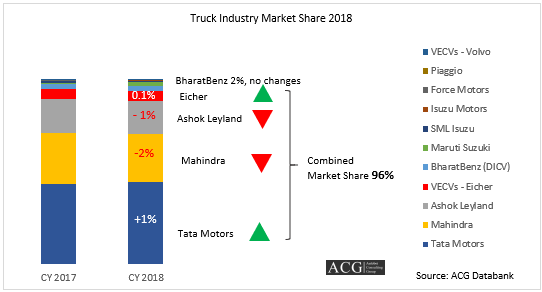
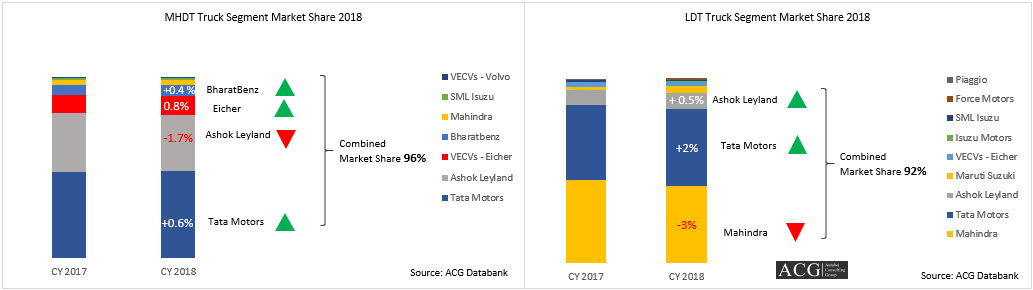
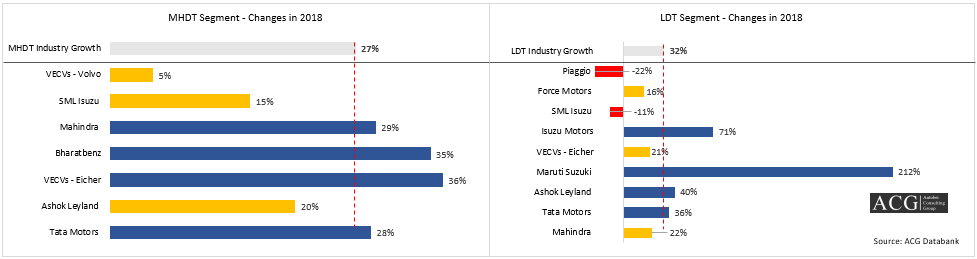
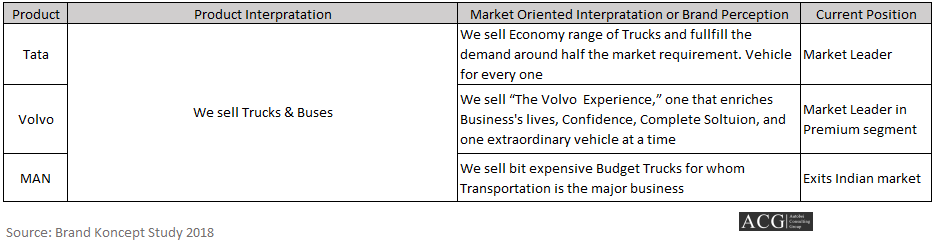
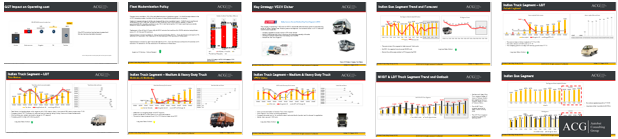
ACG analytics expects domestic commercial vehicle (CV) sales to rise ~22% in fiscal 2019.

The forecast is divided into Sales and Production (Goods & Passenger carrier) segment. The segment further divided into OEMs and Model level along with key technical specs and product features.

Indian commercial Vehicle Industry and outlook 2019

Major Industry Drivers are:

  • National road development
  • Pradhan Mantri Awas Yojna
  • GDP growth
  • Some new pre-election announcement
  • The new product range of higher GVW/payload
  • E-commerce sector growth
  • Regulation

BS VI Norms impact on CV Industry:

  • BS VI impact on demand
  • The cost impact on vehicle
  • The function of SCR/DOC and DPF
  • Emission Control through Engine Design
  • Technology impact of BS VI
  • Other aggregate and cost impact
  • Global Strategy of using SCR and EGR for various Norms
  • Subsidiaries and tie-ups for after treatment
  • Supplier Market share
  • BS VI regulation and history of emission norms

Key highlights of the report:

  • Short-term demand
  • Medium Term Demand
  • Long-term demand
  • Competition Analysis & players Strategy Analysis
  • HCV demand Analysis
  • MCV demand Analysis
  • LCV demand Analysis
  • SCV demand Analysis
  • Bus demand Analysis – Application wise
  • Cost variables
  • Margin Analysis
  • Regulations Impact Analysis
  • Brand Position
  • Brand engagement
  • The relationship between Brand perception, and Application
  • Changing buyers behavior
  • Top purchase criteria
  • After sales – Maintenance cost Analysis
  • Forecast Value and Volumes
  • Vehicle type
  • Engine type
  • GVW wise
  • Transmission type
  • Fuel injection type
  • Vehicle Financing Type and issues
  • Import and Export Trend and Forecast
  • Model-wise Price and Discount Analysis
  • Product benchmarking and Product Portfolio
  • Customer Experience
  • Driver feedback on vehicle usage, USP and its best-suited application

Please contact us for more detail and Table of content

After the implementation of GST, the logistics sector is expected to reduce the logistic cost and show excellent growth in the next 10 years. E-commerce Industry also plays one of the key drivers for the logistic Industry.
Many technology firms are trying to implement digital technology to improve the performance of the Transporters, Logistics companies, Customers experience, and other stakeholders. It is challenging to implement digital technology since the key stakeholders like drivers and Small & Medium Transporters are having some resistance to use it. Most of the transporters still following the traditional style of business.
Large fleet owners are either using the technology to improve the operation or ready to adopt it. ACG discussed with every type of fleet owner to know the pulse of this sector. The fleet owners are expecting not only online loading & unloading features, but they also like to control the expense management through the same platform. Until and unless all logistic companies and the end user will not be connected, it is not going to work.
Once they have a revenue maker and cost control dashboard, the chances are high to start to use it. The digital platform needs to have an all cost related features like maintenance cost, fuel cost, payment terms and mode of payment, and another type of expenses.
In our detail study, we have covered the Fleet owner business model based on Small, Medium, and Large fleet owners, Drivers Analysis like Driving habits, and application of vehicles. Currently, more than 40% of trucks are not using its full load capacity from loading and unloading points. Getting return load is also an issue for transporters, however, it is improved in the last 3 years.
Key Highlight of the report:
  • Indian logistic sector overview
  • Indian logistic sector value forecast 2023
  • Major players
  • Key Challenges and Opportunities
  • Infrastructure development impact on logistic growth
  • Competitive Analysis
  • Future design of Warehouses and logistic companies

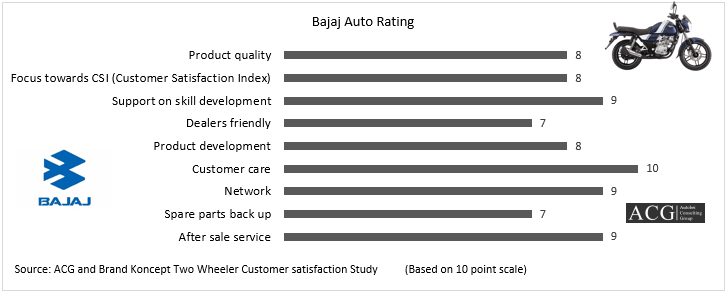
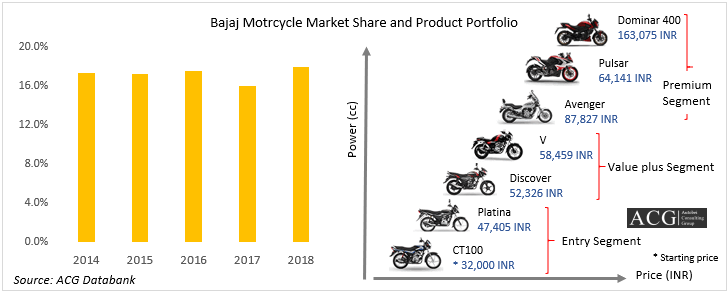
The future of the two-wheeler industry in India gives critical information about Two Wheeler Industry. ACG expect that over next coming year the three-tier structure of the industry which was 20 percent for the entry-level segment, 60 percent in value for the mid-level and 20 percent at a premium level for the time and the current trend has moved to 30-50-20 percent and it is on its way to moving to 35-40-25 percent structure. This means the middle-level market is getting squeezed out, which in turn is very good for companies like, Yamaha, Bajaj, Suzuki. Hero Motocorp and Honda need to introduce new innovative product range in this segment since these companies are the major player of value plus segment.

Segment wise Indian Two Wheeler Industry Forecast

Discounts have been offered to the mid-level sector due to the polarization of the customers to the premium and the entry-level. Another reason for added discounts or offers is scooterization and lack of innovation in the sector.

New regulations like ABS to the 100 and 125 CC vehicles would increase the cost of the unit from 4,000 to 10,000 RS. This added price value and BS-VI can impact the sale rate. All these hurdles will have to be overcome, and innovation will lead to an improved Industry performance. ACG expects double-digit growth for the year 2019 and with all the upcoming changes in norms and with innovation to technology we can look forward to an exciting 2019 ahead.

The biggest challenge for the industry would be to make the transition of the two norms related to safety and emission over the next 12 months.

Indian Two-Wheeler Industry has seen 13%, Scooter segment 9%, and Motorcycle segment 16% growth in the year 2018 compare to the year 2017.

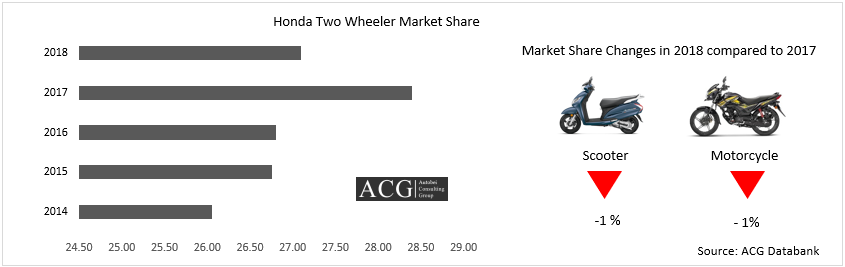
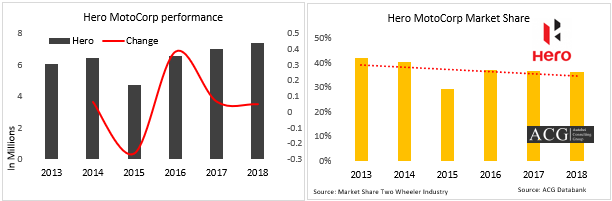
In the Scooter segment, Suzuki and TVS gained 2% market share and market leader Honda lost 1% and Yamaha and Hero lost 2% market share in 2018. The Hero is trying to penetrate this segment with mix product and marketing strategy but could not achieve the desired result.

Indian Scooter & Motorcycle Segment Market Share Analysis 2018

The companies shall enter the electric vehicle segment with new motorcycles and scooters in India.

Highlights of the report:

  • Market size – Volume in units & value
  • Last 10 years trend and next 10 years forecast
  • OEMs Product and Marketing Strategy
  • Price and Discount
  • Best Selling Models
  • New Launches
  • Segment and Subsegment Analysis
  • Competitive Analysis
  • Brand Analysis and Perception
  • Consumer journey
  • Media planning strategy
  • OEM Business analysis
  • Upcoming product launches
  • Key Export countries

Indian Two Wheeler Market Analysis 2018

Indian CV Air Suspension Market Forecast is our qualitative and quantitative report.

The comfort level is the most important and prioritized checkpoint taken into consideration by the customers as a major factor before purchasing a vehicle. The primary function of an automotive air suspension system is to increase vehicle controlling aspects and the comfort level to the passengers. The air suspension system enhances the comfort by protecting passengers from road disturbances and sudden shocks. Vehicle control is achieved by preventing the body of the vehicle from rolling and pitching and maintaining better contact between the tire and the road. A good suspension system can help to maximize the traction between tires and road surface, provide steering stability which will improve vehicle control, and enable better handling. The air suspension system is employed in vehicles to ensure better and improved comfort level for the passengers and it will also help to maintain the vehicle height at the desired level from the road during the travel. The ever-growing demand for luxury and comfort drives the growth and improvement of the air suspension market.

Air suspension systems will essentially replace a vehicle’s coil springs with air springs. The air springs are simple tough rubber and plastic bags inflated to a certain pressure level and height to mimic the coil springs. These air springs can withstand better shock load when compared to coil springs. By adding in an onboard air compressor, sensors and electronic controls, today’s air suspension systems provide several advantages over the all-metal, conventional springs, including near-instant tuning, and the ability to adapt handling to different situations and vary load capability. Early versions of air suspension systems were relatively simple and easy to maintain. Air bags replaced the coil springs. The bag is inflated to the correct pressure level or height with an outside compressor through a valve on the bag. The changes in technology implemented use of more components and these changes provided better control to the system. The air suspension systems currently manufactured all have a basic stock of similar components that vary little from maker to maker. The main differences come mainly in controls and in the method of installation.

The air suspension system in a motor vehicle is powered by an electric or engine is driven air pump or compressor. Air is filled into the air bellows/springs, made up of textile-reinforced rubber through the compressor pump. The air pressure is regulated to the manufacturer’s specified limits. Owing to the air pressure the bellows/air springs inflate and raise the chassis from an axle. The purpose of using an air suspension is to provide a smooth and improved ride comfort and quality to the travelers.

The non-electronically controlled air suspension systems currently dominate the global market, in terms of both value and volume of sale rate. However, the electronically controlled air suspension systems segment is the fastest growing globally, in terms of both value and volume when compared to the electrically controlled units. This rise in sale rate and acceptance of the product in the market is due to the electronically controlled air suspension systems are more advanced and provide better comfort with less maintenance when compared to the non-electronically controlled air suspension systems.

Systems and technology always keep evolving and improving and these developments will always pave the path for innovation of a new product or a new system. This improvised system will help improve the luxury level to the consumer. The client will have to keep up with the developments to be in the consumer’s list and for a better market place.

Key Highlights of the report:

  • Technology.
  • Market Dynamics.
  • Air suspension requirement in Trucks.
  • Disadvantages of Air suspension.
  • The necessity of Air suspension in TrucksThe necessity of Air suspension in Buses
  • Future Government norms for long distance Buses.
  • The global market for Air suspension.
  • Global Players.
  • Air suspension market in India.
  • Restraints for Market growth.
  • Air suspension Manufacturers in India.
  • Foreign suppliers
  • Cost of Air suspension and Conclusion.

Bus Purchase pattern Report is our exclusive report based on Primary and Secondary Data Analysis. This report is useful for Business planning, Product launch, Product planning, Product Strategy, Competitor Analysis, Future trend, and Marketing Strategy.

Key Highlights of the report:

  • Key players in each category
  • Seating capacity
  • Price for the vehicle
  • Usage/Application of the product : STU/School/Contract/Intercity and other
  • Key features and the expected shift in features
  • Purchase decision for the product across application
  • All OEMs included
  • All Key Models Included
  • Key Customers
  • Fuel Type
  • Transmission, Engine Detail
  • Best and Worst features of the each model

Indian Commercial Vehicle leasing report is our latest report on leasing concept. Leasing concept is changing the Indian Commercial Vehicle trend and give new shape and opportunity to all stakeholders of the Industry.

Highlights of the report: 

  • Executive Summary
  • The scope of The Report
  • Research Methodology
  • Introduction
  • Types of Vehicles leasing (Financial and Operating Lease)
  • Major players
  • Market share by lease type (FL and OL)
  • Competition analysis
  • Market Landscape: Market overview, Market size, forecast, and Five forces Critical analysis
  • Market Segmentation By Types Of Vehicle: Truck and Bus
  • Decision Framework
  • Drivers and Challenges: Market drivers and Market challenges
  • Market Trends: A need of the market, Influencing factors for vehicle leasing market
  • Vendor Landscape
  • Conclusion

Future of Electric Buses in India is our detail analysis report on E Bus, Trend, Opportunities, and Demand forecast. An electric vehicle has become a necessity in the current world, with an emission regulation and the alarming fuel cost it necessary to develop ideas to meet the daily needs one such development can be electric vehicles. TCO play a key role in the Commercial Vehicle segment. Justifying TCO and Battery price, Charging Infrastructure is the biggest challenge for all stakeholders of the Industry. In Europe, TCO for Electric buses works well for the longer route.

The Indian economy is racing ahead of its competitor France in the year 2018 itself. The Indian economy is now considered 6th biggest economy after the US, China, Japan, Germany, and Britain. India is often seen by most economists as a rising economic superpower which will play a major role in the 21st-century global economic development. The Indian economy has the mettle to reshape the world market by its trends and economic structure development.

In the year 2016-17, the bus industry witnessed the highest volumes of sale rate after FY 2012. The sale rate spiked to a super value of 98,000 units.

The high sale rate of a product has marked the enforcement of the bus body code (AIS 052), and the school bus code (AIS 063). For product posting with good growth rate, the industry witnessed the initiation and development of the sleeper bus code (AIS 119), which is claimed to be the beginning of this segment. The progress in this segment was also achieved in the tarmac and double-decker bus code draft project. The injection of good order rate from the government-run state transport undertakings (STUs) and city bus undertakings (CBUs), as well as the private bus fleet operators, played a major hand in the development of the segment.

The bus industry grew thick by 6 percent in the year 2016-17. In the year 2017-18, the bus market sector showed signs of degrowth with a rate of 14 percent. The bus code factor, demonetization, and GST have impacted the STU orders in the year 2017-18. After the bus code relaxation and with the GST is stabilizing now and hence demand is expected to rise again in the future. The industry comprises of buses that are categorized into school buses, mini buses, tourist buses, deluxe buses, commuter buses and others depending on the purpose of their use.  The projected growth forecasted is considered to be 1,40,000 buses in India by the year 2023 in which the major growing contributing segment will be Electric Buses.

Based on the type of the vehicle, the Indian electric bus market is segmented into the battery-driven electric bus (BEB) and hybrid electric bus (HEB). Among these, in terms of volume, the HEB category accounted for more than 85 percent share in the electric bus industry in the year 2017. However, the fastest growth rate is forecast is expected from the BEB category, owing to the higher government support for BEBs as they are more eco-friendlier than HEBs. Based on battery, the Indian electric bus market is segmented into lithium-iron-phosphate (LFP), Lithium Nickel Manganese Cobalt Oxide (NMC) batteries, and others. Among these, the LFP category has recorded the highest volume sales, which has surpassed approximately 80 percent of its sale rate in the year 2017. However, the fastest growth is expected from the NMC category, owing to its declining price rate in the market along with the higher energy density and multiple safety levels that it offers. The Indian electric bus market is primarily driven by the strict government emission norms and regulations and the additional support in the form of subsidies and grants.

The Indian electric bus market is projected to grow at 3 digit CAGR by the year 2025. The growth of the market is majorly driven by the increasing support from the government for electric vehicles and the falling battery prices. The switch over to electric vehicles will happen into STU segment as the first step where the volumes will be maxed 8,000 to 10,000 buses per year, based on budget availability, infra readiness, and other factors. The trials started from the year 2014 onwards, and the adoption of some buses for regular operation started by 2017 and this initiation led to floating the tender for 530 buses in the year 2018. These buses will be scheduled to deploy in ten cities as an initial start-up in the year 2018, as per Govt of India plan. FAME provides subsidies as a financial incentive to buyers of electric vehicles.

The scheme allocated for the scheme is approximately INR 155 crore to meet the demand in the year 2015-2016 and the amount was raised to a level around INR 340 crores between the year 2016-2017. As a result, each mode of transport has experienced some acceleration towards electrification. However, this growth is not the same for all modes of transport. For instance, public transport and paratransit modes have witnessed a higher growth rate when shifting to electrification when compared to private vehicles.

Electric vehicles sale will get impacted in the year 2019 due to the general election scheduled in the year and BSVI implementation by the year 2020. The election will impose restriction by EC guidelines and other political interest. These factors will hamper the sale rate and will have a huge influence on the market as well as the economy.

The Indian government has set a target of becoming 100 percent electric in the public transport in the next 12 to 15 years as envisaged by NITI Aayog. The Indian government has understood the environmental need to switch to electric vehicles and to ensure that it is a success. Several initiatives have been implemented to meet the cause. Globally Several large OEMs are working on electric vehicles concept. Along with the traditional auto OEMs, some new players like JSW are also planning to enter this segment. Simply replacing diesel buses with electric buses will not be enough to compel people to give up the freedom and privacy of their cars and two-wheelers in favor of public transport. Customers will an expectation to have Smart E Bus instead of just Electric Bus.

Currently, there are around 36,000 M and HCV segment and 50,000 LCV segment public transport buses operating across India. The current number of buses is not enough for a country of India’s size and this factor has led to the rapid growth of personal vehicles. This increase in personal vehicle utilization has led to tremendous traffic congestion as well as huge financial loss due to burning fuel during the traffic jam, and pollution. Public transport has to be viewed as a desirable experience by the people. It has to be clean, reliable, safe, and comfortable. The transport system should be connected to all localities so that it is the top choice for commuting.

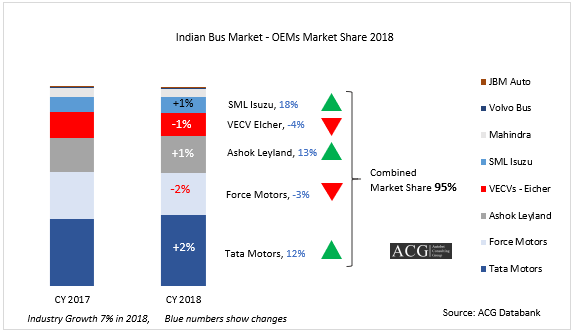
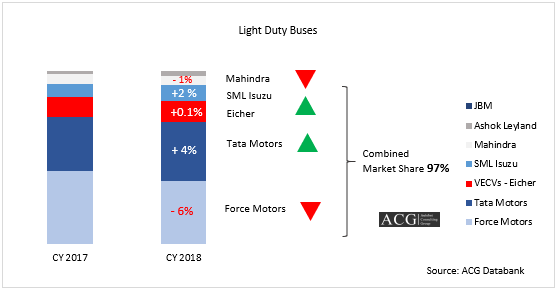
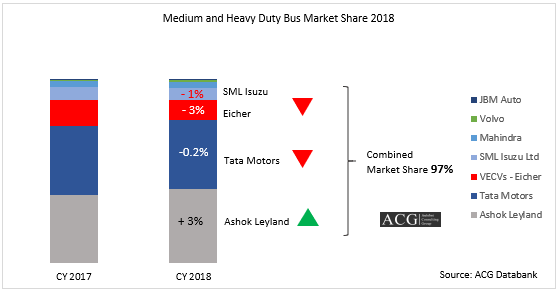
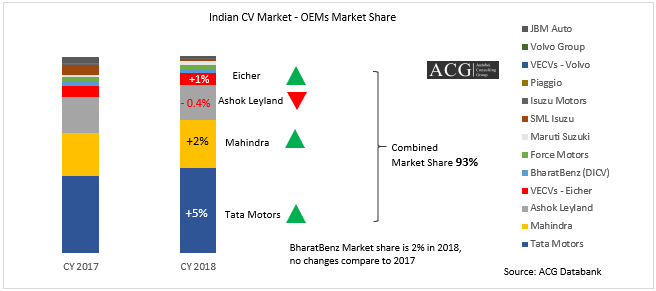
In the current scenario, Ashok Leyland and Tata Motors are dominating the Indian bus market. Both the companies are striving for the no 1 position. For the first three years starting from 2013 Tata was maintaining No 1 position but in the year 2016 Ashok Leyland grabbed No 1 status, followed that Tata again regained its position in the year 2017.

While Tata is having the presence in almost all the segments of transport, but Ashok Leyland is dominating in MCV and HCV category of buses. Recently VECV launched its sub-5-ton projects which will drastically improve its market share.

All Indian OEM’s are trying to be present in E Bus segment with their new and improved platforms but the Chinese are strong in the global market to start the EV companies like BVD (Olectra). The Chinese companies have started penetrating into EV market very fast with their highly developed products. Due to there earlier experience, they are relatively more comfortable offering an affordable product with proven quality. Other players like M&M, SML are stable with single digit Market share. New Players like Corona, JBM have also started recently venturing into bus market. While Corona is making good progress but on the other hand, JBM is still struggling to make an impact in the market. BharatBenz is one of the top respected global brands and expected to command top end School and Staff bus segment. Even though they are very slow in their growth rate due to their low familiarity with the Indian market and cost competitive environment in India.

Recently Central Govt has relaxed bus body building norms after the state government and the bus operators landed in a tight spot due to the stringent guidelines imposed since October 1, 2017. The norms state that the state government can only register the buses only if they build the bus body with technical specifications (AIS-052 norms) from a workshop having an approval certificate from the Automotive Research Association of India (ARAI) after getting the bus prototype examined by the authorities.

The Industry is facing some challenges like make in India EV Technology, Charging Infrastructure, high initial cost, loss-making STUs, charging range, and other factors. Even with all these hurdles, the government will have style some plans for the improvement and development of the electric vehicles. The increasing fuel cost, alarming pollution rate, congestion in traffic are some factors which can be minimized up to a certain level by the introduction of the electric vehicle. The set-up of factories and development of the project are the major concerning factors which will have government thinking. Instead, the development will initiate new companies into the Indian market which can improve the Indian economy. New initiatives and developments are required in the current market for making a place in the market.

The best and Worst feature of the vehicle Report is a set of critical information. It is the blueprint of Product Analysis & strategy of the Indian Automotive Industry. This market intelligence information gives you access to gauge competitive information, Product & Value proposition, and other relevant key information. We spent many years to prepare this database and we have analyzed in many ways. This database is an eye opener for OEMs, Fleet Owners, Financial Institution, Contractors, Logistic companies, Construction companies and other stakeholders of the industry.

  •  Market research: Understand which products are the most popular and why
  •  Customer preference: Database gives you incredible insight about customer choice and purchase parameters
  •  Product planning: Product planning and strategy create a rich product portfolio, and Mapping products with the market segment and customers
  •  Sales planning: Determine sales forecast and planning
  •  Competitive analysis: Benchmark competitors, understand market and Product scenario, How to market products against competitors
  •  Marketing & Promotion: Tailored your message based on your target segment

Segment included:

  • Truck – Mini Truck, Pick up Truck, Rigid Haulage, Tipper, Tractor Trailer
  • Bus – All segments
  • Passenger vehicle – Car, SUV, MUV
  • Two Wheeler – Scooter and Motorcycle
  • Three Wheeler
  • Construction Equipment
  • Agriculture Equipment

The database can be mapped with other key information like Price, Discount, Engine Detail, Transmission detail, Type of Application, Product life cycle, Loyalty, Production volume, Market share, Trend, Warranty, Customer satisfaction,  and other critical information. A separate report of each segment is available.


Indian Construction Equipment Industry Analysis is our detailed report. Indian is one of the key Construction Equipment market in the world. In the last 10 years, Industry registered excellent growth. CE industry is shifting more towards the value proposition solution.

Population, Economy Development, Infrastructure requirement, FDI, Urbanization is key Industry drivers. Along with drivers, there are challenges also that Industry is facing like new regulation implementation, lands, Steel price, etc.

Chines players are successful in this segment due to different market dynamics compare to an Automotive segment.

Key highlights of the report:

  • India’s construction equipment Market overview
  • Trend and Forecast
  • Segment Analysis & top growing segment
  • Opportunities
  • Market overview – Market size & Outlook
  • Key players
  • Key drivers and challenges
  • Opportunities
  • The road ahead
  • Customer Survey – Purchase Behaviour, Brand perception, Brand position, Customer satisfaction – Product and support
  • Product Analysis, Portfolio, Pricing, Planning, and TCO Analysis – Backhoe Loaders, Crawler Loaders, Rigid & articulated dump trucks, Vibratory & static compaction equipment, Cranes, Wheeled Loaders, Hydraulic Excavators, Pick & Carry Cranes, Transit Mixer, Forklifts, Batching Plants, Concrete Pump, Wheel Loader, Crushing equipment, and Others, Key Models & Specs, Annual Maintenance contract cost, Product segment – Low cost, Budget, and Premium category
  • Projects Analysis & Costs of construction equipment as the share of total projects
  • CE Demand Analysis
  • Construction Equipment Rental Market, Financial, and leasing market
  • Details of CE leasing market, players, competition in India
  • After sales CE Analysis and customer expectation

ACG released the latest report on Global Automotive Industry Forecast. Almost all major OEMs, Advertising companies, Supplier’s, Financial Institutes trust on Autobei Consulting Group forecast. The report is based on the latest trend and future market dynamics. The report is available on country and Segment-specific. The yearly Subscription option is also available.

Along with Sales and Production data, we also included expected Technology changes and its impact on Industry & its shareholders.  Our Methodology is unique and considered more than 100 factors while forecasting.

Following categories are part of the database:

  • Passenger Vehicle
  • Commercial Vehicle
  • Truck
  • Bus
  • Two Wheeler
  • Three Wheeler
  • Electric Vehicle
  • Construction Equipment

The region included Asia, ME, NAFTA, Latin America, Europe, Africa, and the rest of the world. The report is also further divided into Country specific like India, China, Germany, Kenya, USA, Brazil, Russia etc.

Our forecast help companies for Business Strategy, Segment Strategy, Planning, Product Planning & Strategy, Human resource planning, Budgeting, Competitor Analysis etc.


There are many market dynamics are going to affect the Indian LCV market. ACG analyzed regulation, Load trend, New Product development, Technology, Emission norms, Demand, Trend, Market Sentiments, Pricing factors, and other key criteria to draw the sketch of Sales and Production forecast. We analyzed the Industry challenges & Drivers.

We have an exclusive City, Model & Brand level database. Along with numbers, Price, Engine Type, Engine Make, Warranty, GVW, Payload, Variants, Product series, Key Application, Product life cycle, Product risk rating, Product series, length, Wheelbase, Clutch Dia, Engine Power, Tyre size & Type, Type of Transmission, Transmission Make, Spare parts, Product USP of each model, Duty cycle, Macro Economy, and other key information.

The purchase behavior is different compared to heavy commercial Commercial. Some of the purchase parameters are going to change and ACG considered those parameters in our forecast methodology.

The database is divided into two parts, Truck, and Bus. Most Popular Model of Truck and Bus based on Price, Volume and other Technical criteria. Van, Mini trucks, Pick Up, Rigid Haulage and other types of vehicles are included.

Companies included like Tata Motors Limited, Ashok Leyland Limited, Mahindra & Mahindra Limited, Eicher, BharatBenz, SML Isuzu Limited, Maruti Suzuki India Limited, Force Motors Limited, and Piaggio Vehicles Private Limited.

Following are the other keys highlight of the database:

  • Product Planning & Strategy
  • Competitor Analysis
  • Business Strategy of OEMs, Suppliers, NBFC, and other stakes holders

Sales and Forecast report are also available in other regions like Europe, Africa, NAFTA, Asia, and the Middle East. As a part of an Annual subscription package Monthly, quarterly and Yearly Forecast data is available.


Vehicle costing plays the most important role in long-term business planning. Our research shows that companies can save up to $ 200M per year after proper cost analysis. We provide detail costing of the vehicle included supplier information.

The prototype costing is different from regular costing intelligence. ACG provides a complete costing solution with soft tool information.

Vehicle Costing Analysis

Car, Truck, Bus, Two Wheeler, Three Wheeler, and Electric Vehicles are included. We help with cost optimization based on many key factors and processes.

It helps to:

  • Costing benchmarking
  • Competitive analysis
  • Pricing Strategy
  • Business strategy and planning
  • Vendor negotiation ​